

CCSD code G5100: Bypass of duodenum billing guide
CCSD code G5100 bills a bypass that leaves the duodenum in place CCSD code G5100...

Last Updated: Oct 16, 2026
K0602 is the HCPCS Level II code for replacement battery for external infusion pump owned by patient, silver oxide, 3 volt, each.
Those two attributes carry the whole risk. A silver oxide cell rated at 1.5 volts belongs to K0601, and an alkaline cell at 1.5 volts belongs to K0603. Bill either one as K0602 and the DME MAC denies the line.
Medicare Part B pays the code from the DMEPOS fee schedule, per battery, under the durable medical equipment benefit. Where the pump is rented rather than owned, the battery earns no separate payment at all.
Let Pabau's smart automation suggest the right codes, reduce claim denials, and keep your practice compliant—effortlessly.
Automate repetitive tasks and focus on what matters most—your patients.
Reduce coding errors and ensure compliance with the latest regulations.
Clean claims, fewer denials, and faster reimbursements.
Powerful insights and reporting to help your practice thrive.
HIPAA compliant SOC 2 certified GDPR-compliant Trusted by 4,000+ clinics worldwide

HCPCS code K0602 describes a silver oxide, 3 volt replacement battery for an external infusion pump owned by the patient.
Patient ownership is written into all five descriptors, so a rented or agency-owned pump rules out the whole K0601 to K0605 family.
The five codes differ only by battery chemistry and voltage, and the pump manufacturer’s specification is what decides between them.
Replacement batteries are not separately payable when they are billed alongside a rented infusion pump, because the rental payment already covers them.
Practice management software like Pabau keeps HCPCS libraries current and validates claim fields before submission.
K0602 is a Level II alphanumeric supply code for one narrow item. The Centers for Medicare and Medicaid Services (CMS) maintains the HCPCS Level II code set. Its official descriptor reads: Replacement battery for external infusion pump, owned by patient, silver oxide, 3 volt, each.
Four elements of that descriptor decide when the code applies. The battery is a replacement rather than part of the original pump setup. The pump belongs to the patient. The chemistry is silver oxide, and the rating is 3 volts.
K-codes are temporary national codes CMS assigns when no permanent code describes an item well enough. The DME MACs use them heavily for infusion pump supplies. Claims go to the DME MAC on the CMS-1500 form, or on the 837P transaction for electronic submission.
Medicare Part B covers K0602 under the DME benefit when the patient owns the pump and the infusion therapy is medically necessary. The DME MAC for the patient’s jurisdiction adjudicates the claim.
Before submitting K0602, billing staff should confirm the patient’s current Medicare enrollment and DME benefit status. The claim then has to meet all of the following criteria:
The DME MAC policy article for external infusion pumps, A52507, sets out the rental rule plainly. Replacement batteries K0601 through K0605 are not separately payable when they are billed with a rented pump.
Read that as a payment rule rather than a code-selection fork. A rental does not send you to a different K-code, because no code in the family describes a pump the patient does not own. It removes the separate payment altogether.
Medicare Administrative Contractors process DME claims by jurisdiction. The Local Coverage Determination for your area may add documentation requirements beyond national policy. Verify the current one with your DME MAC before billing.
Medicare pays K0602 from the DMEPOS fee schedule, which CMS updates quarterly in January, April, July, and October. Payment also varies by DME MAC jurisdiction and by competitive bidding area. Pull the current figure from the CMS DMEPOS fee schedule for the contract year you are billing.
Because K0602 is a per-unit code, the allowable amount is paid per battery. When a patient needs several batteries in one supply cycle, the units are billed on a single claim line with the quantity stated.
Always confirm the current K0602 allowable against the official DMEPOS fee schedule file for your jurisdiction. Third-party rate tables are a useful benchmark, but they often still show last year’s number, so they should never drive a billing decision.
The most common denial trigger for K0602 is a mismatch between the cell that was supplied and the code that was billed. A 1.5 volt battery on a K0602 line is a wrong-code claim, and it denies on the first pass. Reading the pump specification before the order ships is what prevents that.
Key documentation requirements for a compliant K0602 claim:
Submitting a clean claim for K0602 means the claim reaches the MAC complete. Every required field is filled, the ICD-10 code is valid, and the quantity matches the delivery record. A missing field raises the odds of a documentation request or an outright denial.
Code from the pump manufacturer’s specification sheet, never from the battery packaging. Record the pump model and the required cell, silver oxide at 3 volts, in the patient’s supply record at first delivery. Every later resupply is then coded from that same source. It is what keeps a 1.5 volt cell off a K0602 line months later.
K0602 does not have a single required ICD-10 code. The diagnosis on the claim has to support the medical necessity of home infusion therapy using an external pump. Payers look for a diagnosis that explains why the patient infuses at home rather than in a clinical setting.
Commonly paired ICD-10 codes include the conditions treated with home infusion therapy. These codes may support medical necessity, though they do not guarantee coverage. The final determination rests with the MAC and the patient’s clinical circumstances.
Always use the most specific ICD-10 code the record supports. Unspecified codes are acceptable only where the documentation does not allow a more specific choice. The AAPC HCPCS code lookup shows the current descriptor for each code in the series. Verify the diagnoses your MAC accepts against its LCD before billing.
All five codes describe a replacement battery for an external infusion pump owned by the patient. Ownership never separates them, because the same phrase appears in every descriptor. Chemistry and voltage do all the work, which is why a spec sheet beats a guess at the point of coding. The wider HCPCS code reference covers the other supply codes a DME biller handles alongside this family.
Ownership is a threshold question rather than a fork in the road. If the patient does not own the pump, no code in this family is separately payable, and switching codes does not change that.
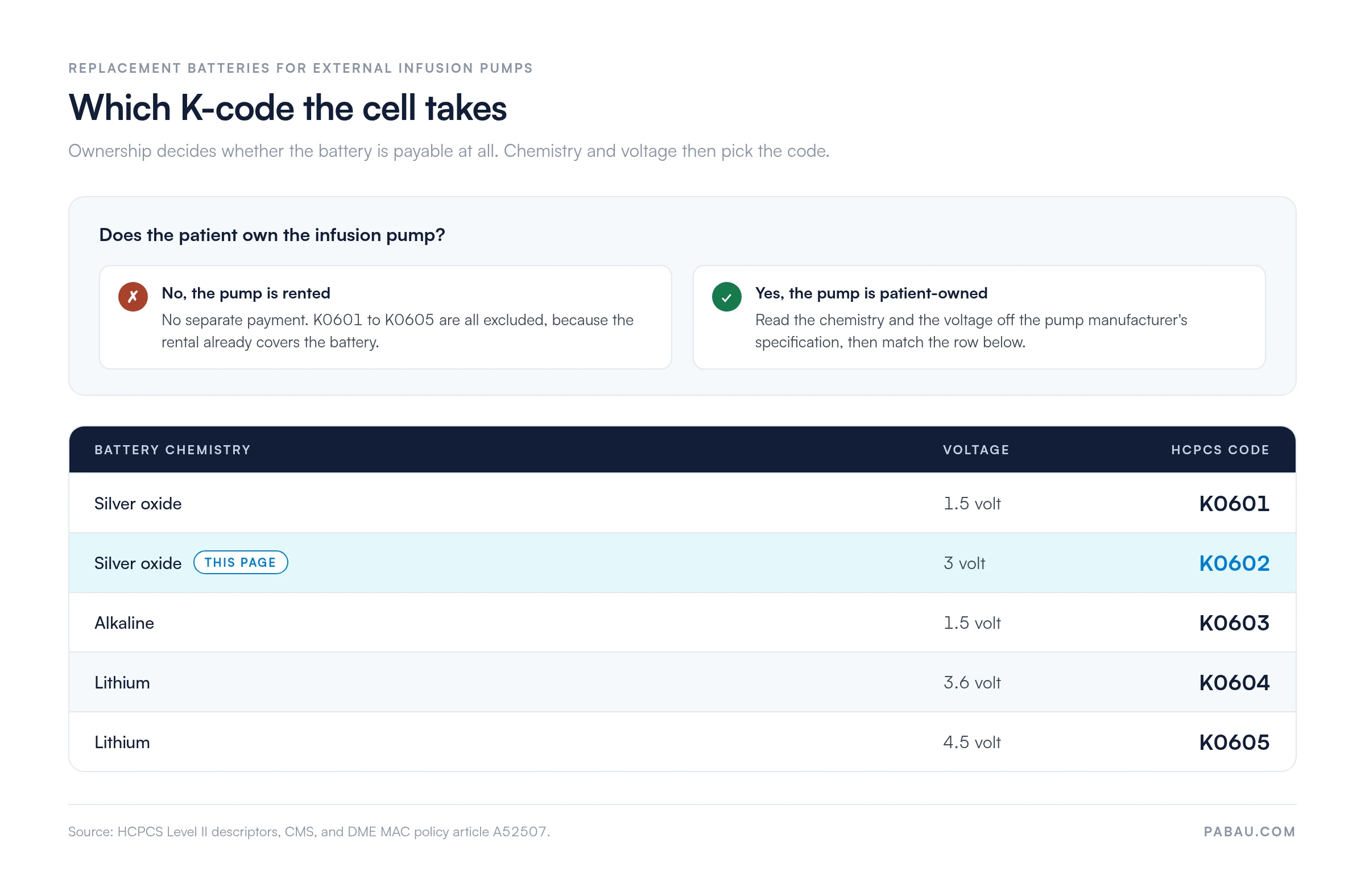
Once ownership is settled, two values pick the code. Silver oxide runs at 1.5 volts under K0601 and at 3 volts under K0602. Alkaline at 1.5 volts is K0603. Lithium splits between K0604 at 3.6 volts and K0605 at 4.5 volts.
Take both values from the pump manufacturer’s specification, since packaging and supplier catalogs are often vague about the cell inside. Silver oxide and alkaline cause the most trouble, because both are sold at 1.5 volts and the two codes are not interchangeable. The chart below runs the checks in order, ownership first.
Medicaid coverage for K0602 varies by state. Each state administers its own program within federal guidelines. That includes its DME coverage policy, its fee schedule, and its prior authorization rules for infusion pump supplies.
Some state programs follow Medicare criteria closely and cover K0602 on similar terms. Others apply stricter medical necessity standards, require prior authorization each billing cycle, or limit coverage to certain patient groups. Check the state Medicaid agency or its DME billing manual before you submit. Multi-payer billing means tracking coverage rules payer by payer, rather than assuming Medicare criteria carry over.
For commercial payers, K0602 coverage depends on the patient’s plan. Many plans use Medicare criteria as a reference point without being bound by them. Prior authorization is common for home infusion supplies, so verify benefits before the batteries are delivered and the claim goes out.
DME suppliers and home infusion practices bill this code on a resupply cycle, and the record is usually split across systems. Ownership paperwork sits in one place, delivery confirmations in another, and the pump specification often lives in someone’s memory.
Pabau is practice management software that keeps the patient record and the claim in one system. Its tools for cleaner claims management hold searchable HCPCS and ICD-10-CM libraries, attach documentation to the claim, and validate required fields before submission. Billing staff can confirm the ownership record and the battery specification while the claim is still editable.
Steps for a compliant K0602 billing workflow inside a practice management platform:
Practices billing several K-codes alongside K0602 can validate descriptors programmatically through the NLM HCPCS Level II API. That cuts data-entry errors in high-volume DME billing, and it is worth the setup where an internal code reference feeds the billing system.
Set up a separate claim template for each code from K0601 to K0605, and put the chemistry and the voltage in the template name. When a biller picks ‘K0602 – silver oxide, 3 volt’, the label itself is the last check before the claim goes out. It catches the 1.5 volt mix-up that causes most wrong-code denials in this family, without adding a separate review step.

Pabau’s claims management tools help DME suppliers and home infusion practices track documentation, scrub HCPCS claims, and submit cleaner K-code claims to Medicare. Fewer denials, faster reimbursement.

K0602 is a small line with a narrow descriptor, and the narrowness is what makes it deniable. One chemistry, one voltage, and a pump the patient owns.
Ownership is not what separates this code from its siblings, since K0601 through K0605 all carry the same requirement. Chemistry and voltage do that, and the pump manufacturer’s specification is where both values come from. Where the pump is rented, the battery is not a separate payment at all.
For practices billing home infusion supplies at volume, the fix belongs in the workflow rather than in a reminder. Pabau’s claims management software keeps the ownership record, the pump specification, and the claim in one place. Book a demo to see how it handles HCPCS supply billing end to end.

Need a structured approach to reducing DME claim denials? Denial management in healthcare covers payer-level strategies for DME and other claim categories, including root-cause analysis and workflow fixes.
Want to understand how ERA data improves billing accuracy? Electronic remittance advice explains how to read ERA files, track CARC denial codes, and use remittance data to find the denials that keep repeating.
Managing multiple payers alongside Medicare? Revenue cycle management outlines how multi-payer practices structure their billing workflows from eligibility through payment posting.
HCPCS code K0602 covers a silver oxide, 3 volt replacement battery for an external infusion pump owned by the patient. The code is billed per battery. It applies to Medicare Part B and other payers for the ongoing battery cost of home infusion therapy, where the patient owns the pump.
Medicare pays K0602 from the CMS DMEPOS fee schedule, which is updated quarterly in January, April, July, and October. The allowable amount varies by DME MAC jurisdiction and by competitive bidding area. Confirm the current figure in the DMEPOS fee schedule file for your jurisdiction, and never bill from a prior-year rate.
Medicaid coverage for K0602 varies by state. Some state programs cover infusion pump replacement batteries on criteria similar to Medicare Part B. Others require prior authorization or apply different medical necessity standards. Verify coverage with the state Medicaid agency or its DME billing manual before you submit the claim.
A K0602 claim needs a written physician or NPP order for home infusion therapy. It also needs proof that the patient owns the pump, plus a signed proof of delivery. Add a valid ICD-10 diagnosis code supporting medical necessity, and confirmation that the cell supplied is silver oxide at 3 volts. Some MACs ask for more, so review the applicable LCD for your jurisdiction.
No. DME MAC policy article A52507 covers this point. Replacement batteries K0601 through K0605 are not separately payable when billed with a rented external infusion pump, because the rental payment already covers them. Renting does not move you to a different K-code either, since every code in the family describes a pump owned by the patient.



