HCPCS Code L0472: Hyperextension TLSO billing guide
HCPCS code L0472: Official descriptor and device definition HCPCS code L0472 des...

Last Updated: Nov 5, 2026
K0038 is the HCPCS Level II code for leg strap, each. Durable medical equipment (DME) suppliers bill one unit per strap dispensed to a beneficiary who uses a covered wheelchair.
The code sits in the K0001-K0195 range for wheelchairs, components, and accessories. A claim needs a written order signed before delivery and documented medical necessity. When the item is a leg strap, bill K0038 rather than K0108 (wheelchair component or accessory, not otherwise specified).
Let Pabau's smart automation suggest the right codes, reduce claim denials, and keep your practice compliant—effortlessly.
Automate repetitive tasks and focus on what matters most—your patients.
Reduce coding errors and ensure compliance with the latest regulations.
Clean claims, fewer denials, and faster reimbursements.
Powerful insights and reporting to help your practice thrive.
HIPAA compliant SOC 2 certified GDPR-compliant Trusted by 4,000+ clinics worldwide

K0038 is the HCPCS Level II code for a wheelchair leg strap, and suppliers bill one unit per strap dispensed.
Append the KX modifier only where the DME MAC policy for the item requires it, so check the Wheelchair Options/Accessories LCD first.
Billing K0108, the not-otherwise-specified wheelchair code, for a leg strap is a common miscoding error when K0038 describes the item.
Pabau, the practice and billing software we build, keeps the written order, diagnosis codes and claim status together before a K0038 claim goes out.
HCPCS code K0038 is the K-series Level II code for a wheelchair leg strap, with the official descriptor “leg strap, each.” Suppliers bill one unit for each strap dispensed. It sits in the K0001-K0195 range for wheelchairs, components, and accessories. The Centers for Medicare and Medicaid Services (CMS) maintains that range for durable medical equipment (DME).
The K code series is maintained by CMS rather than the American Medical Association, which maintains CPT codes. HCPCS Level II codes are used primarily by DME suppliers, home health agencies, and outpatient facilities billing for equipment and supplies not described by CPT.
K0038 is not a procedure code and carries no relative value unit. Reimbursement comes from the DMEPOS fee schedule.
According to the CMS HCPCS Level II overview, K codes are updated annually. Verify the code is active for the billing year before submitting claims.
K0038 covers a leg strap supplied new or rented to a beneficiary who uses a covered wheelchair. The strap must be medically necessary, which means it serves a clinical function. It might stop the leg slipping or falling from the footrest, support positioning, or manage spasticity that would otherwise create a safety risk.
Several scenarios fall outside the code’s scope. Understanding these prevents claim rejection before submission.
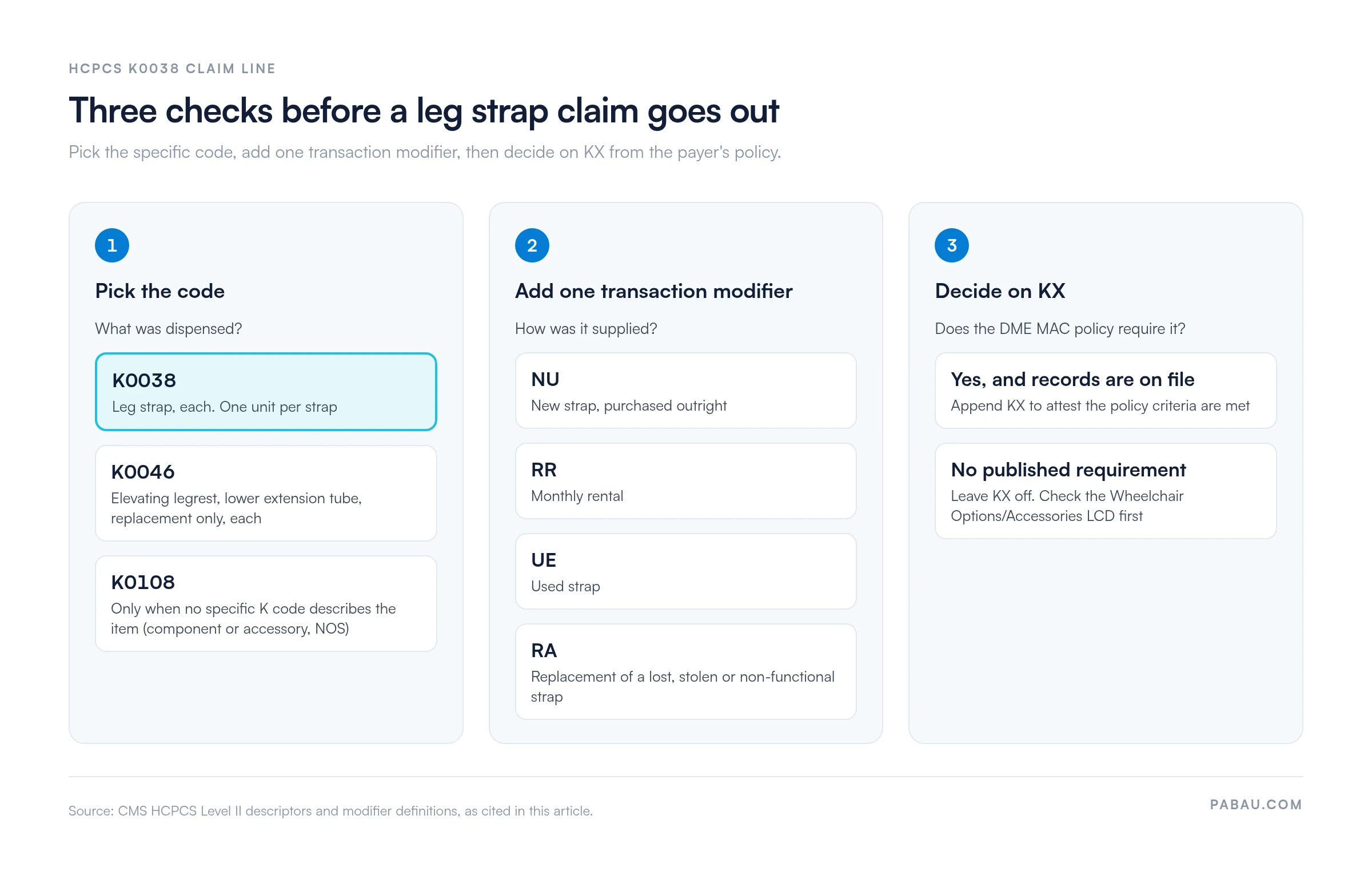
K0046 and K0108 are the two codes most commonly confused with K0038. K0046 describes an elevating legrest lower extension tube, replacement only, which is a different component entirely. K0108 covers a wheelchair component or accessory, not otherwise specified. It applies only when no specific K code describes the item.
Because K0038 exists specifically for a leg strap, K0108 must not be used in its place.
Billing K0108 for an item that K0038 describes is considered a miscoding that may trigger an audit or overpayment demand. Always use the most specific code available. Consult the AAPC HCPCS Level II code lookup to confirm the current descriptor before submitting. The three checks below put the code choice and the modifier decision in order.
Medicare Part B covers wheelchair accessories, including K0038, when three conditions are met. The beneficiary must use a covered wheelchair and the leg strap must be medically necessary. The supplier also needs a valid written order on file before delivery. Insurance eligibility verification should confirm active Part B DME coverage before a strap is dispensed.
The competitive bidding program (DMEPOS Competitive Bidding Program) affects reimbursement rates in designated Competitive Bidding Areas (CBAs). Whether K0038 is a bid item depends on the CBA. Suppliers must confirm their contract status before billing Medicare rates.
Verify the beneficiary’s wheelchair base claim is active and covered before submitting K0038. An accessory claim against a non-covered or rental-expired base will deny. Pull the base claim history before delivery, not after.
Solid documentation is the single biggest lever for avoiding K0038 denials. Strong medical billing compliance puts every item in the checklist below on file before the claim goes out. Assembling them after a denial arrives is too late.
CMS requires DME suppliers to retain documentation for a minimum of seven years. A superbill that captures the diagnosis codes, order date, and delivery date keeps the file organized and audit-ready.
No ICD-10-CM code “guarantees” coverage. Medical necessity is payer-determined and must be supported by clinical documentation. The codes below are those most frequently paired with K0038 claims based on wheelchair dependency and associated musculoskeletal or neurological conditions.
Always use the most specific ICD-10-CM code the clinical record supports. Verify current code validity against the CMS ICD-10 code files for the billing year. Pairing Z99.3 with a causative diagnosis (e.g. G35.D or G82.50) gives the claim the strongest medical necessity narrative.
Modifier selection is where K0038 claims most commonly fail. Each modifier signals a specific transaction type to the payer. Using the wrong modifier, or omitting a required one, generates an automatic denial in most Medicare DME MAC systems.
The KX modifier carries compliance weight. Appending KX without the supporting documentation on file is a false attestation under Medicare billing rules. We found no published KX requirement specific to K0038, so check the Wheelchair Options/Accessories LCD before adding it.
Where the policy does require KX, append it only once the written order, medical necessity documentation, and delivery confirmation are complete and on file. The CGS Medicare DME MAC has published coding verification guidance for DMEPOS claims that covers modifier requirements in detail.
Medicare reimburses K0038 through the DMEPOS fee schedule, not through a relative value unit calculation. The allowed amount for a new item (NU modifier) represents the purchase price. The rental rate (RR modifier) is a monthly fraction of that allowance. Rental payments stop at a capped ceiling, after which ownership transfers to the beneficiary.
Two rate tiers apply depending on where the beneficiary lives. Suppliers in a DMEPOS Competitive Bidding Area (CBA) must hold a contract with CMS to bill Medicare rates for bid items in that CBA. Non-CBA suppliers use the national fee schedule.
Both rate sets are updated annually on January 1. Because rates change yearly, this guide does not publish a specific dollar amount. Verify current allowed amounts using the CMS DMEPOS fee schedule lookup.
K0038 denials cluster around a predictable set of errors. A structured denial management process catches most of these before submission rather than after.
Building a pre-submission checklist into the clean claim submission workflow catches missing modifiers and unsigned orders before they cost a billing cycle. A checklist that mirrors the applicable LCD criteria for wheelchair accessories is the most efficient tool for K0038 compliance.
Run a modifier audit on K0038 claims quarterly. Filter your billing reports by this code and confirm every claim carries exactly one transaction-type modifier (NU, RR, UE, or RA). Add KX wherever the payer’s policy requires it. A missing modifier can be corrected before adjudication. An order signed after delivery cannot rescue the claim.
Non-Medicare payers do not follow a single national ruleset for K0038. Each Medicaid program and each commercial insurer sets its own coverage criteria, prior authorization requirements, and reimbursement rates. The three areas where billing teams most often encounter unexpected variation are prior authorization rules, formulary restrictions, and code substitution requirements.
Medicaid programs in most states cover wheelchair accessories, but some require prior authorization. The request then includes a detailed functional assessment from a certified rehabilitation technology supplier or a physical or occupational therapist.
A few state Medicaid programs take HCPCS codes from a state-maintained fee schedule. That schedule may differ from the federal HCPCS annual update. Confirm the current state Medicaid fee schedule before billing.
Commercial insurers frequently require prior authorization for DME items regardless of cost. The authorization request should reference the treating provider’s order, the relevant diagnosis codes, and the medical necessity rationale.
Some commercial plans specify an equivalent code from a proprietary coding system rather than accepting HCPCS K0038 directly. Always verify the payer’s DME billing guide before submitting. A well-structured revenue cycle management workflow includes a payer-specific rules library that flags these requirements at the point of order, not after claim submission.
A K0038 claim draws on documents from three people. The order comes from the prescriber, the clinical notes from the treating practitioner, and proof of delivery from the patient. When those sit in an inbox, a shared drive and the billing system, one of them goes missing at submission.
Pabau keeps the signed order, the diagnosis codes, the delivery confirmation and the invoice on one patient record. Its claims management software then tracks each claim’s status. Your team can see which K0038 lines are still open and which came back rejected.

Pabau keeps written orders, modifiers and claim status in one place. K0038 and other wheelchair accessory claims reach the payer complete.

K0038 has a narrow descriptor, so its denials come from process rather than from coding ambiguity. Sign the written order before delivery and code the strap as K0038, not K0108, and most of the risk is gone.
The modifier is where judgment still matters. Pick one transaction modifier for how the strap was supplied, and add KX only where the DME MAC policy calls for it. Recheck the Wheelchair Options/Accessories LCD at each annual update, because that is where a KX rule would appear.
If your team still gathers the order, notes and delivery proof after a denial arrives, change that step first. Book a demo to see how Pabau keeps DME documentation and claim status on one record.

Need to understand how denial patterns affect your revenue? Denial management in healthcare covers how to build a structured appeals and prevention workflow.
Want to improve first-pass claim rates across DME codes? Clean claim submission explains the documentation and formatting standards that reduce pre-adjudication rejections.
Looking for a foundation on DME billing rules? What is medical billing explains how the billing cycle works from order to payment posting.
Billing a footrest alongside the strap? HCPCS code K0037 explains how to bill a high mount flip-up footrest.
Keeping track of the equipment you supply? Durable medical equipment list gives you a template for recording DME items.
HCPCS code K0038 is the HCPCS Level II code for a leg strap, each. Durable medical equipment suppliers use it to bill a wheelchair leg strap supplied new, rented, used, or as a replacement. CMS maintains it within the K0001-K0195 wheelchair range.
Use NU for a new purchase, RR for monthly rental, UE for a used item, and RA for a replacement due to loss or damage. Add the KX modifier only where the DME MAC policy for the item requires it. Check the Wheelchair Options/Accessories LCD before appending it.
Yes. Medicare Part B covers K0038 when the beneficiary uses a covered wheelchair and the leg strap is medically necessary. The supplier also needs a valid written order signed before delivery. Suppliers in a Competitive Bidding Area must hold an active contract to bill Medicare rates for bid items in that area.
You need a written order signed before delivery and a clinical record documenting the functional limitation that requires the strap. The claim also needs supporting ICD-10-CM diagnosis codes and proof of delivery signed by the beneficiary. Replacements need a written explanation of the reason. All records must be retained for a minimum of seven years.
K0038 covers a leg strap, while K0046 covers the lower extension tube of an elevating legrest, replacement only. They are distinct components. Billing K0046 when only a leg strap was dispensed is a specificity error that may trigger a denial or audit request.
Not usually for Medicare, because K0038 is a low-cost accessory not listed in the CMS DMEPOS prior authorization program. Medicaid programs and commercial insurers frequently require prior authorization for DME items regardless of cost. Always verify current PA requirements with each payer before dispensing the item.