CPT Code 62284: Injection procedure for myelography
CPT Code 62284: official descriptor and procedure overview The American Medical ...

Last Updated: Oct 19, 2026
K0009 is the HCPCS Level II code for other manual wheelchair/base. It is a catch-all code, used only when no manual wheelchair base code from K0001 to K0008 describes the product.
K0009 has no weight definition, so it is not a bariatric code. Extra heavy duty bases for patients over 300 lbs are billed as K0007. Medicare accepts K0009 only for products the PDAC lists under that code on its Product Classification List.
Let Pabau's smart automation suggest the right codes, reduce claim denials, and keep your practice compliant—effortlessly.
Automate repetitive tasks and focus on what matters most—your patients.
Reduce coding errors and ensure compliance with the latest regulations.
Clean claims, fewer denials, and faster reimbursements.
Powerful insights and reporting to help your practice thrive.
HIPAA compliant SOC 2 certified GDPR-compliant Trusted by 4,000+ clinics worldwide

HCPCS Code K0009 is “other manual wheelchair/base,” a catch-all used only when no code from K0001 to K0008 describes the base.
K0009 carries no weight definition, so a patient over 300 lbs needs K0007, and a patient over 250 lbs needs K0006.
Medicare accepts K0009 only for products the PDAC has reviewed and listed as K0009 on its Product Classification List.
Coverage follows the Manual Wheelchair Bases LCD, L33788, and the KX modifier goes on only when its criteria are documented.
K0009 has no fixed national fee, so confirm how your DME MAC prices the product before you bill.
HCPCS Code K0009 is the Level II code for “other manual wheelchair/base” in CMS’s Healthcare Common Procedure Coding System. It is a residual code. Suppliers use it only when a manual wheelchair base fits the description of no code from K0001 to K0008.
Unlike K0006 and K0007, K0009 has no weight threshold in its descriptor, so a heavier patient is never the reason to choose it. The code applies to the wheelchair base itself, not to seating, accessories, or power wheelchair bases.
Medicare adds one more condition, set out in the Manual Wheelchair Bases policy article, A52497. The rule covers dates of service on or after June 1, 2013. Only products reviewed in writing by the Pricing, Data Analysis, and Coding (PDAC) contractor may be billed as K0009. The product must also appear on the PDAC’s Product Classification List.
K0009 is defined by exclusion. Check every other manual base code first, and use K0009 only when the product matches none of them. Our HCPCS codes library has a page for each base from K0001 to K0006.
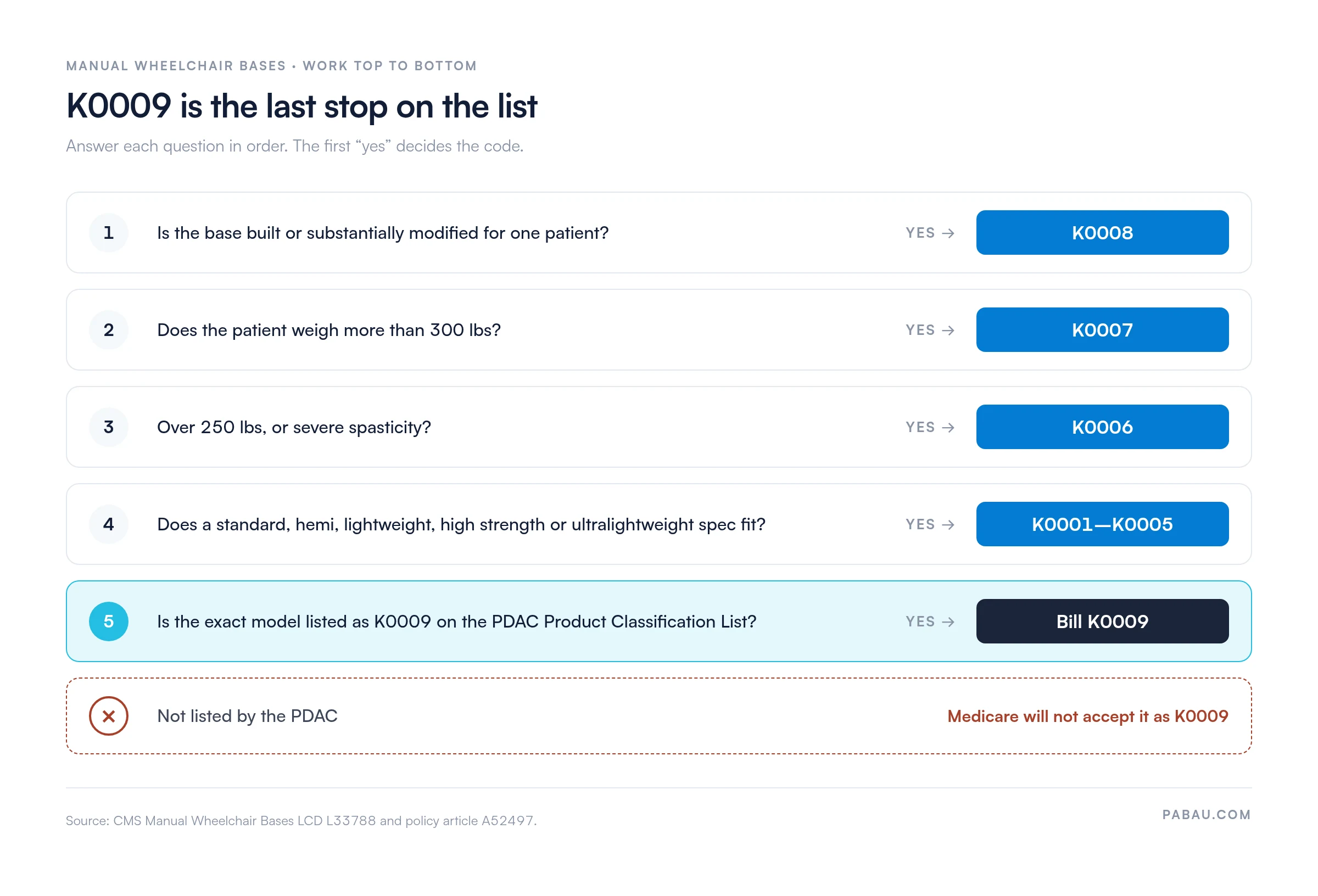
Billing K0009 for a product that a more specific code describes leads to a denial for incorrect coding. Work down the table and stop at the first code that matches the product.
Bariatric patients cause the most confusion. A patient who weighs more than 300 lbs needs an extra heavy duty base, coded K0007, not K0009. A patient over 250 lbs who does not exceed 300 lbs usually starts at K0006.
Before you bill, look up the delivered model on the PDAC Product Classification List. The code listed there decides the claim, whatever the manufacturer calls the chair. The path below puts every check in order, with the PDAC listing as the final gate.
Medicare’s coverage rules for every manual wheelchair base sit in the Manual Wheelchair Bases LCD, L33788, which all DME MACs share. The LCD sets no criteria specific to K0009, so a K0009 claim must meet its basic criteria for a manual wheelchair:
Confirm the current LCD version on the CMS Medicare Coverage Database before you bill, because DME MACs revise it periodically.
K0009 was not among the codes added to CMS’s Required Prior Authorization List in the update effective October 28, 2026. That update added K0005 as the only manual wheelchair base. CMS revises the list regularly, so check the current DMEPOS prior authorization list before each delivery.
A K0009 file has to prove two things: why the patient needs a manual wheelchair, and why no other base code describes the product. Keep these records on file before you submit the claim.
K0009 is reported on the CMS-1500 claim form or its electronic equivalent, the 837P transaction, to the DME MAC for the patient’s state. Place of service 12 (home) is the usual setting for Medicare DME. Report one unit per wheelchair base.
Only a Medicare-enrolled, accredited DMEPOS supplier can bill K0009. A lapse in either status stops claims until it is fixed, so track both renewal dates.
The table covers the modifiers most often seen on manual wheelchair claims.
Never put KX and GZ on the same claim line. Ask your DME MAC whether the product is billed as a rental or a purchase before you choose RR, NU, or UE.
K0009 has no fixed national amount on the DMEPOS fee schedule. It is contractor-priced, so your DME MAC determines the allowed amount.
Medicare Part B generally pays 80% of the allowed amount once the patient’s Part B deductible is met. The patient owes the remaining 20% coinsurance.
Check the CMS DMEPOS fee schedule for updates to related codes. For K0009 itself, ask your DME MAC how it prices the specific product before you deliver.
Before you deliver a K0009 product, save the PDAC Product Classification List entry for that exact model to the patient’s file. Medicare denies an unlisted product as incorrect coding, however strong the clinical need.
Many K0009 denials start before the claim is built, at the coding stage. Reviewing denial management best practices for DME claims helps you build these checks into your workflow.
Maintaining medical billing compliance for DMEPOS means treating documentation as a pre-delivery checklist. A claim sent with an incomplete record is denied even when the patient clearly needs the chair.
No ICD-10-CM code establishes medical necessity for K0009 on its own. The diagnosis explains the mobility limitation, and the medical record shows how that limitation meets the LCD’s basic criteria.
Code to the highest specificity the record supports. Pair the mobility-limiting diagnosis with notes that describe what the patient cannot do at home.
A K0009 claim draws on several records: practitioner notes, the written order, the PDAC listing, and proof of delivery. When they live in separate systems, someone has to rebuild the file every time a claim is queried.
Pabau’s practice management software keeps that evidence on one patient record. Notes, signed forms, and claims management sit together, so the file behind a claim is easy to find.
Your team can then check the file before submission instead of searching for it after a denial. That makes a clean claim easier to send the first time.

Pabau keeps notes, signed forms, and claims on the patient’s record, so your team can check a K0009 file before it goes out.

Treat K0009 as the last manual base code you reach for. If a code from K0001 to K0008 describes the product, that code goes on the claim. If the patient weighs more than 300 lbs, start at K0007.
When K0009 is the right answer, the PDAC listing carries as much weight as the clinical notes. Confirm the listing first, and the rest of the file becomes documentation work your team controls. Book a demo to see how Pabau keeps wheelchair documentation and claims together for your practice.

Need to understand how denial codes affect your K0009 claims? Denial codes in medical billing covers the most common CARC and RARC codes that appear on rejected DMEPOS claims.
Looking for a broader DMEPOS billing workflow overview? What is revenue cycle management explains the end-to-end process from eligibility check through payment posting.
Want to ensure your supplier credentialing stays current? How to get credentialed with insurance companies walks through the accreditation and enrollment process for DMEPOS suppliers.
Need the code for a standard base? HCPCS code K0001 explains the standard wheelchair, the first code to rule out before K0009.
HCPCS Code K0009 is the Level II code for “other manual wheelchair/base.” It is a catch-all used only when no code from K0001 to K0008 describes the base. Medicare accepts it only for products the PDAC lists as K0009.
No. K0009 has no weight definition. Medicare covers an extra heavy duty base, K0007, for patients over 300 lbs. It covers a heavy duty base, K0006, for patients over 250 lbs or with severe spasticity.
K0006 is a heavy duty wheelchair for patients over 250 lbs or with severe spasticity. K0007 is an extra heavy duty wheelchair for patients over 300 lbs. K0008 is a custom base built for one patient. K0009 covers any other manual base those codes do not describe.
K0009 has no fixed national fee schedule amount. It is contractor-priced, so the DME MAC determines the allowed amount. Medicare generally pays 80% of that amount after the Part B deductible, and the patient owes 20% coinsurance.
KX shows that the LCD L33788 coverage criteria are documented. GA marks a signed ABN, and GZ marks an expected denial with no ABN. RR, NU, or UE identify a rental, new purchase, or used purchase. Never put KX and GZ on the same line.
K0009 was not among the codes added to CMS’s Required Prior Authorization List in the October 28, 2026 update, which added K0005. CMS updates the list regularly, so check it before each delivery.
Mobility-limiting diagnoses such as G12.21 (ALS), I69.351 (post-stroke hemiplegia), or M16.11 (hip osteoarthritis) are common. No diagnosis code establishes coverage alone. The record must show the patient meets the LCD’s basic criteria.