HCPCS code A4650: Surgical dressing billing guide
HCPCS code A4650: official descriptor and product definition HCPCS code A4650 is...

Last Updated: Oct 7, 2026
K0006 is the HCPCS Level II code for heavy duty wheelchair.
The code belongs to the K-code series covering manual wheelchair bases, which sits under Healthcare Common Procedure Coding System (HCPCS) Level II. That system is maintained by the Centers for Medicare and Medicaid Services (CMS). The full descriptor reads: Heavy duty wheelchair.
The 250-pound weight threshold is the defining clinical qualifier. Patients below that threshold qualify for standard manual wheelchair codes such as K0001 or K0002.
Patients above 300 pounds may instead require K0007, the extra heavy duty classification. A mismatch between the patient's documented weight and the billed code is one of the most common reasons DME claims are denied.
Let Pabau's smart automation suggest the right codes, reduce claim denials, and keep your practice compliant—effortlessly.
Automate repetitive tasks and focus on what matters most—your patients.
Reduce coding errors and ensure compliance with the latest regulations.
Clean claims, fewer denials, and faster reimbursements.
Powerful insights and reporting to help your practice thrive.
HIPAA compliant SOC 2 certified GDPR-compliant Trusted by 4,000+ clinics worldwide

HCPCS Code K0006 is a Level II durable medical equipment code for a heavy duty manual wheelchair. It fits patients weighing more than 250 lbs.
Coverage under Medicare Part B requires a Standard Written Order, a documented mobility limitation, and a recorded weight above 250 lbs or severe spasticity.
Certificates of Medical Necessity no longer apply to any DME claim dated January 1, 2023 or later. Claims that still carry CMN or DIF data are rejected.
Fee schedule amounts vary by state pricing locality. Competitive bidding is in a gap period, so no bid-area rates apply right now.
Pabau’s claims management software helps DME suppliers and practices track documentation requirements and submit accurate K0006 claims.
Medicare reimburses K0006 under Part B’s DME benefit. Rates come from the CMS DMEPOS fee schedule and vary by state pricing locality. DMEPOS competitive bidding does not split those rates today.
The competitive bidding program has been in a gap period since the Round 2021 contracts expired at the end of 2021. No competitive bidding areas are active, so former bid-area suppliers bill the same fee schedule amounts as everyone else. CMS has said contract pricing from the next round takes effect on January 1, 2028.
There is no single national figure worth quoting for K0006. The allowable differs by state, by purchase versus rental, and by whether the item is new or used. Pull the current amount for your state from the CMS DMEPOS fee schedule before you bill. Then reconcile it against the rates your MAC posts.
CMS policy article A52497 and LCD L33788 govern manual wheelchair base coverage under the Medicare Part B benefit. All of the following conditions must be met to qualify for reimbursement.
Meeting some but not all criteria is grounds for claim denial, so pre-authorization documentation matters more for heavy duty codes than for standard bases.
Confirming the patient’s coverage before delivery protects the supplier from a post-delivery denial. That matters more for K0006 than for a standard base, because the weight threshold makes it a higher-scrutiny code.
Incomplete documentation is what usually sinks a K0006 claim on audit. CMS requires the supplier to retain the following on file before submitting a claim. Holding the same standard from the point of order through delivery reduces audit exposure.
One document is no longer on that list. CMS discontinued Certificates of Medical Necessity and DME Information Forms for all claims with dates of service on or after January 1, 2023. Claims that still carry that data are rejected outright.
Manual wheelchair bases never had a CMN form to begin with. The clinical justification for K0006 lives in the treating practitioner’s medical record, not on a separate signed certification.
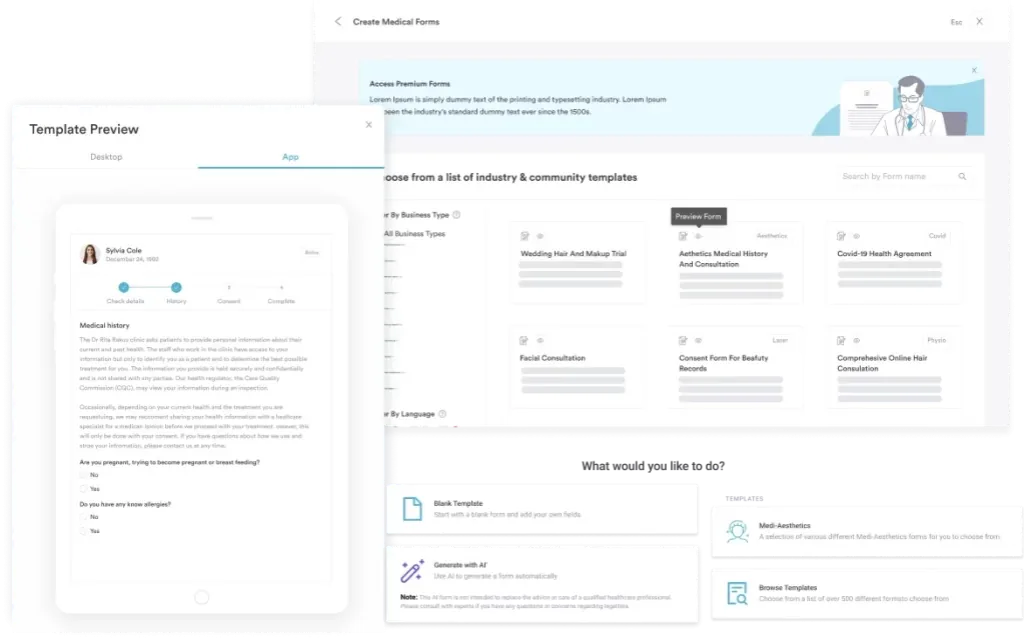
Digital forms keep the SWO, the face-to-face notes, and the delivery confirmation in a single workflow. That reduces the back-and-forth that delays submission and raises the risk of a missing field.
Document the patient’s weight using a clinical source dated within 12 months of the order. A pharmacy scale or home measurement is rarely sufficient for audit purposes. Use a physician visit weight or a hospital record, and note the date and facility in the medical record.
The diagnosis code on the K0006 claim must establish medical necessity for a heavy duty wheelchair specifically. Not every mobility-related ICD-10 code satisfies that requirement.
The diagnosis must reflect a condition that impairs ambulation and fits a patient weighing over 250 pounds. The codes below are commonly accepted, but payers may impose additional coverage criteria.
When obesity or high BMI codes are included, pair them with a primary mobility-impairment diagnosis. An obesity code alone does not establish medical necessity for a wheelchair.
The claim needs a code that directly reflects the functional mobility limitation. Where a patient’s diagnosis is not listed above, check the full ICD-10-CM code reference for a closer match.
Modifier selection directly affects whether a K0006 claim pays or denies. The modifier signals to Medicare the transaction type, whether coverage criteria have been met, and how the supplier intends to defend the claim if audited.
Using the wrong modifier, or omitting a required one, is among the most preventable billing errors in DME claims.
Always verify modifier requirements with the patient’s MAC before submission. Modifier rules for DME can differ across Medicare Administrative Contractors, and incorrect usage carries audit risk.
Selecting the wrong code from the K0001-K0007 series is a common billing error. Each code maps to a specific weight capacity and design standard. The chart below shows where K0006 falls, and the table after it covers the full series.
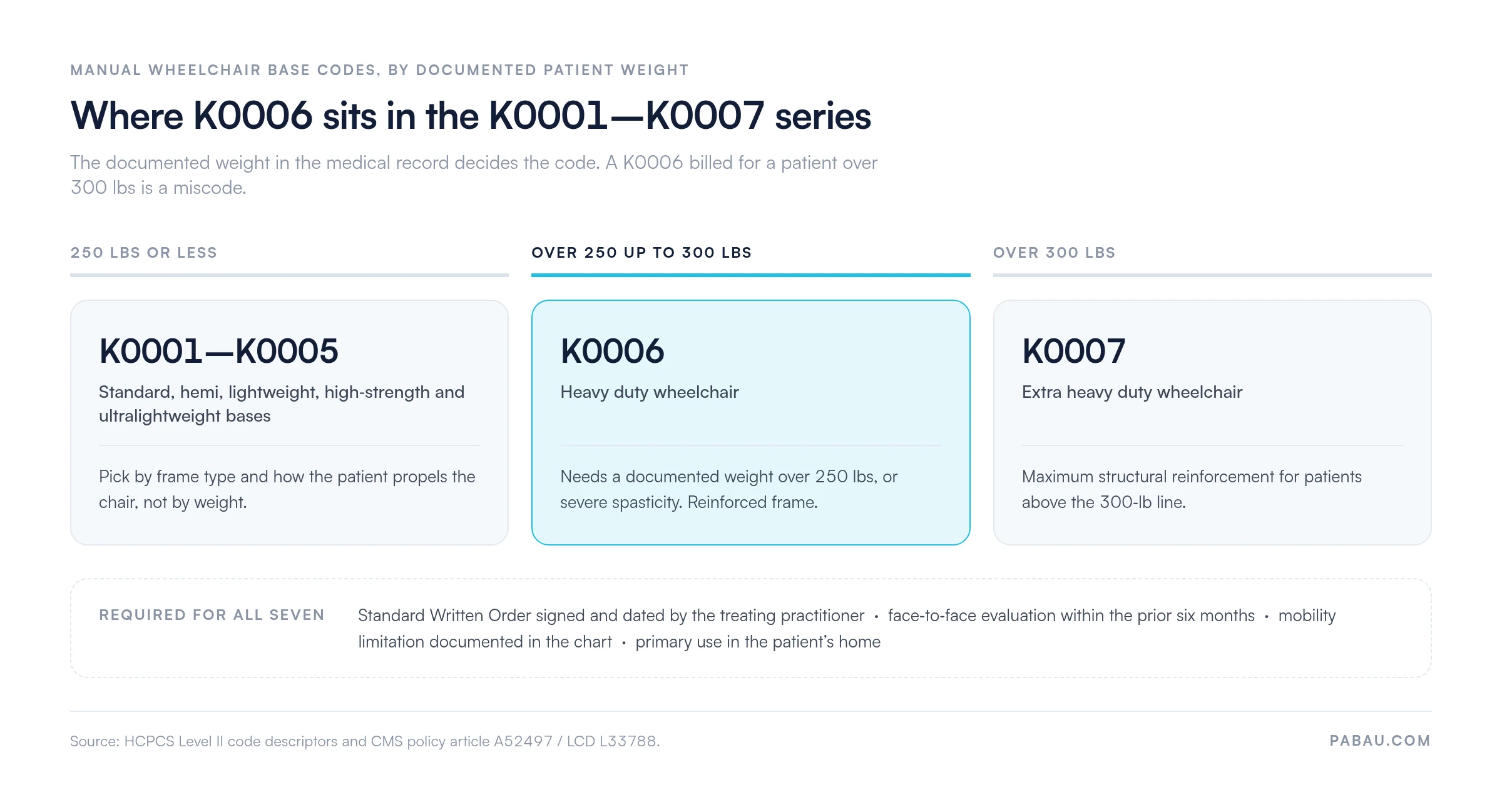
The distinction between K0006 and K0007 comes down to one number: 300 pounds. K0006 covers patients weighing between 250 and 300 pounds.
K0007 applies when the patient exceeds 300 pounds, according to the HCPCS code descriptors and AAPC reference materials. Billing K0006 for a patient over 300 pounds is a miscode, and audits usually catch it because patient weight is a required documentation element.
Record the patient’s exact weight in the medical record and cross-reference it against the chosen code before submission. A weight-to-code check at the point of documentation prevents one of the most avoidable denials in DME billing. Tracking these patterns over time is the core of denial management.
DME suppliers billing K0006 must be enrolled as DMEPOS suppliers with a valid supplier number, and must meet CMS accreditation requirements. Billing fundamentals for DME differ from professional or institutional billing. The rules for rental capping, prior authorization, and modifier use interact in ways that create unexpected denials.
Key billing rules to follow:
For practices that prescribe or supply DME, software built for suppliers connects clinical documentation to the claim. That removes the manual transfer step behind most of these denials.
Manual DME billing workflows create compounding risk. A missing element on the SWO holds up the claim. A delayed face-to-face note pushes delivery outside the allowed window.
A weight recorded in another system never reaches the billing record. These are workflow failures, and they repeat across every K0006 claim until the process is fixed.
A structured approach to K0006 billing typically includes these steps:
Practices that connect clinical documentation to billing in one platform cut the handoffs where these documents go missing. An automated reminder for an unsigned SWO or a lapsing face-to-face window catches the problem early. That beats finding out when the claim bounces.
Run a quarterly audit of your K0006 denial logs. Filter by denial reason code, then trace each category back to the intake step where the document was first collected. Denials tend to cluster around two or three repeatable documentation misses. One process change at intake clears all of them.
A K0006 denial often turns on a document that existed but could not be produced on request. The order sits in one folder, the weight measurement in the chart, and the delivery slip with the driver.
Practice management software like Pabau keeps that file attached to the patient instead. Pabau stores the written order, the clinical notes, and the delivery confirmation against one record. An auditor’s request is then answered from a single screen.
The same record drives the claim, so the documented weight travels with the code selection. A K0006 billed for a patient over 300 pounds gets flagged before the batch goes out, not on appeal months later.

Pabau’s claims management software helps practices and DME suppliers keep written orders, clinical notes, and delivery proof against one patient record. See how it fits your billing process.

HCPCS Code K0006 is straightforward in theory but denial-prone in practice. The weight threshold, the Standard Written Order, modifier selection, and ICD-10 pairing each add a layer where thin documentation can sink an otherwise valid claim.
Most of the leverage sits before delivery. Run the weight-to-code check and count the required documents while the chair is still in the warehouse. A post-delivery denial is argued from behind.
Pabau brings clinical documentation and DME billing into one workflow, which removes the handoffs where K0006 errors start. Book a demo to see how your team would assemble a K0006 claim packet in one place.

Need to understand DME billing fundamentals before diving into K-codes? What is medical billing walks through how DME claims fit into the broader billing landscape.
Struggling with claim denials across your DME portfolio? Common denial codes in medical billing covers the most frequent denial reason codes and how to respond.
Want to tighten your eligibility checks before delivering DME? Insurance eligibility verification explains how to confirm coverage before the item ships.
Want fewer K0006 claims coming back for rework? What is a clean claim sets out what a payer needs to pay on the first pass.
Building a documentation standard your MAC will accept? Medical billing compliance covers the record-keeping rules that hold up under audit.
HCPCS Code K0006 is a Level II durable medical equipment code for a heavy duty manual wheelchair. The code covers chairs built for patients who weigh more than 250 pounds. It is covered under Medicare Part B when the record shows a qualifying mobility limitation. Billing it requires a Standard Written Order signed by the treating practitioner.
No, not since 2023. CMS discontinued Certificates of Medical Necessity and DME Information Forms for every DME claim dated January 1, 2023 or later. Claims that still carry that data are rejected. Manual wheelchair bases never had a CMN form in the first place. The current requirement is a Standard Written Order plus medical records that support the coverage criteria.
A patient must weigh more than 250 pounds to qualify for K0006. Patients weighing 250 pounds or less are billed under standard manual wheelchair codes such as K0001 or K0002. Patients exceeding 300 pounds may require K0007 instead.
K0006 may require prior authorization depending on the MAC jurisdiction and the current CMS required prior authorization list. CMS has expanded prior authorization for certain DMEPOS items, and the list changes periodically. Verify current requirements with the beneficiary’s MAC before delivery to avoid authorization-related denials.
There is no single national amount. The K0006 allowable is set in the CMS DMEPOS fee schedule. It differs by state pricing locality, by purchase versus rental, and by whether the item is new or used. Competitive bidding is in a gap period, so no separate bid-area rates apply. Medicare pays 80% of the approved amount and the beneficiary or a supplemental plan covers the rest.
K0006 covers patients weighing between 250 and 300 pounds (heavy duty). K0007 covers patients over 300 pounds (extra heavy duty). Using K0006 for a patient who actually exceeds 300 pounds is a miscode, and patient weight documentation will expose the discrepancy on audit.
Commonly paired ICD-10 codes include neurological conditions such as G35 (multiple sclerosis) and G82.20 (paraplegia). Musculoskeletal diagnoses such as M16.11 and M17.11 cover osteoarthritis of the hip and knee. Stroke-related codes such as I69.351 and obesity codes such as E66.01 and Z68.41 also appear. The diagnosis must support both the mobility limitation and the weight-based need for a heavy duty frame.
Required documentation includes a Standard Written Order signed by the treating practitioner and face-to-face evaluation notes from within six months of the order date. You also need chart notes supporting the mobility limitation, a documented weight over 250 lbs or severe spasticity, proof of delivery, and supplier accreditation records. A Certificate of Medical Necessity is not among them. CMS discontinued CMNs for all DME claims dated January 1, 2023 or later.