HCPCS Code L0472: Hyperextension TLSO billing guide
HCPCS code L0472: Official descriptor and device definition HCPCS code L0472 des...

Last Updated: Nov 5, 2026
Billable Code
K0044 is the HCPCS Level II code for footrest, upper hanger bracket, replacement only, each. It covers the top part of a footrest hanger, the bracket that attaches the footrest to the wheelchair frame.
The code applies only when that bracket is replaced on its own, on a wheelchair the patient already uses. A footrest supplied with a new wheelchair is part of the base code instead. Medicare pays K0044 under the Part B DMEPOS benefit, and only enrolled DMEPOS suppliers may bill it.
Let Pabau's smart automation suggest the right codes, reduce claim denials, and keep your practice compliant—effortlessly.
Automate repetitive tasks and focus on what matters most—your patients.
Reduce coding errors and ensure compliance with the latest regulations.
Clean claims, fewer denials, and faster reimbursements.
Powerful insights and reporting to help your practice thrive.
HIPAA compliant SOC 2 certified GDPR-compliant Trusted by 4,000+ clinics worldwide

HCPCS code K0044 covers one wheelchair footrest upper hanger bracket, supplied as a replacement part and billed per bracket.
The code never applies to a footrest that ships with a new wheelchair, because that footrest is included in the base code.
Coverage follows the Wheelchair Options/Accessories LCD (L33792) and its policy article (A52504).
Replacement claims carry the RB modifier, plus KX, GA, GZ or GY depending on whether coverage criteria are met.
Most K0044 denials come from billing the wrong footrest part, a missing modifier, or no record of why the old bracket failed.
HCPCS code K0044 describes a footrest, upper hanger bracket, replacement only, each. It is a Level II code in the K-series, which CMS maintains for durable medical equipment billed to the DME Medicare Administrative Contractors (MACs).
The upper hanger bracket is the top part of a footrest hanger, the piece that attaches the footrest to the wheelchair frame. K0044 pays for that bracket alone when it breaks or wears out on a wheelchair the patient already uses.
Getting it right sits inside the wider medical billing cycle, where the code on the claim has to match the part in the box.
The AAPC’s HCPCS Level II code lookup provides a searchable index of K-series codes with descriptor text. PGM Billing’s free HCPCS lookup tool mirrors current CMS data for quick reference. Neither replaces the official CMS file, but both are useful for a fast check.
Our HCPCS code billing guides cover other wheelchair part codes in the same format as this page, with modifiers and denials for each.
K0044 covers one part: The upper hanger bracket of a standard footrest. The code applies only when that bracket is supplied on its own to replace the same part on an existing wheelchair.
Covered under K0044: A replacement upper hanger bracket for a swing-away or detachable footrest, fitted because the original is broken, worn or lost.
Excluded from K0044: These items are billed under a different code, or not billed separately at all.
If the technician replaced more than the bracket, bill each part that went on the chair. Billing K0044 for a full assembly, or K0045 for a single bracket, is wrong code assignment and invites recoupment on review.
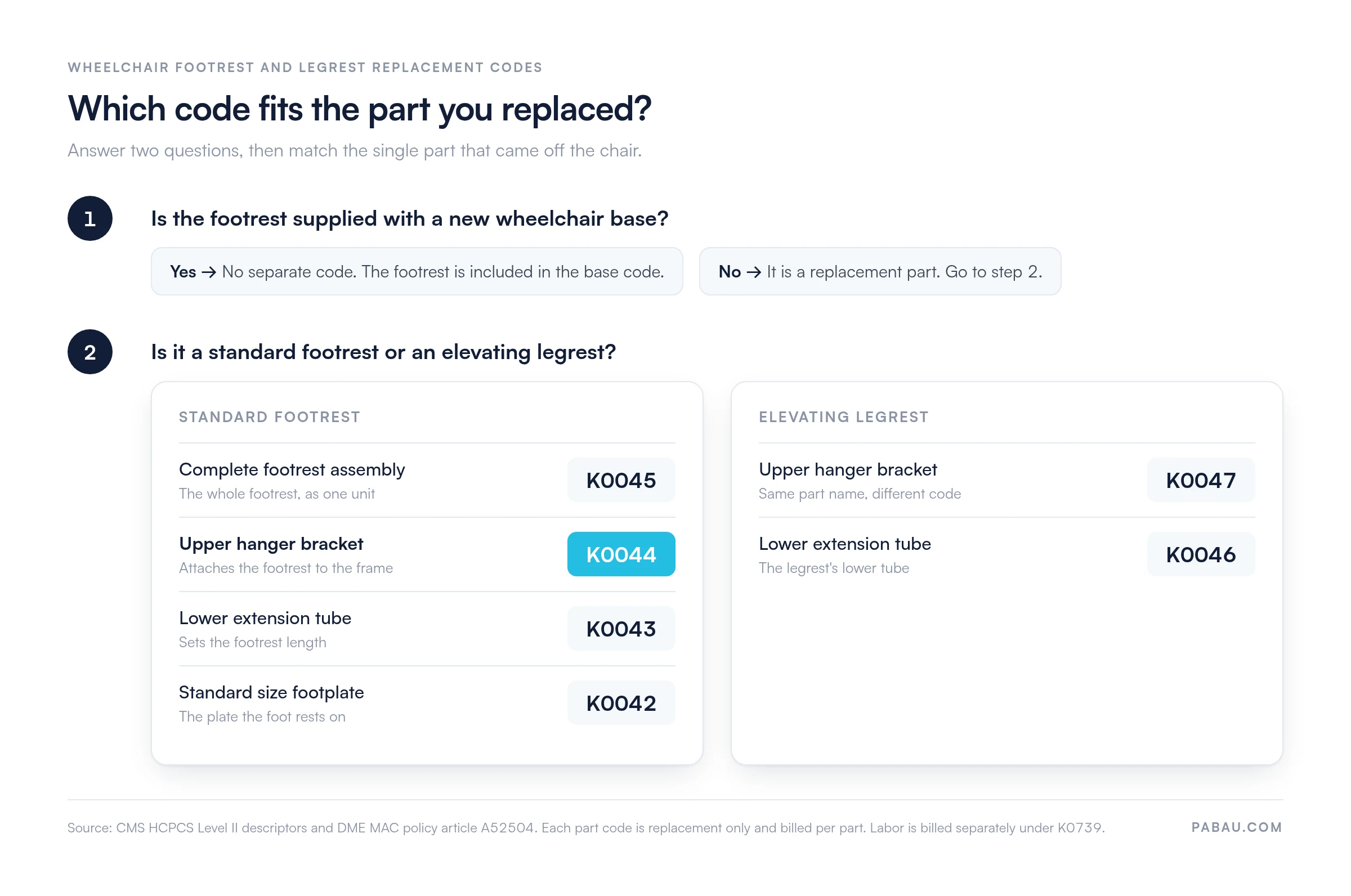
The most common coding error with K0044 is confusing it with the other footrest and legrest replacement codes. Each code names one physical part, so the choice turns on what was removed from the chair and what replaced it.
K0044 and K0047 are the pair most often mixed up, because both describe an upper hanger bracket. K0044 belongs to a standard footrest, while K0047 belongs to an elevating legrest. NLM’s HCPCS Level II API returns the current descriptor text for each code and can be built into a supplier’s verification step.
The chart below runs the same choice as two questions. It starts with whether the chair is new, then matches the single part that came off.
Medicare Part B covers K0044 under the DMEPOS benefit as a replacement part for a wheelchair. Coverage follows the Wheelchair Options/Accessories LCD (L33792) and its policy article (A52504), which the DME MACs publish jointly.
Medicare pays for replacement parts when they keep a covered wheelchair working. A typical K0044 claim meets these conditions:
If the patient needs the wheelchair only outside the home, the policy article tells suppliers to add the GY modifier to every accessory code. That claim then denies as outside the benefit, and the patient or a secondary payer takes responsibility.
Documentation for K0044 has to be in the file before the claim goes out. Meeting the billing compliance requirements from the start avoids the rework cycle.
The table below reflects the standard DME MAC documentation rules for a wheelchair replacement part. Check the policy article for any contractor-specific additions.
The repair justification is the line reviewers look for first on replacement parts. A note that reads “bracket replaced” shows what was done. It doesn’t show why Medicare should pay for it.
Modifier selection on K0044 decides whether Medicare pays the line, holds it, or denies it. Policy article A52504 sets the rules, and the RB modifier carries the most weight on a replacement part.
GY can’t sit on the same line as KX, GA or GZ. Adding KX without supporting documentation is a false attestation and creates audit risk. Check the current policy article before each claim cycle, as modifier rules change with policy revisions.
CMS keeps a Required Prior Authorization List for certain DMEPOS items, and it updates that list over time. The list has focused on higher-cost items such as power mobility devices rather than replacement parts. Check the current list before you assume a K0044 claim needs no authorization.
Completing insurance eligibility verification before ordering the part also shows whether the patient has active Part B coverage on the date of delivery.
When an ABN is required: If you expect Medicare to deny the K0044 claim, issue a valid Advance Beneficiary Notice of Noncoverage (ABN) before delivery. That covers a chair that may not meet coverage criteria, or a replacement the record doesn’t support.
An ABN obtained after delivery is invalid and doesn’t protect the supplier from liability for the cost of the part.
K0044 claims are submitted by enrolled DMEPOS suppliers on the CMS-1500 paper form or its electronic equivalent, the 837P transaction. The supplier needs an active enrollment with the National Supplier Clearinghouse and the DME MAC for the patient’s state.
Using structured DME claims management software reduces the field-level errors that trigger automated edits at the DME MAC.
The CMS DMEPOS fee schedule files list the current allowable amounts for K-series codes by state. Check them before you submit. The Physician Fee Schedule doesn’t price DMEPOS items, so a search there won’t return a K0044 rate.
Medicare reimburses K0044 under the DMEPOS fee schedule, which CMS publishes each year. The allowable amount varies by state, and rural and non-rural rates can differ.
Where a competitive bidding program applies to the product category, the program rate replaces the fee schedule amount. Only contract suppliers can then bill Medicare for that category in the area.
Allowable amounts for K0044 change each year and vary by state. Download the current DMEPOS fee schedule file rather than relying on prior-year figures.
Before submitting a K0044 claim, check the current-year DMEPOS fee schedule file for the patient’s state. Billing at last year’s rate creates adjustment risk on post-payment review.
K0044 denials cluster around three root causes: The wrong footrest code, a missing or wrong modifier, and no record of why the old bracket failed. Most are preventable when the order comes in. Structured denial management workflows that track root causes by code help suppliers spot repeat patterns.
For a CO-50 denial on a supported claim, send the redetermination with the full repair record and proof of delivery. Show what failed, why it couldn’t be repaired, and why the patient still needs the chair.
Submitting a clean claim from the start, with modifiers, units and diagnosis codes checked before transmission, removes the most common denial triggers.
Replacement-part claims are small, so they often get the least attention. The order sits in one folder, the repair note in a technician’s email, and the modifier rule in someone’s head. Months later, a records request means piecing it back together.
Pabau, the practice management platform we build, raises each claim from the patient’s invoice. The claim sits on the same record as their notes and files. Claim validation checks for missing or invalid details before the claim leaves for the clearinghouse. A rejected claim is flagged Needs action, with a link to the field that needs fixing.
US practices submit CMS-1500 claims through Claim.MD and follow every claim from Pending to Paid on one dashboard. Your team spends less time chasing small K0044 lines, and the paperwork is ready when a reviewer asks.

Pabau raises claims from the patient’s invoice, checks them before submission and flags rejections for a quick fix. So K0044 lines get paid without the rework.

K0044 is a narrow code, and that is where the risk sits. It pays for one bracket on one standard footrest, so the claim succeeds only if the part, the modifier and the repair record agree.
Treat the technician’s note as part of the claim itself. A bracket logged with what failed and why it couldn’t be fixed rarely draws a denial.
Book a demo to see how Pabau keeps DME replacement claims documented, validated and tracked to payment.

Need to understand denial codes and how to respond? Denial management in healthcare covers the full appeal process, root-cause analysis, and how to build a denial prevention workflow.
Want a cleaner claims submission process? Submitting a clean claim explains every field-level requirement that determines whether a DME or medical claim processes on first pass.
Looking for guidance on DME billing fundamentals? What is medical billing? outlines the revenue cycle from order intake through remittance posting.
Replacing the whole footrest instead? HCPCS code K0045 covers the complete footrest assembly, with its own modifiers and documentation rules.
Only the lower tube failed? HCPCS code K0043 explains how to bill a replacement footrest lower extension tube.
HCPCS code K0044 covers a footrest upper hanger bracket, replacement only, billed per bracket. It applies when that bracket alone is replaced on a standard footrest of a wheelchair the patient already uses.
K0044 follows the Wheelchair Options/Accessories LCD (L33792) and its policy article, A52504. The DME MACs publish both jointly, and the policy article sets the modifier and bundling rules.
Add the RB modifier because the bracket replaces the same part. Then add KX when the base and accessory criteria are met, or GA or GZ when they may not be. Use GY when the chair is needed only outside the home.
K0044 is the upper hanger bracket of a standard footrest. K0045 is the complete footrest assembly, and K0047 is the upper hanger bracket of an elevating legrest. Bill the code that matches the part fitted on the chair.
No. A footrest supplied with a new wheelchair base is included in the base code, and K0044 is replacement only. Billing both on the same claim usually returns a CO-97 bundling denial.
The most common is CO-4, for a missing or invalid modifier. CO-50 follows when the record doesn’t support the replacement, and CO-97 when the bracket is billed with a new base. Each is fixed by correcting the claim or adding the repair record.