

CPT Code 52352: Ureteroscopic stone removal billing guide
CPT Code 52352: Official descriptor and procedure overview CPT Code 52352 descri...

Last Updated: Oct 30, 2026
J7197 is the HCPCS Level II code for antithrombin III (human), per IU. It reports plasma-derived antithrombin, sold as Thrombate III, given intravenously to patients with hereditary antithrombin deficiency.
One billing unit equals one international unit, so the units on the claim match the IU infused. Most denials trace back to vial-based unit counts, a missing thrombophilia diagnosis such as D68.59, or a Medicaid claim sent without the NDC.
Let Pabau's smart automation suggest the right codes, reduce claim denials, and keep your practice compliant—effortlessly.
Automate repetitive tasks and focus on what matters most—your patients.
Reduce coding errors and ensure compliance with the latest regulations.
Clean claims, fewer denials, and faster reimbursements.
Powerful insights and reporting to help your practice thrive.
HIPAA compliant SOC 2 certified GDPR-compliant Trusted by 4,000+ clinics worldwide

J7197 reports antithrombin III (human), sold as Thrombate III, at one billing unit per international unit (IU) given.
Pair it with D68.59, which includes antithrombin III deficiency, the condition behind the drug’s only FDA-approved use.
From October 1 to December 31, 2026, the Medicare Part B payment limit for J7197 is $4.264 per IU.
CMS does not flag J7197 as a clotting factor, so hemophilia factor rules such as the furnishing fee don’t carry over.
Pabau, the practice management platform we build, validates each claim and links prior authorizations to the appointment before submission.
HCPCS Code J7197 carries the official descriptor Antithrombin III (human), per IU. It sits in the J-code range of HCPCS Level II. The Centers for Medicare and Medicaid Services maintain that code set for drugs, supplies, and services that CPT does not cover.
The CMS HCPCS file shows J7197 added in 1992, with its current descriptor in place since 1997. “Human” is the qualifier that matters. J7197 is for antithrombin purified from pooled human plasma, while recombinant antithrombin has its own code, J7196.
J7197 reports Thrombate III, the plasma-derived antithrombin III made by Grifols Therapeutics. The Thrombate III prescribing information, revised July 2025, approves it for adults and children with hereditary antithrombin deficiency. It covers two uses:
Antithrombin is the body’s main natural inhibitor of thrombin and factor Xa. Patients with a hereditary deficiency carry a higher risk of venous clots, especially around surgery and childbirth. Thrombate III raises plasma antithrombin back toward normal for those high-risk windows.
Recombinant antithrombin (ATryn) was billed under J7196 at 50 IU per unit. Payer policies updated in 2026 list ATryn as discontinued. That leaves Thrombate III as the antithrombin concentrate a J7197 claim normally describes.
J7197 is billed per IU administered. The units on the claim equal the total international units infused at that encounter. Thrombate III vials hold about 500 units, but each vial label states its own potency. Count units from the vial labels, not from the number of vials.
Dosing is weight-based and driven by antithrombin activity levels. The label’s loading dose aims for 120% of normal, using an expected recovery of 1.4% per unit per kilogram. Maintenance doses run at 60% of the loading dose, about every 24 hours.
Here is how one loading dose turns into claim units:
At the October 2026 Medicare payment limit, that loading dose alone comes to about $13,432. A unit error on a claim this size draws a payer’s attention quickly. Good medical billing workflows add a conversion step between the prescriber order and the claim unit field. The flow below traces that dose from lab result to claim line.
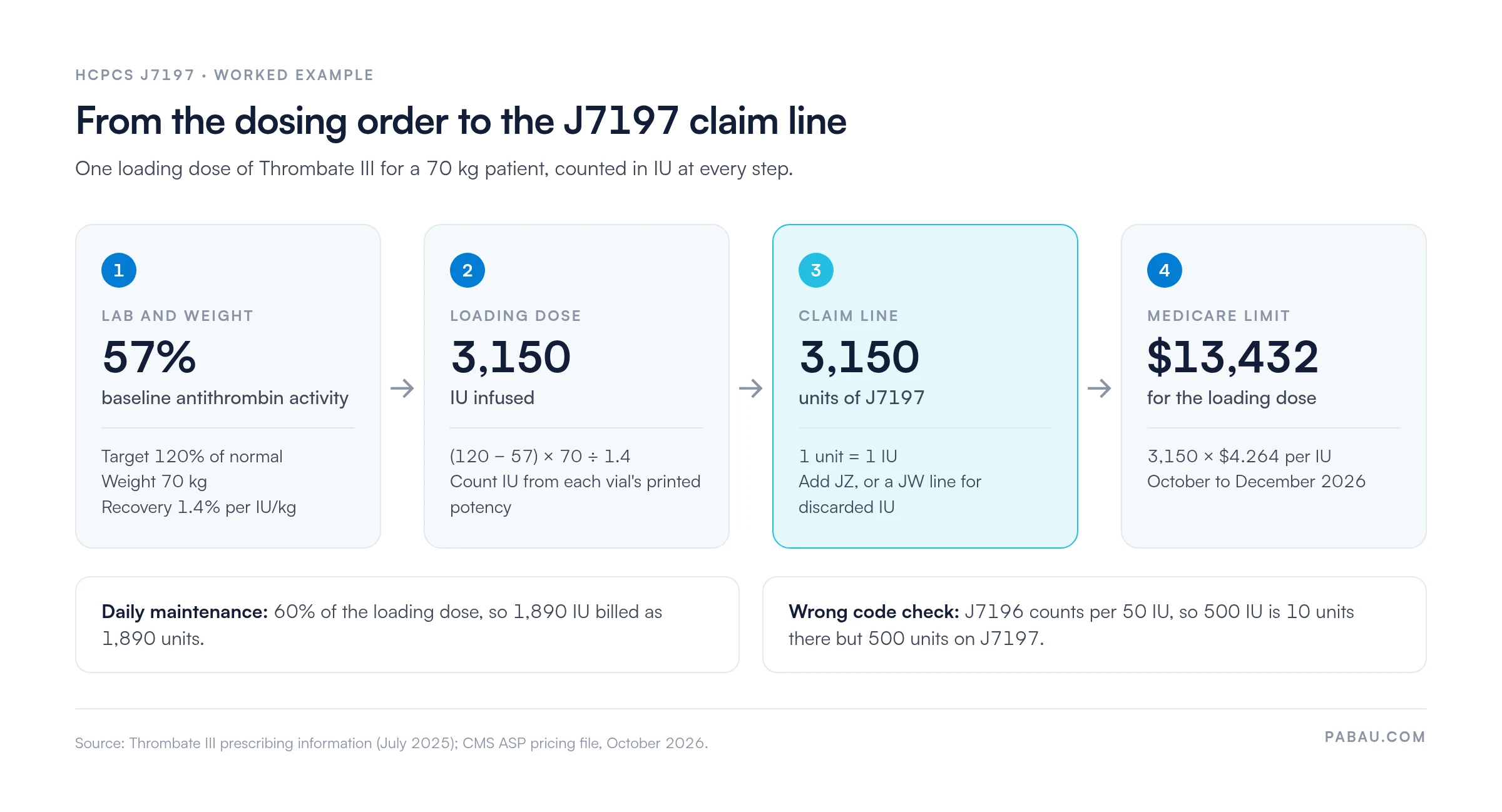
Bill only the IU administered, and don’t round up to a full vial. Thrombate III comes in single-use vials, so Medicare’s discarded drug rules apply. Report any discarded units on a separate line with the JW modifier. When none of the vial is discarded, add the JZ modifier to the administered line.
Payers need an ICD-10-CM code that establishes medical necessity for antithrombin III. The FDA indication is narrow, so the list of supporting diagnoses is short. A J7197 claim without D68.59 or a documented equivalent is likely to be denied.
Disseminated intravascular coagulation (DIC) is not an FDA-approved use. Some payer policies, such as Centene’s antithrombin III policy, list DIC as not authorized. Check the plan’s policy before billing J7197 outside hereditary deficiency.
Medicare Part B pays J7197 under the average sales price (ASP) method in a physician office or a hospital outpatient department. The CMS ASP drug pricing files for October 1 to December 31, 2026 set the payment limit at $4.264 per IU.
That quarter’s file also marks J7197 for inflation-adjusted coinsurance, at 19.759% rather than the standard 20%. Payment limits change every quarter, so pull the current file before you quote a patient’s share.
The CMS HCPCS file assigns J7197 coverage code D, which means special coverage instructions apply. The ASP file does not mark J7197 as a clotting factor. That has two practical effects:
Inpatient use is billed differently. Part A covers peri-operative and peri-partum doses given during an inpatient stay. The drug is paid within the MS-DRG for that stay, not as a separate J7197 line.
Medicaid billing for J7197 adds one requirement at the claim line: the 11-digit National Drug Code (NDC). The Deficit Reduction Act of 2005 requires states to collect NDCs on physician-administered drug claims. The NDC goes on both the 837P and the CMS-1500. A missing NDC is one of the most common Medicaid-specific rejections for J-codes.
Coverage routes vary by state. Some states pay antithrombin through the medical benefit, while others route it through a specialty pharmacy. Medicaid managed care plans often apply their own prior authorization criteria. Solid revenue cycle management processes confirm which pathway applies before the first claim goes out.
J7197 prior authorization depends on the payer and the indication. Medicare Part B has no national prior authorization program for J7197. Commercial plans and Medicaid managed care plans commonly require one.
Centene’s antithrombin III policy, last reviewed in January 2026, shows the usual criteria:
Under that policy, approval lasts 3 months for an acute clot or a surgery or delivery window. Ongoing prevention is approved for 12 months. Elective surgery and planned deliveries give you lead time, so start the request when the procedure is booked.
Request authorization for the full course, including the loading dose and every planned maintenance dose. A unit cap set too low leaves the later infusions unauthorized.
J7197 is billed across several settings, and the place of service (POS) code affects both payment and coverage. The common settings are listed below.
A POS that doesn’t match the infusion record triggers an edit. Payers commonly deny it with CARC 58, an invalid place of service. Confirm the administration site with the clinical team before you submit.
The medical record must support the diagnosis, the dose, and the units on the claim. For antithrombin III, the lab values matter as much as the infusion record.
Records that support medical billing compliance on J7197 claims typically include:
The label calls for functional antithrombin assays, either amidolytic or clotting methods, rather than immunoassays. Keep the assay type with each result, because a reviewer may ask which method set the dose.
Keep the lot number and NDC in the infusion record. Medicaid requires the NDC on the claim itself, and Medicare may request it during an audit. A record that holds the NDC from the start saves a search during a post-payment review.
Two kinds of neighbor cause trouble around J7197. J7196 is also antithrombin, and the rest of the range covers clotting factors for hemophilia. The descriptors below come from the October 2026 CMS HCPCS file. The AAPC HCPCS code lookup shows each code’s descriptor history.
The J7196 versus J7197 choice matters most. J7196 is recombinant and billed per 50 IU, so a 500 IU dose is 10 units. J7197 is human-derived and billed per IU, so the same dose is 500 units. The wrong code misstates the claim by a factor of 50.
J7199 is not a fallback for antithrombin either. Its descriptor limits it to hemophilia clotting factors, and antithrombin III already has its own code.
J7197 denials follow predictable patterns. A structured denial management strategy for this code catches most of them before submission.
The Thrombate III label lists three kit NDCs, each with about 500 units of antithrombin and a 10 mL diluent vial. Convert each one to the 11-digit 5-4-2 format before billing:
Use the NDC printed on the carton you opened. Manufacturers add and retire package codes, so a saved list can go stale.
On the 837P, the NDC goes in Loop 2410 with the N4 qualifier. On the CMS-1500, it sits in the shaded area of Box 24 as N4 followed by the 11-digit NDC. The NDC quantity counts kits, so one kit is UN1, while the HCPCS units still count IU.
A clean claim submission for J7197 on Medicaid needs three elements:
To check NDC-to-HCPCS mappings, use the PGM Billing HCPCS lookup tool or the manufacturer’s current labeling. The CMS HCPCS quarterly update files remain the authoritative source.
Keep one reference sheet for Thrombate III. List each 11-digit NDC, the HCPCS code, both unit types, and the date you last checked the label. Update it each quarter when CMS releases new HCPCS files.
J7197 claims are high-value and detail-heavy. One loading dose can pass $13,000 at Medicare rates. Every line needs the right units, modifier, NDC, and authorization.
Pabau’s claims management software pre-fills each claim from the invoice. It checks for missing or invalid details before the claim leaves the practice. US claims go out as CMS-1500 claims through Claim.MD, and eligibility can be verified before the visit.
Prior authorizations are stored as cases and linked to the appointment and the claim. Your team can check the approval before each maintenance infusion instead of after a denial. Rejected claims are flagged as “Needs action” with the reason shown, so a unit or NDC error is fixed and resubmitted quickly.

Pabau validates each claim before it leaves your practice and links prior authorizations to the appointment, so high-cost J7197 claims go out complete.

J7197 billing goes smoothly once the team treats it as an antithrombin code with its own rules. The hemophilia factor habits from the codes next door, such as furnishing fees and home-infusion exceptions, don’t carry over.
The most valuable fix happens before the claim. Start prior authorization when the surgery or delivery is booked, and record each vial’s potency and NDC at the infusion. Claims built from that record leave little for a reviewer to question.
Book a demo to see how Pabau keeps authorizations, invoices, and claims for high-cost drugs in one record.

Need a framework for managing drug claim denials? Denial management in healthcare covers root-cause analysis and appeal workflows for specialty drug claims.
Want to understand how the 837P claim structure works? 837 file overview explains loop and segment requirements for drug billing, including NDC reporting.
Looking for a clearinghouse that handles specialty drug claims? Medical claims clearinghouse guide outlines how to evaluate clearinghouse support for HCPCS Level II J-code submissions.
Starting an authorization for a planned surgery or delivery? The prior authorization process walks through each step from request to approval.
Filing J7197 on a paper claim? CMS-1500 form guide and template shows where the NDC and units go in Box 24.
HCPCS Code J7197 covers antithrombin III (human), per IU. It reports plasma-derived antithrombin, sold as Thrombate III, for patients with hereditary antithrombin deficiency. Recombinant antithrombin uses J7196 instead.
J7197 is billed per IU administered, not per vial. Count units from the potency printed on each vial, since each holds about 500 units. A 3,150 IU dose is billed as 3,150 units.
The primary pairing is D68.59, other primary thrombophilia, which includes antithrombin III deficiency. Add a code from O99.111–O99.119, O99.12, or O99.13 for peri-partum use, and I26.- or I82.- for an active clot. D68.69 falls outside the FDA indication, so expect payer review.
Medicare Part B has no national prior authorization program for J7197. Many commercial and Medicaid managed care plans require one. Typical criteria are a hereditary deficiency diagnosis and a hematologist’s prescription.
J7196 covers recombinant antithrombin, billed per 50 IU. J7197 covers antithrombin III purified from human plasma, billed per IU. The same 500 IU dose is 10 units of J7196 or 500 units of J7197.
For October 1 to December 31, 2026, the Medicare Part B payment limit for J7197 is $4.264 per IU. Coinsurance for that quarter is inflation-adjusted to 19.759%. Check the CMS ASP pricing files each quarter, because the limit changes.
The Thrombate III label lists kit NDCs 13533-603-20, 13533-602-50, and 13533-606-12. On a claim, use the 11-digit forms 13533060320, 13533060250, and 13533060612. Report the NDC from the carton you opened.



