HCPCS code J0698: Cefotaxime sodium injection billing guide
HCPCS code J0698: Official descriptor and code summary HCPCS code J0698 carries ...

Last Updated: Oct 14, 2026
J3471 is the HCPCS Level II code for injection, hyaluronidase, ovine, preservative free, per 1 USP unit (up to 999 USP units). It is the code for Vitrase, billed per unit administered.
Doses of 1,000 units or more go on J3472, billed per 1,000 units, with any remainder under 1,000 on J3471. Bovine products bill under J3470, and recombinant Hylenex under J3473. Each J3471 line needs the 11-digit NDC and a paired administration code.
Let Pabau's smart automation suggest the right codes, reduce claim denials, and keep your practice compliant—effortlessly.
Automate repetitive tasks and focus on what matters most—your patients.
Reduce coding errors and ensure compliance with the latest regulations.
Clean claims, fewer denials, and faster reimbursements.
Powerful insights and reporting to help your practice thrive.
HIPAA compliant SOC 2 certified GDPR-compliant Trusted by 4,000+ clinics worldwide

HCPCS code J3471 covers preservative-free ovine hyaluronidase (Vitrase), while bovine products bill under J3470 and recombinant Hylenex under J3473.
Bill J3471 per 1 USP unit administered, for doses up to 999 units.
Doses of 1,000 units or more go on J3472 per 1,000 units, with any remainder under 1,000 on J3471.
Most payers require the 11-digit NDC on every J3471 line, and a missing NDC is a leading denial trigger.
J3471 always pairs with an administration code, such as CPT 96372 for an injection or 96369 for a subcutaneous infusion.
HCPCS code J3471 is a permanent Level II drug code maintained by the Centers for Medicare and Medicaid Services (CMS). It covers preservative-free ovine hyaluronidase, billed per 1 USP unit for doses up to 999 units. Vitrase is the product billed under it. Larger ovine doses move to J3472, and bovine and recombinant products have codes of their own.
J3471 appears in the current CMS HCPCS Level II file as an active, permanent code. Vitrase is the main commercially available product billed under it. The source of the enzyme is what separates J3471 from J3470, the code for bovine hyaluronidase such as Amphadase and Hydase. Billing J3470 for a Vitrase administration is a coding error.
Hyaluronidase ovine is an enzyme derived from ovine (sheep) testicular tissue. It temporarily breaks down hyaluronic acid in connective tissue, increasing the absorption and diffusion of co-administered substances. The FDA-approved indications for Vitrase decide which ICD-10 diagnosis codes support medical necessity on J3471 claims.
Off-label uses, including cosmetic filler dissolution, are generally not covered by Medicare or Medicaid under J3471. Document the FDA-approved indication when establishing medical necessity. Vitrase’s preservative-free formulation matters clinically for patients sensitive to preservatives. In the code set, though, the line between J3471 and J3470 is the enzyme’s source, ovine rather than bovine.
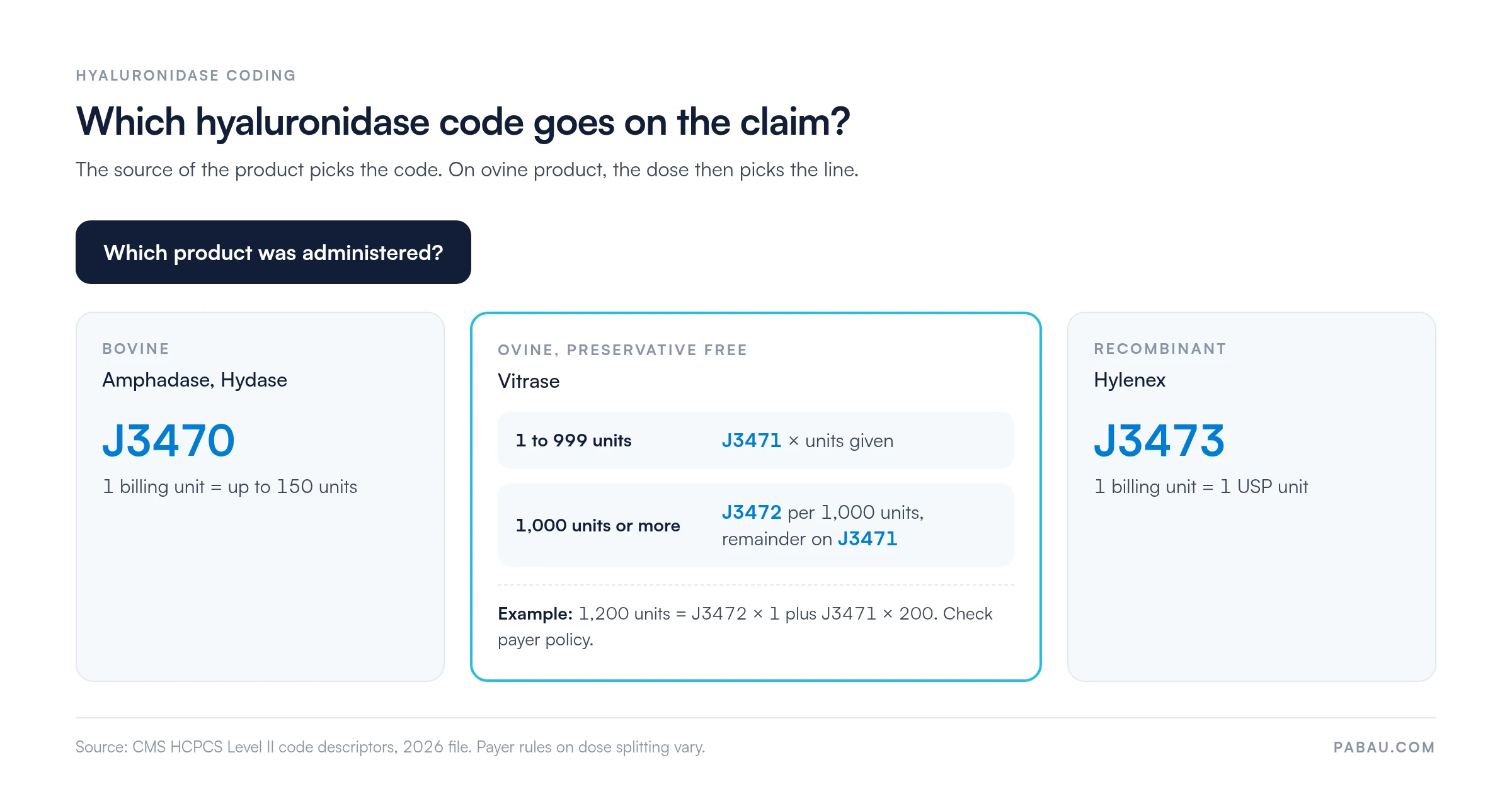
J3471 bills per 1 USP unit of hyaluronidase administered, for doses up to 999 USP units. Doses of 1,000 units or more are billed with J3472, the per-1,000-unit code, with any remainder under 1,000 on J3471. Check payer policy, since some payers set their own rules for that split.
Bill the quantity administered, not the total contents of the vial. Coders often submit vial-level quantities, which is where most unit errors start. When a single-dose vial holds more than the dose given, the unused portion is waste. Report it with modifier JW on a separate line, covered in detail below.
Four HCPCS codes cover hyaluronidase, and each maps to a distinct source or dose range. Picking the wrong one is a common J3471 error, and a modifier cannot fix it. The claim line has to be rebilled with the correct code.
The deciding factor is the product dispensed and administered. Vitrase is J3471 up to 999 units, and J3472 per 1,000 units above that. A bovine product such as Amphadase or Hydase is J3470, and Hylenex, the recombinant product, is J3473. When the chart doesn’t name the product, query the provider rather than defaulting to J3470 as a catch-all. The diagram below maps each product and dose to its code.
Medicare Part B and most state Medicaid programs require an NDC alongside HCPCS code J3471, and commercial payers commonly do too. A missing or malformed NDC is a leading cause of J3471 rejection at the clearinghouse, often before the claim reaches the payer. Track NDC fields at the point of superbill documentation so the information is captured before billing.
Verify the Vitrase NDC against the current FDA NDC directory at the time of billing, as package configurations and NDCs can change between manufacturer runs. Never hard-code a single NDC into billing templates without a verification step.
Medicare Part B pays for physician-administered drugs, including J3471, under the buy-and-bill model at Average Sales Price plus 6% (ASP+6%). The practice buys Vitrase, administers it, and bills J3471 alongside the drug administration CPT code. Payment follows the current quarter’s limit in the CMS ASP drug pricing files. Those limits update quarterly, so look up the current figure rather than relying on a cached rate.
Medicaid fee-for-service rates for J3471 vary by state and are set independently of Medicare ASP. Managed care organizations under Medicaid contracts may apply their own fee schedules, so load each payer’s rate separately.
Look up J3471 payment rates each quarter in the CMS ASP drug pricing file, not from a year-old fee schedule. A rate that was accurate in Q1 can be wrong by Q3 if ASP moved.
Medicare Part B does not routinely require prior authorization (PA) for J3471 in the office setting. Medicare Advantage plans, commercial insurers, and Medicaid managed care organizations frequently do. PA rules depend on the payer, the plan year, and the indication, so verify them at each plan renewal.
A PA request for J3471 typically includes the diagnosis, dose ordered, route of administration, and clinical rationale, such as failed IV access. A request sent without the prescribing provider’s clinical notes is a common reason for PA denial.
J3471 is a drug code, not a service code. It always appears on a claim alongside a CPT administration code that describes how the drug was given. Our guide to medical billing fundamentals covers the wider claim-construction framework. The J3471-specific steps are below.
Every element below must be in the medical record before J3471 is submitted. Drug codes are audited often, and a missing lot number or unsigned order can trigger a refund demand. Build these checks into the documentation workflow with medical billing compliance protocols, rather than relying on retrospective review.
When Vitrase comes in a single-dose vial and only part of it is given, the unused drug is discarded and reported with modifier JW. CMS enforces its drug wastage policy, so a missing JW line is a documentation deficiency that can surface on audit. Since July 2023, Medicare has also required modifier JZ when no drug from a single-dose container is discarded.
Payment for JW wastage lines varies by payer. Medicare Part B pays for the wasted drug at the same ASP+6% rate as the administered portion. Some commercial payers do not pay JW lines, so verify payer policy before routinely billing wastage.
Structured denial management workflows cut the revenue lost to J3471 denials. The table maps the most frequent denial triggers to their root causes and fixes. Check code specifics in the AAPC HCPCS code lookup before rebilling.
The diagnosis code on a J3471 claim must reflect why hyaluronidase was used, not the patient’s primary chronic condition. A patient with heart failure receiving hypodermoclysis needs the dehydration code, not I50.9, to support medical necessity. Confirm each code in our ICD-10 lookup for coders before the claim goes out.
Payer Local Coverage Determinations (LCDs) may restrict covered diagnoses for J3471. Check the relevant Medicare Administrative Contractor (MAC) LCD and any commercial payer policy before assuming a diagnosis will be accepted. Medical spa and aesthetic practices should note that Medicare and most commercial payers do not cover cosmetic indications under J3471.
Build a J3471 charge capture checklist into your clinical workflow. Confirm the drug source (ovine) and document the dose in USP units. Pull the NDC from the administered vial, and map the indication code to the hyaluronidase use. Those four checkpoints prevent the four most common denials.
On a typical J3471 claim, the dose lives in the treatment note and the NDC on a vial label. The units sit in a separate billing screen. Each handoff is a chance to retype a number wrong or miss the 999-unit limit.
Pabau, the practice management platform we build, keeps treatment notes, stock records and billing in one system. The dose charted and the vial drawn from stock sit on the same patient record as the invoice. Our claims tools for coders then build the claim from that record, so nobody re-keys the units.
That leaves fewer chances for a unit mismatch or a missing NDC, the two denial triggers this guide keeps returning to.

Pabau keeps the treatment note, vial stock and claim on one patient record, so J3471 units and NDCs match what was given.

J3471 coding comes down to two checks before the claim leaves: which product was given, and how many units. Get the source right and the code follows. Get the dose right and the split between J3471 and J3472 follows.
The trade-off is a minute at the point of care. Recording the NDC, lot and exact dose during the visit saves a rebill weeks later. Book a demo to see how Pabau carries the charted dose straight through to a clean drug claim.

Need to understand drug code denials in depth? Denial management in healthcare explains how to categorize, track, and appeal claim denials across payer types.
Looking for a clean claim checklist? Clean claim requirements outlines the data elements every drug claim must carry before submission.
Billing a Vitrase dose of 1,000 units or more? HCPCS code J3472 covers the per-1,000-unit ovine code and how it pairs with J3471.
Working with a bovine product instead? HCPCS code J3470 explains billing for Amphadase and Hydase.
Want to see how drug claims move through the system? Revenue cycle management covers the workflow from drug administration to payment posting.
HCPCS code J3471 covers injection of preservative-free ovine hyaluronidase, billed per 1 USP unit for doses up to 999 units. Vitrase is the main product billed under it.
J3471 covers doses up to 999 USP units, billed per unit administered rather than per vial. Doses of 1,000 units or more are billed with J3472 per 1,000 units, with any remainder on J3471. A 1,200-unit dose, for example, is J3472 × 1 plus J3471 × 200. Check payer policy for the split.
J3470 is the code for bovine hyaluronidase, such as Amphadase and Hydase, with each billing unit covering up to 150 units. J3471 covers preservative-free ovine hyaluronidase, billed per 1 USP unit up to 999. Vitrase maps to J3471, and billing it as J3470 is a coding error.
Yes, Medicare Part B covers J3471 for FDA-approved indications under the buy-and-bill model, paid at ASP+6% of the current quarter’s Average Sales Price. Medicare Advantage plans may require prior authorization. Medicare does not cover off-label uses, including cosmetic applications.
The most common reasons are a missing or malformed NDC, J3470 billed instead of J3471, and units counted from the vial instead of the dose. Missing prior authorization and a diagnosis that doesn’t reflect the hyaluronidase indication follow. Most can be prevented by capturing the right data at the point of administration.
Yes, and it must be. J3471 is a drug code and needs a paired CPT administration code on the same claim. Use CPT 96372 for a subcutaneous or intramuscular injection. Use 96369 and 96370 for subcutaneous infusion (hypodermoclysis), depending on infusion time. Place the administration code first and J3471 on the following line.