CCSD code H4430: Examination of rectum under anaesthetic
CCSD code H4430 pays for the examination alone CCSD code H4430 is the UK private...

Last Updated: Oct 20, 2026
J3472 is the HCPCS Level II code for injection, hyaluronidase, ovine, preservative free, per 1000 usp units.
One claim unit equals 1,000 USP units administered, so a 2,000-unit dose bills as 2 units. A dose below 1,000 USP units belongs on J3471 instead, which CMS defines per single USP unit. Every J3472 claim drawn from a single-dose vial also carries a JW or JZ modifier.
The code reports the drug, not the work of administering it. A separate administration CPT code, usually 96372, has to appear on the same claim.
Let Pabau's smart automation suggest the right codes, reduce claim denials, and keep your practice compliant—effortlessly.
Automate repetitive tasks and focus on what matters most—your patients.
Reduce coding errors and ensure compliance with the latest regulations.
Clean claims, fewer denials, and faster reimbursements.
Powerful insights and reporting to help your practice thrive.
HIPAA compliant SOC 2 certified GDPR-compliant Trusted by 4,000+ clinics worldwide

HCPCS Code J3472 covers Injection, hyaluronidase, ovine, preservative free, per 1,000 USP units, and it is active for 2026 under Medicare Part B.
Units are billed per 1,000 USP units administered, so a 2,000-unit dose bills as 2 units.
A dose below 1,000 USP units belongs on J3471, which CMS defines per single USP unit.
CMS requires either the JW modifier (drug waste from a single-dose vial) or the JZ modifier (no waste) on every J3472 claim.
Practice management software like Pabau tracks each J3472 claim, submits it electronically, and runs validation checks before it reaches the payer.
The Centers for Medicare and Medicaid Services (CMS) maintains J3472 among the J-category drug codes. The table below lists the attributes a payer checks on a J-code claim line.
Because J3472 sits in the J-code category, it follows Medicare Part B drug payment rules, not the CPT physician fee schedule. That distinction shapes every billing decision downstream, from unit counting to modifier selection.
J3472 covers hyaluronidase ovine in its preservative-free formulation. Hyaluronidase is an enzyme that temporarily breaks down hyaluronic acid in connective tissue. That raises tissue permeability, so co-administered drugs or fluids spread more rapidly.
The preservative-free designation in J3472 matters clinically. Preservative-free formulations reduce the risk of allergic reactions and are required for certain ophthalmic and neuraxial applications where preservatives are contraindicated. When a reaction to hyaluronidase leaves a lasting condition, a later visit lists that residual diagnosis first, then T45.3X5S.
Getting the brand-to-code mapping right prevents a misfiled claim before it leaves the practice. The three brands in this drug family sit on three different HCPCS codes.
Billing Amphadase under J3472 is a coding error because Amphadase is bovine-derived, not ovine. Always verify brand identity against the CMS NDC-to-HCPCS crosswalk before claim submission.
Two decisions sit behind every J3472 claim line. The first is which code the dose belongs on, and the second is how many claim units that dose converts to. Both answers come from the USP units documented at administration, so record the dose before anyone builds the claim.
Divide the total USP units administered by 1,000 to get the units to bill, and round any fraction up to the next whole unit. J3472 only applies from 1,000 USP units upward. Below that, the dose goes on J3471 at one claim unit per USP unit.
Billing more units than the dose supports is an overbilling audit risk. Document the exact number of USP units administered, then check that the same figure reaches the unit field on the CMS-1500 or 837P claim. A clean claim for J3472 needs the dose, the units billed, and the NDC quantity to agree.
NDC reporting requirements differ by payer. For Medicaid, reporting an 11-digit National Drug Code is mandatory on every J3472 claim. For Medicare Part B, NDC is not universally required on the claim form but may be requested by your MAC. Commercial payers vary.
When NDC is required, use the qualifier N4 followed by the 11-digit NDC in the format 5-4-2 (e.g., N412345-6789-01). Record the NDC quantity and unit of measure alongside it. Verify the correct NDC for the specific Vitrase lot being administered through the FDA drug database or your distributor records before submission.
CMS modifier policy for Part B drugs is unambiguous: every single-dose vial claim must carry either JW or JZ. Missing both is a compliance deficiency, not just a billing oversight. Understanding the distinction between them prevents unnecessary audits.
The JW modifier reports drug that was drawn from a single-dose vial but not administered because the vial contained more drug than the patient needed. The JZ modifier confirms the opposite: the entire vial was administered and no drug was wasted. One of these two must appear on every J3472 claim involving a single-dose vial.
Document waste in the patient record at the time of administration. The JW claim line should reflect the wasted units, also billed under J3472 with the modifier appended. Medicare does not separately reimburse for drug waste, but the JW line is required for audit transparency per CMS policy.
Modifier 59 may apply when J3472 is billed alongside another drug on the same date, because it reports a distinct procedural service. Site-of-service modifiers may also be required, depending on your MAC. Always check the local coverage determination issued by your MAC for region-specific modifier requirements.
Run two checks before a J3472 claim goes out. First, confirm the dose was 1,000 USP units or more, because a smaller dose belongs on J3471. Second, confirm the unit field equals the dose divided by 1,000, rounded up, and that JW or JZ is appended.
Medicare Part B covers injectable drugs when they meet medical necessity criteria and are administered in a covered clinical setting. Hyaluronidase ovine falls under Part B’s drug payment methodology, which bases reimbursement on Average Sales Price (ASP).
Under CMS policy, most Part B drugs are paid at ASP plus 6%. The ASP figure for J3472 changes every quarter, so confirm the current rate in the quarterly ASP drug pricing files that CMS publishes. The physician fee schedule tool prices CPT services, not J-code drugs, so it is the wrong place to look.
Coverage for J3472 may also be subject to local coverage determinations (LCDs) issued by individual Medicare Administrative Contractors (MACs). Some MACs specify covered diagnoses for hyaluronidase injections, particularly for ophthalmic and subcutaneous fluid administration indications. Check your MAC’s active LCD before billing if you are unsure whether a specific clinical indication is covered.
ASP-based rates change quarterly and vary by MAC region, so a dollar figure published here would be stale within months. Use these sources instead.
Submit J3472 claims electronically in the 837P format, then reconcile the payment against the remittance advice. If the allowable does not match the current ASP-based rate, the units or the modifier are the usual reason.
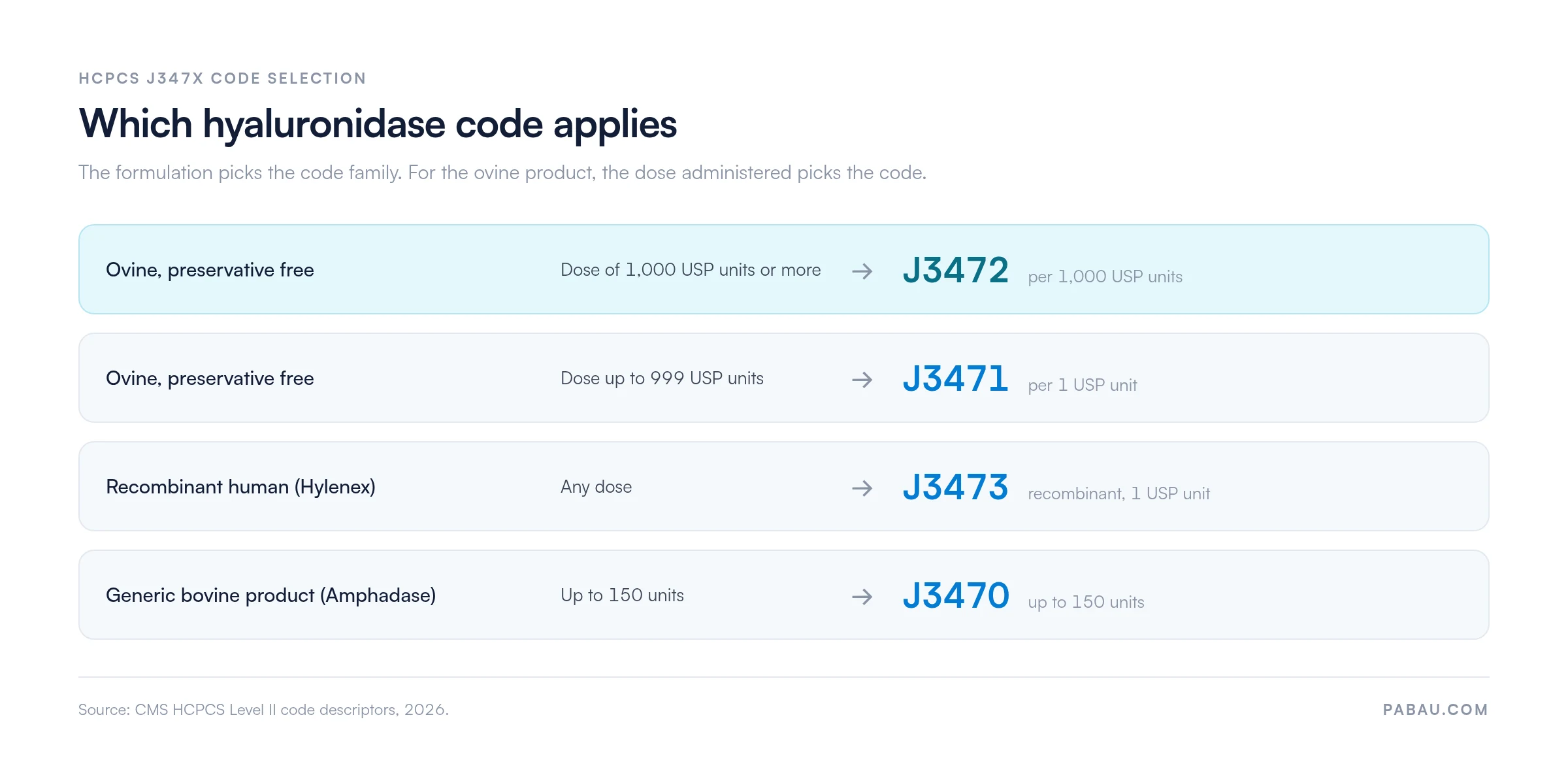
The J347x family covers the full range of hyaluronidase formulations. All four codes carry “hyaluronidase” in the descriptor, which is why the wrong one gets picked so often. What separates them is the formulation and the unit measure.
Match the formulation first, then the dose. Ovine and preservative-free narrows it to J3471 or J3472, and the dose administered decides between them. Recombinant hyaluronidase is J3473 at any dose, and the generic bovine product sits on J3470. Billing J3472 for a 600-unit dose reports 1,000 units of drug the patient never received.
The chart below runs that rule from formulation and dose through to the code.
J3472 is the drug code. It does not capture the work of administering the injection. A separate CPT administration code must appear on the same claim to bill for the clinical service of delivering the drug.
The correct administration code depends on the route and clinical context:
Watch the two ophthalmic codes. CPT 67505 describes a retrobulbar injection of alcohol, so it never applies to hyaluronidase. Subconjunctival injection is not described by either code, so check payer guidance before you report an administration code for that route.
Billing J3472 alongside an Evaluation and Management (E&M) code on the same date depends on the documentation. The record has to show a significant, separately identifiable E&M service. The administration work is bundled with most E&M visits unless modifier 25 supports a distinct service. Check your MAC’s guidance and payer policy before appending modifier 25 to an E&M on a day when J3472 is also billed.
The J347x code family generates a predictable set of billing errors. Each one is cheap to prevent at the claim-build stage and expensive to unwind after an audit.
When a J3472 claim is denied, read the adjustment reason code on the remittance before you resubmit. The denial codes reference tells you whether you are looking at a modifier problem, a coverage decision, or a units mismatch. Each of those needs a different correction, and guessing costs another billing cycle.
Build a claim scrubbing rule for the J347x family. Doses under 1,000 USP units route to J3471, not J3472. The J3472 unit field equals the dose divided by 1,000, rounded up. JW or JZ must be present, and an administration CPT such as 96372 must appear on the same date.
In most practices a J3472 line is built in one place and chased in another. The dose sits in the patient record, and the claim goes out through a clearinghouse portal. The status ends up in a spreadsheet someone updates on Fridays.
Practice management software like Pabau keeps the three together. Its claims management software links each claim to the patient and the insurer, then submits it electronically through Claim.MD. Validation checks run before submission, and each claim carries its own status through to reconciliation.
So a held J3472 line shows up where your team already works, instead of surfacing on a remittance three weeks later. Your biller still owns the unit conversion and the modifier. No claim sits in a queue nobody is watching.

Pabau links each claim to the patient and the insurer, submits it electronically, and runs validation checks before it goes out. Your team can see the status of every J3472 line without leaving the patient record.

J3472 denials almost always trace to one of three errors. Those are the wrong code in the J347x family, a miscalculated unit count, and a missing JW or JZ modifier.
None of the three needs a judgment call. They need the same two checks applied to every claim, which is easier to guarantee in a system than in a habit. Write the dose in USP units into the record, and let the code and the unit count follow from it.
Practices giving hyaluronidase injections every week feel this most, because the same conversion repeats on every claim. Book a demo to see how Pabau submits, validates, and tracks J-code claims from the patient record.

Need to understand how billing denials are classified? Denial codes in medical billing explains the CARC/RARC system so you can act on J3472 denials faster.
Want to verify that your J-code claims submit cleanly? Claim.MD clearinghouse overview covers how electronic claim validation works before claims reach the payer.
Looking for a practical guide to Part B drug billing compliance? Medical billing compliance outlines the documentation and modifier requirements that apply across Medicare Part B drug codes.
HCPCS Code J3472 is the Level II code for Injection, hyaluronidase, ovine, preservative free, per 1,000 USP units. Report it when a sheep-derived, preservative-free hyaluronidase is given to increase tissue permeability for a drug or fluid infusion.
J3471 covers ovine, preservative-free hyaluronidase per 1 USP unit, for doses up to 999 units. J3472 covers the same drug per 1,000 USP units. The dose administered decides which of the two you report.
Divide the total USP units administered by 1,000 and round up to the nearest whole number. A 1,500-unit dose bills as 2 units, and a 3,000-unit dose bills as 3. A dose below 1,000 USP units belongs on J3471 instead.
NDC reporting is mandatory for Medicaid claims; use the 11-digit NDC with qualifier N4. For Medicare Part B, NDC is not universally required on the claim form but your MAC may request it. Commercial payer requirements vary, so verify with each payer before submission.
CMS requires either JW (drug discarded from a single-dose vial) or JZ (no drug waste) on every J3472 claim involving a single-dose vial. Omitting both modifiers is a compliance risk that can trigger claim holds, denials, or audit scrutiny. Document waste at the point of administration.
Yes, Medicare Part B covers J3472 as an injectable drug when medical necessity is documented. The service also has to meet any LCD criteria in your MAC jurisdiction. Reimbursement follows the ASP plus 6% methodology; confirm the current rate using CMS quarterly ASP files before billing.
For most outpatient and office settings, CPT 96372 (therapeutic, prophylactic, or diagnostic injection, subcutaneous or intramuscular) is the standard companion code. Retrobulbar administration uses CPT 67500. Always report an administration CPT on the same claim date as J3472.