HCPCS Code J2360: Orphenadrine citrate injection billing guide
HCPCS Code J2360: Official descriptor and drug overview HCPCS Code J2360 is the ...

Last Updated: Nov 3, 2026
J3473 is the HCPCS Level II code for injection, hyaluronidase, recombinant, 1 USP unit. It reports recombinant human hyaluronidase, sold as Hylenex recombinant, with one billing unit for each USP unit given.
The drug source decides the code. Ovine preservative-free hyaluronidase, such as Vitrase, is billed with J3471 or J3472, and J3470 covers hyaluronidase up to 150 units. Medicare expects the JW or JZ modifier on a J3473 line, and Medicaid claims need the NDC.
Let Pabau's smart automation suggest the right codes, reduce claim denials, and keep your practice compliant—effortlessly.
Automate repetitive tasks and focus on what matters most—your patients.
Reduce coding errors and ensure compliance with the latest regulations.
Clean claims, fewer denials, and faster reimbursements.
Powerful insights and reporting to help your practice thrive.
HIPAA compliant SOC 2 certified GDPR-compliant Trusted by 4,000+ clinics worldwide

HCPCS code J3473 reports injection of recombinant hyaluronidase, such as Hylenex recombinant, at one billing unit per 1 USP unit given.
Ovine preservative-free hyaluronidase, such as Vitrase, is billed with J3471 or J3472, and J3470 covers hyaluronidase up to 150 units.
A fully used 150 USP unit vial goes on the claim as 150 units. The JW or JZ modifier shows whether any drug was discarded.
The NDC goes in the shaded area of item 24A on the CMS-1500, or loop 2410 on an 837P, with the N4 qualifier.
Pabau, the practice software we build, keeps the product, dose and NDC on the treatment record, so each J3473 claim line matches the chart.
HCPCS code J3473 is the Level II code for injection, hyaluronidase, recombinant, 1 USP unit.
It reports a physician-administered dose of recombinant human hyaluronidase, sold in the US as Hylenex recombinant. Each billing unit equals 1 USP unit of drug.
Hyaluronidase is an enzyme that temporarily breaks down hyaluronic acid in connective tissue. That makes the tissue more permeable, so fluids or injected drugs spread and absorb faster. The recombinant form is made by recombinant DNA technology, so it carries no animal source.
The code sits in the J0013-J8999 range of HCPCS Level II, which covers drugs administered other than by mouth. J3473 has been part of the code set for many years, so the coding question is rarely whether it exists. The question is whether the product in the vial was recombinant hyaluronidase. The neighboring drug codes, including the other hyaluronidase codes, are in our HCPCS code library.
J3473 covers physician-administered injections of recombinant hyaluronidase. The drug source is what decides the code, so the chart has to name the product given.
Covered under J3473:
Excluded from J3473:
Billing an ovine product? If your practice stocks Vitrase or another ovine, preservative-free hyaluronidase, J3473 is the wrong code. Use J3471 for injection, hyaluronidase, ovine, preservative free, per 1 USP unit (up to 999 USP units). Use J3472 for the same drug per 1,000 USP units.
Recombinant hyaluronidase is given to help other fluids or drugs spread through tissue. Coders need the clinical context because the indication has to be documented to support a J3473 claim. The labeled uses for Hylenex recombinant are:
Aesthetic practices also use hyaluronidase to dissolve hyaluronic acid filler. That use is off-label. A purely cosmetic correction is generally not covered by Medicare or commercial plans, so the patient usually pays for it directly. When the injection treats a filler complication, coverage depends on the payer and the documented diagnosis.
The administering provider and the clinical indication must both appear in the encounter note. Vague indication language leads to medical necessity denials for this code.
Four HCPCS codes describe hyaluronidase, and the product source decides which one applies. J3473 is the only one for the recombinant form.
The deciding fact is the product name on the administration record. If the chart only says “hyaluronidase,” the coder cannot pick between these codes safely. Query the clinician or check the stock record before the claim goes out. A bovine product such as Amphadase belongs on J3470, where one unit covers up to 150 units of drug.
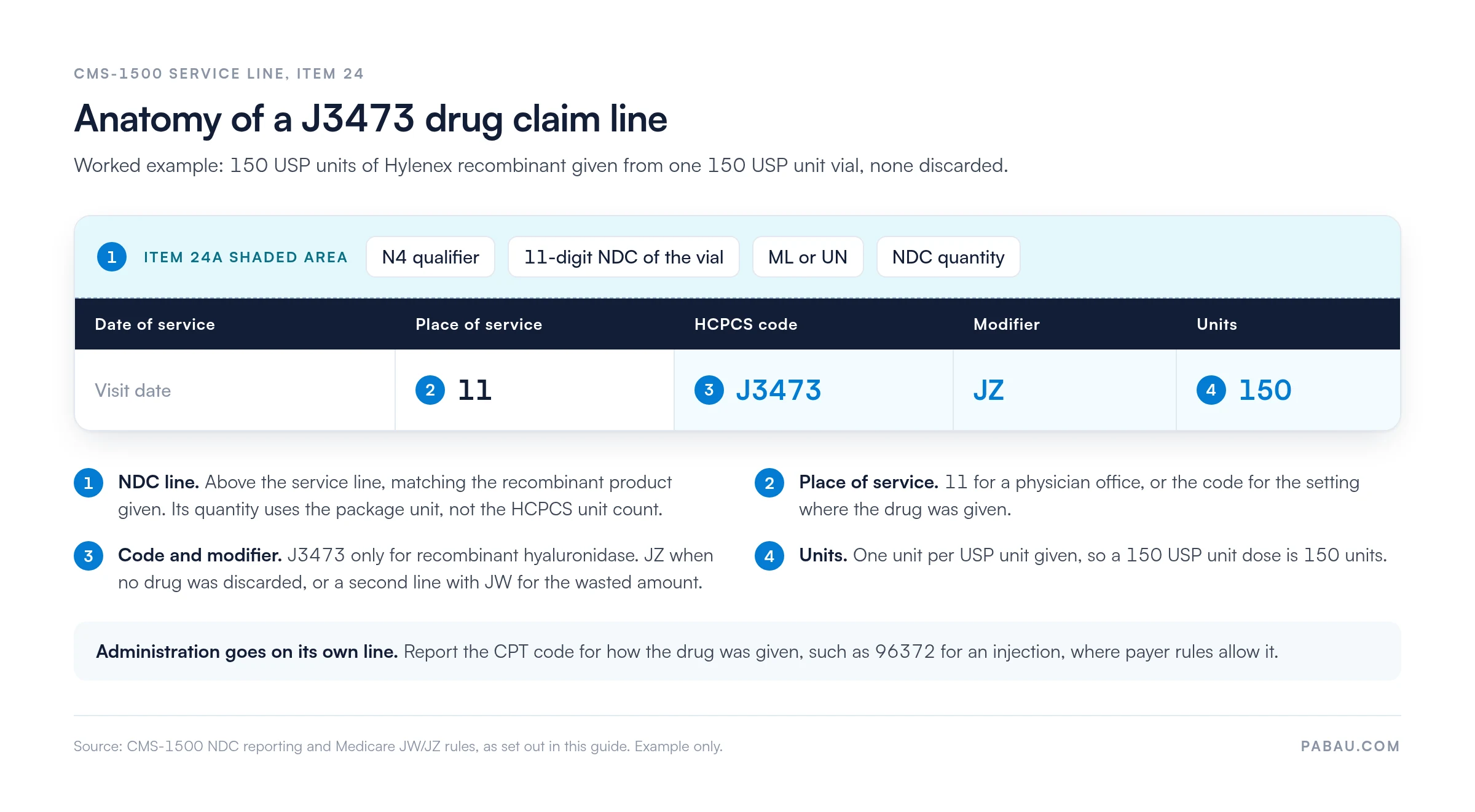
A J3473 claim line needs three facts right: the USP units given, the NDC of the vial used, and the place of service. The worked example below shows where each one sits on a CMS-1500 service line. Good claims management software captures them at the point of care, which cuts the manual re-entry behind unit errors.
Document the discarded amount in the record whenever you bill a JW line. Medicare can recoup wastage that the chart does not show.
J3473 covers only the drug. The administration service is reported with a CPT code, and the right one depends on how the drug was given. 96369 covers pump-based subcutaneous infusion of a drug, and 96370 and 96371 are add-on codes reported only with it.
When hyaluronidase is mixed with another drug in the same injection, a second administration code usually is not reported. Check NCCI edits and your payer policy before you add one.
Medicaid programs require the NDC on physician-administered drug claims, and many Medicare contractors and commercial payers ask for it too. For J3473, the NDC must match the recombinant hyaluronidase product actually given.
On the paper CMS-1500, the NDC goes in the shaded area of item 24A, above the service line. On an 837P electronic claim, it goes in loop 2410. The format is the N4 qualifier, the 11-digit NDC, a unit qualifier such as ML or UN, and the quantity.
The NDC quantity uses the package unit of measure, so it rarely equals the HCPCS unit count. Check the NDC against the current CMS NDC-HCPCS crosswalk before submission, because an outdated NDC triggers a rejection.
Check the CMS NDC-HCPCS crosswalk each quarter. NDCs change when a manufacturer repackages a product, even though J3473 itself does not change. An invalid NDC usually comes back as CO-16 with remark code M119.
Strong medical billing compliance starts with what the clinician documents at the point of care. The medical record must contain the following to support a J3473 claim:
Some Medicare Administrative Contractors publish Local Coverage Determinations or billing articles with extra conditions. Check your MAC’s guidance before billing.
Medicare Part B covers J3473 as a physician-administered drug when medical necessity is documented. Payment follows the Average Sales Price method, at ASP plus 6% in the physician office setting, and CMS updates the rate every quarter.
The current payment limit for J3473 is published in the CMS Physician Fee Schedule and ASP drug pricing files. Never reuse a prior quarter’s rate, because ASP changes with manufacturer-reported sales data. A rate hardcoded into a fee schedule can leave your practice collecting less than it should.
For US practices, Pabau sends claims through the Claim.MD clearinghouse to thousands of US payers and checks eligibility before treatment. Reading the electronic remittance advice for each J3473 claim helps you spot underpayments early.
Original Medicare does not generally require prior authorization for a Part B drug like J3473. Medicare Advantage and commercial plans set their own rules, so check each payer before the drug is given.
When prior authorization is required, include the clinical indication, the product NDC, the expected dose in USP units and the ordering physician. A denial at the authorization stage is easier to fix than a post-service claim denial.
J3473 denials tend to follow a few predictable errors. Strong denial management workflows catch each one before submission.
The CARC on the remittance tells you why a claim was denied. CO-4 means the modifier is wrong or missing, and CO-16 means information is missing, such as the NDC. CO-50 means the payer does not consider the service medically necessary. Appeal with the administration record, the NDC and the indication note attached.
Build a pre-submission checklist for J3473. Confirm the chart names recombinant hyaluronidase and count the USP units. Then add JW or JZ, check the NDC against this quarter’s crosswalk and confirm a covered diagnosis.
Practices billing J3473 often find the drug details scattered. The product name sits in one note, the dose in another, and the NDC on a box in the stock room. Pabau brings them into one treatment record that your billing team works from.
The result is a J3473 claim line that matches the chart, the vial and the payer rules before it leaves your practice.

Pabau keeps the hyaluronidase product, USP dose and NDC on the treatment record. Your billing team then builds each J3473 line from the chart.

J3473 is a narrow code, and the product name decides it. If the vial was Hylenex recombinant, bill J3473 at one unit per USP unit, with JW or JZ and the NDC in item 24A. If it was Vitrase, move to J3471 or J3472.
Fix the record before you fix the claim. A chart that names the product, the dose and the discarded amount makes the code choice obvious and the appeal rare. Book a demo to see how Pabau carries physician-administered drug details from the treatment note to a paid claim.

Need to understand how claim denials are managed at scale? Denial management in healthcare covers root cause analysis, CARC code interpretation, and workflow fixes for recurring rejection patterns.
Want to understand what makes a claim pass on first submission? Clean claim submission explains the data completeness and edit checks that separate a paid claim from a pended one.
Looking for the broader context of J-code billing? Medical billing workflows walks through the full revenue cycle from encounter to payment, including physician-administered drug claims.
Billing Vitrase in larger doses? HCPCS code J3472 covers ovine, preservative-free hyaluronidase billed per 1,000 USP units.
HCPCS code J3473 covers injection of recombinant hyaluronidase, billed per 1 USP unit. The main product billed with it is Hylenex recombinant. Ovine and bovine hyaluronidase products use different codes.
The drug source decides the code. J3470 is hyaluronidase up to 150 units, used for bovine products. J3471 and J3472 are ovine, preservative-free hyaluronidase, such as Vitrase. J3473 is recombinant hyaluronidase, such as Hylenex.
Bill one unit of J3473 for each USP unit given. A full 150 USP unit dose goes on the claim as 150 units. Add modifier JZ when nothing was discarded, or a separate JW line for the wasted amount.
Original Medicare does not generally require prior authorization for J3473. Medicare Advantage and commercial plans set their own rules. Check with the payer before the drug is given to avoid a post-service denial.
On the CMS-1500, the NDC goes in the shaded area of item 24A, above the J3473 service line. On an 837P, it goes in loop 2410. Enter the N4 qualifier, the 11-digit NDC, the unit of measure and the quantity.
Yes. Medicare Part B covers J3473 as a physician-administered drug when medical necessity is documented. Payment is based on ASP plus 6% in the office setting, and CMS updates the rate each quarter.
You can only bill a payer when the use is medically necessary. Dissolving filler for cosmetic reasons is generally not covered, so the patient usually pays directly. Treatment of a filler complication depends on the payer and the documented diagnosis.