HCPCS Code J1110: Dihydroergotamine mesylate injection billing guide
HCPCS Code J1110: Official descriptor and drug overview HCPCS Code J1110 is the ...

Last Updated: Oct 29, 2026
J3030 is the HCPCS Level II code for injection, sumatriptan succinate, 6 mg. One unit equals 6 mg, and the code covers only injections a clinician gives. Its official descriptor note says it is not for use when the drug is self-administered.
Most billing errors on this code come from two sources. Medicare MACs list sumatriptan as a self-administered drug (SAD), so traditional Part B treats J3030 as non-covered. Units that don't match the documented dose draw denials too. Getting either wrong typically means a CO-96 or CO-151 denial.
Let Pabau's smart automation suggest the right codes, reduce claim denials, and keep your practice compliant—effortlessly.
Automate repetitive tasks and focus on what matters most—your patients.
Reduce coding errors and ensure compliance with the latest regulations.
Clean claims, fewer denials, and faster reimbursements.
Powerful insights and reporting to help your practice thrive.
HIPAA compliant SOC 2 certified GDPR-compliant Trusted by 4,000+ clinics worldwide

HCPCS Code J3030 covers sumatriptan succinate injected by a clinician. Oral tablets, nasal spray, and auto-injectors dispensed for home use are excluded.
One billing unit equals 6 mg, and units that don’t match the documented dose draw a CO-151 denial.
Medicare MACs list sumatriptan as a self-administered drug, so traditional Medicare Part B treats J3030 as non-covered whoever gives the injection.
J3031 is fremanezumab-vfrm (Ajovy), a different migraine drug, so pick the code by the drug given rather than by the neighboring number.
Pabau, the practice management platform we build, scrubs each claim for missing or invalid details before it reaches the clearinghouse.
HCPCS Code J3030 describes injection, sumatriptan succinate, 6 mg. The code belongs to the J-code section of HCPCS Level II, which CMS maintains to identify drugs and biologicals not classified under CPT. J3030 applies to sumatriptan succinate that a clinician injects subcutaneously in a qualifying outpatient setting.
Sumatriptan succinate (brand name Imitrex) is a selective serotonin receptor agonist approved for acute migraine and cluster headache. The injectable form is used when rapid onset is clinically necessary, or when the patient can’t tolerate or absorb an oral triptan.
The key billing distinction is route and setting. J3030 covers clinician-administered injections only, never oral formulations and never drugs dispensed for self-injection at home.
Verify the current descriptor against the annual HCPCS Level II release before each code year. CMS issues annual updates that may revise drug descriptors or dosage language.
One unit of J3030 equals 6 mg of sumatriptan succinate. The standard subcutaneous dose is 6 mg, so most claims for a single injection report one unit. Problems arise when a provider gives a non-standard dose, or when a coder rounds up without checking the descriptor.
Billing two units for a single 6 mg injection is a common units error on this code. Payers typically deny it as CO-151, meaning the documentation does not support the units billed. Always reconcile the dose in the clinical note against the units field before submitting.
Per the HCPCS Level II reference, the billing unit is tied to the descriptor quantity, not the vial size.
Bill CPT 96372 with J3030 when the injection is the only service at the visit. The J-code covers the drug, and 96372 covers the work of giving it. If an evaluation and management (E/M) visit happens on the same date, add modifier 25 to the E/M code. The modifier shows a separately identifiable service.
Check NCCI bundling edits each quarter, when CMS updates them. Code 96372 has had bundling conflicts with certain E/M codes that can affect same-day billing.
Every J3030 claim needs a linked ICD-10-CM diagnosis code that establishes medical necessity for injectable sumatriptan. The G43 migraine category and G44.009 (cluster headache) cover the FDA-approved indications. Choosing the most specific code within the migraine family reduces the risk of a CO-167 denial (diagnosis not covered).
Select the most specific code the clinical note supports. Billing G43.909 (migraine, unspecified) when the documentation clearly identifies migraine with aura is a documentation mismatch that invites audits.
Traditional Medicare Part B generally excludes J3030, because sumatriptan appears on MAC self-administered drug (SAD) exclusion lists. The code’s own descriptor note says it is not for use when the drug is self-administered. This is where most J3030 claims fail. A clinician giving the injection in the office does not change the drug’s status.
CMS decides whether a drug is usually self-administered at the drug level, based on how the Medicare population as a whole uses it. A patient’s condition and the person who gives the dose play no part in that decision. Drugs given by subcutaneous injection, like sumatriptan, are presumed usually self-administered.
So no per-patient exception exists under traditional Medicare, and most Part B claims for J3030 deny as non-covered. CGS, for example, has listed J3030 as excluded since January 1, 1995. Noridian, Novitas, and other MACs publish their own SAD lists, so check the applicable MAC’s current list before billing.
SAD lists are updated periodically, so record the version and date accessed in your compliance documentation. For how denials move through the revenue cycle, see Pabau’s overview of denial management in healthcare.
Valid place of service (POS) codes for J3030 include POS 11 (office), POS 22 (on-campus outpatient hospital), and POS 23 (emergency department). Hospital outpatient settings (POS 22 and 23) typically bill under OPPS rather than the physician fee schedule. Confirm with the facility whether the professional and facility components are billed separately.
Prior authorization (PA) requirements for J3030 vary by payer, plan year, and whether the patient has tried other migraine therapies first. Traditional Medicare does not usually require PA for J3030, but commercial and Medicaid managed care plans frequently do.
Check eligibility and benefit details before each encounter where J3030 may be given. Confirming PA status during insurance eligibility verification reduces the risk of a retrospective denial for a missing authorization.
A clean J3030 claim needs specific elements in both the clinical record and the claim form. Missing any one of them is enough for a denial or a post-payment audit recovery.
NDC numbers on drug labels are usually printed as 10 digits with hyphens. Convert them to the 11-digit 5-4-2 format by padding the short segment with a leading zero. For example, 1234-5678-90 becomes 01234567890 once the hyphens are dropped.
Enter the result in the shaded portion of box 24a, preceded by the qualifier N4. For Medicaid, the NDC unit qualifier is usually UN (units). Confirm it in your state’s Medicaid billing manual, since some states use F2 (international units) for specific products. The NDC is one item on a longer checklist, covered in the guide to clean claim requirements.
Before submitting any J3030 claim, reconcile three fields: the dose in the clinical note, the units on the claim form, and the NDC’s unit qualifier. A dose that doesn’t match the units can draw a CO-151 denial, and a missing or malformed NDC a CO-16, without any clinical review.
J3030 and J3031 sit next to each other in the HCPCS J-code list, but they describe different drugs. J3030 is sumatriptan succinate, an acute treatment for migraine and cluster headache. J3031 is fremanezumab-vfrm (Ajovy), a preventive migraine antibody that has used the code since October 1, 2019.
Because both drugs treat migraine, a coder working from the diagnosis alone can land on the wrong neighbor. Select the code by matching the drug in the administration record, not the condition or the code number.
A sumatriptan injection billed as J3031 describes a drug the patient never received. Payers that crosswalk the NDC to the HCPCS code will reject it.
Most J3030 denials fall into five categories. Each maps to a claim adjustment reason code (CARC), sometimes paired with a remittance advice remark code (RARC), and a specific fix. The wider list of medical billing denial codes explains what each code means on the remittance.
A CO-96 denial under the SAD exclusion can’t be overturned with chart notes, because no patient-specific exception exists under traditional Medicare. Appeal only when the MAC’s list did not include sumatriptan on the date of service. Submit any Medicare redetermination request within 120 days of the initial determination. Commercial timelines vary by plan contract.
Each of these denials maps to one check in the claim build. Run the five checks in this order, and the claim leaves the practice with every known J3030 denial trigger covered.
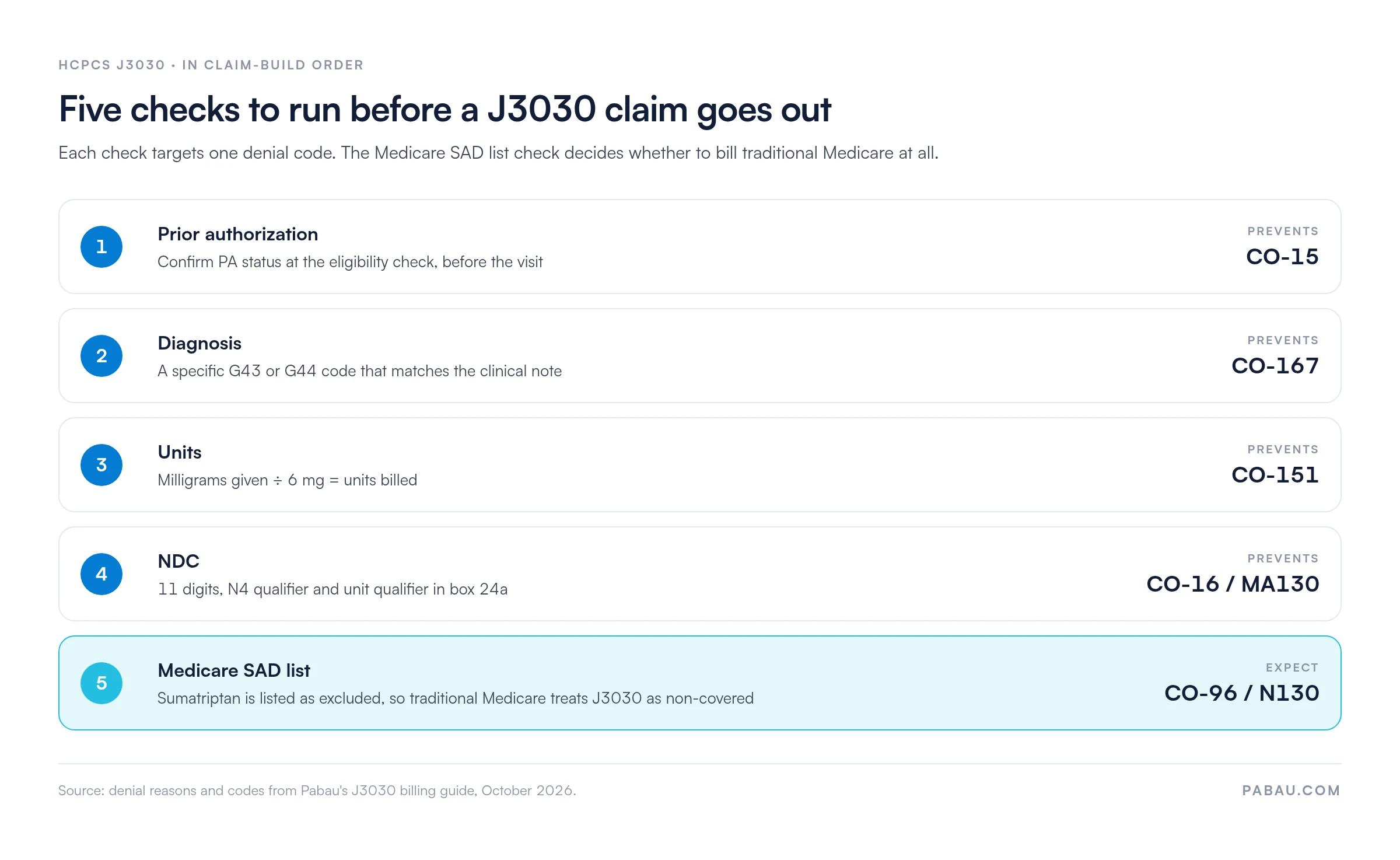
For a structured approach to working denials, see the guide to revenue cycle management fundamentals. It shows how denial categories should feed back into claim build protocols.
Keep a denial log specific to J3030. Repeated CO-96 denials mean claims are still going to traditional Medicare for a drug on the SAD list. Fix the payer check at intake first, then route the denied claims correctly.
Medicare pays Part B drugs under the Average Sales Price (ASP) methodology, at ASP plus 6% in the office setting. The exact allowable changes each quarter as CMS updates its ASP pricing files.
Because sumatriptan is available as a generic, the ASP allowable is typically low. Pull the current-quarter rate from the CMS Physician Fee Schedule lookup tool or the ASP pricing file rather than a cached figure.
Commercial payer rates vary widely. Some plans pay a contracted rate per unit, while others apply a percentage of average wholesale price (AWP) or a flat fee schedule. Confirm the contracted rate for J3030 in each payer contract before setting patient cost expectations. Pabau’s medical billing overview covers how Part B drug reimbursement fits alongside physician fee schedule claims.
Every denial above is visible before the claim goes out: a units field that doesn’t match the note, a blank NDC, or a missing authorization. Without a check at the claim build, nobody spots them until the remittance comes back weeks later.
Pabau’s claims management software scrubs every claim for missing or invalid details before it leaves your practice. A flagged claim shows as Needs action, with a Fix link that opens the field to correct. US eligibility checks run through Claim.MD before the visit, and prior authorizations attach at booking.
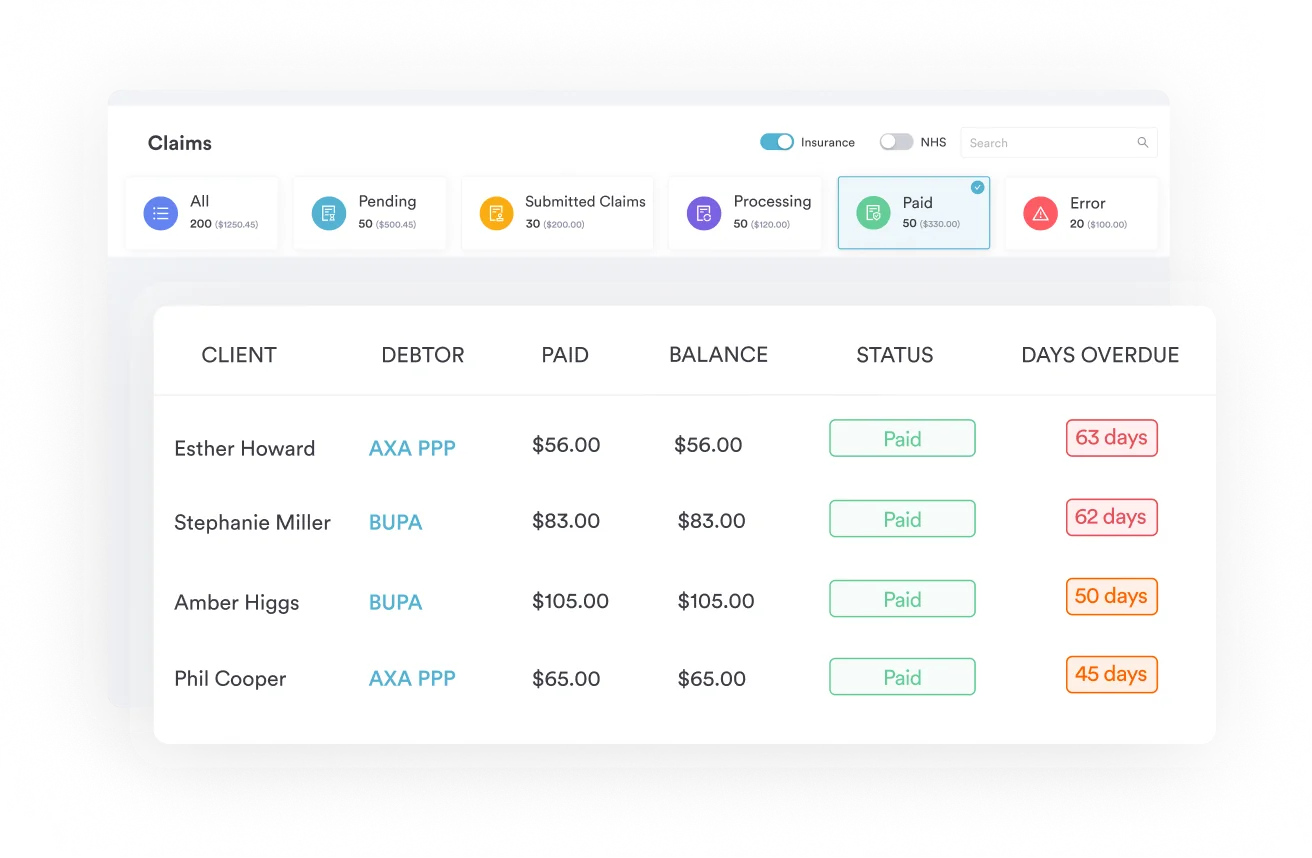
Once claims are out, the dashboard tracks each one from pending to paid, with days overdue on every row. US practices can settle insurer payments from electronic remittance advice (ERA) files, so J3030 payments are matched to their invoices without manual keying.

Pabau scrubs every claim for missing or invalid details before it leaves your practice. Your billing team fixes J3030 errors at the claim build instead of after a denial.

With J3030, the payer decides where the work goes. Under traditional Medicare, expect CO-96 denials, so verify the MAC’s SAD list before billing. With commercial and Medicaid plans, the work moves to the front desk, where prior authorization is confirmed at the eligibility check.
Whatever the payer, check the drug before the code number, because J3031 is a different medicine entirely. Then reconcile dose, units and NDC on every claim. A low ASP allowable leaves little margin for rework, so a J3030 claim pays best when it goes out right the first time.
Book a demo to see how Pabau’s claim scrubbing and eligibility checks stop J3030 errors before they reach the payer.

Need to understand how denials are tracked across your billing portfolio? Denial management in healthcare covers how to categorize, work, and prevent the most common claim rejections.
Want to build a cleaner claim from the start? Clean claim requirements walks through every mandatory field on a CMS-1500 and how to validate them before submission.
Looking to connect Pabau to a clearinghouse for J-code claims? Medical claims clearinghouse guide explains how clearinghouse routing works for physician fee schedule drug codes.
HCPCS Code J3030 covers the injection of sumatriptan succinate, 6 mg, when administered by a clinician in a qualifying outpatient setting. It does not cover oral tablets, nasal sprays, or sumatriptan auto-injectors dispensed to the patient for home self-injection.
One unit equals 6 mg of sumatriptan succinate, so a standard 6 mg injection is one unit. If 12 mg was given in two injections, bill two units and document both injections in the chart. Never bill more units than the dose supports.
Yes, Medicare Part B MACs generally list sumatriptan as a self-administered drug (SAD), so traditional Medicare treats J3030 as non-covered. CMS makes that call at the drug level, so no per-patient exception exists. Check your MAC’s current SAD list before billing.
J3030 is sumatriptan succinate injection, 6 mg per unit. J3031 is a different migraine drug: fremanezumab-vfrm (Ajovy), 1 mg per unit, used for prevention. Choose the code by the drug given, not by the neighboring code number.
It depends on the payer. Traditional Medicare Part B does not usually require PA, but Medicare Advantage, Medicaid managed care, and most commercial plans frequently do. Many add step therapy, meaning documented failure of oral triptans first, so verify PA at the eligibility check for every patient.
The NDC must match the specific sumatriptan succinate product given. Report it as an 11-digit number with qualifier N4 in the shaded area of CMS-1500 box 24a. Medicaid always requires the NDC, while Medicare MAC requirements vary. Use the NDC printed on the drug label and confirm it is active.