HCPCS Code J3030: Sumatriptan succinate injection billing guide
HCPCS Code J3030: Definition and clinical use HCPCS Code J3030 describes injecti...

Last Updated: Oct 29, 2026
J1110 is the HCPCS Level II code for injection, dihydroergotamine mesylate, per 1 mg. It covers injectable DHE given by IV, IM, or subcutaneous route for acute migraine and cluster headache.
One billing unit equals 1 mg administered, and intranasal DHE is not billed under this code. Medicare Part B claims also need the JW or JZ modifier and a specific migraine or cluster headache diagnosis.
Let Pabau's smart automation suggest the right codes, reduce claim denials, and keep your practice compliant—effortlessly.
Automate repetitive tasks and focus on what matters most—your patients.
Reduce coding errors and ensure compliance with the latest regulations.
Clean claims, fewer denials, and faster reimbursements.
Powerful insights and reporting to help your practice thrive.
HIPAA compliant SOC 2 certified GDPR-compliant Trusted by 4,000+ clinics worldwide

HCPCS Code J1110 covers injectable dihydroergotamine mesylate only, so intranasal DHE (Migranal) is never billed under it.
One unit equals 1 mg of dihydroergotamine mesylate administered, so bill the milligrams given rather than the full vial size.
For Medicare Part B single-dose containers, JW (drug waste) has been required since 2017 and JZ (zero waste) since July 1, 2023.
A specific migraine or cluster headache diagnosis supports the claim, while R51.9 (unspecified headache) is frequently rejected.
Claims software such as Pabau validates each claim for missing details before it goes out, so J1110 claims leave the practice complete.
HCPCS Code J1110 is the Centers for Medicare and Medicaid Services (CMS) code for “Injection, dihydroergotamine mesylate, per 1 mg.”
It sits within the HCPCS Level II J-series, which covers drugs billed separately from the act of administering them. J1110 applies to injectable DHE given by IV, IM, or subcutaneous injection, and each billing unit equals 1 mg administered.
Dihydroergotamine mesylate is an ergot alkaloid that acts as both a vasoconstrictor and a serotonin agonist. The FDA approves it for acute migraine and cluster headache, and it is typically reserved for cases where oral triptans have failed or are contraindicated. The injectable formulation is sold under the brand name DHE-45.
What J1110 covers: Injectable dihydroergotamine mesylate administered by IV, IM, or subcutaneous route in any care setting where the drug qualifies as separately payable.
What J1110 does not cover: J1110 covers injectable DHE only. Intranasal dihydroergotamine (Migranal nasal spray) is self-administered by the patient and is not billed under this code. Oral ergotamine preparations are not injectable and fall outside this code too. Never use J1110 for intranasal administration, whatever drug name is on the label.
One unit of J1110 equals 1 mg of dihydroergotamine mesylate administered. Bill the actual milligrams given, not the full vial size.
Injectable DHE is supplied as 1 mg/mL in 1 mL single-dose vials or ampules, so the calculation is straightforward when the full vial is used. A partial dose from a 1 mg vial still bills as 1 unit with the JZ modifier. No JW line applies, because Medicare does not pay fractional billing units. JW applies only when the discarded amount is at least one whole billing unit (1 mg).
Under Medicare Part B, HCPCS Code J1110 is reimbursed as a separately payable drug at the Average Sales Price (ASP) plus 6 percent. CMS updates ASP rates every quarter, so this guide does not print a dollar figure that would go stale within 90 days.
To find the current rate, download the latest quarterly file from the CMS ASP Drug Pricing Files page and search it for J1110. The file lists the Part B payment limit per 1 mg billing unit.
Facility vs. non-facility settings: When J1110 is administered in a physician office (POS 11), the practice bills the drug as a separately payable line. In an outpatient hospital (POS 22), the facility bills on the UB-04 and may package the drug into its Ambulatory Payment Classification (APC) payment. In that case the physician has no separate J1110 line to bill. Verify reimbursability by care setting before billing.
Medicare Advantage plans follow their own drug coverage and payment rules. Always verify J1110 coverage, prior authorization requirements, and allowed amounts with the specific plan before service.
Payers require a supported diagnosis on every J1110 claim. Dihydroergotamine is FDA-approved for acute migraine and cluster headache, so those ICD-10-CM categories form the core of accepted diagnoses.
R51.9 (unspecified headache) is the most common diagnosis error on J1110 claims. Payers read it as insufficient evidence of medical necessity for a drug approved specifically for migraine and cluster headache. Always code to the highest specificity the documentation supports.
Traditional Medicare fee-for-service does not currently list J1110 on its prior authorization program for Part B injectables. That status can change, so check the current CMS prior authorization list before each billing period.
Medicare Advantage plans vary significantly. Some require step therapy through oral triptans before approving injectable DHE. Always verify with the specific plan before administering the drug.
State Medicaid programs commonly require prior authorization for J1110, typically with a step therapy protocol showing that triptans were tried and failed. Documentation requirements differ by state, but Medicaid PA reviewers look for these elements:
Where DHE is administered determines who bills J1110 and on which claim form. The table below summarizes the three most common settings.
J1110 covers the drug cost only. A separate CPT code for the administration act must appear on the same claim in the physician office setting. Omitting the administration code leaves the claim incomplete. Pairing J1110 with the wrong administration code can trigger an unbundling denial.
CPT 96372 is not separately billable by the physician in a facility setting (POS 22 or 23), where administration is bundled into the facility payment. In the office setting, pair 96372 with J1110 on the same date of service. Then confirm the superbill submission captures both codes before the claim goes out.
Several HCPCS codes are easy to confuse with J1110, either because they treat migraine or because the drug name looks similar on a code list. Selecting the wrong code produces a denial, because the drug on the claim does not match the HCPCS descriptor.
The J0360 mix-up is costly because both drugs are injectables and both names contain “hydr,” which is easy to misread on a drug-code list. Always verify the drug name against the HCPCS descriptor before submitting. The AAPC HCPCS code lookup shows the full descriptor alongside each code.
Medicare Part B requires a waste modifier on drugs from single-dose containers. JW has been required since 2017, and JZ has been required since July 1, 2023. Every Medicare Part B claim for J1110 now carries either JW or JZ, and a claim without one can come back with a CO-4 denial.
When JW is used, bill the administered amount on the primary J1110 line. The discarded amount, in whole milligrams, goes on a second J1110 line with the JW modifier. A discard under 1 mg gets no JW line, because CMS does not use fractional billing units. Medicare pays for the administered dose and the discarded amount reported with JW, up to the single-dose container size. False waste reporting carries False Claims Act risk, so the record must match what was discarded.
National Drug Code (NDC) reporting requirements vary by payer, and Medicaid is the most consistent. Every Medicaid claim for J1110 must include the 11-digit NDC from the dispensing label. The Deficit Reduction Act of 2005 requires states to collect NDCs on physician-administered drugs so they can claim manufacturer rebates, as Medicaid.gov explains.
Traditional Medicare FFS does not require the NDC on the CMS-1500, but some Medicare Administrative Contractors (MACs) request it as a supporting element. Check your MAC’s local coverage guidance. Some commercial payers also require NDC reporting per their contract terms.
NDC format and placement on electronic claims:
Pull the 11-digit NDC from the vial label of the drug given to the patient, not from a reference database. The NDC on the label identifies the specific manufacturer lot and package size. Submitting an NDC that does not match the dispensing label exposes the claim to an audit-level mismatch.
J1110 denials cluster around six correctable billing errors. The CARC code on the remittance advice tells you which error triggered the rejection. Our CARC denial codes reference covers the full list, and the most common J1110 denials are below.
A structured denial management workflow routes CO-4 and CO-50 denials to a dedicated coder for same-day correction. That way, most of these claims can be fixed and resubmitted before timely filing limits close.
Each of these denials traces back to a single field on the CMS-1500. Checking the seven fields below before submission prevents them at the source.
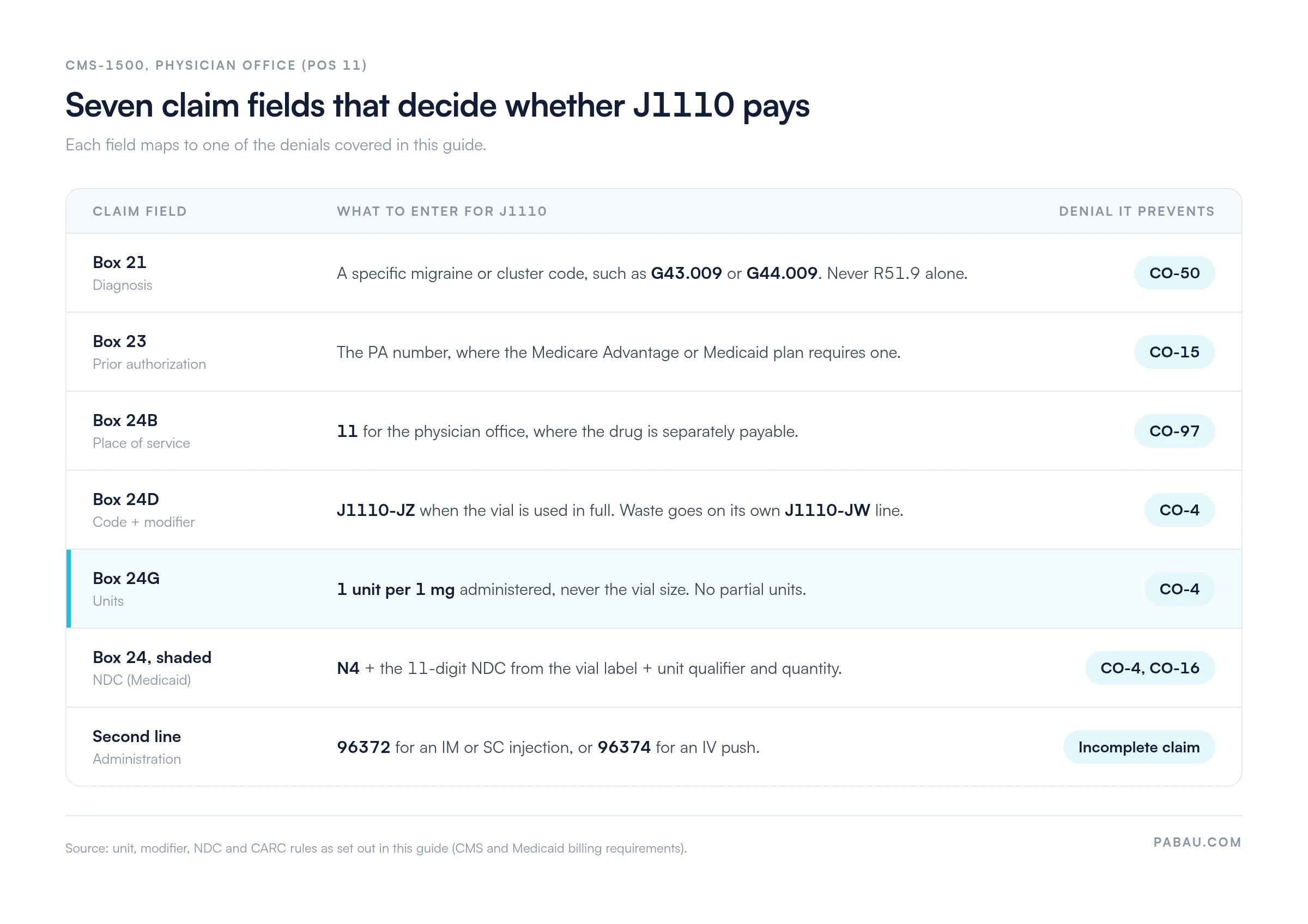
Every J1110 claim must be supported by a medical record that independently justifies the drug, the dose, and the diagnosis. The record must contain:
Solid documentation also supports appeal arguments when a payer denies on medical necessity grounds. Aligning the clinical note language with the ICD-10 code submitted on the claim is a key element of medical billing compliance.
Medicaid billing for J1110 differs from Medicare in three important ways:
Many states list dihydroergotamine on their Preferred Drug Lists (PDLs) at a non-preferred tier. Step therapy through triptans is then usually required before a Medicaid PA is approved. The state Medicaid agency’s fee schedule governs what J1110 pays, and those amounts can differ substantially from Medicare’s ASP+6% rate.
A sound revenue cycle management process for Medicaid J1110 claims checks the state fee schedule at least quarterly. It confirms PA status before each administration and records the NDC at the point of care rather than at billing. Each state Medicaid agency can confirm its current PDL status and PA criteria for J1110.
Verify J1110 PA status and NDC requirements separately for each state Medicaid program where you treat patients. A PA requirement in one state does not predict requirements in another. Keep a one-page reference sheet per state Medicaid payer updated each quarter alongside the new ASP pricing release.
In many practices, the dose and vial details live in the treatment note, and a biller re-keys them into the claim days later. Each re-keyed field is another chance for a wrong unit count, a missing JZ modifier, or a dropped NDC.
Pabau, the practice management platform we build, raises the claim from the patient’s invoice. Its claims software for practices opens each claim pre-filled and checks it for missing or invalid details before it reaches the clearinghouse. Prior authorization codes attached at booking follow the appointment onto the claim.
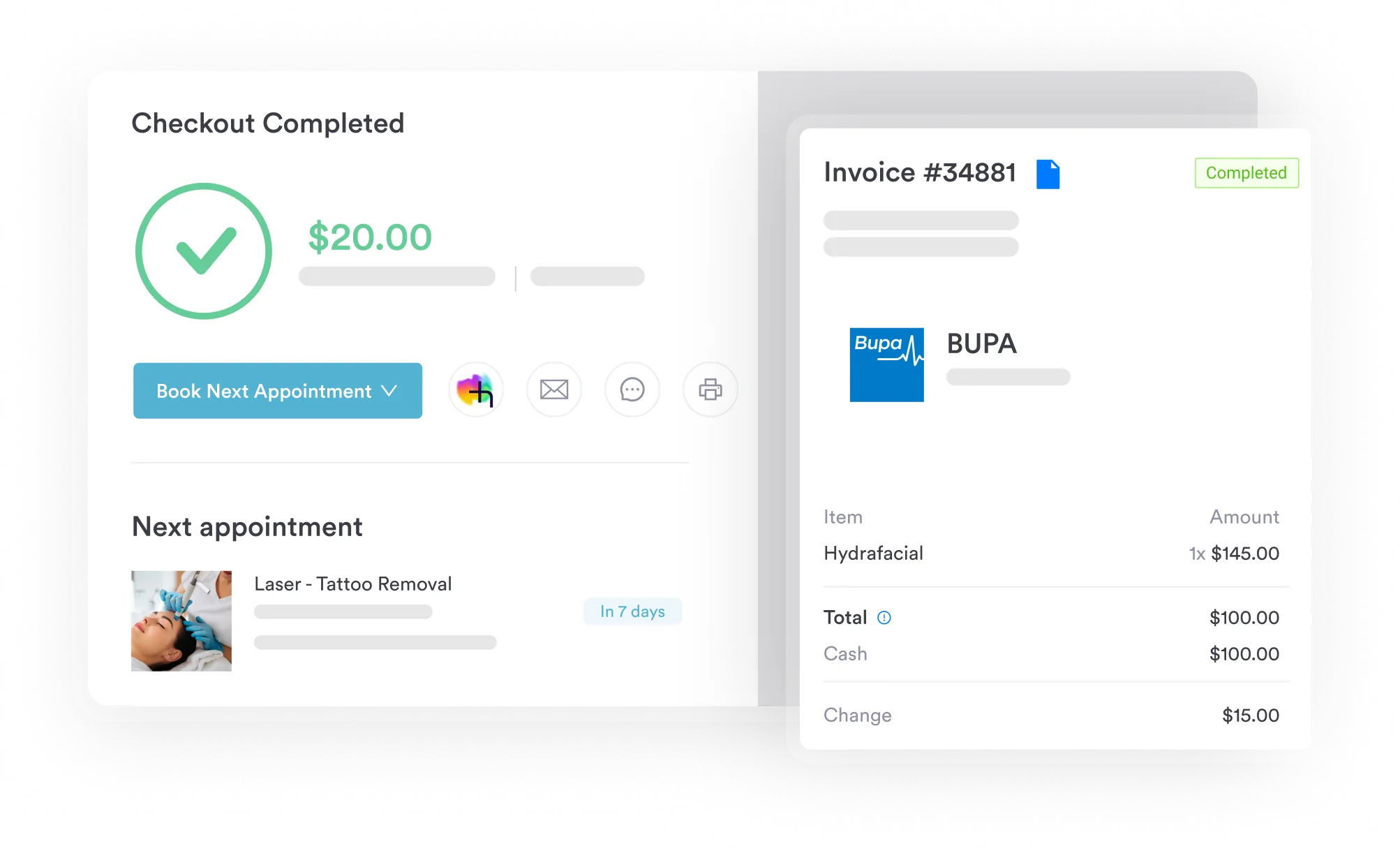
When a payer does reject a J1110 claim, Pabau flags it as needing action and points to the field to fix. Your biller corrects one field and resubmits, instead of rebuilding the claim from paper notes.

Pabau pre-fills each claim from the invoice and checks it for missing details before it reaches the clearinghouse, so fewer J1110 claims come back.

J1110 itself is simple: one injectable drug, one code, one unit per milligram. Denials come from the fields around it, namely the waste modifier, the diagnosis, the NDC, and the place of service.
If your practice gives DHE regularly, a short pre-submission check on those fields pays back faster than a quicker appeals process. A claim that leaves complete is paid on the first pass. A denied one costs a correction, a resubmission, and weeks of cash flow.
Book a demo to see how Pabau takes a J1110 visit from the treatment note to a validated claim.

Need to understand how claim rejections get tracked and resolved? Denial management in healthcare covers the full workflow for identifying, appealing, and preventing recurring denials.
Looking for a reference on CARC codes your remittance uses? CARC denial codes in medical billing maps the most common adjustment reason codes to their corrective actions.
Want to see how Pabau fits into a compliant billing operation? Medical billing compliance outlines the documentation and process standards practices need to meet.
HCPCS Code J1110 covers injection of dihydroergotamine mesylate, per 1 mg, given by IV, IM, or subcutaneous route. Intranasal dihydroergotamine (Migranal) is a self-administered nasal spray and is not billed under J1110. Oral ergotamine preparations are not covered either.
Bill one unit for each milligram of dihydroergotamine mesylate administered. A full 1 mg vial used entirely equals 1 unit with modifier JZ. If only 0.5 mg was administered, bill 1 unit with modifier JZ, because Medicare does not pay fractional units. Do not add a JW line for that 0.5 mg discard. JW applies only when at least one whole billing unit is discarded.
Payers accept specific migraine codes (G43.009, G43.109, and related G43.x codes) and cluster headache codes (G44.009) as medically necessary diagnoses for J1110. Avoid unspecified headache (R51.9), which often produces CO-50 denials for insufficient specificity.
Traditional Medicare FFS does not currently require prior authorization for J1110, but Medicare Advantage plans frequently do. Most state Medicaid programs require PA with step therapy documentation showing triptan failure. Always verify with the specific plan before administering the drug.
Yes, for Medicaid. An 11-digit NDC is mandatory on every Medicaid J1110 claim. Enter it with qualifier N4 in Loop 2410 on the 837P, or in the shaded area of Box 24 on the CMS-1500. Traditional Medicare FFS does not require it on the claim form, but some MACs request it and commercial payer contracts vary.
JW (drug waste) and JZ (zero waste) are the primary modifiers. For Medicare Part B drugs from single-dose containers, JW has been required since 2017 and JZ since July 1, 2023. Use JZ when the full vial is administered with no remainder. Use JW on a separate line to report the wasted portion when only part of the vial is used.
J0360 is the code for hydralazine HCl injection, a cardiovascular drug. J1110 is for dihydroergotamine mesylate, an ergot alkaloid for migraine and cluster headache. The codes share no clinical overlap. Mix-ups happen when a coder misreads a similar-looking drug name on a code list, so always match the code to the drug dispensed.