ICD-10 code E55.9: Vitamin D deficiency, unspecified
ICD-10 code E55.9: Definition and official descriptor ICD-10 code E55.9 is the I...

Last Updated: Nov 10, 2026
Billable Code Specific Code
G43.909 is the billable ICD-10-CM code for migraine, unspecified, not intractable, without status migrainosus. It applies when the provider confirms a migraine but the note records neither aura status nor a chronic pattern. The attacks respond to acute treatment, and no status migrainosus is documented.
The code is valid for FY 2026 and FY 2027 claims. It carries documentation requirements that payers audit closely, and missing them is a frequent reason G43.909 claims are denied.
Let Pabau's smart automation suggest the right codes, reduce claim denials, and keep your practice compliant—effortlessly.
Automate repetitive tasks and focus on what matters most—your patients.
Reduce coding errors and ensure compliance with the latest regulations.
Clean claims, fewer denials, and faster reimbursements.
Powerful insights and reporting to help your practice thrive.
HIPAA compliant SOC 2 certified GDPR-compliant Trusted by 4,000+ clinics worldwide

G43.909 codes a confirmed migraine when the note documents neither aura status nor a chronic pattern.
Not intractable means the migraine responds to standard acute treatment. Without status migrainosus means no documented status migrainosus (a debilitating attack lasting more than 72 hours).
G43.919 is the intractable counterpart, and switching to it requires documented treatment failures rather than clinical severity alone.
Chronic migraine has its own G43.7 codes, so a chart showing 15 or more headache days a month never takes G43.909.
In Pabau, the practice management platform we build, US claims go out through Claim.MD with eligibility checks, ERA remittances, and tracked claims and denials.
ICD-10 code G43.909 is the billable code for migraine, unspecified, not intractable, without status migrainosus. It sits in the G43 migraine category of the ICD-10-CM tabular list, under the G43.9 parent for unspecified migraine. The CDC/NCHS ICD-10-CM lookup tool confirms that full descriptor. It is a billable leaf-node code, so no further character is needed to submit a claim.
The code has been valid since ICD-10-CM was first implemented. It remains active in the current CMS ICD-10-CM update cycle for FY 2026 and FY 2027. Neither year’s annual tabular refresh changed the descriptor or its inclusion notes.
The G43.909 descriptor contains three qualifiers, and each one maps to a clinical and coding decision. Getting one of them wrong assigns the wrong code or exposes the claim to a payer audit.
The WHO ICD-10 classification browser lists status migrainosus as a distinct condition with its own code, not a severity modifier. A migraine that reaches 72 hours is not automatically status migrainosus. Under ICHD-3 criteria, the attack must be debilitating and last more than 72 hours.
G43.909 applies when a provider documents migraine without enough clinical detail for a more precise G43 subcode. It turns up most at new patient visits, in brief follow-up notes, and in primary care rather than headache clinics.
The G43 category carries an Excludes1 note for headache NOS (R51.9), so a coder cannot assign both codes for the same encounter. G43.909 requires a provider-confirmed migraine diagnosis. R51.9 is for undifferentiated headache where no migraine has been confirmed.
G43.909 and G43.919 are mirror codes separated by one clinical distinction: Whether the migraine is intractable. G43.919 is “Migraine, unspecified, intractable, without status migrainosus.”
In ICD-10-CM, intractable means the migraine is pharmacoresistant. It has failed to respond to standard acute therapies such as triptans, NSAIDs, antiemetics, or ergotamines. The provider makes that determination in the note, and a coder never infers it.
A coder must never upgrade G43.909 to G43.919 without explicit provider documentation of treatment failure. Doing so is upcoding and creates audit exposure. If the note says “migraine, severe” but names no failed treatment, G43.909 is correct.
No. G43.909 does not confirm, imply, or cover chronic migraine. Chronic migraine has its own ICD-10-CM codes: G43.70x (chronic migraine without aura, not intractable) and G43.71x (chronic migraine without aura, intractable). They require 15 or more headache days a month for more than three months, with at least eight meeting migraine criteria under ICHD-3.
G43.909 fits only when the documentation does not establish that frequency threshold. Coding G43.909 for a patient whose chart records 20 headache days a month is a specificity error. G43.709 or G43.719 is required, and many payers flag the mismatch on audit.
The G43 category is built from three documentation decisions: Migraine type, intractability, and status migrainosus. Each decision sets one character of the code, as the path below shows. G43.909 is the combination where aura is undocumented and the other two answers are no.
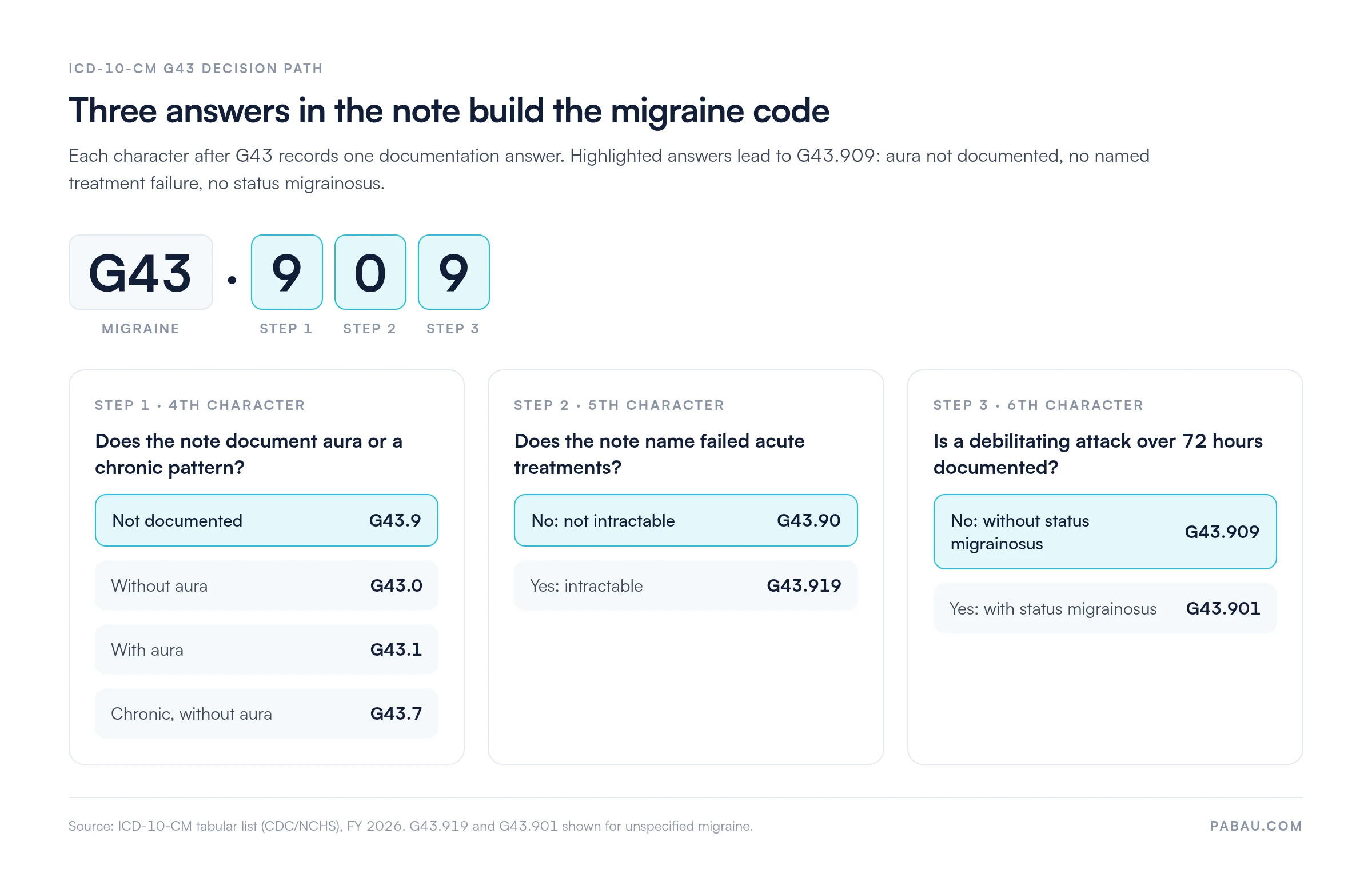
Use the AAPC Codify ICD-10-CM lookup to browse the full G43 range. It includes the G43.4 hemiplegic, G43.A cyclical vomiting, G43.B ophthalmoplegic and G43.D abdominal migraine subtypes, which sit outside the most commonly coded groups.
A claim for ICD-10 code G43.909 rests on the provider note, not the coder’s clinical judgment. Payers audit G43.909 encounters for medical necessity, and thin documentation is a frequent trigger for post-payment recovery requests. Every note supporting this code should address the following, in line with CMS ICD-10-CM guidance on specificity.
Some notes read only “migraine headache, follow up.” When documentation is that vague, the coder queries the provider rather than assigning G43.909 on assumption. Building a clean claim for G43.909 starts with this documentation checklist, well before the billing stage.
Send a documentation query to the provider if the note does not address acute treatment response. Without it, the ‘not intractable’ qualifier is unsupported. The same note that justifies G43.909 today is what an auditor reads in a recovery request six months later.
G43.909 appears on claims across many service types, from standard E&M visits to nerve blocks and infusions. Knowing which pairings are routine and which draw payer review lets billing teams prepare documentation before submission. Pabau’s neurology claims management tools submit US claims through Claim.MD and track each claim and denial, so the team sees which pairings come back.
Erenumab and galcanezumab are self-injected, so they carry no J-code on the medical claim. For nerve blocks, CPT 64405 covers the greater occipital nerve and 64450 covers other peripheral nerves, including supraorbital blocks.
The diagnosis code G43.909 alone does not trigger prior authorization for the office visit. Medicare and most commercial payers cover standard E&M visits for migraine management without one. The picture changes when preventive therapies join the claim, specifically CGRP monoclonal antibodies and botulinum toxin injections.
Commercial payers, and a growing number of Medicare Advantage plans, require step-therapy evidence before approving CGRP inhibitors such as erenumab, fremanezumab, and galcanezumab. The usual requirement is documented failure of two to four preventive agents, such as beta-blockers, tricyclic antidepressants, or anticonvulsants like topiramate.
Billed with G43.909, a CGRP J-code claim often faces an extra hurdle. Some payers require G43.919 (intractable) or a chronic migraine code to cover preventive therapy. Check the specific LCD or payer policy before submitting, since requirements vary by carrier and region.
FDA approval for botulinum toxin in migraine prevention is specific to chronic migraine, defined as 15 or more headache days a month. Payers typically align their coverage criteria with that approval. When CPT 64615 is paired with G43.909 rather than a G43.7x code, the claim is likely to be denied for medical necessity. This pairing is a common error in practices that have not yet confirmed chronicity in the chart.
Pabau’s claims software sends US claims through Claim.MD and lets the team run eligibility checks before submission. Understanding the full revenue cycle management loop for neurology helps billing teams see where G43.909 pairings cause friction before adjudication.
Most G43.909 denials trace back to one of three causes. The note lacks detail, the code is less specific than the chart, or the CPT pairing fails payer edits. Good denial management workflows treat these as documentation problems upstream rather than billing department problems.
The specific CARC denial codes on each G43.909 rejection tell billing teams where to route the appeal. CO-50 (not medically necessary) and CO-4 (procedure code inconsistent with modifier, or required modifier missing) are common G43.909-related denials.
Track G43.909 denials by payer rather than in aggregate. An acceptable overall denial rate can hide one carrier with a stricter documentation threshold. Isolate that payer, review three to five denied claims together, and find the documentation element those notes all lack before reworking your query template.
In many neurology and primary care practices, the migraine note lives in one system and the claim in another. Billing staff read the note, pick a G43 code, and chase prior authorizations by email or spreadsheet. When a CGRP or Botox claim comes back, nobody can quickly see which note or authorization it relied on.
Pabau keeps the note, the authorization, and the claim on one patient record. Each prior authorization is tracked on the case with its auth code, dates, and sessions, and a warning shows when one is missing. US claims go out through Claim.MD after an eligibility check, and ERA remittances come back into Pabau.
The result is a denial you can trace to its cause in minutes, so your team spends less time rebuilding the story for an appeal.

Pabau records the provider note, prior authorizations, and claims on one patient record. US claims go through Claim.MD with eligibility checks and tracked denials, so appeals start from the documentation.

Treat G43.909 as the code for a confirmed migraine whose note stops short of aura, chronicity, and treatment failure. When the chart says more, code more. The costly errors come from coding chronic patients as unspecified, pairing CPT 64615 with G43.909, and sending CGRP J-codes without step-therapy history.
Each of those is fixed upstream. Build a documentation query into the provider workflow before coding, and the code follows from the note instead of a guess.
Book a demo to see how Pabau links the migraine note, prior authorizations, and Claim.MD submissions for neurology billing.

New to the billing side of migraine care? Medical billing fundamentals explains how visit documentation turns into a submitted claim.
Seeing high denial rates on neurology claims? How Claim.MD works as a clearinghouse covers how a clearinghouse checks and routes claims before they reach the payer.
Want to understand what happens after a claim is denied? Reading electronic remittance advice explains how to interpret ERA denial codes and route appeals.
Billing occipital nerve blocks for migraine? CPT code 64405 covers how to bill the greater occipital nerve block.
ICD-10 code G43.909 is the billable diagnosis code for migraine, unspecified, not intractable, without status migrainosus. It applies when a provider confirms migraine but the note does not specify aura status, chronicity, or treatment failure. The code is valid for FY 2026 and FY 2027.
No. G43.909 does not cover chronic migraine. Chronic migraine has its own codes, G43.70x for not intractable and G43.71x for intractable. They require 15 or more headache days a month for more than three months. Assigning G43.909 when the chart supports a chronic code is a specificity error that many payers flag on audit.
G43.919 is the intractable counterpart: Migraine, unspecified, intractable, without status migrainosus. Intractable means the migraine is pharmacoresistant and has not responded to standard acute therapies such as triptans, NSAIDs, or antiemetics. G43.909 applies when the provider documents at least partial treatment response. Upgrading to G43.919 without documented treatment failure is upcoding.
The most common pairings are E&M codes 99202-99215, nerve block codes 64405 and 64450, and IV infusion codes 96365-96368 for acute migraine care. CGRP inhibitor J-codes and CPT 64615 (botulinum toxin) also appear with G43.909. Both often trigger prior authorization or payer edits, because those therapies usually need a more specific or chronic diagnosis.
Use G43.909 only when the provider note cannot support a more specific code. That means aura status is not addressed, chronicity is not established, and no treatment failure is recorded. It is not a default for speed. If the chart supports G43.009, G43.109, or any G43.7x code, use that code instead.
G43.909 alone does not trigger prior authorization for a standard office visit or nerve block. Prior authorization comes into play when preventive therapies are added. CGRP inhibitors typically require documented failure of two to four preventive agents. Botulinum toxin (CPT 64615) usually requires a chronic migraine diagnosis. Check the payer’s LCD or coverage policy before submitting, since requirements vary by carrier.