HCPCS code H2034: Alcohol and other drug treatment billing
HCPCS code H2034: Official descriptor and covered services HCPCS code H2034 carr...

Last Updated: Nov 2, 2026
J2547 is the HCPCS Level II code for injection, peramivir, 1 mg. Peramivir is the IV influenza antiviral sold as Rapivab, and each billing unit equals 1 mg. The standard 600 mg adult dose is reported as 600 units.
Peramivir is given only by IV, so Medicare does not require a JA or JB route modifier on J2547. A clean claim pairs the right unit count with the NDC, an infusion administration code and an influenza diagnosis. Check each payer's own modifier rules too.
Let Pabau's smart automation suggest the right codes, reduce claim denials, and keep your practice compliant—effortlessly.
Automate repetitive tasks and focus on what matters most—your patients.
Reduce coding errors and ensure compliance with the latest regulations.
Clean claims, fewer denials, and faster reimbursements.
Powerful insights and reporting to help your practice thrive.
HIPAA compliant SOC 2 certified GDPR-compliant Trusted by 4,000+ clinics worldwide

HCPCS Code J2547 describes injection, peramivir (Rapivab), 1 mg, so the standard 600 mg adult dose is billed as 600 units.
Medicare doesn’t require a JA or JB route modifier on J2547, because peramivir is given only by IV. Add JA only if a specific payer asks for it.
A clean J2547 claim pairs the right unit count with the NDC, an infusion administration code such as CPT 96365, and an influenza diagnosis.
Medicare Part B pays J2547 at ASP plus 6%, so check the current quarterly ASP Drug Pricing File before you bill.
Pabau, the practice management platform we build, supports insurance billing for US practices through claims management, next to appointments and patient records.
HCPCS Code J2547 covers injection, peramivir, 1 mg. That is intravenous peramivir, the neuraminidase inhibitor sold under the brand name Rapivab. The Centers for Medicare and Medicaid Services (CMS) maintains J2547 among the Level II HCPCS codes. It sits in the J-code range, which covers drugs administered other than by mouth.
Use J2547 only when a clinician gives peramivir by IV infusion. Oral antivirals such as oseltamivir and baloxavir have no J-code and run through the pharmacy benefit. On the claim, bill the units the patient received. Then check the NDC, the administration CPT code, the diagnosis and any payer-specific modifier rules.
Peramivir is an IV neuraminidase inhibitor. The FDA approves it for acute uncomplicated influenza in patients 6 months and older. Those patients must have had symptoms for no more than two days. It blocks the neuraminidase enzyme of influenza A and B, which stops new virus particles from leaving infected cells.
Because a clinician gives it by infusion, peramivir is billed through the medical benefit rather than the pharmacy benefit. A single IV infusion makes up the full course, so most encounters carry one J2547 line. Peramivir has only one route, so Medicare does not ask for a route modifier on it.
The label also notes that efficacy was not established in serious influenza requiring hospitalization. Document why IV therapy was chosen over an oral antiviral, such as vomiting or an inability to swallow. Record that reason in the infusion note at the point of care, so it is on file if a payer questions the claim.
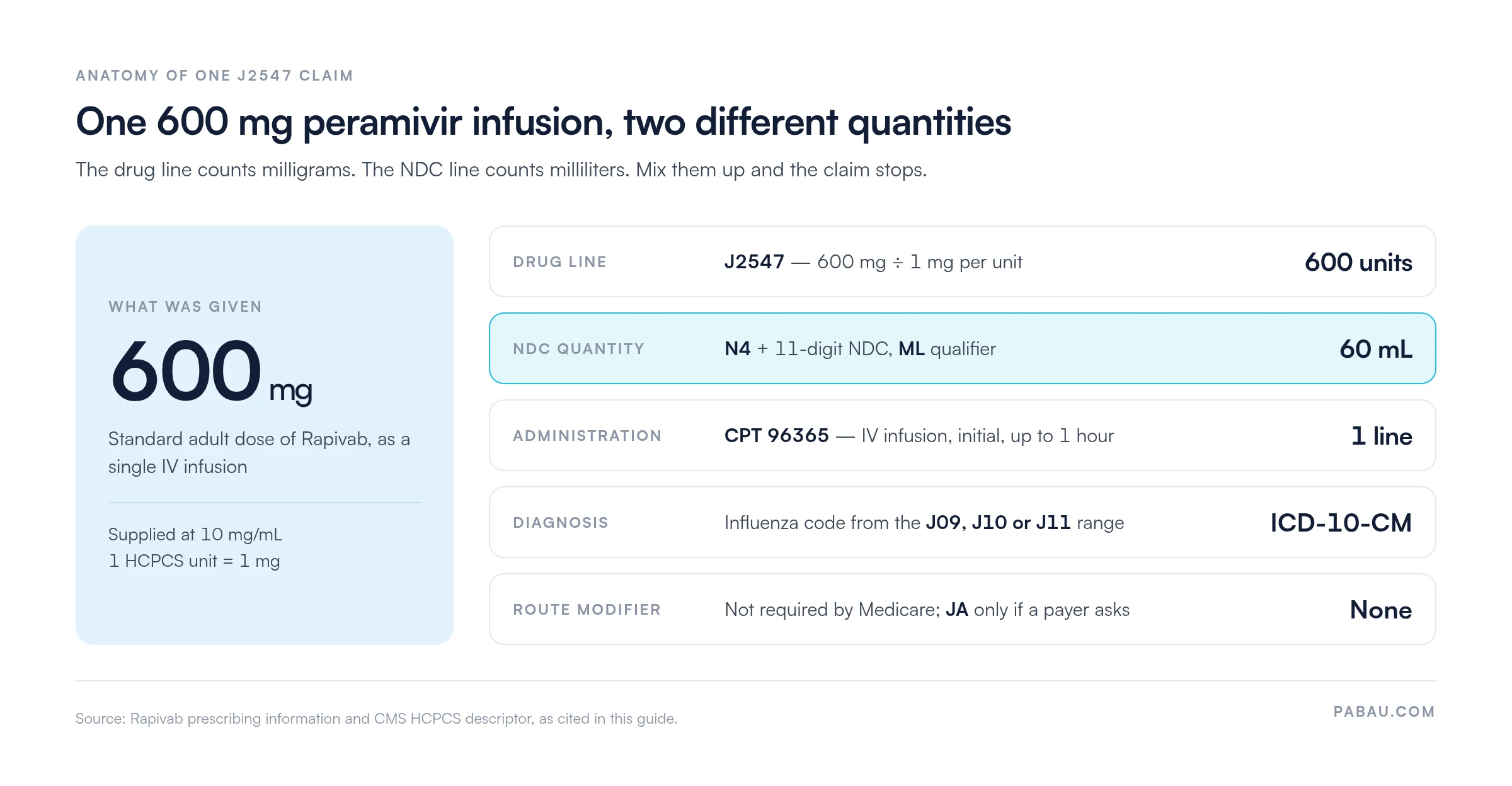
The billing unit for J2547 is 1 mg. The standard adult dose of peramivir is 600 mg, given as a single IV infusion, per the FDA-approved Rapivab prescribing information. That means a standard adult claim line reports 600 units of J2547.
Pediatric doses are weight-based, so check the current prescribing information for the dosing table. Any pediatric claim should report the dose actually given rather than the adult default.
If an infusion stops early, bill only the units actually administered. Modifier 53 does not apply here: it marks a discontinued procedure and does not adjust a drug quantity.
J2547 has no mandatory route modifier. Since April 2021, Medicare has required JA (intravenous) or JB (subcutaneous) only for drugs whose single J or Q code covers more than one route. That rule sits in the CMS Self-Administered Drug Exclusion List article A52527. Peramivir is given only by IV, so JA is not required on J2547.
Add JA only if a specific payer’s policy asks for it. Rapivab comes in single-dose vials, so check whether J2547 is on CMS’s current JW/JZ modifier list. Then check the payer’s own rules, since commercial plans can set their own.
Modifier 99 rarely matters on peramivir claims. It applies only when a line needs more than four modifiers, which a J2547 line seldom does.
J2547 covers the drug only. The infusion itself needs a separate administration CPT code on the same claim. If that code is wrong or missing, the administration service is denied and the J-code line may draw scrutiny.
For most peramivir encounters, 96365 paired with J2547 is the correct claim structure. Report 96374 only when the record shows a push of 15 minutes or less. Check current National Correct Coding Initiative (NCCI) edits before submitting, because edits between administration codes change with quarterly updates.
Medicaid requires the NDC (National Drug Code) on claims for physician-administered drugs, including J2547. Many Medicare Advantage plans and commercial payers ask for it too. A missing NDC usually gets the claim rejected up front, so it never reaches adjudication.
An NDC can change when the labeler or the package changes. Record it from the vial at the time of administration. Good medical billing compliance practice includes capturing the NDC before the claim is built. The diagram below shows how one standard dose lands on each part of the claim.
Medicare Part B covers J2547 when peramivir is given in a covered outpatient setting and the documentation supports medical necessity. Knowing how medical billing workflows meet Medicare’s coverage rules helps practices head off coverage denials.
Commercial payers and Medicare Advantage plans set their own peramivir policies. Some want documentation of why an oral antiviral was not used, and some require prior authorization. Check the payer’s policy before the infusion when time allows.
Medicare Part B pays most separately payable drugs, J2547 included, at average sales price (ASP) plus 6%. CMS updates ASP every quarter, so the J2547 allowable changes four times a year. Look up the current payment limit in the CMS quarterly ASP Drug Pricing Files before billing.
Commercial payers often pay J2547 at a percentage of average wholesale price (AWP) or at a negotiated contract rate. Contract rates vary, so use the payer’s current fee schedule or a recent remittance advice. Practices can also use the PGM Billing HCPCS lookup tool for a quick cross-reference of CMS data.
Download the CMS quarterly ASP Drug Pricing File at the start of each quarter and update your J2547 charge before the new rates take effect. A charge below the Medicare allowable leaves money on the table, because Medicare pays the lower of the two.
Original Medicare generally does not require prior authorization for J2547 in outpatient settings. Medicare Advantage plans, Medicaid managed care plans and commercial payers may require it, and their rules change often. Document the clinical rationale for IV antiviral therapy before you submit a request.
For urgent same-day infusions, some payers accept a retrospective authorization request. Confirm the payer’s window before relying on it, since the rules and timeframes differ.
Every J2547 claim needs an ICD-10-CM code that supports IV antiviral therapy. The diagnosis should reflect confirmed or clinically diagnosed influenza. A generic viral infection code is unlikely to pass a payer’s medical necessity review.
Coders sometimes reach for J2547 when another billing path is correct, or the reverse. Peramivir’s IV-only route is the clearest dividing line. Oral oseltamivir (Tamiflu) and baloxavir (Xofluza) are dispensed through the pharmacy benefit and have no J-code on the medical benefit.
Most J2547 denials trace back to the claim basics: the unit count, a missing NDC, the administration code, the diagnosis and payer authorization. Denial management in healthcare for J-code claims follows one pattern. Find the root cause from the remittance codes, correct that element, and follow the payer’s corrected-claim or reopening process.
A complete J2547 claim draws on three records: the prescriber order, the infusion record and the billing system. When one of them is missing a detail, the claim runs into a denial from the table above. Work through these checks before submission, because building a clean claim up front costs less than a resubmission.
Build a J2547 charge template that prompts for the mg given, the NDC, the mL quantity and the infusion times. Review each claim against the checklist above at charge capture, before it reaches the clearinghouse.
A peramivir claim pulls together figures recorded at different moments. The mg ordered, the mL infused, the NDC on the vial and the influenza diagnosis all have to agree. When those sit in separate tools, one of them can drift before the claim goes out.
Pabau supports insurance billing for US practices through its claims management software. Your billing team works each claim in the same system that holds the patient’s appointments and records. That keeps every J2547 line tied to the visit and infusion note it came from, so a rejected claim is easier to trace and correct.

Pabau supports insurance billing for US practices through claims management, in the same system as scheduling and patient records. See how it fits your infusion billing workflow.

Get the two quantities right and most J2547 claims pay the first time. Bill units against the mg given, and report the NDC with its mL quantity where the payer asks. Then pair the drug line with the infusion code your times support.
Leave modifiers off unless a rule calls for one. Medicare does not need JA on a single-route drug like peramivir. Check each payer’s policy and CMS’s current JW/JZ list before you add one by habit.
Book a demo to see how Pabau keeps each infusion claim tied to the visit record it came from.

Need to understand how HCPCS drug billing fits into your revenue cycle? What is revenue cycle management covers the end-to-end process from charge capture to payment posting.
Dealing with repeated claim rejections on J-codes? Denial codes in medical billing explains the most common CARC and RARC codes and how to act on them.
Want to automate eligibility checks before administering peramivir? Insurance eligibility verification outlines how automated verification reduces PA surprises and coverage denials.
Submitting J2547 claims electronically? 837 file billing covers the electronic claim format used to transmit HCPCS drug codes to payers and clearinghouses.
HCPCS Code J2547 is the Level II code for injection, peramivir, 1 mg. Practices use it to bill Medicare Part B and commercial payers for IV peramivir (Rapivab) given by a clinician. One unit equals 1 mg, so the standard 600 mg adult dose is billed as 600 units.
Medicare does not require a route modifier on J2547. Since April 2021, JA or JB has been required only for drugs whose single code covers more than one route, and peramivir is IV-only. Add JA only if a specific payer’s policy asks for it. Rapivab comes in single-dose vials, so also check whether J2547 is on CMS’s current JW/JZ list and what the payer’s rules say.
Modifier JA means a drug was administered intravenously. Medicare requires it only when one drug code covers more than one route, which is not the case for peramivir. Use JA on J2547 only when a payer’s own billing policy asks for it.
Bill one unit of J2547 per 1 mg of peramivir given. For the standard adult dose of 600 mg, bill 600 units. For a pediatric or partial dose, bill the mg actually given as units. Record that dose in the infusion record to support the billed quantity.
Report the NDC from the Rapivab vial you used, with the N4 qualifier and the 11-digit format with no hyphens. Follow it with the ML unit-of-measure qualifier and the volume given. An NDC can change when the labeler or the package changes, so record it from the vial at the time of administration.
CPT 96365 (intravenous infusion, initial, up to 1 hour) is the usual administration code for peramivir. Use 96366 only if the infusion runs well past the first hour, which is rare. CPT 96374 applies only to an IV push of 15 minutes or less. Check current NCCI edits before submitting.