

CPT Code 52352: Ureteroscopic stone removal billing guide
CPT Code 52352: Official descriptor and procedure overview CPT Code 52352 descri...

Last Updated: Oct 30, 2026
J2326 is the HCPCS Level II code for injection, nusinersen, 0.1 mg. It reports Spinraza, the intrathecal drug used to treat spinal muscular atrophy, and is billed with a separate spinal puncture code such as CPT 96450.
The billing unit is 0.1 mg, while the 12 mg standard dose is 120 units, so a 1-unit claim underpays about 120-fold. On the high-dose regimen, a 50 mg loading dose is 500 units and a 28 mg maintenance dose is 280 units.
Let Pabau's smart automation suggest the right codes, reduce claim denials, and keep your practice compliant—effortlessly.
Automate repetitive tasks and focus on what matters most—your patients.
Reduce coding errors and ensure compliance with the latest regulations.
Clean claims, fewer denials, and faster reimbursements.
Powerful insights and reporting to help your practice thrive.
HIPAA compliant SOC 2 certified GDPR-compliant Trusted by 4,000+ clinics worldwide

HCPCS code J2326 reports nusinersen at 0.1 mg per unit, so a 12 mg standard-regimen dose is billed as 120 units.
On the high-dose Spinraza regimen, each 50 mg loading dose is 500 units and each 28 mg maintenance dose is 280 units.
J2326 covers only the drug, and Medicare contractor guidance pairs it with CPT 96450 for the spinal puncture on the same date.
Most Medicare Advantage, Medicaid and commercial payers require prior authorization, and a missing or expired PA is a leading cause of denials.
Medicare pays J2326 at ASP plus 6% (about 4.3% after sequestration) in the physician office setting under Part B.
Pabau, the practice management platform we build, keeps billing, payments and invoicing, and reporting in one system beside the patient record.
HCPCS code J2326 is the Healthcare Common Procedure Coding System Level II code for injection, nusinersen, 0.1 mg. The Centers for Medicare and Medicaid Services maintains it within the J-series drug codes, and it took effect on January 1, 2018. Nusinersen, sold under the brand name Spinraza by Biogen, is an antisense oligonucleotide approved by the FDA for all types of spinal muscular atrophy.
Each unit is 0.1 mg, so a 12 mg standard-regimen dose is billed as 120 units. The high-dose regimen bills 500 units per 50 mg loading dose and 280 units per 28 mg maintenance dose. To check a neighboring J-code before you submit, our HCPCS code reference lists each drug code with its official descriptor.
Nusinersen is FDA-approved for spinal muscular atrophy across all four clinical types. The specific ICD-10-CM diagnosis code on the claim must match the patient’s documented SMA classification. According to the CDC/NCHS ICD-10-CM web tool, the primary codes used with J2326 are in the G12 subcategory.
G12.1 is the most frequently billed code because it covers SMA types 2, 3, and 4. Those types account for most patients on ongoing maintenance therapy. Medical necessity documentation must specify which SMA type the patient has. It must also tie that classification to the genetic test result confirming an SMN1 biallelic deletion or point mutation.
J2326 reports only the drug. The intrathecal injection is a separate billable service with its own CPT code. Noridian, a Medicare administrative contractor, directs providers to bill J2326 with CPT 96450 on the same date of service. That code covers chemotherapy administration into the central nervous system, requiring and including spinal puncture.
Confirm the payer’s policy before choosing between 96450 and a lumbar subarachnoid injection code. Whichever code you bill, the procedure note must document the spinal puncture and any imaging guidance used. Billing J2326 without a companion procedure code is a common error that triggers automatic claim edits at most payers.
Each J2326 unit is 0.1 mg, so the unit count is the dose in milligrams multiplied by 10. Billing one unit for a 12 mg dose pays for roughly 1/120th of the drug. That underpayment often surfaces only at reconciliation, weeks after the claim went out. The chart below shows the count to enter for each dose across both regimens.
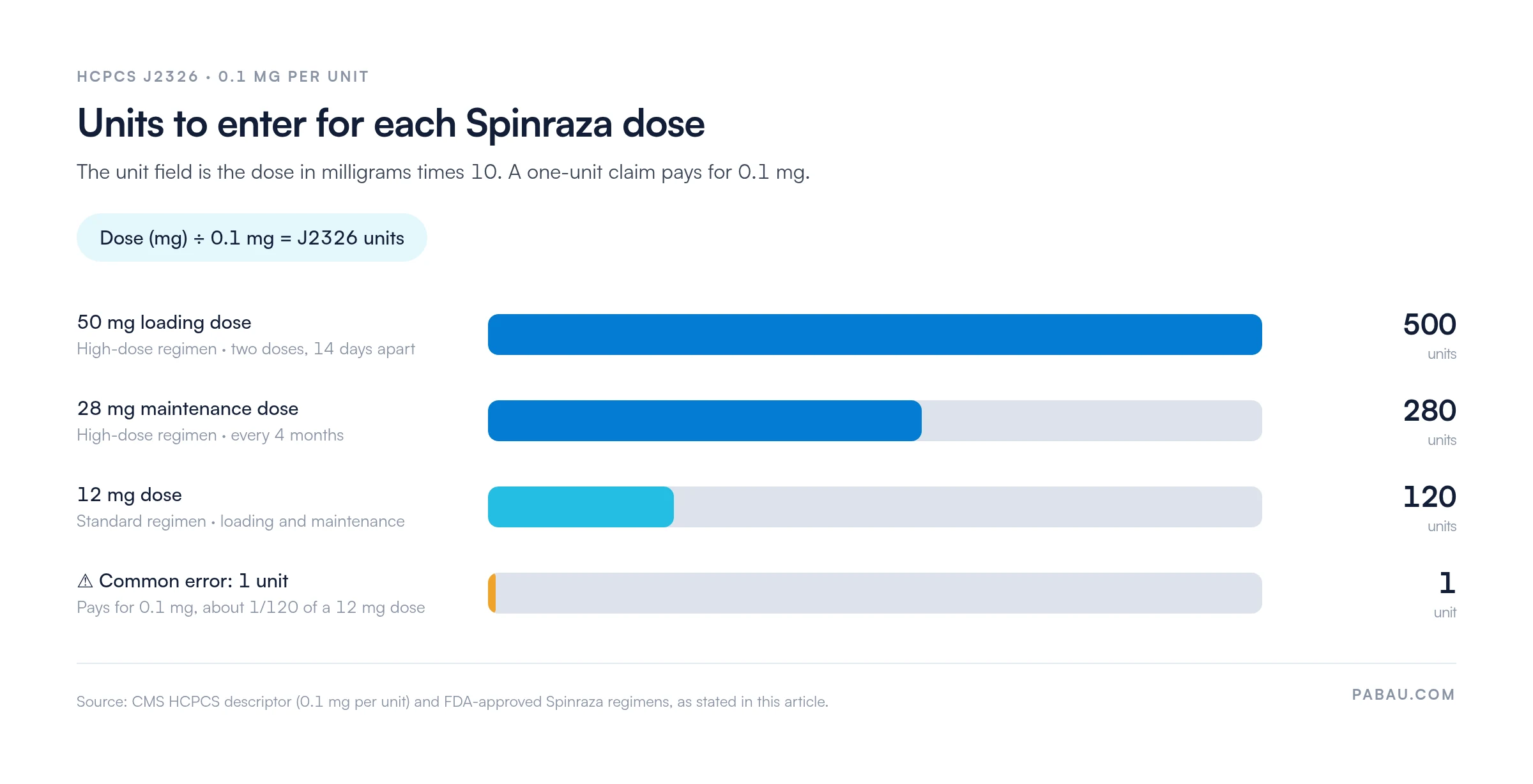
The standard regimen uses a fixed 12 mg dose, so its claims carry 120 units. A high-dose claim carries 500 units for a loading dose and 280 units for a maintenance dose. Any other unit count needs a documented, payer-approved dose change behind it.
Spinraza has two FDA-approved regimens, and each sets a different J2326 claim rhythm. Knowing which regimen the patient is on lets coders anticipate frequency edits before they occur.
Payers apply frequency edits to J2326 based on these schedules. Under the standard regimen, a maintenance claim submitted earlier than about 112 days after the prior claim commonly triggers a denial. When the date falls close to that threshold, include the prior administration date and the PA approval letter to pre-empt an edit.
Ask each payer how it edits the high-dose schedule, because its 14-day loading interval differs from the standard regimen’s.
Where the intrathecal injection is performed determines both the applicable CPT companion code rules and the reimbursement methodology for J2326. Three settings are commonly used.
The physician office (POS 11) setting is where coders most often encounter J2326. The outpatient hospital setting introduces OPPS packaging risk. The drug cost may be bundled into the facility’s APC payment rather than separately reimbursed on the professional claim. Neurology practices performing the procedure in an office or infusion suite avoid this complication.
Most Medicare Advantage, Medicaid and commercial payers require prior authorization for HCPCS code J2326. Nusinersen is one of the highest-cost drugs in the neurology formulary, and payers apply rigorous clinical criteria before approving coverage. A missing or expired PA is one of the most common denial reasons after unit errors. Our guide to the prior authorization process walks through the submission and renewal steps.
Traditional Medicare generally follows CMS coverage criteria without requiring a formal PA for Part B drug claims. Most Medicare Advantage plans and commercial payers do require one, so confirm the specific payer’s policy before the first administration.
Build PA renewal tracking into your workflow, because maintenance dose authorizations typically expire annually. A lapse causes an immediate denial even when the clinical criteria are unchanged. Insurance eligibility verification before each administration date catches expired authorizations before the injection occurs.
Medical necessity documentation must connect every element of the claim. Payers auditing J2326 claims look for a clear chain from the genetic diagnosis through the functional assessment to the administration record. A document missing anywhere in that chain produces a denial, even when the clinical picture is straightforward. Our guide to medical billing compliance covers the record-keeping standards behind an audit.
Under Part B, Medicare pays J2326 at ASP plus 6% (about 4.3% after sequestration) in the physician office setting. Payment starts from the drug’s average sales price (ASP) for the current quarter, plus the statutory add-on. The ASP figure changes quarterly. Check the CMS Physician Fee Schedule lookup and the CMS ASP Drug Pricing files on cms.gov for the current J2326 amount. Never rely on a figure from a previous quarter for current claims.
J2326 is a Part B drug because a healthcare professional administers it by intrathecal injection. Part D does not cover drugs that fall under Part B, so claims submitted to Part D for nusinersen are rejected. Medicare Advantage plans apply the same Part B benefit, but they may add utilization management requirements beyond traditional Medicare’s criteria.
For a drug at this cost level, every day between administration and claim submission delays a large payment. Streamlined claims management builds the claim from the visit record, so nobody re-keys the dose or the units.
Several coding errors stem from confusing J2326 with codes for other SMA treatments or for adjacent drug administration services. The table below covers the most frequent points of confusion.
Risdiplam (Evrysdi) is the oral SMA treatment that most frequently causes confusion. Because it treats the same condition as nusinersen, coders sometimes attempt to use J2326 for it. Risdiplam has no HCPCS J-code because patients take it orally at home. It falls under the Part D pharmacy benefit, not the Part B drug benefit. For a broader look at HCPCS Level II code structure, the AAPC Codify HCPCS lookup is a reliable reference.
Run a pre-submission review on every J2326 claim. Confirm the units match the dose: 120 for 12 mg, 500 for 50 mg or 280 for 28 mg. Confirm the companion CPT code is present and the ICD-10 code matches the SMA type in the PA approval. Then confirm the authorization number has not expired. These four checks catch the most common J2326 denials before they happen.
Nusinersen denials cluster around a predictable set of errors. Understanding the pattern lets billing teams build a pre-submission checklist that prevents most of them. Structured denial management workflows matter most for high-cost drugs, where each unresolved denial holds back a large payment.
State Medicaid programs and commercial plans apply more variable criteria than traditional Medicare, so each policy needs checking before the first claim.
Each state Medicaid program sets its own coverage policy for nusinersen. Common Medicaid-specific requirements include:
Check the relevant state Medicaid drug policy bulletin or preferred drug list before submitting the first claim for a Medicaid patient.
Commercial plans typically apply the most restrictive criteria of the three payer categories. Step therapy requirements are uncommon for nusinersen, but commercial plans may require a re-authorization review every six months rather than annually. Some plans impose site-of-care restrictions, preferring infusion centers over physician offices to manage cost. That changes the place-of-service code and can change which companion CPT code the payer accepts.
A clean J2326 claim depends on the dose, the unit count, the PA dates and the procedure note agreeing with each other. In many practices those records live apart. The treatment note sits in the EHR, the authorization letter in a shared drive, and the invoice in a separate billing tool.
In Pabau, the treatment note, digital forms, invoice and payment all sit on the same patient file. Your billing team can check the documented dose against the units on the claim line without switching systems.
Pabau’s reporting pulls invoices and payments into one view, so an underpaid J2326 claim shows up before month-end reconciliation rather than weeks later.

Pabau brings treatment notes, invoicing, payments and reporting into one system. Your billing team can match every J2326 claim to its documented dose before it goes out.

The check that pays back fastest on J2326 is a pre-submission review of units, the companion code and the PA dates. Start with the regimen, because the high-dose schedule changes both the unit count and the claim rhythm.
For practices with several SMA patients on maintenance therapy, the harder work is keeping authorization dates and dose records aligned with each claim. Pabau keeps medical billing, payments and reporting in one system with the patient file, so that check happens in one place.
Book a demo to see how Pabau keeps each J2326 dose, invoice and payment on one patient record.

Need a structured approach to clean claim submission? What makes a clean claim breaks down the elements payers check before processing any drug claim.
Working through an ERA after a J2326 denial? Understanding electronic remittance advice explains how to read CARC and RARC denial codes from the 835 transaction.
Want to understand how billing fits the broader revenue cycle? What is revenue cycle management covers the full claim-to-payment workflow for outpatient practices.
Preparing a PA request for nusinersen? Medical prior authorization form gives you a ready template for the request payers ask for.
HCPCS code J2326 is used to bill nusinersen (Spinraza) injection at 0.1 mg per unit for patients with spinal muscular atrophy. It is billed alongside an intrathecal administration code, typically CPT 96450, and most payers require prior authorization.
A 12 mg standard-regimen dose is billed as 120 units, because each J2326 unit is 0.1 mg. On the high-dose regimen, a 50 mg loading dose is 500 units and a 28 mg maintenance dose is 280 units. Billing 1 unit instead of the full count is a common J2326 error.
Yes, Medicare Part B covers J2326 because nusinersen is physician-administered (intrathecal injection) rather than self-administered. Reimbursement is ASP plus 6% (about 4.3% after sequestration) in the physician office setting. Traditional Medicare does not require a prior authorization, but Medicare Advantage plans often do.
Medicare contractor guidance from Noridian pairs J2326 with CPT 96450 on the same date of service. That code covers chemotherapy administration into the central nervous system, requiring spinal puncture. Some payers accept the lumbar subarachnoid injection codes 62322 or 62323 instead, so confirm the payer’s policy first.
The leading denial reasons are an incorrect unit count and a missing or expired prior authorization. Others include an ICD-10 code that doesn’t match the PA approval and standard maintenance doses submitted fewer than 112 days apart. A missing companion CPT code for the intrathecal injection also triggers denials.
Yes, prior authorization is required by virtually all commercial payers and most Medicaid programs for J2326. Traditional Medicare Part B does not formally require PA, but Medicare Advantage plans typically do. Authorization generally must be renewed annually for maintenance therapy.



