

HCPCS code E0198: Water pressure pad billing guide
HCPCS code E0198 is a water pad for a standard mattress HCPCS code E0198 is the ...

Last Updated: Oct 13, 2026
J2185 is the HCPCS Level II code for injection, meropenem, 100 mg. It bills the drug when a provider gives meropenem, a carbapenem antibiotic sold as Merrem IV, by IV infusion or injection.
One billing unit covers 100 mg, so a 1 g dose is 10 units. The WG Critical Care and B. Braun meropenem products have their own codes, J2183 and J2184, and are not billed with J2185.
Let Pabau's smart automation suggest the right codes, reduce claim denials, and keep your practice compliant—effortlessly.
Automate repetitive tasks and focus on what matters most—your patients.
Reduce coding errors and ensure compliance with the latest regulations.
Clean claims, fewer denials, and faster reimbursements.
Powerful insights and reporting to help your practice thrive.
HIPAA compliant SOC 2 certified GDPR-compliant Trusted by 4,000+ clinics worldwide

HCPCS Code J2185 reports meropenem injection, and one billing unit equals 100 mg, so a 1 g dose is billed as 10 units.
Bill the dose given from a single-dose vial, and report any discarded amount on a second line with the JW modifier.
Medicare requires the JZ modifier on separately payable single-dose vial claims when no drug was discarded.
Meropenem from WG Critical Care and B. Braun has its own codes, J2183 and J2184, so check the product before you code.
In Pabau’s practice software, the treatment note, the invoice and the claim status sit on one patient record, so billing works from one source.
HCPCS Code J2185 is the Level II code for “Injection, meropenem, 100 mg,” maintained by the Centers for Medicare & Medicaid Services (CMS). It sits in the J-code range, which covers drugs given by a route other than the mouth.
Meropenem is a carbapenem antibiotic, sold in the US as Merrem IV and as generic meropenem for injection. It is a broad-spectrum drug for serious bacterial infections, given intravenously as an infusion or a bolus injection.
The Merrem IV prescribing information covers complicated skin and skin structure infections and complicated intra-abdominal infections. It also covers bacterial meningitis in children aged 3 months and older. J2185 has been active since January 1, 2004, and it remains valid for 2026 claims.
J2185 is billed when a provider gives meropenem intravenously and the drug is separately payable for that encounter. The code covers the drug alone.
The infusion or injection goes on its own line with an administration code. Use CPT 96365 for an initial IV infusion of up to one hour, or 96374 for an IV push.
Typical scenarios include outpatient infusion for a patient stepping down from hospital care, and emergency department doses for a patient who is not admitted. Meropenem is usually dosed every 8 hours, so one date of service can carry several doses.
Billing J2185 for the wrong product or setting is a frequent cause of denials. Check the administration against these exclusions before the claim goes out.
One unit of J2185 equals 100 mg of meropenem. Bill for the dose given to the patient, then report any drug discarded from a single-dose vial on its own line. Four checks, in order, turn one vial into the right claim lines.
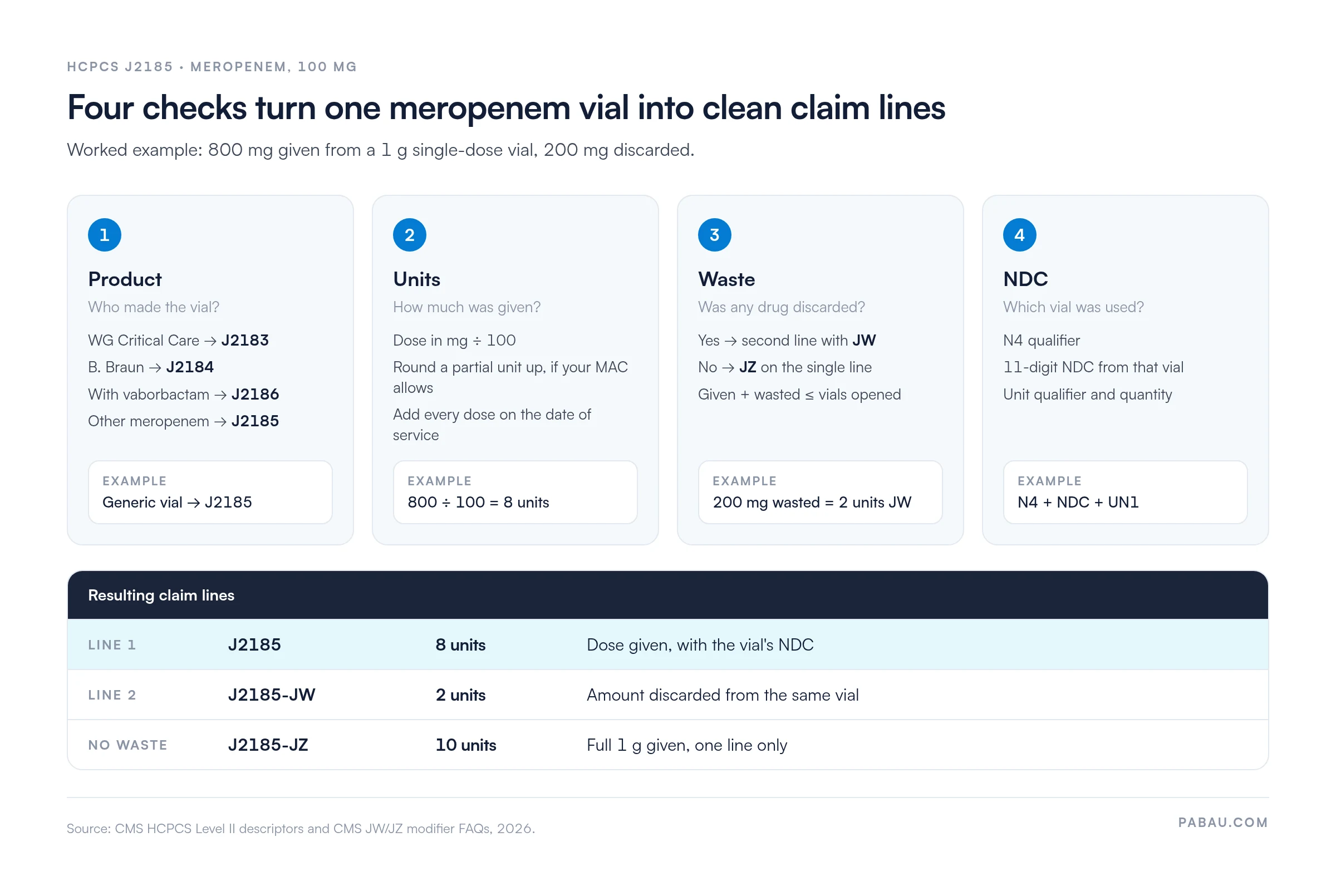
Divide the dose in milligrams by 100. Medicare contractors generally tell you to round a partial unit up to the next whole unit, so confirm your MAC’s policy.
Each dose counts toward the line total. Three 1 g doses on one date of service add up to 30 units.
Meropenem comes in single-dose vials, so Medicare’s discarded drug rules apply. CMS has required the JW modifier for discarded drug since January 1, 2017, and the JZ modifier since July 1, 2023.
Medicare pays for the discarded amount on the JW line. A missing modifier can lead to a CO-4 denial. The CMS JW and JZ modifier FAQs apply the rule only to Part B drugs that are separately payable. Medicaid and commercial payers set their own waste rules.
Every J2185 claim needs a medical record that supports medical necessity and the dose billed. Payers compare the medication administration record with the units on the claim, and a mismatch is a common audit trigger.
A complete superbill is not enough on its own. The clinical note must contain each of the following elements.
For clean claim submission on the CMS-1500, the NDC goes in the shaded area above Box 24A. Take the NDC from the vial you used, because NDCs differ by manufacturer and package size.
Add a three-point check to your pre-submission routine for J2185. Confirm the manufacturer matches the code, the units match the documented dose, and the modifier matches the waste record. These checks catch the errors behind the denials listed below before a payer sees them.
Medicare Part B covers meropenem under J2185 when it is reasonable and necessary and given in an office or hospital outpatient setting. Doses given during a covered inpatient stay are paid through Part A instead.
Medicare pays most Part B drugs given in a physician office at the average sales price (ASP) plus 6%. Hospital outpatient departments are paid under the Outpatient Prospective Payment System (OPPS), where low-cost drugs can be packaged into another payment. CMS updates ASP pricing every quarter, so check the current CMS ASP pricing files rather than an old figure.
Medicare Part B does not usually require prior authorization for meropenem. Medicaid programs and commercial plans set their own rules, and some review carbapenem use for outpatient infusion. Confirm the payer’s rules before the first outpatient dose, not after a denial.
Electronic remittance advice (ERA) from payers lists the reason and remark codes behind any reduction or denial. Our guide to electronic remittance advice covers how to track those codes systematically.
Most J2185 coding errors come from picking the wrong meropenem code. Another comes from J2175, which differs from J2185 by one digit but bills a different drug.
HCPCS coding rules call for the specific code whenever one exists, so J3490 is never correct for standard meropenem. Payers often reject an unclassified code that has a specific alternative, and at best they send the claim to manual review.
J2185 denials usually trace back to the NDC, the units, the waste modifier, or the product code. The table maps each pattern to its denial codes and the fix.
A structured approach to denial management that tracks J-code denials by reason code surfaces patterns quickly. If NDC or waste denials repeat, fix the documentation step at the infusion chair, not at the billing desk.
Run a quarterly review of your J2185 claims. Group each denial by reason code and trace it to its source: the NDC, the units, the waste modifier, or the product code. Then fix the step that caused it, not only the individual claim.
Meropenem is a broad-spectrum antibiotic, so reviewers look at why it was chosen as well as how it was billed. Hospitals must run an antibiotic stewardship program under the Medicare Conditions of Participation, and carbapenems are a common focus.
Medical billing compliance works best when the chart and the claim match at the point of care. Records rebuilt at audit time rarely hold up.
Many practices record the dose in one system, raise the invoice in another, and submit the claim through a third. Each handoff is a chance for the units, the NDC, or the modifier to drift away from the chart.
Pabau keeps treatment notes, invoices, and insurance claims on the same patient record. Add the patient’s insurer and policy once, and each invoice routes to the right payer. In the US, claims go out electronically through the Claim.MD clearinghouse, with real-time eligibility checks.
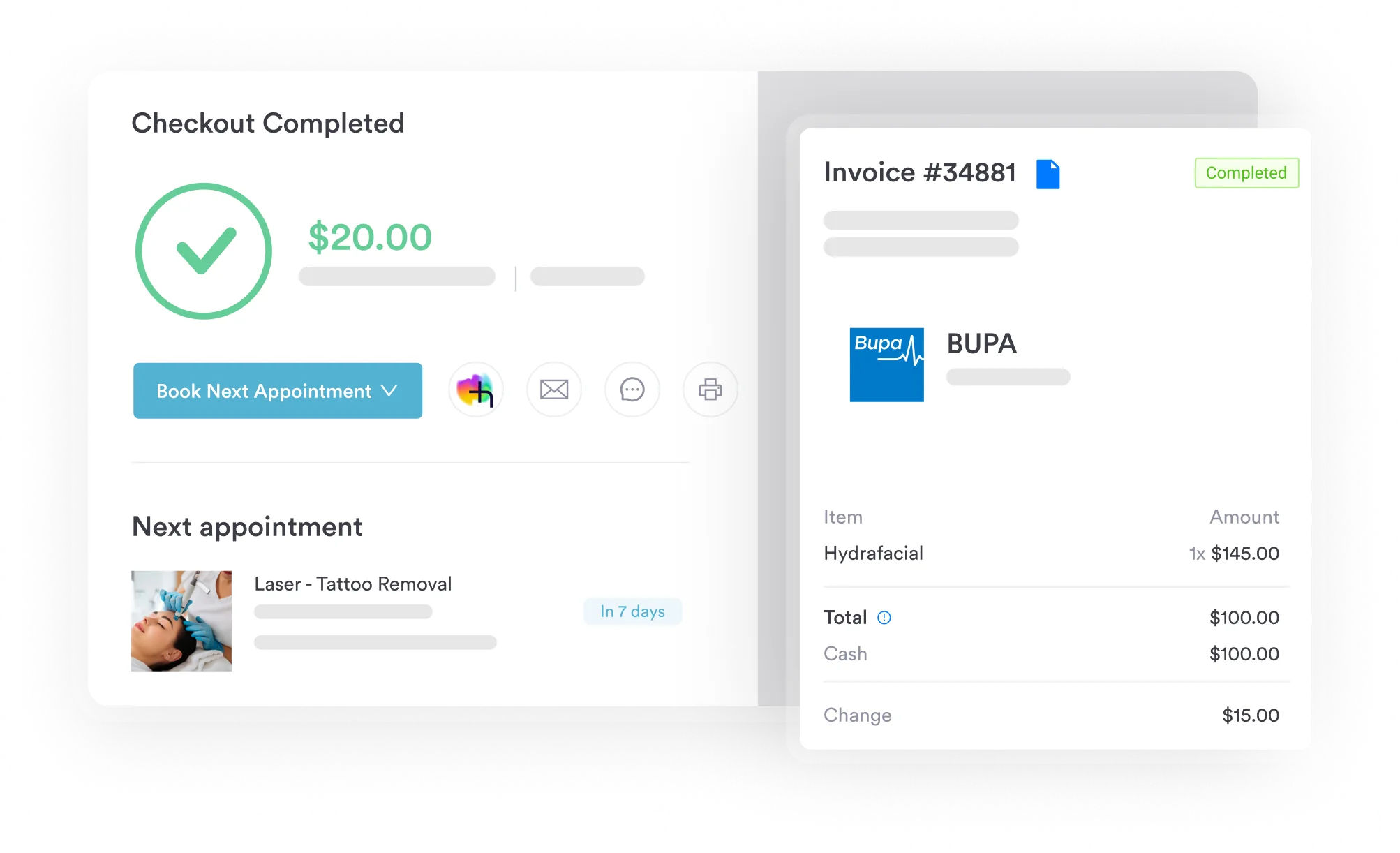
Pabau’s claims management software runs validation checks each time you send a claim, so missing payer details are flagged before submission. Your coder still assigns the code, units, and modifiers, working from the same record that holds the documented dose. The claims dashboard then tracks each claim from pending to paid and posts ERA remittances.

Pabau keeps treatment notes, invoices, and insurance claims on one patient record, and checks each claim before it is sent. Your team spends less time reworking denied J2185 claims.

HCPCS Code J2185 looks simple: one drug, one code, and 100 mg per unit. The claim still succeeds or fails on four checks. Match the product to the right meropenem code, bill units from the documented dose, report waste with JW or JZ, and send a valid NDC.
Build those checks into the infusion workflow, where the vial, the dose, and the waste are recorded. A minute at the chair saves the billing desk an appeal later.
Pabau keeps the dose record, the invoice, and the claim in one place. Book a demo to see how it supports J-code billing in your practice.

Need to understand how clean claims reduce revenue cycle delays? Clean claim best practices walks through the elements payers check before processing payment.
Want a reference for handling claim denials systematically? Denial codes in medical billing covers the most common remark codes and corrective actions.
Looking for guidance on billing compliance for your practice? Medical billing compliance covers audit risk, documentation standards, and OIG focus areas.
HCPCS Code J2185 is the Level II code for injection, meropenem, 100 mg. It bills the drug when a provider gives meropenem, a carbapenem antibiotic sold as Merrem IV, by IV infusion or injection. One billing unit equals 100 mg.
Divide the dose given in milligrams by 100. A 500 mg dose is 5 units, and a 1 g dose is 10 units. Medicare contractors generally round a partial unit up, so a 250 mg dose becomes 3 units. Confirm your MAC’s rounding policy.
Yes. Medicare Part B covers meropenem billed under J2185 when it is reasonable and necessary and given in an office or hospital outpatient setting. Doses given during a covered inpatient stay are paid through the inpatient payment instead. Physician office payment is usually based on ASP plus 6%, updated quarterly.
Medicare claims use JW for drug discarded from a single-dose vial and JZ when none was discarded. Bill the dose given on one line and the discarded units on a second line with JW. With no waste, add JZ to the single line.
J2185 covers meropenem without a product-specific code. J2184 covers the B. Braun meropenem product, and J2183 covers the WG Critical Care product. Both descriptors state the product is not therapeutically equivalent to J2185, so code from the product given.
No. Meperidine injection is billed with J2175, which covers meperidine hydrochloride per 100 mg. J2185 is meropenem, an antibiotic. The two codes differ by one digit, so check the code against the drug before you submit.
The record must show the drug and manufacturer, the dose ordered and given, the route and timing, and any amount discarded. It also needs the administering clinician’s signature and a supporting ICD-10-CM code. The claim needs the 11-digit NDC in the N4 qualifier format.



