HCPCS Code K0900: Customized DME billing and coding guide
HCPCS Code K0900: Official descriptor and code overview HCPCS Code K0900 is a CM...

Last Updated: Nov 18, 2026
J2770 is the HCPCS Level II code for injection, quinupristin/dalfopristin, 500 mg (150/350). It reports Synercid, an intravenous streptogramin antibiotic, billed in units of 500 mg.
Payers check three parts of every J2770 claim: the unit count, the 11-digit National Drug Code (NDC), and a diagnosis that supports medical necessity. CMS uses no fractional units, so a partial 500 mg unit is billed as a full one.
Let Pabau's smart automation suggest the right codes, reduce claim denials, and keep your practice compliant—effortlessly.
Automate repetitive tasks and focus on what matters most—your patients.
Reduce coding errors and ensure compliance with the latest regulations.
Clean claims, fewer denials, and faster reimbursements.
Powerful insights and reporting to help your practice thrive.
HIPAA compliant SOC 2 certified GDPR-compliant Trusted by 4,000+ clinics worldwide

HCPCS Code J2770 describes one 500 mg vial of quinupristin/dalfopristin (Synercid), a streptogramin antibiotic for vancomycin-resistant infections.
Units are billed per 500 mg, and CMS pays no fractional units, so a 750 mg dose bills as 2 units.
An 11-digit NDC with the N4 qualifier is mandatory on every J2770 claim under Medicare and most Medicaid programs.
Pabau’s claims management software sends J2770 claims through Claim.MD and tracks each prior authorization code on the patient’s case.
HCPCS Code J2770 is the Healthcare Common Procedure Coding System (HCPCS) Level II code for intravenous quinupristin/dalfopristin, billed per 500 mg unit.
The Centers for Medicare and Medicaid Services (CMS) maintains this descriptor as part of the quarterly HCPCS Level II update cycle for drug codes. J-codes fall within the drug range J0000 to J9999 and cover injected drugs that patients don’t typically give themselves at home.
The official CMS descriptor reads: Injection, quinupristin/dalfopristin, 500 mg (150/350). The parenthetical “(150/350)” specifies the fixed-ratio mixture: 150 mg quinupristin and 350 mg dalfopristin per vial, supplied commercially as Synercid.
The ratio matters for documentation. The physician order and the nursing administration record must both show the total dose in mg, because the coder calculates units from it.
Quinupristin/dalfopristin is a combination streptogramin antibiotic that blocks bacterial protein synthesis at two sequential steps on the 50S ribosomal subunit. The combination is synergistic and bactericidal against gram-positive organisms, including strains resistant to other antibiotic classes.
The FDA has approved Synercid for two primary indications. They matter for coding because payers use them to validate medical necessity on J2770 claims.
Quinupristin/dalfopristin is given intravenously through a dedicated central or peripheral line. There is no oral formulation, which is why a J-code for injectables that are not self-administered is the correct HCPCS vehicle for this drug.
J2770 covers only the drug itself, billed per 500 mg of quinupristin/dalfopristin given intravenously. The infusion is a separate service, usually reported with 96365 for the first hour, and is never bundled into J2770.
HCPCS Code J2770 is billed in units of 500 mg, so divide the total administered dose by 500. CMS does not use fractional billing units. A partial unit is reported as a full one.
Common error: Rounding a 750 mg dose down to 1 unit. CMS’s JW and JZ modifier guidance says a dose below the billing unit is reported as the full unit. The leftover half unit therefore counts as 1.
Medicare Part B also expects a modifier on drugs from single-dose containers. JZ attests that no drug was discarded. When a discarded amount is billed, it goes on a second claim line with the JW modifier.
CMS requires the National Drug Code (NDC) to accompany every J2770 claim submitted on a CMS-1500 form or 837P electronic transaction. Missing or malformed NDC data is one of the leading causes of J2770 claim denials. Submitting a clean claim means the NDC field is complete before the claim leaves the practice.
The NDC must be formatted as an 11-digit number in 5-4-2 segments (labeler-product-package), even if the vial labeling shows a 10-digit format. Zero-pad the appropriate segment to reach 11 digits.
On a paper CMS-1500, NDC information goes in Box 24. On an 837P, it populates Loop 2410. Check the exact loop and segment rules against current CMS billing instructions for your MAC jurisdiction, because the format has been refined over successive updates.
Every J2770 claim requires at least one ICD-10-CM diagnosis code that establishes medical necessity. Payers cross-reference the submitted diagnosis against their Local Coverage Determination (LCD) or coverage policy for this drug. The table below lists the primary codes accepted by most MACs for quinupristin/dalfopristin claims.
Important: Always check accepted diagnosis codes against your MAC’s current LCD for this drug. Some MACs restrict coverage to culture-confirmed VREF, so the chart needs culture and sensitivity results before the claim goes out.
Before submitting a J2770 claim, confirm the medical record contains a culture and sensitivity report identifying the organism. Payers commonly audit for this document and deny claims where the diagnosis code for VRE appears without supporting microbiology results in the chart.
Medicare Part B covers J2770 when the drug is given in a covered outpatient setting and an appropriate diagnosis supports the claim. Covered settings include hospital outpatient departments, physician offices, and Medicare-certified infusion centers. The drug line is billed alongside the administration code on the same claim.
Medicare Part B pays for J2770 under the Average Sales Price (ASP) method, at ASP plus 6% in physician office and clinic settings. CMS publishes quarterly ASP pricing files, and the J2770 rate changes each quarter. Check the current file before you submit a claim or quote a 2026 figure.
Medicaid coverage varies by state. Some state programs cover J2770 for the same indications as Medicare. Others require prior authorization or cover the drug only in inpatient settings, where J2770 is not separately billable on an outpatient claim. Check coverage and unit limits with the state program before outpatient treatment starts.
Traditional Medicare has no program-level prior authorization (PA) requirement for J2770. Individual Medicare Advantage plans and most commercial payers do require PA before the drug is given. A claim submitted without a required PA almost always comes back denied, and that denial can’t be reversed retroactively.
A PA request for J2770 should include:
A J2770 claim stands on the clinical record. Auditors reviewing J2770 denials keep finding the same two problems. The record does not confirm the organism, or the documented dose does not map to the billed units. Every chart needs these elements before J2770 is submitted.
Supporting a J2770 claim also means meeting medical billing compliance standards:
A superbill that groups the drug, the administration code, and the diagnosis codes speeds up claim preparation. It also makes a missing element easier to spot.
Three codes generate the most confusion when billing quinupristin/dalfopristin or similar gram-positive antibiotics. Using the wrong code delays payment and can trigger National Correct Coding Initiative (NCCI) edit conflicts. When a payer’s fee schedule has no entry for J2770, it may tell you to bill J3490 instead.
The AAPC HCPCS code lookup and the PGM Billing HCPCS search tool both show the full J2770 descriptor. Coders can check adjacent J-codes there before finalizing a claim.
J2770 denials follow predictable patterns, and each one traces back to a field on the claim line. The chart below sets out those six fields, and the list after it covers the denial each one causes.
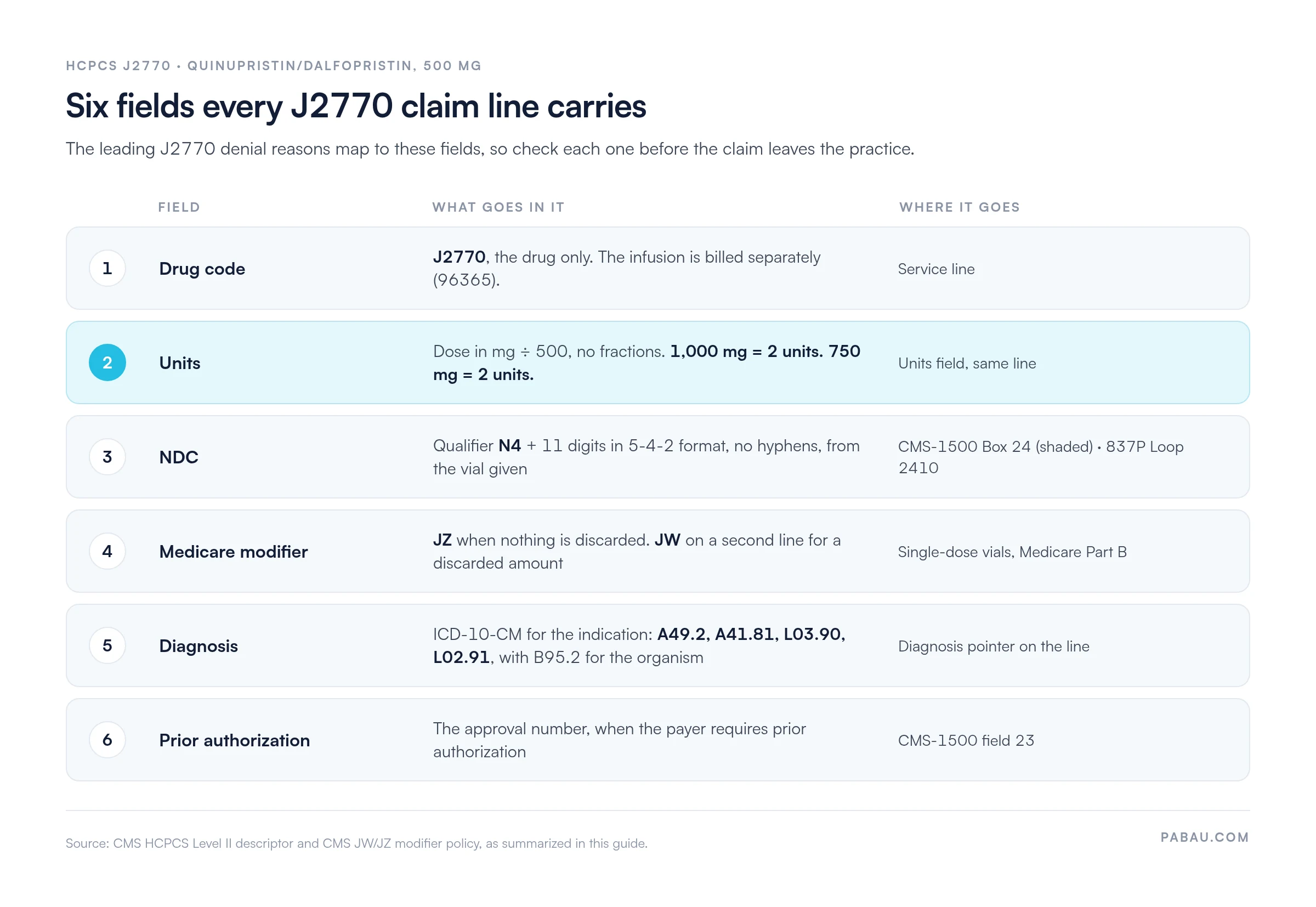
When a J2770 claim is denied, find the Claim Adjustment Reason Code (CARC) on the remittance. Look it up among the standard medical billing denial codes. A denial management workflow that maps common CARCs for J-code drugs to corrective actions shortens the time from denial to resubmission.
A J2770 claim usually passes through three hands. The physician writes the order, nursing records the dose, and a coder re-keys both into the claim. Each hand-off is a chance to lose the NDC, miscount units, or drop the prior authorization number.
Pabau, the practice management platform we build, keeps the patient record and the claim in one system. Its claims management software sends CMS-1500/837P claims through the Claim.MD clearinghouse and runs eligibility checks before the first dose. Electronic remittance advice (ERA) posts back against the same patient.
The prior authorization code, its dates, and its sessions sit on the patient’s case, with a warning when one is missing. So the approval number is on file before the infusion, and a denied drug line shows up on the remittance instead of at month-end.

Pabau’s claims management software submits J-code claims through Claim.MD, checks eligibility, and tracks prior authorizations on the patient’s case. See how it handles specialty drug billing.

J2770 is a low-volume code, so few coders bill it often enough to remember its quirks. The two that cost money are units and authorization. Report any partial 500 mg unit as a full one, and get the approval number on file before the first dose.
The rest of the claim follows from a complete chart: the culture result, the dose in mg, and the NDC from the vial. Book a demo to see how Pabau keeps the clinical record, the authorization, and the J2770 claim in one workflow.

Need a framework for reducing claim errors across all drug codes? Pabau’s claims management software provides end-to-end billing controls for specialty drug practices.
Unsure how remittance codes map to your denial patterns? Electronic remittance advice (ERA) explained breaks down how to read and act on ERAs for drug code denials.
Want to understand the full revenue cycle behind J-code billing? What is revenue cycle management covers the end-to-end billing process from coding to collections.
HCPCS Code J2770 covers the intravenous injection of quinupristin/dalfopristin (Synercid) in units of 500 mg per vial. The code describes the drug only; the administration fee is billed separately using the appropriate infusion administration code.
One unit equals 500 mg administered. Divide the total dose in mg by 500, and report any partial unit as a full one, because CMS uses no fractional billing units. A 1,000 mg dose bills as 2 units, and so does a 750 mg dose.
Traditional Medicare fee-for-service does not require prior authorization for J2770 at the program level, but Medicare Advantage plans typically do. Most commercial payers and many state Medicaid programs also require PA before the drug is administered. Confirm requirements with the specific plan before initiating treatment.
Include the 11-digit NDC with the N4 qualifier in Box 24 of the CMS-1500 form or in Loop 2410 of the 837P transaction. The NDC comes from the label of the vial given, without hyphens. Pair it with a unit qualifier (typically UN) and the quantity dispensed.
The 2026 Medicare reimbursement rate for J2770 is determined by the Average Sales Price (ASP) plus 6% methodology and changes quarterly. Check the current rate in the CMS quarterly ASP Drug Pricing File. No fixed figure holds for the year, because the rate updates every three months.
The most common reasons are a missing or malformed NDC, a unit error, or a diagnosis code the payer does not accept for J2770. Missing prior authorization, a non-covered setting, and National Correct Coding Initiative (NCCI) bundling conflicts follow. The CARC code on the remittance identifies the specific denial reason for each claim.