HCPCS Code Q4185: Cellesta flowable amnion billing guide
HCPCS Code Q4185: definition and official descriptor HCPCS Code Q4185 is the Lev...

Last Updated: Nov 20, 2026
J2248 is the HCPCS Level II code for injection, micafungin sodium, 1 mg. One billed unit equals one milligram given, so a 100 mg dose is reported as 100 units.
Micafungin is an echinocandin antifungal given intravenously for candidemia, esophageal candidiasis, and Candida prophylaxis in stem cell transplant patients. Adult doses run from 50 to 150 mg a day, so the unit count changes with the indication.
Let Pabau's smart automation suggest the right codes, reduce claim denials, and keep your practice compliant—effortlessly.
Automate repetitive tasks and focus on what matters most—your patients.
Reduce coding errors and ensure compliance with the latest regulations.
Clean claims, fewer denials, and faster reimbursements.
Powerful insights and reporting to help your practice thrive.
HIPAA compliant SOC 2 certified GDPR-compliant Trusted by 4,000+ clinics worldwide

HCPCS Code J2248 covers micafungin sodium injection, billed as one unit per milligram administered.
A standard 100 mg candidemia dose is billed as 100 units, never as one vial.
Medicare Part B pays J2248 at ASP plus 6%, which CMS set at $0.203 per unit for October to December 2026.
Baxter’s premixed micafungin bills as J2246 and Par Pharm’s as J2247, so the NDC on the product decides the code.
Pabau, the practice management platform we build, sends 837P drug claims through the Claim.MD clearinghouse and tracks prior authorization codes on the patient’s case.
HCPCS Code J2248 is the Level II code for injection, micafungin sodium, 1 mg. Each billed unit equals one milligram of micafungin given, so a 100 mg dose is 100 units. CMS’s October 2026 payment limit file lists J2248 as micafungin sodium injection with a 1 mg billing unit.
The Centers for Medicare and Medicaid Services (CMS) maintains HCPCS Level II, whose J-codes cover drugs given by injection or infusion. Micafungin is weight-based for children and fixed-dose for adults. A per-milligram unit lets payers check the billed quantity against the physician order in both cases.
Coders who bill per vial instead of per milligram over-report or under-report the dose, depending on the vial size dispensed.
The unit rule for J2248 is simple. Units billed equal milligrams administered, and the usual error is rounding to the nearest vial.
FDA prescribing information for Mycamine sets a different adult daily dose for each indication. The table below turns each one into billed units.
When a weight-based dose leaves part of a single-dose vial unused, bill the milligrams administered on one J2248 line. Medicare pays for the discarded amount on a separate J2248 line with modifier JW, and expects modifier JZ when nothing was discarded. Units far above the documented dose can trip a medically unlikely edit (MUE) and deny.
Coverage for HCPCS Code J2248 is tied to FDA-approved indications. Medicare and commercial payers may not cover off-label use without extra medical necessity documentation. Some also want a letter of medical necessity from the treating physician.
Prophylaxis claims need the most supporting detail of the three, because the record has to show the patient is an HSCT recipient. Check your Medicare Administrative Contractor’s (MAC’s) Local Coverage Determination (LCD) or billing article before billing prophylaxis, since criteria vary by region.
A complete J2248 claim has five components that must all be present and consistent with each other. Missing any one of them is enough to generate a denial.
Use claims management software that validates NDC entries and flags unit mismatches before submission. A claim with a missing NDC, or units that don’t match the administered dose, usually denies on the first pass.
Medicaid requires the National Drug Code (NDC) on physician-administered drug claims, and many Medicare contractors and commercial payers expect it on J-code lines too.
The NDC identifies the exact product given, including the labeler, product, and package size. CMS’s quarterly crosswalk maps Mycamine and several generic micafungin products to J2248.
Source: CMS ASP NDC-HCPCS crosswalk, October 2026. The crosswalk also lists Northstar, Apotex and Hisun products. Confirm the NDC on the vial you used before billing.
When reporting the NDC on the 837P, use the N4 qualifier, the 11-digit zero-padded NDC, the unit qualifier (UN for units), and the quantity dispensed.
On a paper CMS-1500, the NDC information goes in the shaded area of field 24. An NDC in any format other than 11 digits, or a missing unit qualifier, triggers a claim edit at the clearinghouse or the payer.
Before submitting any J2248 claim, pull the medication administration record and confirm the NDC printed on the actual vial used. Pharmacy may dispense a different manufacturer’s generic on any given day. A claim with yesterday’s NDC on today’s claim date will trigger a crosswalk mismatch denial.
Medicare Part B pays for HCPCS Code J2248 at the average sales price (ASP) plus 6%. That method applies to buy-and-bill in physician offices, while hospital-based infusion centers are paid under the hospital outpatient prospective payment system (OPPS). Chapter 17 of the Medicare Claims Processing Manual sets out the ASP+6% method.
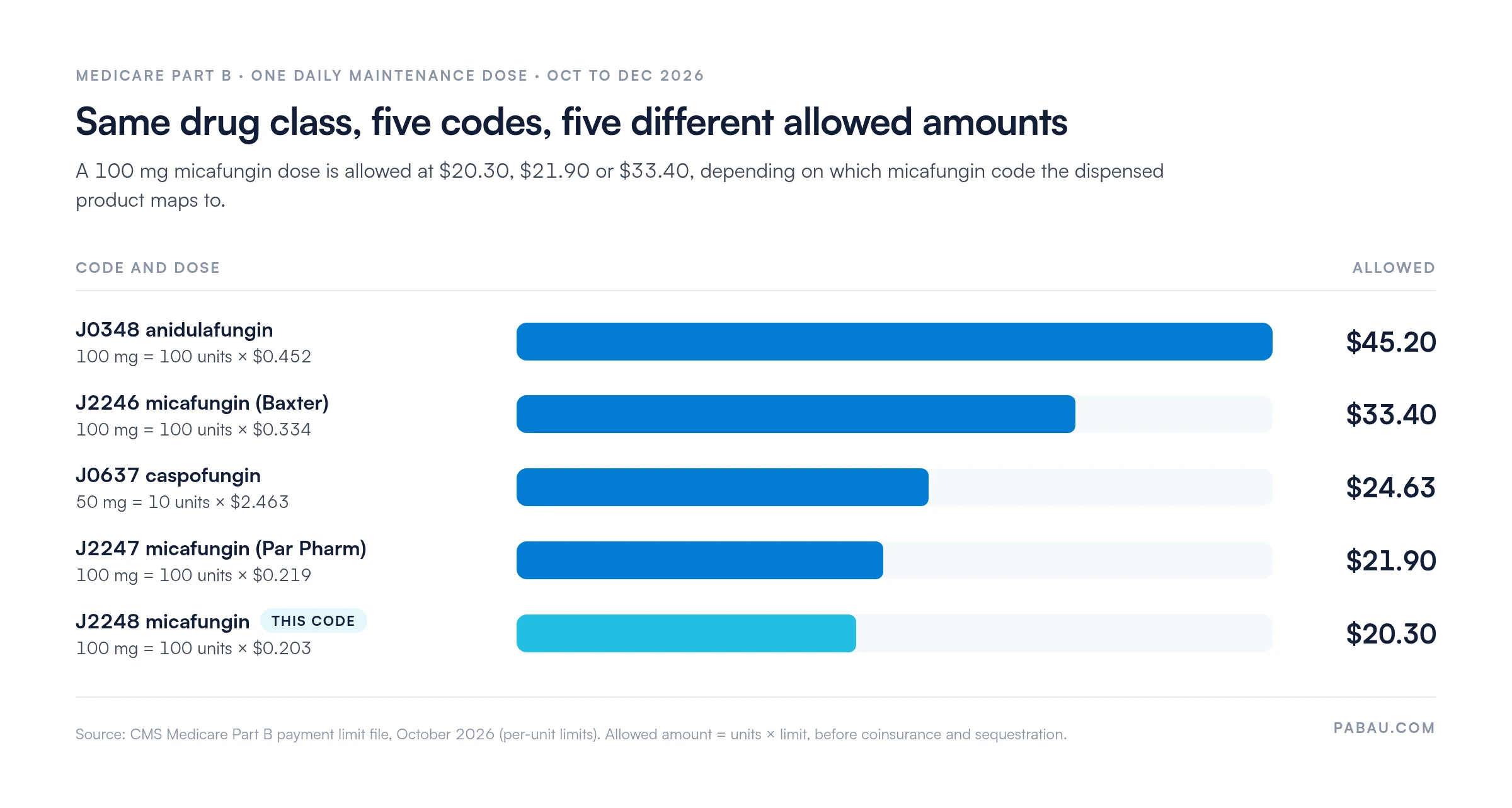
CMS recalculates ASP every quarter, so the J2248 payment limit changes four times a year. For October 1 to December 31, 2026, the limit is $0.203 per unit, which puts a 100 mg dose at $20.30.
CMS posts each quarter’s limits on its ASP pricing files page. Update your fee schedule from that file each quarter rather than hardcoding a rate.
Under white-bagging, a specialty pharmacy ships the drug to the infusion site for the patient’s plan. The provider never buys it, so it cannot bill J2248 under buy-and-bill.
Brown-bagging, where the patient brings the drug, works the same way. Confirm the dispensing arrangement first, because billing buy-and-bill on a white-bagged dose is a false claims exposure.
Medicare generally does not require prior authorization for HCPCS Code J2248 under the standard Part B fee-for-service program. Medicare Advantage plans and commercial insurers, however, frequently do require prior authorization (PA) for micafungin, particularly for outpatient or home infusion settings.
Medicaid programs vary by state. Some state Medicaid programs have step-therapy requirements that mandate a trial of fluconazole or another antifungal before authorizing micafungin. Document treatment failure or contraindication explicitly in the medical record to support PA requests when step therapy applies.
Five HCPCS codes cover the echinocandin antifungals, and three of them are micafungin. Billing the wrong one is easy when a pharmacy substitutes one product for another during a shortage.
J2248 belongs only to the micafungin products CMS maps to it, so using it for caspofungin or for Baxter’s premixed bag misreports the claim.
J2246 and J2247 are the trap specific to micafungin. CMS describes each one as not therapeutically equivalent to J2248. So the Baxter bags (NDCs starting 00338-905) and the Par Pharm vials (42023-0229-10 and 42023-0230-10) never go on a J2248 line.
The unit difference between J2248 and caspofungin’s J0637 causes the other common error. J2248 bills per milligram and J0637 per 5 mg. Bill a 50 mg caspofungin dose per milligram and the claim shows 50 units of J0637 instead of 10.
Anidulafungin bills as J0348, also per milligram. Check every code against the annual CMS update or AAPC’s HCPCS code ranges each January.
The code also changes what Medicare pays. Priced from the October 2026 file, one 100 mg micafungin dose is allowed at $20.30 under J2248, $21.90 under J2247 and $33.40 under J2246.
Incomplete documentation is behind most J2248 medical necessity denials found on audit. Every claim needs a paper trail linking the drug given to the physician order, the clinical indication, and the administration itself.
A solid documentation package also makes retrospective audits faster. When a superbill and clinical notes are stored together in the patient record, responding to a payer audit request takes hours rather than days.
Most J2248 denials trace back to four causes. They are a missing NDC, a unit error, absent prior authorization, or a diagnosis outside the approved indications. The table below maps each one to its Claim Adjustment Reason Code (CARC), root cause and fix. For the full code lists, see our guide to medical billing denial codes.
When a denial comes back on the remittance advice, read both the CARC and the accompanying Remittance Advice Remark Code (RARC) together. The CARC identifies the category of the denial; the RARC usually contains the actionable detail. For NDC denials, RARC M119 flags a missing, invalid or deactivated NDC.
Effective denial management starts with routing each remittance reason to the team member best positioned to fix it, not with sending blanket appeals.
Run a monthly J2248 denial report filtered by CARC code. If CARC 16 (NDC error) accounts for more than 15% of your J2248 rejections, the problem is in your pre-billing workflow, not your appeals process. Add an NDC validation step at charge entry that cross-references the administered vial’s label against the payer crosswalk file before the claim is built.
Many infusion practices bill micafungin from three places. The dose sits in the MAR, the NDC on a pharmacy label, and the authorization in an email thread. Each handoff is a chance for a unit error, a missing NDC or a lapsed authorization.
Pabau keeps those details on the patient record the claim is built from. The lot number and expiry of each vial are recorded against the patient and the appointment. Prior authorization codes, dates and sessions sit on the case, with a warning when one is missing.
Claims go out through the Claim.MD clearinghouse as 837P files. Eligibility responses and electronic remittance advice come back to the same record. A CARC 16 or CARC 151 denial then lands next to the charted dose. Your team corrects the line there and resubmits.

Pabau sends 837P claims through Claim.MD, checks eligibility, and posts remittances to the patient record. Prior authorizations are tracked on the case, so J2248 claims go out with the details payers check.

J2248 rewards one habit above the rest: read the product before you pick the code. The NDC on the vial or bag tells you whether the line is J2248, J2246 or J2247. The MAR tells you the milligrams, and the units follow from those two facts.
Get those right and most of the denial table above never reaches your practice. What remains is authorization for commercial and Medicare Advantage plans, plus a quarterly check of the CMS payment limit. Book a demo to see how Pabau keeps drug doses, authorizations and claims on one patient record.

Need a clearinghouse reference for submitting J-code drug claims electronically? Medical claims clearinghouse guide explains how clearinghouses validate NDC entries and route drug claims to payers.
Want to understand the 837P file structure for J-code NDC reporting? 837 file overview covers the transaction loop and qualifier fields used to submit NDC information on electronic drug claims.
HCPCS Code J2248 covers injection of micafungin sodium, billed at 1 unit per 1 mg of drug administered. It has three FDA-approved indications. They are candidemia and invasive candidiasis, esophageal candidiasis, and Candida prophylaxis in hematopoietic stem cell transplant recipients.
Bill 1 unit per 1 mg of micafungin administered. A 100 mg dose for candidemia = 100 units. A 150 mg dose for esophageal candidiasis = 150 units. A 50 mg prophylaxis dose = 50 units. Always base units on milligrams administered per the MAR, not the vial size dispensed.
Medicare fee-for-service does not generally require prior authorization for J2248, though medical necessity documentation is always required. Medicare Advantage plans and commercial insurers frequently do require PA, and Medicaid requirements vary by state. Always verify PA requirements with the specific payer before administering the drug in an outpatient setting.
Medicare Part B reimburses J2248 at ASP+6% (Average Sales Price plus 6 percent). The per-unit dollar amount changes quarterly as CMS updates the ASP Drug Pricing Files. Check the CMS ASP files each quarter for current rates; never rely on a fixed figure in your billing system.
The primary brand is Mycamine (Astellas Pharma) in 50 mg and 100 mg vials. Multiple generic manufacturers also produce micafungin sodium. Generic NDCs change as manufacturers enter or leave the market. Check the NDC on the vial you used against the FDA NDC Directory and your payer’s crosswalk before billing.
Yes. J2248 can be billed in physician offices (POS 11) and independent infusion centers. It can also be billed in off-campus (POS 19) and on-campus (POS 22) hospital outpatient departments. The reimbursement methodology and rate differ by setting: Physician offices receive ASP+6% under Part B buy-and-bill; hospital outpatient settings receive an OPPS APC rate.