HCPCS code J3471: Hyaluronidase ovine injection billing guide
HCPCS code J3471: Descriptor, code type, and quick-reference data HCPCS code J34...

Last Updated: Oct 14, 2026
J0698 is the HCPCS Level II code for injection, cefotaxime sodium, per gm. Practices use it to bill the drug when a provider gives cefotaxime by IV infusion or intramuscular injection. The administration is billed separately with a CPT code.
Units are billed per gram. Unit-conversion mistakes, missing JW or JZ modifiers and, on payers that require one, a missing NDC are common causes of denial.
Let Pabau's smart automation suggest the right codes, reduce claim denials, and keep your practice compliant—effortlessly.
Automate repetitive tasks and focus on what matters most—your patients.
Reduce coding errors and ensure compliance with the latest regulations.
Clean claims, fewer denials, and faster reimbursements.
Powerful insights and reporting to help your practice thrive.
HIPAA compliant SOC 2 certified GDPR-compliant Trusted by 4,000+ clinics worldwide

HCPCS code J0698 covers injection, cefotaxime sodium, per gram, billed in whole units with the administered dose rounded up to the next gram.
Medicare Part B covers J0698 when a provider administers the drug incident-to a physician’s service or in an outpatient setting.
JW and JZ modifiers are required on Medicare Part B claims for drugs from single-dose containers. JZ claim edits began July 1, 2023, and a line missing them can be denied.
J0694 (cefoxitin) also bills per gram, so only the drug name on the order separates it from J0698.
Pabau, the practice software we build, helps carry treatment documentation into claim preparation, so dose and vial details are on record before billing.
HCPCS code J0698 carries the official CMS descriptor “Injection, cefotaxime sodium, per gm.” Each part of that descriptor shapes the claim.
“Injection” limits the code to parenteral use, so an oral cephalosporin can’t be billed under it. “Cefotaxime sodium” names the drug, and a different cephalosporin needs its own code. “Per gm” sets the unit of service at one gram, rounded up to the next whole gram.
FDA labeling for Claforan and its generics classes cefotaxime as a third-generation cephalosporin. It treats serious bacterial infections, including sepsis, meningitis, pneumonia and intra-abdominal infections. The ICD-10-CM code paired with J0698 needs to reflect one of these conditions to support medical necessity.
J0698 sits in the J-code range for drugs given other than by mouth, which you can browse in our searchable HCPCS code library.
Medicare Part B covers J0698 when a provider administers the drug, either incident-to a physician’s service or in an outpatient setting. That includes a physician office or a hospital outpatient department. The CMS HCPCS program governs the code’s scope. Medicare benefit policy decides which settings qualify.
Because coverage turns on who gave the drug and where, record both in the clinical note at the time of administration. A dose given during an inpatient stay belongs on the hospital’s Part A claim, not on a J0698 line from the practice.
Each unit of J0698 equals one gram of cefotaxime sodium. A 2 g dose is billed as 2 units. A 500 mg dose is 0.5 g, which rounds up to 1 unit.
Medicare bills the administered amount in units rounded up, and JW covers only the remaining whole discarded units. The three checks below turn any dose into the right claim lines.
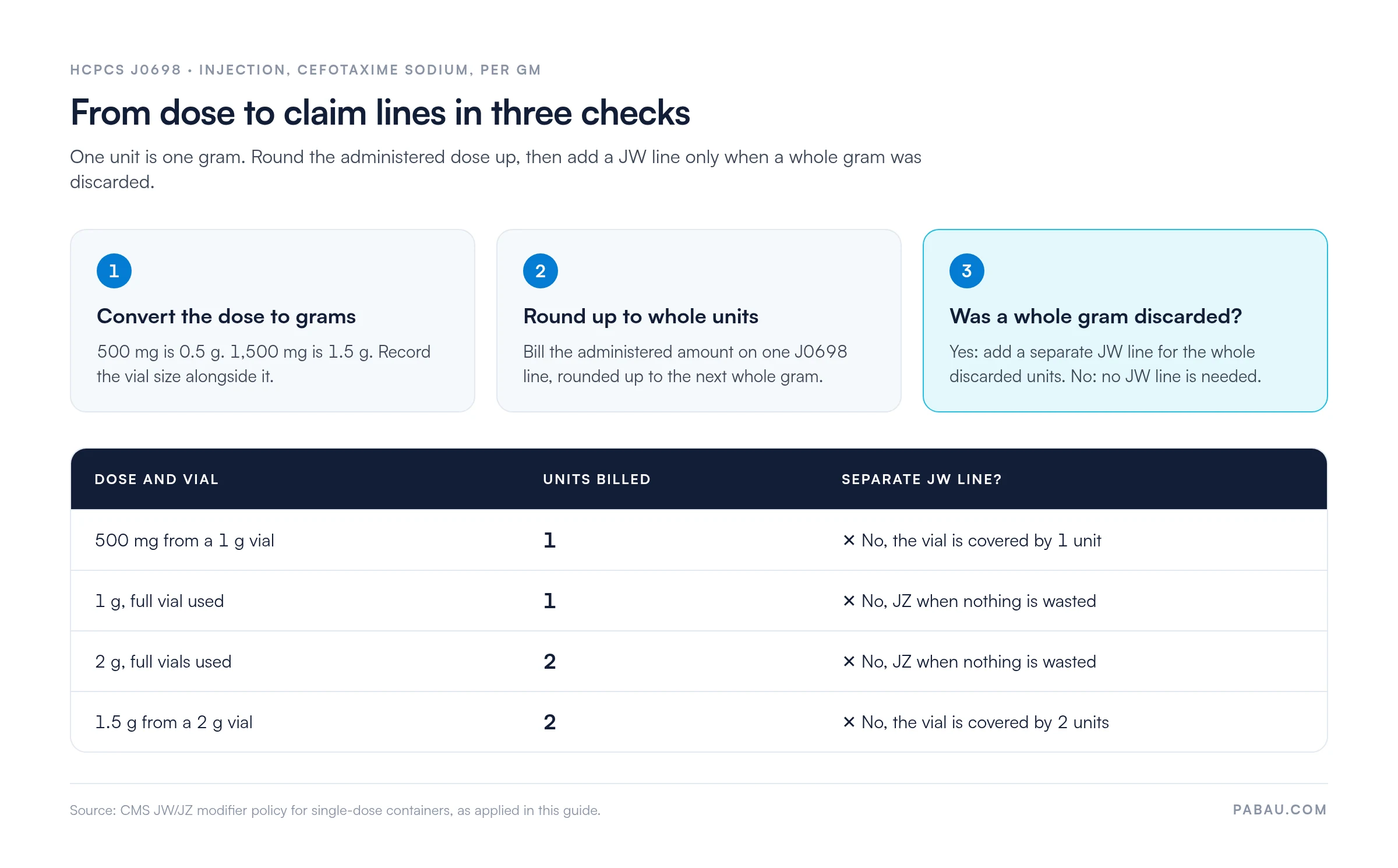
The table works through the same four doses, with the modifier each one needs.
The buy-and-bill model applies to most J0698 claims. The practice buys cefotaxime sodium, administers it, and bills both the drug and the administration service. Recording vial size, dose drawn and dose discarded is the foundation of an audit-ready record under this model.
Medicaid and many commercial payers require a National Drug Code (NDC) on drug claims, including J0698. Medicare Part B usually does not require one, so check your MAC and each payer’s policy.
Where an NDC is required, it must match the specific cefotaxime sodium product purchased and administered. CMS publishes a quarterly crosswalk file that maps each active NDC to its J-code. Check the current file before you submit, because NDCs change when manufacturers update packaging or discontinue products.
When a payer requires it, report the NDC in the 11-digit 5-4-2 format. It goes on the CMS-1500 form or in the designated loop of the 837P electronic claim. Use the unit qualifier “GR” (grams) to match the per-gram billing unit of J0698. On those claims, a mismatched NDC or missing qualifier is a common denial trigger.
The NLM’s HCPCS API lets you cross-reference HCPCS code data programmatically.
Medicare Part B reimburses J0698 at the average sales price plus 6% (ASP + 6%), the standard method for physician-administered Part B drugs.
CMS updates ASP-based rates every quarter. The rate that applies is the one for the quarter the drug was given, not the quarter the claim went out. Pull the current rate from the CMS ASP Drug Pricing Files before quoting expected reimbursement.
The CMS Physician Fee Schedule lookup gives the facility and non-facility rates for the administration code billed with J0698. That’s CPT 96365 or 96366 for an IV infusion, or 96372 for an IM injection. Well-run claims management workflows help practices reconcile ASP-based drug payments against administration code payments.
Medicare Part B covers cefotaxime sodium under J0698 when four conditions are met:
Medical billing compliance for J-code drugs depends on that documentation being in the record before the claim goes out. Three payer rules shape the claim beyond those four conditions.
Every J0698 claim requires at least one ICD-10-CM diagnosis code that establishes medical necessity for cefotaxime sodium therapy. The diagnosis must be documented in the clinical record and must link logically to the drug’s approved indications.
Specificity matters. Pairing J0698 with A49.9 when the record supports a more specific sepsis or meningitis code signals incomplete coding and can invite an audit. Use the most granular ICD-10-CM code the clinical documentation supports.
The JW and JZ modifiers are required on Medicare Part B claims for drugs from single-dose containers. The policy started January 1, 2023 (CMS Change Request 12849), with an education period, and JZ claim edits began July 1, 2023. A single-dose vial line that carries neither modifier can be denied.
Commercial payers vary. Some adopt the Medicare JW/JZ policy and others don’t, so check each payer’s billing guide. Where a payer doesn’t accept JW/JZ, submit without the modifier and document wastage in the clinical record for audit purposes.
Document vial size, dose drawn, dose administered, and dose discarded in the clinical note at the time of administration. That one note supports the JW/JZ modifier choice and gives an Office of Inspector General (OIG) auditor the record they expect.
J0698 covers the drug only, so a separate CPT administration code goes on the claim for the service. Cefotaxime can be given IV or IM, and the route decides the code. 96365 covers the first hour of an IV infusion, while 96372 covers an IM injection.
Bundling rules and the order of drugs given on the same date also affect which CPT code applies.
Check the CMS National Correct Coding Initiative (NCCI) edits before submitting J0698 with any administration code, because the edits change quarterly. Superbill documentation that captures infusion start time, stop time and drug sequence supports the right CPT choice and defends against rebundling denials.
Cefotaxime (J0698) is frequently confused with closely related cephalosporin codes, including J0696 (ceftriaxone, also third-generation). The drug name is the only reliable way to tell them apart, so check the order and the administered drug before you pick a code. The AAPC HCPCS code lookup confirms descriptors when in doubt.
J0696 (ceftriaxone) uses a per-250 mg unit, while J0698 (cefotaxime) uses a per-gram unit. Applying J0698’s unit math to a ceftriaxone claim underbills it fourfold. The reverse error, a cefotaxime dose coded as J0696, can trigger a unit mismatch denial. The units won’t line up with the documented vial sizes.
Cefoxitin is the quieter trap. J0694 also bills per gram, so a swap between the two codes passes every unit check. Only the drug name on the order catches it.
The four denials below are the ones J0698 claims are most exposed to, and each has a fix you can apply before resubmission. Systematic denial management in healthcare for drug codes starts with tracking which of these causes keeps recurring in your practice’s claims.
A J0698 claim that survives an audit needs a record answering six questions. What drug, what dose, what route, who gave it, when, and why? A clean claim submission starts with this documentation being present before the charge is entered.
Structured administration templates help infusion practices capture all six elements at the point of care. Rebuilding the record during an audit or appeal is far harder, and late entries draw extra scrutiny from the OIG.
On a busy infusion day, the dose often lands in one note and the vial size in another. The biller then works backward from the drug invoice to rebuild the units and decide whether a JW line is needed.
Pabau keeps the treatment note, the drug given and the diagnosis in one patient record. Its claims tools help carry that treatment documentation into claim preparation, so your biller starts from what the clinician recorded.
The result is fewer drug claims coming back for unit or modifier corrections. When a payer or auditor asks for the administration record, it’s already attached to the visit.

Pabau helps carry treatment documentation into claim preparation, so J0698 doses, vial sizes and administration details are on record before the claim goes out.

The cheapest place to get J0698 right is the point of administration. Record the dose, vial size and any discarded amount when the drug goes in, and the units, JW decision and NDC follow from the note.
The trade-off is a minute of extra charting per dose. That minute stops a 500 mg dose from picking up a JW line it doesn’t need. It also stops a cefoxitin vial from going out as J0698.
If your team still rebuilds drug claims from invoices, Pabau can help carry treatment documentation into claim preparation. Book a demo to see how that works for your practice’s drug administration billing.

Need to understand how drug billing fits into your revenue cycle? What is medical billing explains the end-to-end process from charge capture through payment posting.
Dealing with repeated J-code claim rejections? Denial codes in medical billing covers CARC and RARC reason codes that appear on remittance advice for drug claims.
Want to reduce claim rework across your infusion practice? Medical billing compliance outlines the documentation and process controls that support clean claim submission.
Giving cefotaxime as an IM injection? CPT code 96372 covers the administration code that pairs with an intramuscular J0698 dose.
Pushing the dose rather than infusing it? CPT code 96374 explains billing for an IV push of a single or initial drug.
HCPCS code J0698 covers injection, cefotaxime sodium, per gram. It’s billed when a provider gives the drug IV or IM in an outpatient or office setting. It does not cover self-administered doses, oral cephalosporins, or inpatient administration under Medicare Part A.
Bill one unit per gram administered, rounded up. A 2 g dose = 2 units. A 500 mg dose = 1 unit; no JW line is needed because the 1 g vial is fully accounted for by the 1 billed unit. Use JW only for whole units discarded.
The NDCs that map to J0698 belong to injectable cefotaxime sodium products (Claforan and generics) in 1 g, 2 g and bulk vial configurations. Report one when the payer requires an NDC, as Medicaid and many commercial payers do. NDC numbers change with new packaging, so check the current CMS quarterly ASP crosswalk file first.
Yes. Medicare Part B covers cefotaxime sodium when a provider administers it incident-to a physician’s service or in an outpatient setting. The claim also needs medical necessity documentation.
Medicare requires JW (drug wastage occurred) or JZ (no drug wastage) on Part B claims for drugs from single-dose containers. JZ claim edits began July 1, 2023, and a line missing the modifier can be denied. Commercial payers vary, so verify each plan’s modifier policy separately.
J0698 is for cefotaxime sodium billed per gram, while J0696 is for ceftriaxone sodium billed per 250 mg. Both are third-generation cephalosporins, but their unit scales differ. Applying J0696’s unit math to a cefotaxime claim produces a fourfold unit error and a denial.