

CCSD code G5100: Bypass of duodenum billing guide
CCSD code G5100 bills a bypass that leaves the duodenum in place CCSD code G5100...

Last Updated: Oct 16, 2026
J0692 is the HCPCS Level II code for injection, cefepime hydrochloride, 500 mg. One unit equals 500 mg of cefepime administered, so a 2 g dose bills as 4 units.
J0692 claims usually fail on the unit count, the NDC or the administration code. Medicaid and many commercial payers require the NDC, and the CPT administration code belongs on the same claim. A wrong unit count can draw a CO-151 denial, and a missing NDC typically returns CO-16 with remark M119.
Let Pabau's smart automation suggest the right codes, reduce claim denials, and keep your practice compliant—effortlessly.
Automate repetitive tasks and focus on what matters most—your patients.
Reduce coding errors and ensure compliance with the latest regulations.
Clean claims, fewer denials, and faster reimbursements.
Powerful insights and reporting to help your practice thrive.
HIPAA compliant SOC 2 certified GDPR-compliant Trusted by 4,000+ clinics worldwide

J0692 covers cefepime hydrochloride injection billed per 500 mg unit, distinct from the ceftriaxone code J0696 and the cefoxitin code J0694.
Each 500 mg of cefepime administered equals one billable unit, so a 2 g dose bills as 4 units.
NDC reporting in 11-digit format with the N4 qualifier is required by Medicaid and many commercial payers, and by Medicare for dual-eligible patients.
Pair J0692 with CPT 96365 for the initial IV infusion and 96366 for each additional hour of administration.
Bill discarded drug from a single-dose vial with the JW modifier, and report JZ when no drug was discarded.
HCPCS code J0692 describes “Injection, cefepime hydrochloride, 500 mg” in the HCPCS Level II code set. That code set is maintained by the Centers for Medicare and Medicaid Services (CMS). Cefepime is a fourth-generation cephalosporin antibiotic active against gram-positive and gram-negative organisms, including Pseudomonas aeruginosa. It is given intravenously or intramuscularly for serious infections that need broader coverage than third-generation cephalosporins provide.
Each unit of J0692 represents 500 mg of cefepime administered. Divide the total dose given by 500 and bill that many units. If a partial unit remains, round up to the next 500 mg increment.
Unit calculation errors are one of the leading causes of J0692 claim denials. Check the dose on the physician order against the nursing infusion note before you submit.
Document the ordered dose in milligrams on the claim alongside units billed. When a chart audit hits, auditors compare the physician order to the submitted unit count. A 2 g order billed as 2 units (instead of 4) will trigger a refund request.
Every J0692 claim requires a diagnosis code that establishes medical necessity. Medicare Administrative Contractors (MACs) use Local Coverage Determinations (LCDs) to define covered indications, so confirm the applicable LCD for your jurisdiction before submitting.
Off-label use of cefepime may not meet payer medical necessity criteria. Confirm that the diagnosis on the claim is supported by culture and sensitivity results or clinical documentation in the chart before submission.
NDC reporting in 11-digit format with the N4 qualifier is required by Medicaid and many commercial payers, and by Medicare for dual-eligible patients. Where it applies, the NDC goes in the item 24 shaded area on the paper CMS-1500. On electronic claims it goes in loop 2410 LIN03 of the 837P, and on facility claims in FL43 of the UB-04.
Pull the NDC from the vial used on the date of service, not from memory or a formulary list. NDCs change when a manufacturer updates packaging or lot size. Verify against the AAPC HCPCS Level II lookup or the FDA NDC directory to confirm the NDC cross-references to J0692 before submission.
HCPCS code J0692 covers the drug cost only. The infusion is billed separately with a CPT administration code, usually 96365 for the first hour. Leaving the administration code off is a common denial trigger, because payers expect both on the same claim.
Per AMA guidance, 96365 is the correct primary code when cefepime is the main therapeutic infusion for the encounter. If another drug was already infusing when cefepime was added sequentially, use 96367 instead.
Medicare Part B covers J0692 when cefepime is administered in an outpatient setting and the service is not bundled into an inpatient DRG payment. Under Part A, the drug is folded into the DRG and cannot be billed separately. The table shows how Part B coverage changes by setting.
Medicare Part B pays for J0692 at the average sales price (ASP) plus 6%, updated quarterly by CMS. The dollar amount changes each quarter. Check the current rate in the CMS Physician Fee Schedule lookup tool or the quarterly ASP drug pricing file before billing.
Traditional Medicare fee-for-service generally does not require prior authorization for J0692 when the diagnosis clearly supports medical necessity. Medicare Advantage plans and most commercial insurers are stricter, and their PA rules for IV antibiotics vary by plan.
A strong PA request typically includes these four items.
Good billing compliance means assembling this documentation before the authorization request, not after.
Audit-ready documentation for J0692 claims covers six elements. Every element must be in the chart before the claim is submitted, because a missing one leaves the claim exposed on audit.
Strong documentation also makes clean claim submission far more achievable on the first pass, reducing the time your billing team spends on rework and appeals.
Attach a copy of the culture and sensitivity report to the patient record on the date of service. If a payer audits 18 months later, that lab result proves the diagnosis was valid on the day of administration. A retrospective progress note does not.
Cefepime is commonly supplied in single-dose vials. When a patient receives less than the full vial volume, the discarded portion must be billed using the JW modifier on a separate line. CMS requires both lines to appear on the same claim. Since July 2023, Medicare also requires the JZ modifier on single-dose vial drugs. Report JZ when no drug was discarded.
Example: A patient receives 1.5 g (1,500 mg) of cefepime from a 2 g single-dose vial. The administered dose is 3 units of J0692. The 500 mg (1 unit) discarded from the remaining vial goes on a second line: J0692 with the JW modifier, quantity 1.
Add the infusion code and the full claim for that dose carries three lines, set out below with the no-wastage alternative.
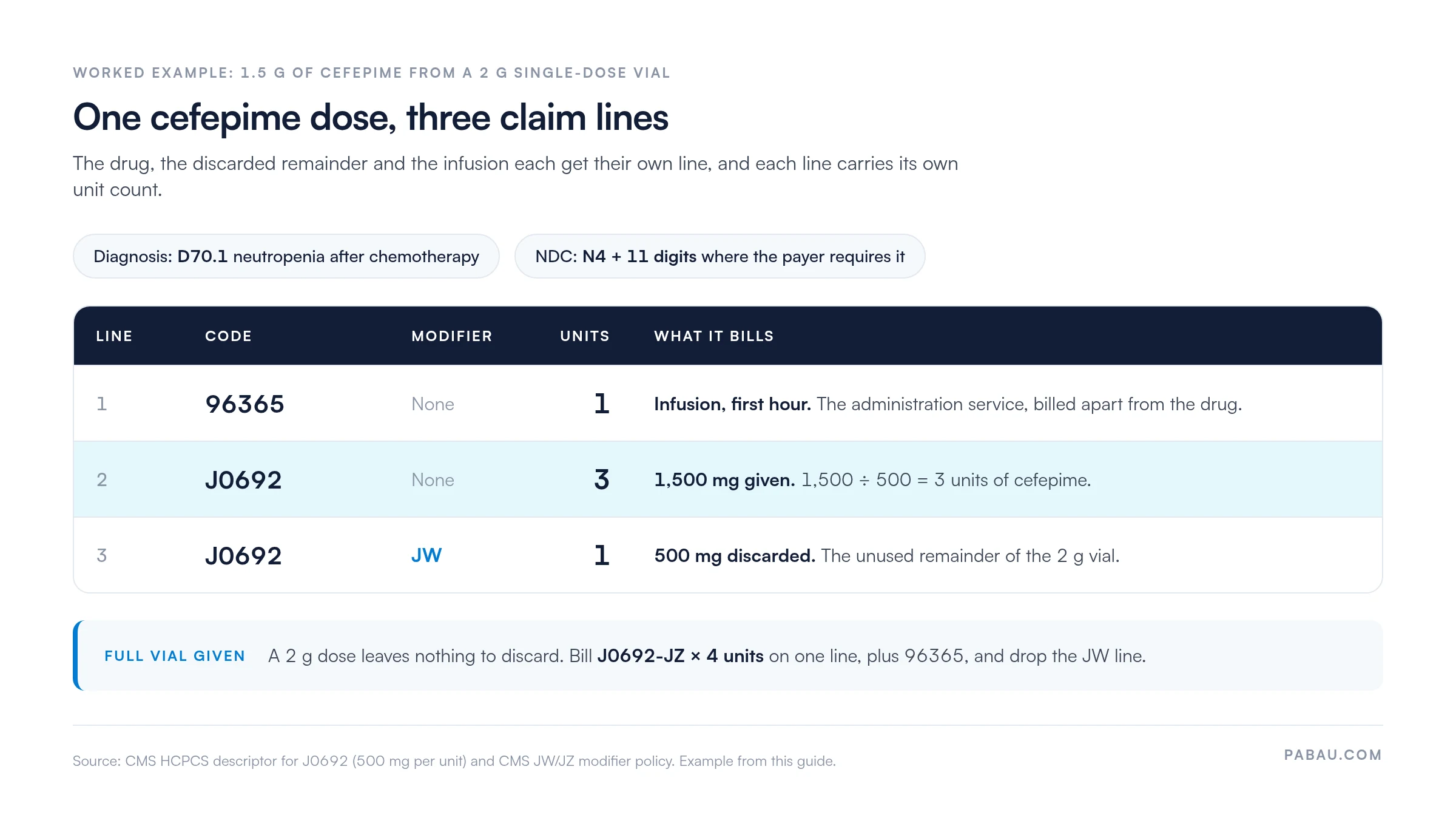
Some commercial payers and state Medicaid programs do not recognize the JW modifier or have stricter documentation requirements than the CMS standard. Verify payer-specific wastage policy before billing, and note that Medicare Advantage plans may follow their own rules rather than traditional Medicare guidance.
Cefepime is often confused with ceftriaxone, billed under J0696, because both are cephalosporins used for serious gram-negative infections. They have different HCPCS codes, different unit increments, and different clinical profiles. Using the wrong code misrepresents the drug on the claim.
See the PGM Billing HCPCS lookup tool to verify any antibiotic J code descriptor before submission. Cross-reference the drug name on the order against the HCPCS descriptor to confirm they match exactly.
J0692 denials cluster around four problem areas: NDC errors, unit miscalculation, missing PA, and mismatched diagnosis. Knowing the remittance remark code tells you exactly where the claim failed.
Proactive denial management starts with tracking which denial codes appear most often for J0692 in your practice. Build a checklist that catches those errors before submission, not after.
The rules for billing J0692 differ by care setting. The claim form, revenue code, and payer coverage criteria all change depending on where the drug is administered. Using the wrong combination of POS code, claim form, and revenue code is a fast path to denial.
In many infusion practices, a J0692 claim is pieced together from three places. The physician order, the nursing infusion note and the billing screen each hold part of it. Every handoff is a chance for the unit count, the NDC or the wastage line to drift from the chart.
Pabau, the practice management and billing platform we build, keeps the order, the infusion note and the claim on one patient record. Its claims software for practices builds J-code claims for any place of service. The drug line, the administration code and any JW or JZ modifier go out together.
Your billing team checks one record instead of three. Fewer claims come back for a missing NDC or a wrong unit count, so less of the week goes on rework.

Pabau’s claims management software tracks drug codes, administration CPTs, and NDC fields in one workflow so your J0692 claims go out clean the first time.

If J0692 denials keep coming back, start with the infusion note rather than the claim form. Unit, wastage and NDC errors on J0692 usually start with a dose, a discarded amount or a vial number missing from the claim.
Build one pre-submission check around those three fields, and confirm each payer’s NDC and prior authorization rules once rather than claim by claim. A few minutes per claim up front costs far less than reworking a denial two billing cycles later.
Pabau keeps the order, the infusion note and the claim on one record, which makes that check quicker to run. Book a demo to see how it fits an IV antibiotic infusion practice.

Need to understand how J-code denials are tracked and resolved? Denial management in healthcare covers the full workflow from remittance code to corrected claim.
Looking for guidance on what makes a claim clean before it leaves the practice? Clean claim submission breaks down every element payers check before processing.
Want to understand the broader billing compliance landscape for IV drug codes? Medical billing compliance explains the audit and documentation standards that apply to Part B drug claims.
Comparing cefepime with another antipseudomonal cephalosporin? HCPCS code J0713 covers ceftazidime billing, units and pairing rules.
Giving cefepime as an IV push instead of an infusion? CPT code 96374 explains how push administration is billed alongside the drug code.
HCPCS code J0692 covers injection of cefepime hydrochloride, billed per 500 mg administered. It covers the drug cost only, not the infusion administration service. Bill the administration fee separately on the same claim with a companion CPT code. Use 96365 for an IV infusion or 96374 for an IV push.
Bill one unit of J0692 for every 500 mg of cefepime administered. A 1 g dose is 2 units, and a 2 g dose is 4 units. Base the unit count on the dose confirmed in the infusion nursing note, not on the vial size or an ordered dose that differed.
Multiple manufacturers produce cefepime hydrochloride and each has a unique NDC. The correct NDC is always pulled from the specific vial used on the date of service, not from a static crosswalk list. Verify the NDC against the current FDA NDC directory or a tool like the AAPC HCPCS lookup before submitting to confirm it maps to J0692.
Traditional Medicare fee-for-service does not routinely require PA for J0692, but Medicare Advantage plans, commercial insurers, and some state Medicaid programs often do. Check the specific plan’s coverage policy before administering cefepime in an outpatient setting, particularly for courses longer than three to five days.
J0692 covers cefepime hydrochloride, a fourth-generation cephalosporin billed per 500 mg. J0696 covers ceftriaxone sodium, a third-generation cephalosporin billed per 250 mg. Cefepime has antipseudomonal activity and is used in febrile neutropenia, while ceftriaxone is used for community-acquired infections. Using the wrong code is a billing error regardless of clinical similarity.
When part of a single-dose vial of cefepime is discarded, bill that amount on a second line as J0692 with the JW modifier. The administered dose goes on the first line, and both lines appear on the same claim. Report JZ when no drug was discarded. Document the administered and discarded amounts in the infusion nursing note before billing.



