

CCSD code G5100: Bypass of duodenum billing guide
CCSD code G5100 bills a bypass that leaves the duodenum in place CCSD code G5100...

Last Updated: Oct 16, 2026
J0515 is the HCPCS Level II code for injection, benztropine mesylate, per 1 mg. It covers benztropine (Cogentin) given by injection, most often for drug-induced parkinsonism or an acute dystonic reaction.
Bill one unit per milligram administered, not the vial size. Each drug line needs the vial's NDC, a JW or JZ modifier when the vial is single-dose, and an administration code such as 96372.
Let Pabau's smart automation suggest the right codes, reduce claim denials, and keep your practice compliant—effortlessly.
Automate repetitive tasks and focus on what matters most—your patients.
Reduce coding errors and ensure compliance with the latest regulations.
Clean claims, fewer denials, and faster reimbursements.
Powerful insights and reporting to help your practice thrive.
HIPAA compliant SOC 2 certified GDPR-compliant Trusted by 4,000+ clinics worldwide

HCPCS code J0515 covers benztropine mesylate injection, billed per 1 mg administered, not per vial size.
Every drug line needs the vial’s NDC, reported in 837P loop 2410 or the shaded area of CMS-1500 Item 24A.
JW reports drug discarded from a single-dose vial, and JZ confirms zero wastage (required by Medicare since July 2023).
Pair each J0515 line with an administration code, usually 96372 for an IM injection or 96374 for an IV push.
Pabau’s claims management software fills NDC fields and flags missing modifiers before the claim is submitted.
HCPCS code J0515 describes “Injection, benztropine mesylate, per 1 mg.” Benztropine mesylate is an anticholinergic agent that blocks muscarinic acetylcholine receptors in the central nervous system, counteracting the dopamine-acetylcholine imbalance that drives extrapyramidal symptoms. It is also marketed under the brand name Cogentin.
Under the CMS HCPCS Level II coding system, J0515 falls in the J-series for drugs administered by injection. Payers process it as a buy-and-bill drug. The practice buys the vial, gives the dose, and bills Medicare Part B or the commercial plan for the milligrams given.
Every J0515 claim needs a supported ICD-10-CM diagnosis that links benztropine mesylate administration to a documented clinical indication. The two primary indications recognized in FDA labeling are drug-induced parkinsonism and acute dystonic reactions, both caused by antipsychotic or other dopamine-blocking agents.
Document the causative agent explicitly. Payers applying Local Coverage Determinations (LCDs) often require both the movement disorder code and the adverse effect code for the responsible drug. For example, T43.3X5A reports an adverse effect of phenothiazine antipsychotics. Verify applicable LCD policies through your Medicare Administrative Contractor before billing.
J0515 is billed per 1 mg of benztropine mesylate administered, not per vial. Billing the full vial instead of the dose given is a common unit error on J0515 claims.
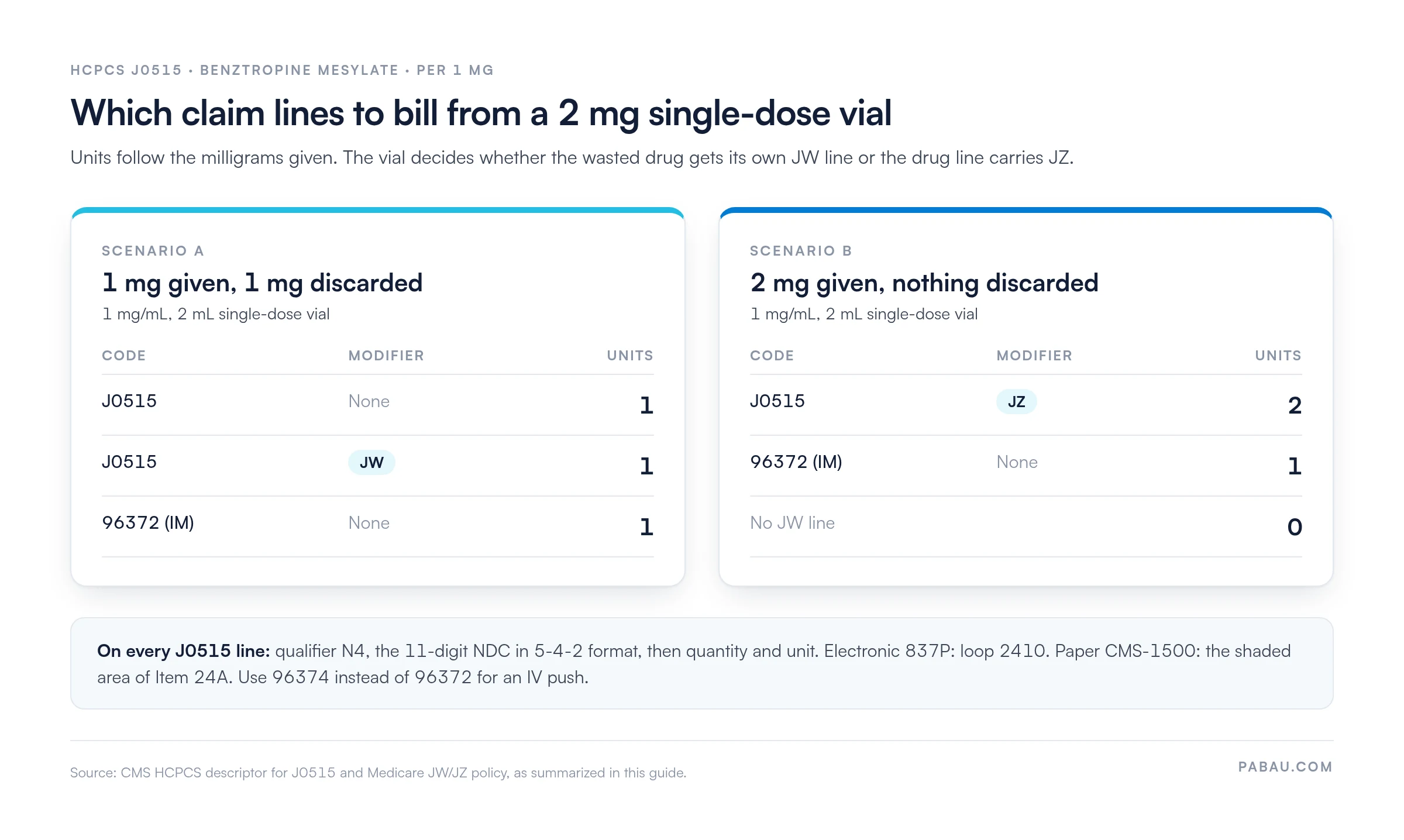
The two scenarios below turn those units into claim lines, including the administration code that rides alongside the drug.
Medicare and most commercial payers require a National Drug Code (NDC) on every J0515 drug claim line. Missing or invalid NDC numbers are a common denial trigger for injectable J-code claims.
On the electronic 837P transaction, report the NDC in loop 2410. On the paper CMS-1500, use the shaded area of Item 24A. Enter the “N4” qualifier, the 11-digit NDC in 5-4-2 format, then the quantity and unit of measure (UN for units, ML for milliliters). Check the NDC against the vial in hand, because NDC numbers change when manufacturers reformulate or repackage.
Two modifiers govern drug wastage reporting on J0515 claims. Medicare has required both since the dates in the table below. Commercial payer rules vary, so confirm with each plan.
Multi-dose vial exception: JW and JZ do not apply if J0515 is drawn from a multi-dose vial. A 2 mg dose drawn that way bills as 2 units of J0515 with no wastage modifier. The rest of the vial stays available for future patients, so there is no per-dose waste to report.
Check your vial label before billing. Benztropine mesylate 1 mg/mL in a 2 mL vial is typically single-dose, which makes JW or JZ mandatory on Medicare claims. If you draw from a multi-dose vial, leave both modifiers off. Billing JW on a multi-dose vial line is itself a claim error.
Bill J0515 with CPT 96372 for an intramuscular (IM) or subcutaneous injection, or 96374 for an IV push. J0515 covers the drug cost only, so the administration code bills for giving the injection. The right code depends on the route and the clinical setting.
Place of service (POS) affects reimbursement. In the non-facility setting, POS 11 (office), the practice typically bills both the drug line and the administration line. Facility settings, including POS 22 (outpatient hospital), are paid at the facility rate, and the facility bills its own charges separately. Verify your payer’s facility versus non-facility payment policy before submitting.
Medicare Part B pays ASP plus 6% (before sequestration) for J0515, where ASP is the drug’s average sales price. Because ASP updates quarterly, the payment rate per unit of J0515 changes four times per year. Check the current rate in the CMS Physician Fee Schedule and ASP drug pricing files rather than a figure from a prior quarter.
Benztropine mesylate is a low-cost generic drug with a low per-unit allowable, so check the current ASP file. The drug revenue on a single J0515 claim is modest, and the administration code (96372) contributes more to the encounter. Commercial payers negotiate separately and may pay above or below ASP plus 6%.
Medicare Part B generally does not require prior authorization (PA) for J0515 under the standard buy-and-bill benefit. Benztropine mesylate is a low-cost drug with clear clinical indications, so it typically falls outside CMS prior authorization demonstration programs. That said, verify current MAC LCD policies and any applicable CMS Part B prior authorization initiatives before assuming PA is not needed.
Three coding scenarios cause billers to reach for the wrong code when benztropine is administered. The table below resolves each one.
Most J0515 denials trace back to one of six preventable errors. Solid denial management workflows catch these before submission rather than after adjudication. When a claim does come back, the remittance denial codes point to the error that triggered it.
Submitting a clean claim from the start reduces your days in accounts receivable and avoids the cost of rework. Because the drug’s allowable is low, reworking one J0515 denial can cost more than the line pays.
Run a quarterly audit of your J0515 claim lines. Pull every claim from the prior 90 days and check four points. Each line needs an NDC, and units must match the dose given rather than the vial. Single-dose vial claims need JW or JZ, and each encounter needs a 96372 or 96374 line.
Reference sites list J0515’s descriptor but rarely detail what the medical record needs to contain. These are the elements an auditor expects to find for every J0515 encounter, and the foundation of solid medical billing documentation.
HCPCS J-code auditors check whether the clinical note and the claim line agree. If the note says “2 mg IM” but the claim shows 4 units of J0515, an overpayment recovery demand follows. Align charting and billing templates so the nurse or clinician captures the exact data the biller needs.
Most J0515 errors repeat from claim to claim because they come from the workflow. A biller who bills vial size instead of dose will keep doing so until a system rule stops them. Practice software catches this at charge entry, long before a denial review would.
Pabau, the practice management and billing platform we build, ties automated claims management to superbill generation. NDC fields fill from the administered drug record, and each J-code line is checked for a 96372 or 96374 pairing. A missing JW or JZ modifier is flagged before the claim reaches the clearinghouse. So a claim that would have denied gets fixed before submission, not weeks later.

Pabau’s claims management software fills NDC fields, flags missing JW and JZ modifiers, and scrubs J0515 lines before they reach the payer. Your team spends less time fixing denials and more time on patient care.

J0515 pays little per unit, so the margin on a benztropine injection depends on the claim going through the first time. One denial can cost more to rework than the drug line pays, and an audit mismatch can claw back more.
The fix belongs upstream, at the point of care. Chart the milligrams given, the NDC, and the vial type when the injection happens, and the claim lines follow from them. Clean data at that step also steadies your wider revenue cycle management.
Book a demo to see how Pabau checks NDCs, units, and wastage modifiers on J-code claims before they leave your practice.

Need to understand how HCPCS claims move through the revenue cycle? Medical claims clearinghouse guide explains how claims are validated and routed to payers.
Trying to reduce your overall claim denial rate? Denial codes in medical billing covers the most common CARC and RARC codes your team needs to know.
Want to verify eligibility before administering J0515? Insurance eligibility verification walks through the steps to confirm Part B coverage before the appointment.
Giving diphenhydramine alongside benztropine? HCPCS code J1200 covers units and billing for diphenhydramine HCl injection.
Giving benztropine by IV push? CPT code 96374 explains IV push billing, modifiers, and documentation.
HCPCS code J0515 covers injection, benztropine mesylate, per 1 mg, an anticholinergic drug administered by injection to treat drug-induced parkinsonism and acute dystonic reactions. The code is billed per milligram of drug administered, not per vial.
Bill 2 units of J0515 for a 2 mg dose, because the descriptor is “per 1 mg.” If 1 mg is wasted from a single-dose vial, add a second J0515 line for 1 unit with the JW modifier appended.
Yes. Cogentin is the brand name for benztropine mesylate, so injectable Cogentin is billed under J0515. The same code applies whether the brand or a generic is administered.
Medicare Part B generally does not require prior authorization for J0515 under the standard buy-and-bill benefit. Medicare Advantage and Medicaid managed care plans may still require it. Verify with each specific plan before administration.
Report the NDC from the specific vial administered, in 11-digit 5-4-2 format with the N4 qualifier. NDC numbers vary by manufacturer and package size, so transcribe it from the vial label rather than a static reference list.
The most common causes are a missing or badly formatted NDC and billing the vial size instead of the milligrams given. Omitting JW or JZ on a single-dose vial claim and an unsupported ICD-10-CM diagnosis also cause denials. A missing administration code such as 96372 or 96374 is another common trigger.



