

HCPCS Code E0272: Foam rubber mattress billing guide
HCPCS Code E0272: official descriptor and code overview HCPCS Code E0272 is the ...

Last Updated: Nov 6, 2026
J0500 is the HCPCS Level II code for injection, dicyclomine hcl, up to 20 mg. One billing unit covers any dose up to 20 mg, given by a provider as an intramuscular injection.
Coders often confuse J0500 with oral dicyclomine dispensed under a retail pharmacy benefit, which this code never covers. Common denial causes include a missing NDC, miscalculated units, or a diagnosis that does not establish medical necessity under the payer's coverage policy.
Let Pabau's smart automation suggest the right codes, reduce claim denials, and keep your practice compliant—effortlessly.
Automate repetitive tasks and focus on what matters most—your patients.
Reduce coding errors and ensure compliance with the latest regulations.
Clean claims, fewer denials, and faster reimbursements.
Powerful insights and reporting to help your practice thrive.
HIPAA compliant SOC 2 certified GDPR-compliant Trusted by 4,000+ clinics worldwide

HCPCS code J0500 covers provider-administered dicyclomine HCl injection only, so oral dicyclomine is never billed under this code.
One unit of J0500 is up to 20 mg, so any dose from 5 mg to 20 mg is reported as 1 unit.
Medicaid and many commercial payers require the 11-digit NDC with qualifier N4, while Medicare Part B generally does not unless the MAC asks for it.
The injection itself is billed on its own line with CPT 96372, and Medicare claims for single-dose vials carry modifier JZ or JW.
Pabau, the practice management platform we build, checks each claim for errors before submission and flags rejected claims with the field to fix.
HCPCS code J0500 is the Level II code for dicyclomine hydrochloride injection, up to 20 mg. It is billed when a provider administers the drug in a clinical setting, and one unit covers any dose up to 20 mg. The code sits in the J-code range, which covers drugs administered other than by mouth.
The table collects the lookup fields a biller checks before putting J0500 on a claim.
CMS maintains the full HCPCS Level II code set, updated each January with quarterly corrections. Check J0500 against the current-year HCPCS file before submitting, especially after a formulary change involving dicyclomine.
J0500 covers dicyclomine hydrochloride given by a provider as an intramuscular injection, at up to 20 mg per unit. Other forms and routes need a different billing path.
Dicyclomine is prescribed far more often as an oral antispasmodic for irritable bowel syndrome than as an injection. So a biller can reach for J0500 on an encounter where the patient only collected a prescription from the pharmacy. That claim denies, because no drug was administered in the office.
J0500 is billed per 20 mg. One unit on the claim covers any dose up to 20 mg. A 5 mg, 10 mg or 20 mg injection is each reported as 1 unit. On Medicare claims, drug discarded from a single-dose vial is reported on its own line with modifier JW. Modifier JZ states that none was discarded.
Over-reporting units is a CMS audit trigger. If the claim shows 2 units (40 mg) but the provider order documents 20 mg, that discrepancy alone can trigger a post-payment review and clawback. Confirm the administered dose against the written order and the administration record before entering units.
Medicaid and many commercial payers require the 11-digit National Drug Code (NDC) with qualifier N4 on J0500 claim lines. Medicare Part B generally does not, unless the MAC specifies it. Where a payer does require the NDC, a missing or mismatched one denies the line.
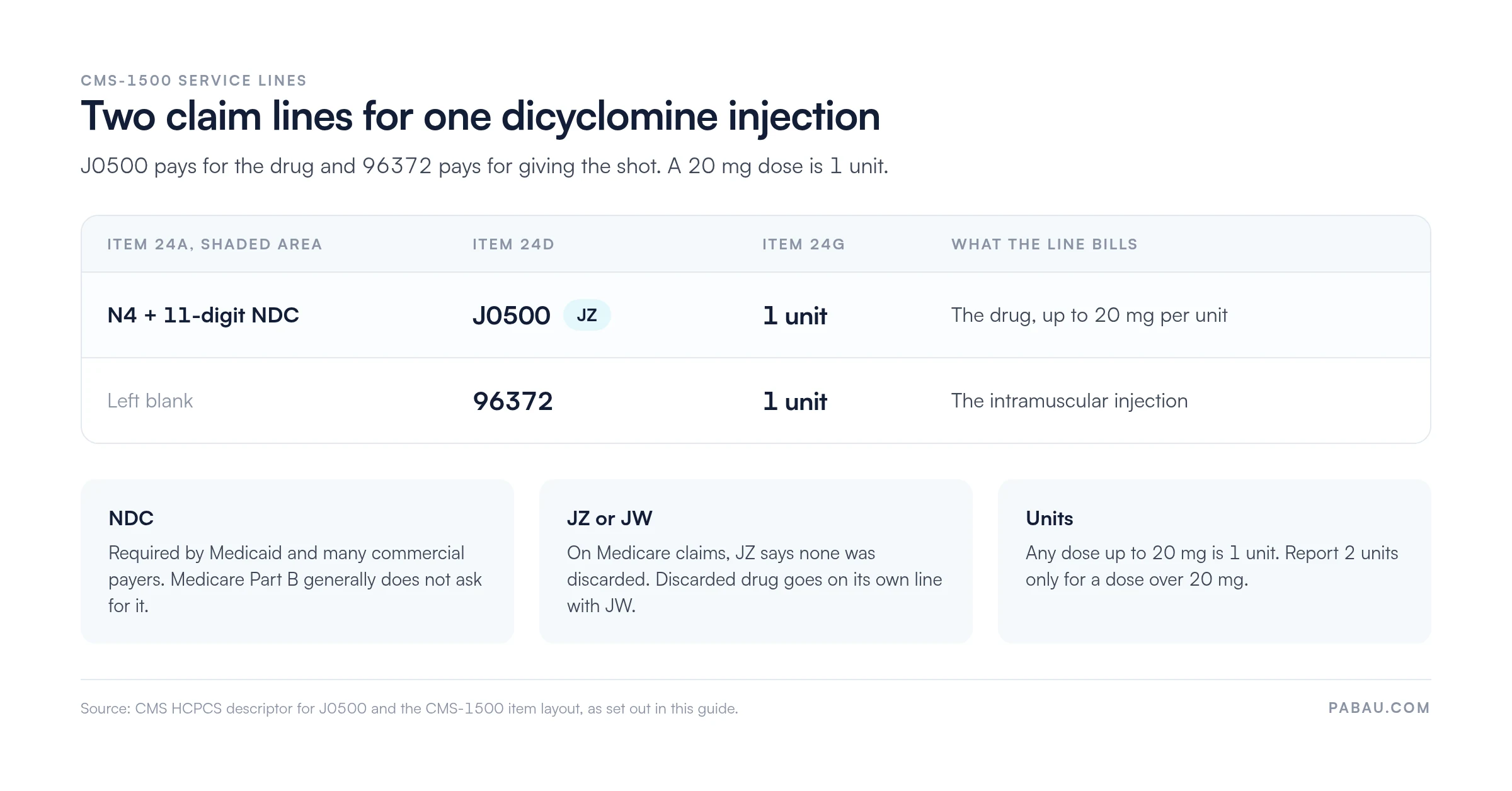
The NDC follows an 11-digit 5-4-2 format. Five digits identify the labeler, four the product and two the package. On the CMS-1500, enter qualifier N4 and the NDC in the shaded area of item 24A. The HCPCS code stays in item 24D and the units go in item 24G. On the 837P, the NDC goes in loop 2410, in the LIN and CTP segments.
Never report the 10-digit NDC as printed on some vial labels. Convert it to the 11-digit, zero-padded version the payer expects. The two claim lines below show where each piece of a J0500 claim goes.
Read the NDC from the label of the vial used that day. Do not enter NDCs from memory or from a static list in your billing system. Manufacturers occasionally change package sizes or labelers, and each change can generate a new NDC. A claim carrying last month’s NDC may deny if the payer’s crosswalk has been updated.
When a payer requires the NDC, a J-code line without a valid one typically denies. Expect CO-16 (claim lacks information needed for adjudication) or a payer-specific remark code. The fix is a corrected claim with the NDC added, which adds weeks to the payment timeline. Recording the NDC at the point of injection, not at the billing desk, avoids the delay.
Every J0500 claim must be paired with a diagnosis code that establishes medical necessity for the antispasmodic injection. Irritable bowel syndrome (IBS) is the primary clinical indication. The ICD-10-CM codes most commonly accepted by payers are listed below.
Payer coverage policies for antispasmodic injectables vary. Some Medicare Administrative Contractors (MACs) publish Local Coverage Determinations (LCDs) that restrict accepted diagnoses to specific IBS subtypes. Always check the applicable MAC’s current LCD before coding a claim with K59.9 or a broader GI diagnosis.
J0500 covers only the drug. The injection service is billed separately with CPT code 96372, the code for a therapeutic intramuscular or subcutaneous injection. Leave it off the claim and the practice absorbs the administration cost.
Neither of the last two codes stands in for J0500. J0515 bills benztropine, a different anticholinergic drug. J3490 applies only when no specific code exists for the drug given.
The CMS Physician Fee Schedule lookup shows the current rate for 96372 by locality before you build your charge master. Rates differ between facility and non-facility settings. The non-facility rate applies to most physician offices, so it is the one that matters for J0500 encounters.
Medicare Part B does not typically require prior authorization for physician-administered drugs, but commercial payers and Medicaid plans frequently do. Prior authorization (PA) requirements for J0500 vary by payer, plan year and state, with no universal rule.
POS 11 (physician office) is the most common setting for J0500 administration. The non-facility rate applies to the 96372 administration there, and it is higher than the facility rate. In a hospital outpatient department, J0500 is paid under the Outpatient Prospective Payment System instead of the physician fee schedule. That changes both the billing mechanics and the payment.
Medicaid PA requirements vary by state. Never assume a Medicaid plan in one state follows the same step-therapy or PA logic as a plan in another. Check the applicable state Medicaid drug policy before submitting.
The table maps five common J0500 denials to their claim adjustment reason code (CARC), the cause, and the corrective action.
A denial management workflow that flags J0500 rejections within 24 hours of the ERA shortens the correction cycle. The longer a denied claim sits, the closer it gets to the payer’s timely filing deadline. That deadline typically falls 90 to 365 days from the date of service, depending on the contract. To decode payer denial codes beyond these five, use the full CARC and RARC reference.
Run a monthly J0500 denial audit by pulling all 835 ERA transactions filtered to J0500. Group denials by CARC code. If CO-16 (NDC issues) leads the list, fix the drug administration workflow before you change the billing system.
A complete clinical record is your first line of defense in an OIG audit or MAC medical review. For J0500, the documentation must support both the drug administration and the medical necessity of the injection. Missing even one element can result in full claim recoupment.
The clinical record for a J0500 encounter must include:
Missing administration detail carries extra risk on this code, because dicyclomine is mostly prescribed orally. An auditor reviewing a J0500 claim looks for evidence that the drug was injected in the office, not simply prescribed. The lot number and NDC on the administration record, matched to your drug inventory log, provide that evidence. A grounding in medical billing compliance helps a practice build these habits before an audit, not after one.
Create a J0500 drug administration checklist that nursing staff complete at the point of injection. It should capture: drug lot number, NDC from the vial, dose drawn, dose administered, route, time, and administering staff name. Attach it to the encounter note before the chart closes, so each audit question already has an answer in the record.
J-code billing often starts from a paper administration log. A biller works out the units by hand and looks up the NDC afterward. That is where CO-16 and CO-151 denials begin.
Pabau’s error-checked claims management opens each claim pre-filled from the invoice and scrubs it before it leaves. US claims go out on the CMS-1500 through Claim.MD, so formatting errors surface before a payer sees them.
When a J0500 claim comes back rejected, Pabau flags it as Needs action and shows the reason. A link goes straight to the field that needs correcting, so the claim can be fixed and resubmitted without starting over.
Payments are then settled straight from the payer’s electronic remittance advice (ERA) files. For the wider cycle from encounter to payment, see how medical billing works.

Pabau scrubs each claim before it reaches the clearinghouse and flags rejected claims with the reason and the field to fix. Your team spends less time reworking J0500 denials.

HCPCS code J0500 is a narrow code: injection only, one unit per 20 mg, and the NDC required by Medicaid and many commercial payers. Its denials tend to start where the claim drifts away from the administration record.
So put the checks where the injection happens. Record the NDC from the vial, confirm the units against the order, and clear prior authorization before the dose is drawn. The biller then confirms a claim instead of reconstructing one.
If your team still rebuilds drug claims by hand, book a demo to see how Pabau catches J-code errors before a payer does.

Need a framework for managing drug claim denials? Denial management in healthcare covers the end-to-end workflow for identifying, appealing, and preventing recurring claim rejections.
Want to understand how J-code claims fit into the broader billing process? What is medical billing explains the full revenue cycle from encounter to payment posting.
Looking for a superbill template that captures NDC and drug administration data? Superbill guide walks through the fields a superbill carries for physician-administered drugs.
HCPCS code J0500 covers the provider-administered intramuscular injection of dicyclomine hydrochloride, up to 20 mg, billed per 20 mg unit. It does not cover oral dicyclomine, self-administered injections, or compounded formulations. Those fall under a different benefit or need a separate code.
One unit of J0500 is up to 20 mg. A 5, 10, 15 or 20 mg dose is reported as 1 unit. Report 2 units only for a dose over 20 mg.
Medicare Part B does not routinely require prior authorization for J0500. Commercial payers and state Medicaid plans frequently do, often requiring documentation of a failed oral therapy trial. Check the specific payer’s PA requirements before the injection, not after the claim denies.
Report the 11-digit NDC from the vial used that day, with qualifier N4, wherever the payer requires it. Medicaid and many commercial payers do, while Medicare Part B generally does not. Convert a 10-digit NDC to the 11-digit format. Read it from the vial label each time, because package or labeler changes can create a new NDC.
Three common causes are a missing or invalid NDC (CO-16), oral dicyclomine billed as J0500 (CO-96), and a diagnosis that fails medical necessity (CO-11). Missing prior authorization (CO-197) and units that exceed the payer’s medically unlikely edit (CO-151) are the other two. Each has its own corrective action, set out in the denial table in this article.
J0500 is specific to dicyclomine hydrochloride injection, up to 20 mg. J0515 (benztropine) is a different drug and is not interchangeable with it. If no specific code exists for a GI antispasmodic your payer covers, J3490 (unclassified drugs) applies.




