

HCPCS Code Q4185: Cellesta flowable amnion billing guide
HCPCS Code Q4185: definition and official descriptor HCPCS Code Q4185 is the Lev...

Last Updated: Nov 20, 2026
G0300 is the HCPCS code for direct skilled nursing services of an LPN in the home health or hospice setting, each 15 minutes. One unit covers each 15 minutes of direct, face-to-face skilled care.
CMS created G0300 with its RN counterpart, G0299, effective January 1, 2016. Medicare doesn't price it per unit. The line reports LPN visit time within the home health 30-day payment or the hospice per diem.
Let Pabau's smart automation suggest the right codes, reduce claim denials, and keep your practice compliant—effortlessly.
Automate repetitive tasks and focus on what matters most—your patients.
Reduce coding errors and ensure compliance with the latest regulations.
Clean claims, fewer denials, and faster reimbursements.
Powerful insights and reporting to help your practice thrive.
HIPAA compliant SOC 2 certified GDPR-compliant Trusted by 4,000+ clinics worldwide

HCPCS code G0300 reports direct skilled nursing by a licensed practical nurse (LPN) in home health or hospice, in 15-minute units.
The performing nurse’s credential decides the code, so an LPN visit is G0300 and an RN visit is G0299.
Medicare doesn’t price G0300 per unit, because home health is paid per 30-day period and hospice per diem.
Each visit note must document start and end times, homebound status, and the specific skilled nursing task performed.
Pabau’s claims management software validates each claim before submission, so missing visit details are caught before a payer sees them.
HCPCS code G0300 reports skilled nursing time delivered by a licensed practical nurse. Its CMS descriptor reads “direct skilled nursing services of a licensed practical nurse (LPN) in the home health or hospice setting, each 15 minutes.” CMS created it alongside G0299 under Change Request (CR) 9369, effective January 1, 2016.
The two codes replaced G0154 for nursing visits, which had covered RN and LPN time under one code. Licensed vocational nurses (LVNs), the title used in California and Texas, report their visits under G0300 too.
Two settings qualify. Medicare-certified home health agencies (HHAs) report G0300 under the home health benefit, and Medicare-certified hospices report it on their own claims. The table below summarizes the key attributes at a glance.
The CMS HCPCS coding system reviews G0300 every year. Its descriptor has remained stable, but payer coverage policies for home health and hospice nursing change from year to year.
CMS covers G0300 only when the service requires the clinical skill of a licensed nurse. Coverage turns on one test: Could a person without nursing training safely do the same task after instruction?
The Medicare Benefit Policy Manual, Chapter 7, sets the skilled nursing test. A service qualifies only when it is “so inherently complex” that only professional or technical personnel can perform or supervise it safely and effectively. Custodial care, no matter how often it is delivered, does not meet that threshold.
G0300 is a time-based code. One unit equals each 15 minutes of direct LPN skilled nursing service delivered during a visit. The CMS 8-minute rule governs timed therapy codes, but CMS has not published a matching rounding rule for G0300. The safer and more auditable practice is to bill only full 15-minute increments and document time precisely.
The most common overcounting error is including travel time or documentation time in the billed units. Only face-to-face direct skilled nursing service counts. Travel, charting after the visit, and phone follow-up are never billable units under G0300.
Document start time and end time as clock times in the visit note (e.g. ‘Arrived 10:05 AM, skilled nursing service completed 10:47 AM’). Calculate units from the direct-service window only. Auditors will subtract any documented non-direct time from the billed unit count.
G0299 covers direct skilled nursing services in home health or hospice when the provider is a registered nurse (RN). G0300 covers the same settings and service type when the provider is an LPN or LVN. The code follows the performing nurse’s credential, so the same wound visit is G0299 for an RN and G0300 for an LPN.
Billing G0299 when an LPN performed the service is an upcoding error. In hospice, it can also inflate the service intensity add-on, and Medicare can recover that overpayment. Medicaid and commercial payers that price RN and LPN time differently may recoup the difference. Under a Medicaid private duty program that pays LPN home shifts by the day, the agency bills Medicaid code T1031 instead.
Agencies that staff mostly RNs often set billing templates to default to G0299. Those defaults create a systematic mismatch whenever LPN staff cover visits, so review them before claims go out.
Several HCPCS codes are commonly billed alongside or confused with G0300. Knowing where the boundaries sit prevents unbundling violations and helps route each service to the right code.
Billing G0300 and T1021 for the same visit by the same clinician is an unbundling risk. An aide-level task performed during an otherwise skilled visit does not create a separate billable event under the aide code. Document the skilled component that justifies G0300 and leave aide-level tasks out of the claims narrative.
Medicare doesn’t pay G0300 as a per-unit fee. Home health agencies receive a bundled amount for each 30-day period under the Home Health Prospective Payment System. Hospices receive a daily per diem rate for each day a patient is under their care.
Within those payments, G0300 lines report which discipline visited and for how long. Two payment adjustments still depend on those lines being accurate.
In home health, a 30-day period with too few visits falls under a low-utilization payment adjustment (LUPA). Medicare then pays per visit by discipline instead of the bundled amount. In hospice, RN visits in the last 7 days of life can earn a service intensity add-on, but LPN time under G0300 cannot.
The breakdown below shows where a G0300 line sits in each payment route.
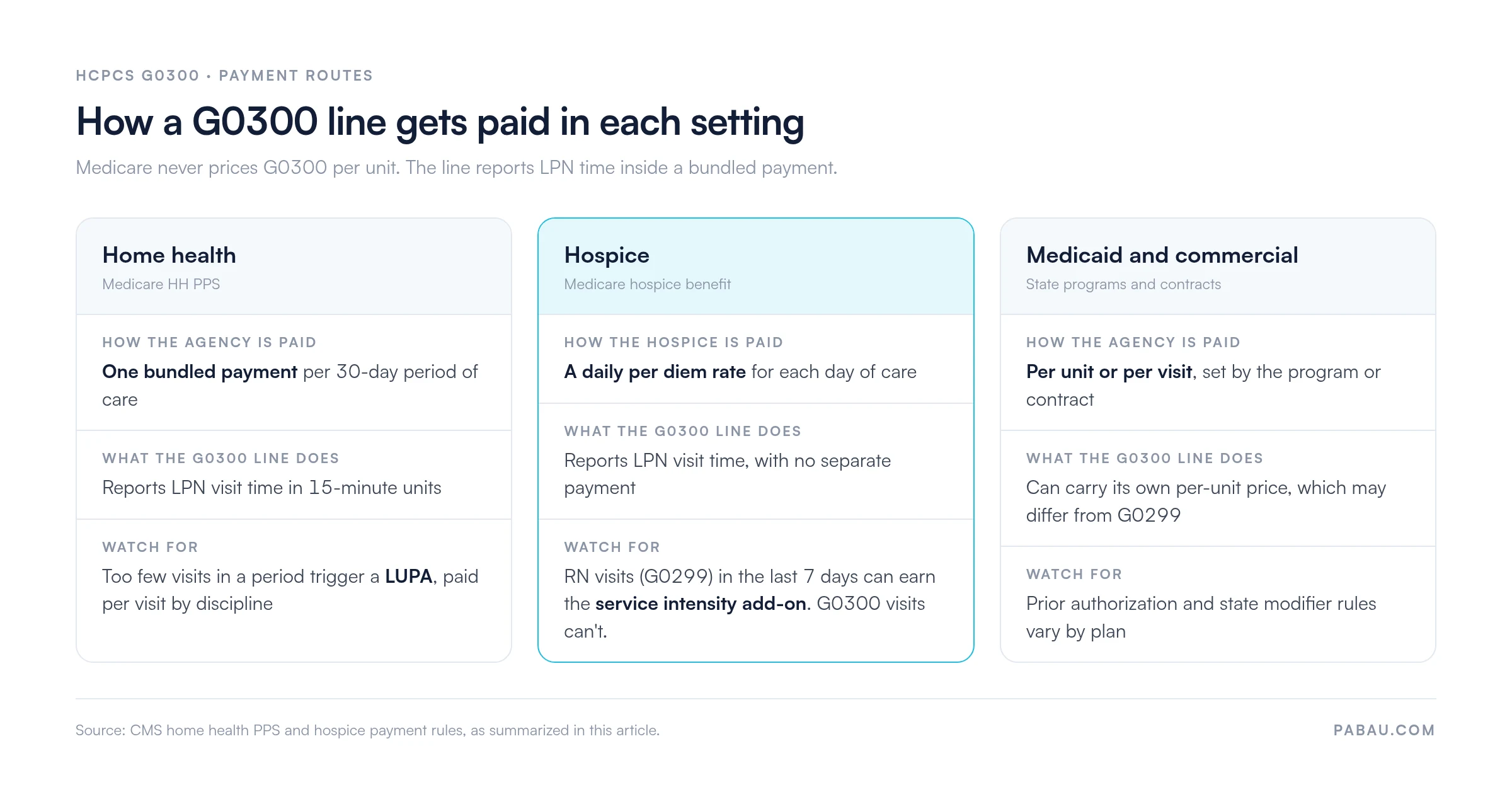
Commercial payer rates for G0300 vary and are not tied to Medicare’s payment systems. UnitedHealthcare and Blue Cross Blue Shield plans that cover home health skilled nursing usually set their own contracted rates. State Medicaid programs may also pay G0300 per unit on their own fee schedules.
Many commercial plans have expanded prior authorization requirements for ongoing home health services too. Check each payer’s current provider manual before assuming Medicare’s payment method applies.
Use the AAPC HCPCS code reference or the PGM Billing HCPCS lookup tool to confirm the current descriptor before a patient’s episode begins. Agencies that run pre-submission checks in medical billing software catch descriptor and coverage mismatches before a claim goes out.
A complete G0300 claim rests on a chain of documents. A missing link at any point gives a Medicare Administrative Contractor (MAC) or commercial reviewer grounds to deny the claim. Work through the checklist below before submitting any G0300 claim.
Strong medical billing compliance processes build these checklist items into the clinical documentation workflow before the LPN leaves the patient’s home. Retrofitting documentation after a denial is far more expensive than capturing it correctly on the day of service.
Traditional Medicare does not require prior authorization for home health skilled nursing covered under a valid Plan of Care. Commercial payers are different. UnitedHealthcare, Blue Cross Blue Shield plans, and Cigna have each expanded prior authorization requirements for ongoing home health visits in recent years. Confirm each plan’s current requirements on its provider portal before the episode begins.
G0300 claims deny for a predictable set of reasons. The table below maps each common denial to its root cause and the corrective action that resolves it.
Robust denial management starts by sorting each denial by reason before appealing. Repeated “not medically necessary” denials on G0300 point to documentation training. Repeated unit-count denials point to how the agency captures visit time. Each pattern needs its own fix.
Familiarize your billing team with the common denial codes so they can route each rejection to the right corrective workflow before the appeal window closes.
Run a monthly audit of all G0300 claims denied in the previous 60 days. Group them by denial reason code. If one reason accounts for more than 30% of denials, change the template or default that causes it. Appealing those claims one by one won’t stop the next batch.
In hospice, G0300 reports LPN visit time on the hospice’s own claim. Medicare pays the hospice its per diem rate, so the G0300 line carries no separate payment. That shapes which modifiers apply, as the table below shows.
Medicare’s hospice per diem covers nursing care related to the terminal diagnosis. The hospice still reports each LPN visit on its claim with G0300, in 15-minute units. Those lines document the care delivered and carry no separate payment.
Care unrelated to the terminal condition falls outside the hospice benefit. Another provider bills it to Medicare Part B, and that claim carries the GW modifier. The GV modifier marks services from an attending physician whom the hospice doesn’t employ or pay under arrangement. Neither modifier belongs on the hospice’s own G0300 lines.
Billing staff should know that medical billing workflows in hospice differ from the home health context. The per diem model catches agencies off guard when they first take on hospice contracts alongside their home health work.
Most G0300 denials start in the visit note. A missing clock time, a vague skilled task, or the wrong credential surfaces weeks later as a rejection.
In Pabau, the practice management platform we build, the visit, the patient record and the claim sit in one system. Insurance details are entered once and carry through to the claim. Claim validation then checks each claim before it reaches the clearinghouse, so a mismatch gets fixed while the visit is still fresh.
Prior authorization codes follow the appointment, so commercial plans that require them don’t stall the claim. Billers track each claim from submission to payment, which cuts the time spent chasing payers.

Pabau’s claims management tools help home health teams record LPN visit details, validate each claim before submission, and get G0300 claims paid the first time.

G0300 claims rarely fail on the code itself. They fail when the visit note can’t prove the credential, the clock time, or the skilled need behind the line.
So fix it at the point of care. Build credential, start and end times, and homebound language into the LPN visit template, and audit any billing default set to G0299 this month. The trade-off is a few extra minutes per note in return for fewer recoupments and cleaner visit data.
Book a demo to see how Pabau validates home health and hospice claims before they reach the payer.

Need a framework for tackling claim rejections systematically? Denial management in healthcare walks through root-cause categorization and appeal workflows for billing teams.
Billing Medicaid private duty nursing by the day? HCPCS code T1030 covers the per diem RN nursing code many state Medicaid programs use.
Coding therapy visits in the same home health episode? HCPCS code G0151 explains the physical therapy G-code and its most common denials.
Want the full Medicare claim cycle in one place? Medicare billing for practices follows a claim from the appointment to payment.
HCPCS code G0300 covers direct skilled nursing by a licensed practical nurse (LPN or LVN) in home health or hospice, in 15-minute increments. Covered services include wound care requiring nursing judgment, catheter management, IV therapy oversight, skilled medication administration, and patient education on complex regimens. Custodial care, companion services, and aide-level tasks don’t meet the skilled nursing criterion and are excluded.
G0299 applies when a registered nurse (RN) provides direct skilled nursing in a home health or hospice setting. G0300 applies when a licensed practical nurse (LPN or LVN) provides the same type of service. The credential of the clinician who delivered the care decides the code, whatever the task. Billing G0299 for a visit performed by an LPN is an upcoding error that payers can recoup.
One unit of G0300 equals each 15 minutes of direct skilled nursing service delivered by the LPN. A 45-minute visit bills as 3 units, and a 60-minute visit bills as 4 units. Only face-to-face direct service time counts. Travel, documentation after the visit, and phone follow-up are not billable units. Record clock-time start and end in the visit note, and calculate units from that window only.
A valid G0300 claim needs a current, signed CMS-485 Plan of Care that orders skilled nursing. The visit note must give the LPN’s name and credential, clock-time start and end, and the specific skilled task with its clinical justification. It must also state homebound status in CMS-compliant language and the patient’s response to treatment. Where state law requires RN supervision of LPN services, keep evidence of that supervision on file.
Yes, but it isn’t paid separately. A hospice reports G0300 on its own claim to record LPN visit time in 15-minute units. Medicare pays the hospice a per diem rate that covers that care. The GV and GW modifiers belong on Part B claims from other providers, not on the hospice’s G0300 lines.
There’s no modifier Medicare requires on every G0300 line. GV and GW are Part B modifiers for attending-physician services and unrelated care billed by providers outside the hospice. KX or GA apply only where a payer’s own policy calls for them. Some state Medicaid programs add their own modifiers, so check the program’s billing manual.
Medicare has no per-unit fee schedule rate for G0300. Home health agencies are paid per 30-day period under the Home Health Prospective Payment System, and hospices are paid a per diem rate. G0300 lines report LPN visit time and discipline within those payments. A per-unit rate applies only where a Medicaid program or commercial contract sets one.
Most G0300 denials come from documentation. The visit note may not show why the task needed a licensed nurse, or the Plan of Care may be missing or unsigned. Homebound status may lack CMS-compliant language, or the unit count may include travel or charting time. The code may not match the nurse’s credential, or the claim may miss the filing deadline. Documentation templates built before the visit prevent most of these.





