HCPCS code T2014: Prevocational habilitation billing guide
HCPCS code T2014 pays for one day of prevocational training HCPCS code T2014 car...

Last Updated: Oct 9, 2026
T1030 is the HCPCS Level II code for nursing care, in the home, by registered nurse, per diem. State Medicaid programs use it to pay for private duty nursing (PDN) when an RN works the shift. Its companion code, T1031, covers the same skilled home nursing by a licensed practical nurse.
So the code on each claim follows the nurse's license. An LPN shift billed as T1030 is a credential mismatch that can trigger a denial. Medicare pays neither code, and the payer's manual decides whether a unit means a day, an hour or a shift.
Let Pabau's smart automation suggest the right codes, reduce claim denials, and keep your practice compliant—effortlessly.
Automate repetitive tasks and focus on what matters most—your patients.
Reduce coding errors and ensure compliance with the latest regulations.
Clean claims, fewer denials, and faster reimbursements.
Powerful insights and reporting to help your practice thrive.
HIPAA compliant SOC 2 certified GDPR-compliant Trusted by 4,000+ clinics worldwide

HCPCS code T1030 bills skilled home nursing by a registered nurse, and T1031 bills the same care by a licensed practical nurse.
The descriptor is per diem, but many payers convert it to hourly or shift units, so check the payer’s manual first.
Medicare pays neither T1030 nor T1031, and Medicare home health bills RN care under G0299 in 15-minute units.
Most Medicaid programs require prior authorization, and authorization periods and appeal options vary by state and payer.
Pabau’s claims management software helps teams build and submit claims and keep documentation together.
HCPCS code T1030 is the Level II code for skilled nursing care given in the patient’s home by a registered nurse (RN). Its official unit is per diem.
State Medicaid programs use it as the RN code for private duty nursing (PDN). The code is maintained by the Centers for Medicare and Medicaid Services (CMS) as part of the T-code range for non-Medicare payers.
T1030 and T1031 describe the same skilled home nursing. The nurse’s license is the one difference between them. An RN shift goes on T1030, and a licensed practical nurse (LPN) shift goes on T1031.
T1030 covers skilled nursing that an RN delivers in the home. Typical tasks include medication administration, wound care, tracheostomy and ventilator care, tube feeding, IV therapy oversight, and nursing assessment of medically complex patients.
These services sit outside T1030:
Most code choices come down to two questions. Which program pays, and who held the license for the shift?
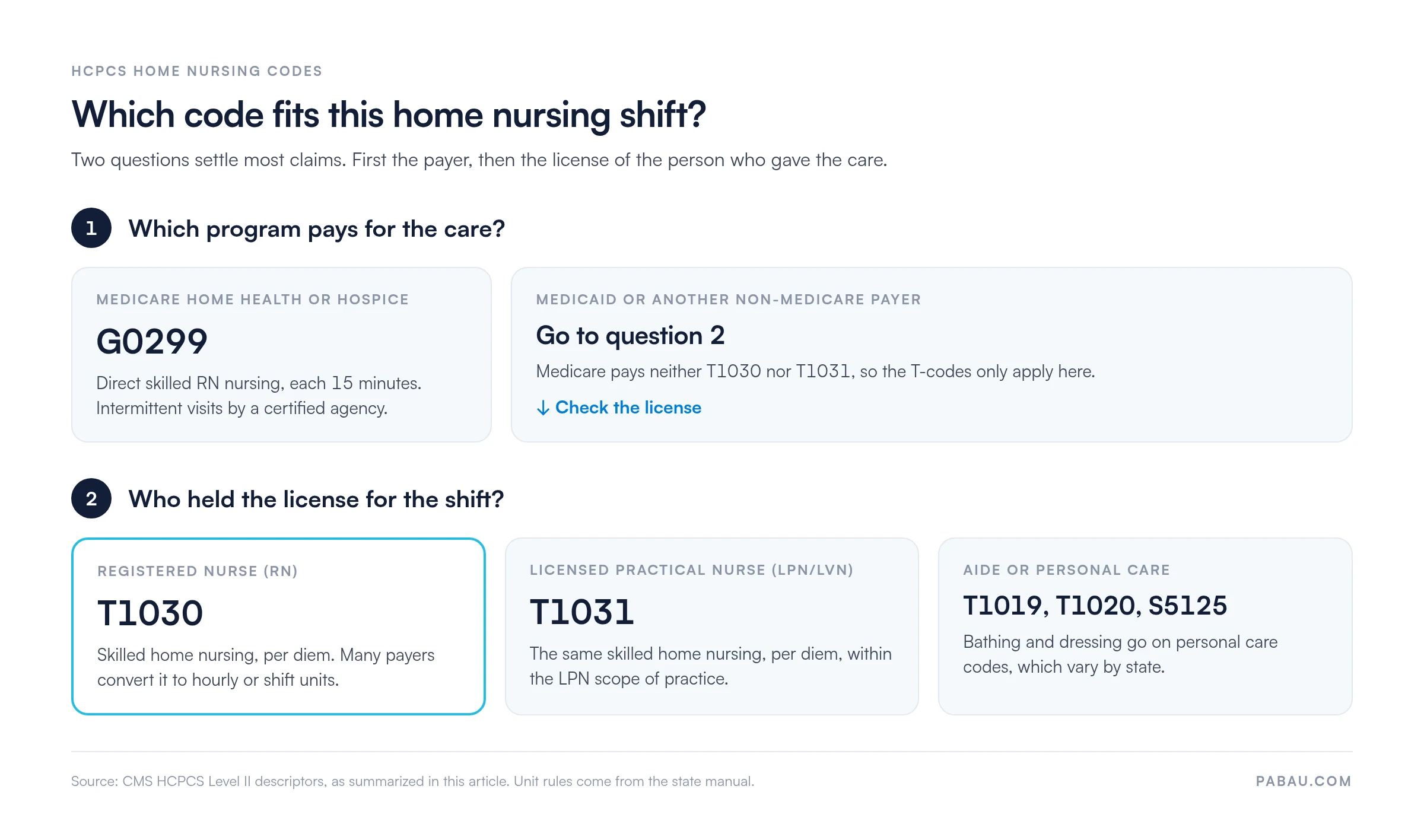
Both codes describe skilled nursing in the home, billed per diem. Neither one is a personal care code. So the question to ask is simple: who held the license for that shift?
Because the unit is set by the payer, the same shift can look different on two claims. The U.S. Department of Labor’s Energy Employees Occupational Illness Compensation Program, for example, bills each code per 8-hour shift (EEOICPA Bulletin 08-09). A Medicaid program may instead pay per hour or per day.
G0299 describes direct skilled nursing services of a registered nurse in the home health or hospice setting, each 15 minutes. Medicare home health agencies and hospices report it on their claims. T1030 belongs to Medicaid and other non-Medicare payers. Both involve an RN, but they never substitute for each other.
In practice, a Medicare patient receiving intermittent visits from a certified agency points to G0299. A Medicaid patient with authorized PDN hours points to T1030 or T1031. Dual-eligible patients can generate both claim types, so each service must go to the right payer under the right code.
T1030 is a T-code built for non-Medicare payers. Medicare will not pay it. Coverage looks like this:
Most Medicaid programs and managed care plans want prior authorization before PDN starts. Rules differ by payer. Some authorize per episode of care, while others review on a set cycle. Care delivered without authorization is often denied, and appeal options vary by state and payer.
A typical authorization request runs in five steps:
The approved nurse type matters here. If the plan authorized RN hours, LPN shifts may need their own approval under T1031.
Run through this list for every claim. It mirrors what billing compliance requirements ask of home nursing agencies.
First, confirm how the payer defines a unit. The descriptor says per diem, but your state manual may say hourly or per shift. Use one unit definition per claim line, and follow the manual exactly.
After submission, the claim usually follows this path:
Tracking those results is part of revenue cycle management. A denial pattern spotted early costs far less than one found at audit.
T1030 denials tend to come from the same few causes. A steady denial management routine catches them before they repeat.
Reading the denial codes on your remittances shows which of these mistakes keeps coming back.
Before each billing run, check three things on every T1030 claim. Is the authorization number present? Does a signed RN note exist for every shift? Do the units stay inside the authorized hours? Those checks catch most preventable denials.
The diagnosis codes on a T1030 claim show why skilled nursing is needed. States differ on which conditions qualify, so check the state list before you submit. These codes often appear on PDN claims:
Children with tracheostomies, feeding tubes or ventilators make up a large share of PDN patients. Adults with ALS or spinal cord injury also receive Medicaid-funded home nursing. Confirm the diagnosis qualifies in the patient’s state program.
The same T1030 shift can be billed two ways. It depends on whether the patient is in a managed care plan or traditional fee-for-service Medicaid.
Many PDN agencies keep shift notes in one place and claims in another. When a payer asks for records, staff chase paper and spreadsheets.
Pabau, the practice management and billing platform we build, helps teams build and submit claims and keep documentation together. Its claims management software sits next to the patient record. So the plan of care, the shift notes and the claim are easy to find when a question comes in.

Pabau helps PDN teams build and submit claims and keep documentation together, so T1030 and T1031 shifts reach the payer with less rework.

Start every T1030 claim with one question: was the nurse an RN? Get that right, and the rest becomes routine. Then match the payer’s unit, stay inside the authorized hours, and keep a signed note for each shift.
The trade-off is a little more checking before each billing run. That time costs less than reworking denied claims weeks later.
Want claims and nursing records in one place? Book a demo to see how Pabau keeps the paperwork beside each claim.

Need to understand how denials are coded? Denial codes in medical billing covers CARC and RARC denial reason codes used on home health remittances.
Looking for a billing software comparison? Best medical billing software in the US reviews the top platforms for home health and outpatient billing teams.
Want to reduce claim rejections before they happen? Clean claim requirements explains the fields and validations that determine whether a claim passes edits on the first submission.
T1030 means home nursing care by a registered nurse, billed per diem. State Medicaid programs use it for RN private duty nursing shifts. The payer’s manual decides whether a unit is a day, an hour or a shift.
No. Medicare does not pay T1030 or T1031. Medicare home health agencies and hospices report RN skilled nursing as G0299, in 15-minute units, on their own claims.
S9123 bills RN home nursing per hour, while T1030 uses a per diem descriptor. S9124 is the LPN version of S9123. Use whichever code the payer’s manual lists.
No. T1030 names a registered nurse, so an LPN shift goes on T1031. Billing an LPN shift as T1030 creates a credential mismatch that can lead to denials and recoupment.
Under the per diem descriptor, one unit covers one day. Many states convert T1030 to hourly or shift units instead. Either way, billed units must stay inside the authorized hours.
Often, yes, if the authorization covers both RN and LPN hours. Bill each shift under the code matching the nurse who worked it, and never let the hours overlap.