CPT code 21011: Excision of soft tissue tumor of the face
CPT code 21011: Official descriptor and procedure overview CPT code 21011, as pu...

Last Updated: Oct 8, 2026
99457 is the CPT code for remote physiologic monitoring treatment management services, first 20 minutes. It covers clinical staff, physician or other qualified health care professional time in a calendar month. That time must include at least one real-time, interactive communication with the patient or caregiver.
It sits in the remote physiologic monitoring family with 99453, 99454 and 99458, plus 99445 and 99470 from January 1, 2026. Device setup and device supply are billed separately, and each additional 20 minutes is reported with add-on code 99458.
Let Pabau's smart automation suggest the right codes, reduce claim denials, and keep your practice compliant—effortlessly.
Automate repetitive tasks and focus on what matters most—your patients.
Reduce coding errors and ensure compliance with the latest regulations.
Clean claims, fewer denials, and faster reimbursements.
Powerful insights and reporting to help your practice thrive.
HIPAA compliant SOC 2 certified GDPR-compliant Trusted by 4,000+ clinics worldwide

CPT code 99457 requires at least 20 minutes of RPM treatment management per calendar month, including one real-time interactive communication with the patient or caregiver.
The code covers treatment management and interactive communication only. Device supply is billed under 99454 or 99445, and device setup under 99453.
99458 is the add-on code for each additional 20 minutes beyond 99457. CPT guidelines bar reporting 99091 in the same period as 99457.
From January 1, 2026, 99470 covers months with 10-19 minutes of management time, and 99445 covers device supply with 2-15 days of data.
Pabau, our practice management and billing platform, sends CMS-1500 claims through the Claim.MD clearinghouse with real-time eligibility checks and claim status tracking for US practices.
CPT code 99457 is the remote physiologic monitoring (RPM) treatment management code for the first 20 minutes of care management in a calendar month.
That time can come from a physician, another qualified health care professional (QHP), or clinical staff under general supervision. It must include at least one real-time, interactive communication with the patient or caregiver.
The code belongs to the RPM family in the AMA’s CPT code set. That family runs from 99453 to 99458, plus 99445 and 99470 from January 1, 2026.
Three elements must all be present in the month for a valid 99457 claim. Remove any one of them and the code is unbillable for that month.
The code does not cover device setup or device supply. Setup is billed under 99453 and supply under 99454, and the table below maps each RPM service to its code.
The 20-minute threshold for CPT code 99457 is cumulative across the calendar month, so it does not have to be met in one session. A provider who spends 12 minutes reviewing blood pressure data on one date and 10 minutes on a follow-up call the same week meets it. The count resets on the first of each month, whenever the claim is submitted.
CMS defines interactive communication as a real-time, synchronous, two-way audio interaction, which can be enhanced with video. Asynchronous messages, patient portal notes and SMS exchanges do not qualify, even when they are medically relevant and well documented. This misunderstanding sits behind many denied 99457 claims.
Documentation for CPT code 99457 must be in place before the claim goes out, not assembled after a denial. These are the five elements every chart must show.
Incident-to billing applies when clinical staff perform RPM activities under a physician’s or other QHP’s general supervision. The supervising practitioner must be enrolled in Medicare. Staff time counts toward the 20 minutes, and the interactive communication may be performed by the QHP or by clinical staff under general supervision.
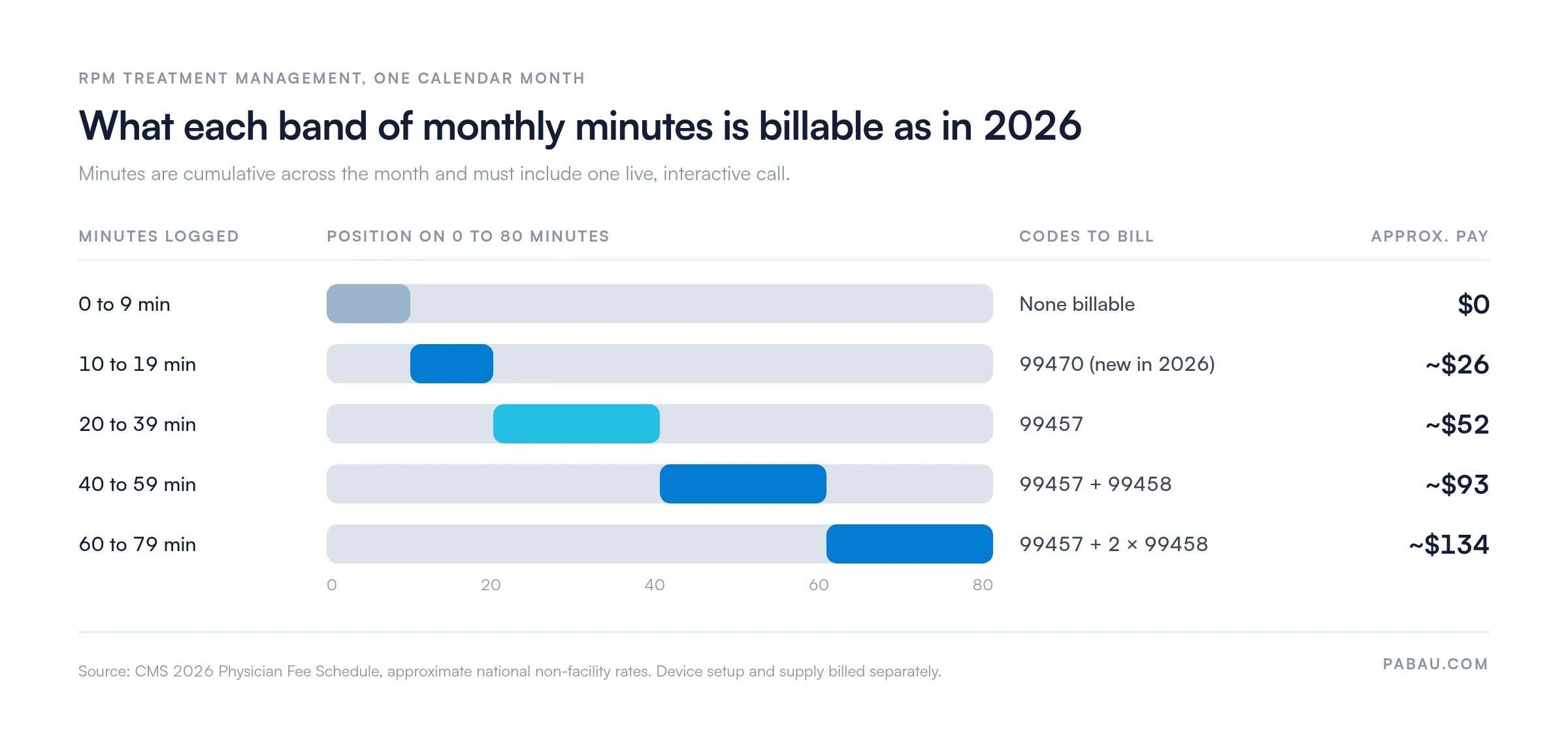
CPT 99458 is billed for each additional 20 minutes of RPM treatment management beyond the initial 99457 in the same calendar month. It cannot be billed without 99457 in that month. From January 1, 2026, a month with 10-19 minutes can be reported with 99470, which is not billed alongside 99457. The time-band table below shows which codes to bill.
CPT 99091 covers collection and interpretation of physiologic data by a physician or other QHP, for a minimum of 30 minutes per 30-day period. Unlike 99457, it does not require interactive communication. The physician or other QHP must personally perform the work, and clinical staff time does not count. CPT guidelines bar reporting 99091 and 99457 in the same period for the same patient.
99091 predates the RPM family and is now used far less often. Practices billing RPM services tend to choose 99457, because its lower time threshold and the ability to count clinical staff time make it more practical.
CPT 99490 covers chronic care management (CCM), not remote physiologic monitoring. CCM coordinates care for patients with two or more chronic conditions but does not require a monitoring device. RPM under 99457 needs device-generated physiologic data and interactive communication. CCM needs care coordination and a comprehensive care plan, with no device.
CMS allows 99457 and 99490 to be billed in the same calendar month when both services are independently furnished and documented. Many commercial payers do not follow this policy, so check each payer’s rules before co-billing. When both are billed, each service needs its own time log, and the clinical activities must not overlap.
Medicare pays roughly $52 for CPT code 99457 in 2026 at the national non-facility rate, and about $41 for each unit of 99458. CMS began separate payment for 99457 in the 2020 Physician Fee Schedule and updates the rates every year.
Rates are adjusted by the Geographic Practice Cost Index (GPCI) and vary by Medicare Administrative Contractor locality. Use the CMS Physician Fee Schedule lookup tool to confirm the rate for your locality. Two codes joined the family on January 1, 2026. 99445 covers device supply with 2-15 days of data, and 99470 covers the first 10 minutes of treatment management.
Rates above are approximate national figures. Check the FastRVU 2026 RVU lookup for current Work, PE, and MP RVU values. Commercial payers set their own rates, often as a percentage of the Medicare fee schedule. Some tiered contracts pay above the Medicare rate, and some below it.
Put the time bands and the 2026 rates together, and each extra 20 minutes of documented management adds about $41 to the month.
Five conditions need to be in place before the first 99457 claim goes out. Four come from Medicare rules, and the fifth covers commercial payers.
A clean claim submission for 99457 requires all five prerequisites confirmed and documented before the claim date. Verifying eligibility before each monthly billing cycle also catches coverage changes before they turn into denials.
The table below pairs each common 99457 denial with the claim adjustment reason code (CARC) it usually arrives under, and the fix. Working these through your denial management workflows lets you correct and resubmit before the timely filing deadline.
Our guide to common denial codes lists further CARC and remittance advice remark code (RARC) combinations that appear on RPM remittances. When claims run through a clearinghouse, electronic remittance advice (ERA) delivers machine-readable denial detail, so these corrections are faster to spot.
ICD-10 codes for conditions that clinically justify continuous physiologic monitoring support 99457. Hypertension, type 2 diabetes, chronic obstructive pulmonary disease (COPD), heart failure and stage 3 chronic kidney disease are common examples. The monitored parameter must connect directly to the diagnosis documented in the chart.
Blood pressure monitoring billed under 99457 needs I10 or another hypertension diagnosis in the chart. A low-acuity complaint on its own does not establish medical necessity. The codes below are a starting point, not an exhaustive list, and payer policies may narrow or widen it.
Document the clinical rationale in the note, not only the ICD-10 code. “Patient with I10 monitored via home blood pressure cuff to assess response to lisinopril titration” is defensible. “I10” with no supporting narrative is not.
Run an eligibility check through your clearinghouse before the first 99457 claim each month, not only at patient enrollment. Payer coverage for RPM can change with plan renewals. A patient whose RPM benefit was active in January may have lost it by March. The check takes minutes, while a write-off after a denial is lost revenue.
When RPM notes, eligibility and claims sit in separate systems, a lapsed benefit or a blank claim field only surfaces weeks later as a denial. By then the month has closed, and the fix means an appeal.
Pabau’s claims management software sends CMS-1500 claims through Claim.MD, our US clearinghouse partner. It runs real-time eligibility checks before submission and validates each claim for missing fields. An incomplete 99457 claim is stopped before the payer sees it.
Claim status and ERA tracking sit in the same place, so your billing team sees which RPM claims were paid, which were adjusted, and why. Less time goes on resubmissions, and more goes on the patient calls that make 99457 billable.

Pabau checks eligibility in real time and flags missing claim details before CMS-1500 claims go to the Claim.MD clearinghouse. Your 99457 claims go out clean the first time.

Treat 99457 as a monthly habit rather than a code you reach for at billing time. Log each minute as it happens, record the interactive call on its own, and confirm consent before the first reading arrives. The month-end claim then becomes a formality.
The 2026 changes reward that habit. With 99470 and 99445 in place, months that fell short of 20 minutes or 16 days of data can now be billed. That only works if the log shows exactly where each month landed.
Book a demo to see how Pabau’s eligibility checks and claim validation help your practice send 99457 claims that get paid on the first pass.

Need to understand how clearinghouses process RPM claims? Medical claims clearinghouse guide explains how 837P transactions are validated before they reach payers.
Want to build a clean-claim checklist for your billing team? Superbill documentation guide covers the line-item requirements that keep RPM claims out of the denial queue.
Looking for the full RPM credentialing picture? Insurance credentialing guide walks through enrolling providers so they can bill 99457 under Medicare.
Billing chronic care management in the same month? CPT code 99490 sets out the CCM time and care plan rules that sit alongside RPM.
CPT code 99457 covers the first 20 minutes of remote physiologic monitoring treatment management in a calendar month. That time includes reviewing device data, managing the care plan and at least one real-time, interactive communication with the patient or caregiver. Device setup (99453) and device supply (99454 or 99445) are billed separately.
Interactive communication for 99457 must be a real-time, synchronous, two-way audio interaction with the patient or caregiver, which can be enhanced with video. Asynchronous messages, patient portal notes and SMS texts do not qualify under CMS guidelines, whatever their clinical value.
Yes, 99458 can be billed with 99457 when total RPM treatment management time reaches 40 minutes or more in the calendar month. Each unit of 99458 represents an additional 20 minutes beyond the initial 99457. There is no published limit on the number of 99458 units per month, though some payers may impose one.
CPT 99457 is a remote physiologic monitoring code that requires a monitoring device and interactive communication. CPT 99490 is a chronic care management code for patients with two or more chronic conditions, with no device requirement. CMS permits billing both in the same month when each service is independently furnished and documented, but many commercial payers do not.
Physicians and other qualified health care professionals enrolled in Medicare can bill 99457, including nurse practitioners and physician assistants. Clinical staff time counts toward the 20-minute threshold under general supervision, and interactive communication may be performed by clinical staff under general supervision. State scope of practice rules may further restrict NP and PA billing in some jurisdictions.
The most common reasons are a missing record of the interactive communication and total time below 20 minutes. Consent not on file before services began and a billing provider not enrolled in Medicare are the other frequent causes. Check the claim adjustment reason code (CARC) on your remittance advice to find the specific reason, then fix the documentation before appealing or resubmitting.