



CCSD code G5100: Bypass of duodenum billing guide
CCSD code G5100 bills a bypass that leaves the duodenum in place CCSD code G5100...

Last Updated: Oct 16, 2026

CPT Code 99215 covers established patient office visits that need high complexity medical decision making, or 40-54 minutes of total time.
High complexity medical decision making requires meeting the threshold in at least 2 of 3 elements. Those are problems, data, and risk.
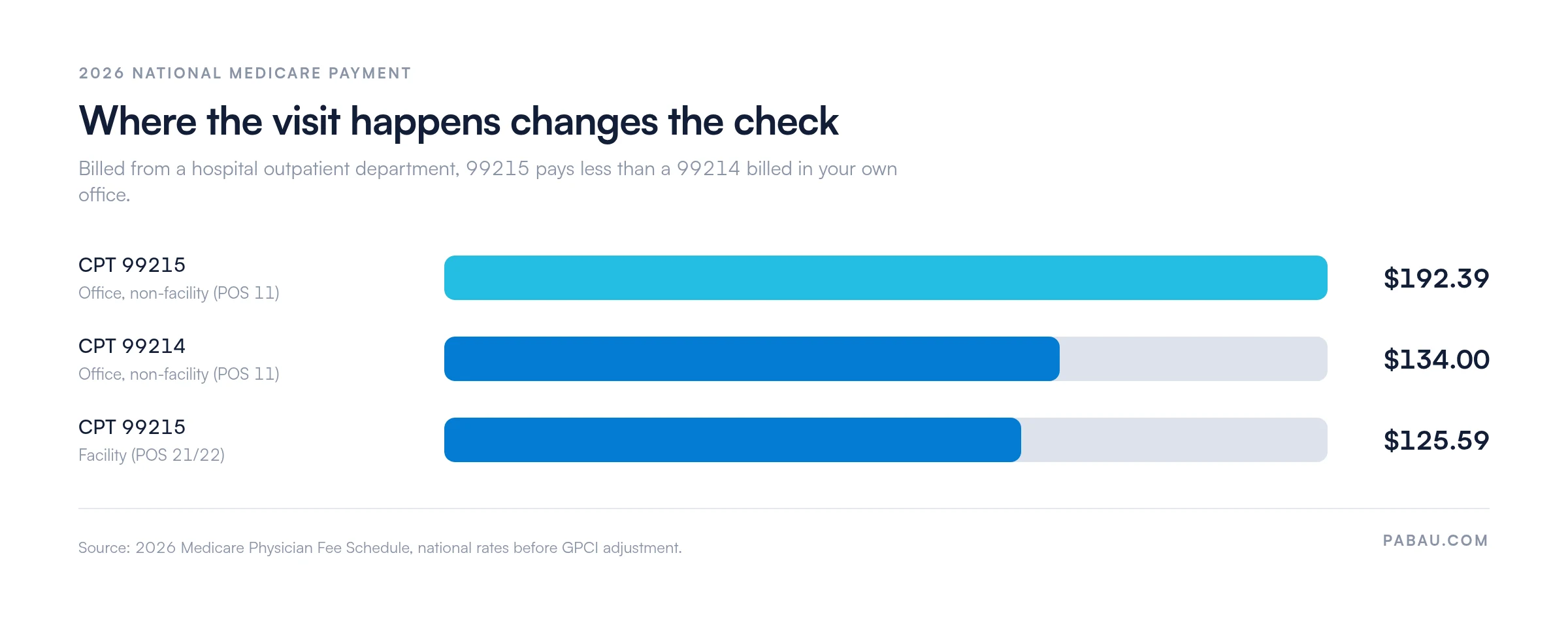
Medicare pays roughly $192 for 99215 in the office and roughly $126 in a facility setting.
Billing 99215 without documentation that supports the level is a leading OIG audit trigger. Each note has to stand on its own.
Practice management software like Pabau submits 99215 claims through the Claim.MD clearinghouse, with real-time eligibility checks and ERA reconciliation.
CPT Code 99215 is the top-level office visit code for an established patient. Specifically, it applies when the encounter involves high complexity medical decision making, or when the billing provider spends 40-54 minutes on the date of service.
Fewer than 5% of established-patient visits reach that level, according to the American Academy of Family Physicians. Because of that rarity, payers and the Office of Inspector General watch the code closely.
This reference covers the descriptor, both qualification pathways, 2026 Medicare rates, add-on codes, and the documentation that holds up under review. It also flags one number worth knowing before you set your place-of-service defaults.
The official descriptor covers an office or other outpatient visit for an established patient. It requires a medically appropriate history and/or examination, plus either high complexity medical decision making or a total time of 40-54 minutes on the encounter date.
It sits at the top of the established-patient outpatient E/M ladder. By contrast, CPT 99214 sits below it at moderate complexity and 30-39 minutes. From there, add-on code 99417 picks up beyond 54 minutes.
“Established patient” means the patient has had professional services from the billing physician within the past three years. A physician of the same specialty and subspecialty in the same group counts as well. However, first-time patients, regardless of complexity, must be billed under new-patient codes (99202-99205). Understanding this distinction matters for coaching and other E/M procedure codes in similar specialties.
The code is maintained by the American Medical Association (AMA) as part of the CPT code set. The 2021 E/M guideline revision removed the exam as a required element for outpatient E/M codes. In practice, history and physical findings are now documented as “medically appropriate”. As a result, the 1995 and 1997 documentation guidelines no longer set the code level.
There are two independent paths to 99215. Either way, you pick whichever pathway supports the higher level of service, and you do not need both.
High complexity medical decision making (MDM) is determined using the AMA’s three-element table. In other words, a visit qualifies as high complexity when at least two of the three elements reach the high-complexity threshold.
Total time under the 2021 AMA guidelines includes all time the billing provider personally spends on the date of the encounter, face-to-face and otherwise. However, time spent by clinical staff such as nurses and medical assistants does not count.
Activities that count toward total time include:
If total time on the encounter date reaches 55 minutes or more, add-on code 99417 then applies for each additional 15-minute increment beyond 54 minutes.
Poor documentation is the primary reason 99215 claims fail audit. In fact, the clinical note must independently support the level billed. After all, a coder or auditor should not have to infer complexity from outside the record. Following HIPAA-compliant documentation practices keeps records both legally sound and audit-ready.
Required elements for MDM-based billing:
Required elements for time-based billing:
In practice, referencing a primary care compliance checklist during documentation audits helps practices verify that each note element meets payer standards before claims go out.
The most common coding decision in outpatient E/M billing is choosing between 99214 and 99215. In fact, the differences are meaningful in both documentation burden and reimbursement.
The documentation decides the code, not the other way around. In other words, picking 99215 because the visit felt long will not survive review.
CPT Code 99215 can be billed by physicians and other qualified healthcare professionals (QHPs) who are enrolled with Medicare and have independent billing privileges. In fact, understanding medical billing fundamentals is essential before selecting this code for non-physician providers.
Eligible providers include:
Incident-to billing: A non-physician practitioner may see an established patient under physician supervision. In that case, those claims can be billed incident-to the physician at 100% of the fee schedule, rather than the practitioner’s usual 85%.
In fact, the requirements are strict: a supervising physician must be physically present in the office suite, not just the building, and must have already established the plan of care for a condition they evaluated at the visit.
See CMS Benefits Policy Manual Chapter 15, Section 60 for the full eligibility criteria. In fact, incident-to is a Medicare policy, and commercial payers set their own rules. Similar principles apply to IVF procedure code billing when several providers share the care.
Place of service: 99215 applies to office and outpatient settings. In fact, the place-of-service code changes what you are paid. Non-facility settings (POS 11) pay more than facility settings (POS 21, 22), because facilities receive separate overhead payments from CMS.
Reimbursement for CPT Code 99215 is set annually by CMS through the Medicare Physician Fee Schedule (MPFS). Rates come from Relative Value Units (RVUs) multiplied by the conversion factor, which is $33.4009 for 2026. The Geographic Practice Cost Index (GPCI) then adjusts for local cost differences.
Verify current rates using the CMS Physician Fee Schedule lookup tool. In turn, understanding the full picture of revenue cycle management helps practices predict and optimize 99215 reimbursement over time.
Place of service moves the payment more than the code choice does. For example, a 99215 billed from a hospital outpatient department pays less than a 99214 billed in your own office.
Geographic variation matters too. High-cost localities such as Manhattan and San Francisco carry GPCI adjustments that can lift payment 15-25% above the national average. Use the FastRVU 2026 RVU lookup for locality-adjusted rates. In fact, commercial payers negotiate separately, and typically pay 110% to 160% of Medicare for 99215.
Practice management software like Pabau handles electronic claims via Claim.MD, a clearinghouse that reaches 4,000+ US payers. As a result, it returns real-time eligibility verification and electronic remittance advice.
Practices can also review electronic remittance advice (ERA) processing to reconcile 99215 payments against expected MPFS rates. Systematic underpayments show up early, before they compound across a billing cycle.
Track your 99215 utilization rate against your specialty benchmark quarterly. Consistently billing 99215 well above the national average of roughly 5% of established-patient E/M visits can trigger a payer audit. Document a rationale in any outlier month so your compliance file reflects your patient population.
Several codes may be reported alongside 99215 to capture additional services provided on the same date. In turn, each requires separate documentation. Accurate superbill creation for office visits captures add-on codes at the point of care rather than from memory later.
Verify add-on code pairings against current AMA CPT coding resources and your payer’s coverage policy before billing. In particular, payer-specific edits apply for Medicare managed care plans.
CPT Code 99215 appears regularly on OIG Work Plans and payer audit targets because it is the highest-paying routine outpatient E/M code. In turn, robust denial management workflows catch 99215 errors before they become repayment demands.
The most common billing errors:
Achieving clean claim submission standards for 99215 starts before the claim leaves your system. In fact, structured EHR note templates that prompt for each MDM element catch a thin note at the point of care, not at audit. The AAPC Codify CPT lookup provides additional crosswalk guidance on E/M code edits and payer-specific policies.
Run a monthly internal audit on a random sample of 10 99215 claims. For each, verify that the note independently supports the level billed without referencing prior visits. Flag any note where the MDM reasoning is implied rather than stated explicitly. Correct the pattern before a payer does.
High complexity visits generate high documentation volume. A practice billing 99215 across several providers needs a system that captures MDM elements and tracks time. It also has to move claims to adjudication without manual hand-offs.
Pabau’s claims management software connects to the Claim.MD clearinghouse. You can submit CMS-1500 and 837P claims to 4,000+ US payers. In turn, eligibility checks run in real time before the visit starts. From there, ERAs come back into Pabau as 835 remittances, ready for reconciliation.
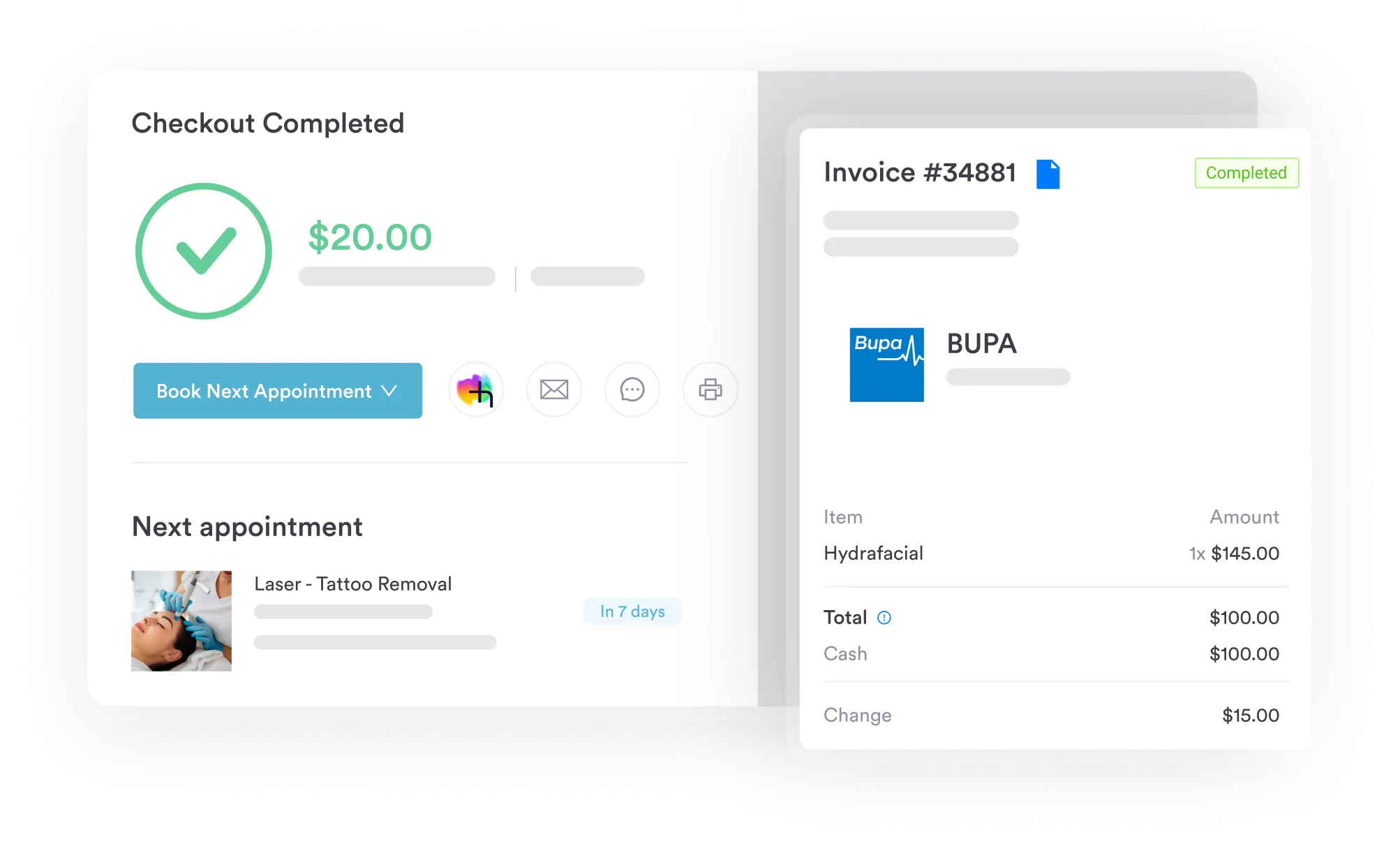
Clinical documentation through Pabau’s EHR module captures the structured note elements that support high MDM. In turn, active problem status, data reviewed, risk rationale, and total time each have a home. When the note is complete, the claim populates from the encounter data instead of a separate manual entry.
Pabau also surfaces ERA adjustment reason codes (CARCs) on 99215 denials. Billing staff can spot the pattern behind a run of rejections instead of working each one alone.

Pabau connects your encounter notes and claim submission in one system. Your 99215 visits move from note to paid claim with fewer manual steps.

99215 pays well because it is hard to document. If your notes carry the MDM reasoning in specific terms, the code is yours to bill. If they do not, no amount of coding advice will hold it up under review.
Run the monthly sample audit. Check your place-of-service defaults while you are in there, because a facility 99215 pays less than an office 99214.
Pabau’s EHR and claims platform captures the structured documentation 99215 requires and submits clean claims through Claim.MD. Explore how revenue cycle management works in practice to see where 99215 sits in the wider billing cycle. Or book a demo to watch Pabau move an E/M claim from note to payment.

Need guidance on medical billing fundamentals before tackling high-complexity E/M codes? What is medical billing covers the end-to-end claim lifecycle from patient encounter to payment posting.
Looking to reduce 99215 denials before they reach your AR queue? Denial management in healthcare outlines structured workflows for identifying, appealing, and preventing claim rejections.
Want to understand how clearinghouse connections speed up reimbursement? Medical claims clearinghouse explains how 837P transmission, eligibility verification, and ERA processing work together.
CPT Code 99215 is an evaluation and management code for established patient office or outpatient visits. It requires high complexity medical decision making, or 40-54 minutes of total provider time on the encounter date. It is the highest-level routine outpatient E/M code in the 99211-99215 series, maintained by the AMA.
CPT 99215 carries a work RVU of 2.80 and a total non-facility RVU of 5.76 for 2026. Multiplied by the CMS conversion factor of $33.4009, that produces a national non-facility rate of about $192.39. GPCI locality adjustments then move the figure up or down.
Yes. Nurse practitioners, physician assistants, and other qualified healthcare professionals enrolled with Medicare may bill 99215 independently at 85% of the physician fee schedule. Under incident-to rules, NPs may also bill at 100% of the physician rate. The supervising physician must be physically present in the office suite, and must have established the plan of care. Eligibility criteria vary by payer.
The non-facility rate for CPT 99215 in an office setting (POS 11) is about $192.39 under 2026 Medicare. The facility rate (POS 21/22) is about $125.59, because the facility separately receives overhead payments from CMS. Providers billing from a hospital outpatient department should expect materially lower physician reimbursement.
Four patterns draw the most attention. The first is utilization well above the specialty benchmark of roughly 5% of established-patient E/M visits. The second is copy-forward notes that repeat across dates of service. The third is MDM documentation that asserts high complexity without specific clinical reasoning. The fourth is a missing modifier 25 when a procedure is billed on the same date. Monthly internal audits on a sample of 99215 claims are the most effective preventive control.
Billing CPT Code 99215 for a visit that does not meet the documented criteria constitutes a false claim under the False Claims Act. The OIG distinguishes inadvertent errors from intentional upcoding patterns. Errors are addressed through repayment and corrective action plans. Patterns can bring civil monetary penalties and exclusion from federal healthcare programs. Robust internal audit programs and clear documentation policies are the primary compliance safeguards.



