HCPCS Code J1110: Dihydroergotamine mesylate injection billing guide
HCPCS Code J1110: Official descriptor and drug overview HCPCS Code J1110 is the ...

Last Updated: Oct 29, 2026
97606 is the CPT code for negative pressure wound therapy using durable medical equipment (DME) on a total wound surface area over 50 square centimeters. It is billed per session and includes topical application, wound assessment, and instructions for ongoing care.
When several wounds are treated in one session, their areas are added together before the code is chosen. A total of 50 square centimeters or less moves the session to 97605. Disposable, non-DME systems are billed with 97607 or 97608 instead.
Let Pabau's smart automation suggest the right codes, reduce claim denials, and keep your practice compliant—effortlessly.
Automate repetitive tasks and focus on what matters most—your patients.
Reduce coding errors and ensure compliance with the latest regulations.
Clean claims, fewer denials, and faster reimbursements.
Powerful insights and reporting to help your practice thrive.
HIPAA compliant SOC 2 certified GDPR-compliant Trusted by 4,000+ clinics worldwide

CPT code 97606 covers negative pressure wound therapy using durable medical equipment (DME) when total wound surface area is greater than 50 cm².
It is billed once per session, and the areas of all wounds treated in that session are added together before you pick the code.
Total wound area and device type decide between 97605, 97606, 97607 and 97608, while the device brand plays no part.
Missing wound measurements (length x width, totaled in cm²) are among the most common 97606 denial causes.
Pabau’s claims management software prompts for wound measurements and device type at the point of care, so NPWT claims leave complete.
CPT code 97606 is the code for negative pressure wound therapy (NPWT) using durable medical equipment (DME) on over 50 cm² of total wound area.
It is billed per session under the American Medical Association’s CPT code set. The AMA places 97606 in the Active Wound Care Management codes (97597-97610), within Physical Medicine and Rehabilitation (97010-97799).
The official descriptor reads as follows, quoted in three parts. DME here means a reusable, powered pump that the practice or institution owns or rents.
The superbill for each NPWT session needs the total wound surface area before the claim goes out. Without that measurement on file, even a correctly selected code is likely to be denied.
The sole billing difference between 97605 and 97606 is total wound surface area. Both codes require a DME device, a reusable powered pump. Coders sometimes assume the device model or manufacturer decides the code, but brand plays no part. The 50 cm² threshold is the only gate between the two.
Calculate surface area by multiplying wound length by wound width in centimeters. A wound measuring 8 cm x 7 cm equals 56 cm², which crosses the 97606 threshold. A wound measuring 7 cm x 7 cm equals 49 cm², which falls under 97605.
When you treat more than one wound in a session, add their areas together. Two wounds of 30 cm² each total 60 cm², so that session is 97606. Record each measurement and the total at every session, not just the first application. The same three checks pick the code every time:
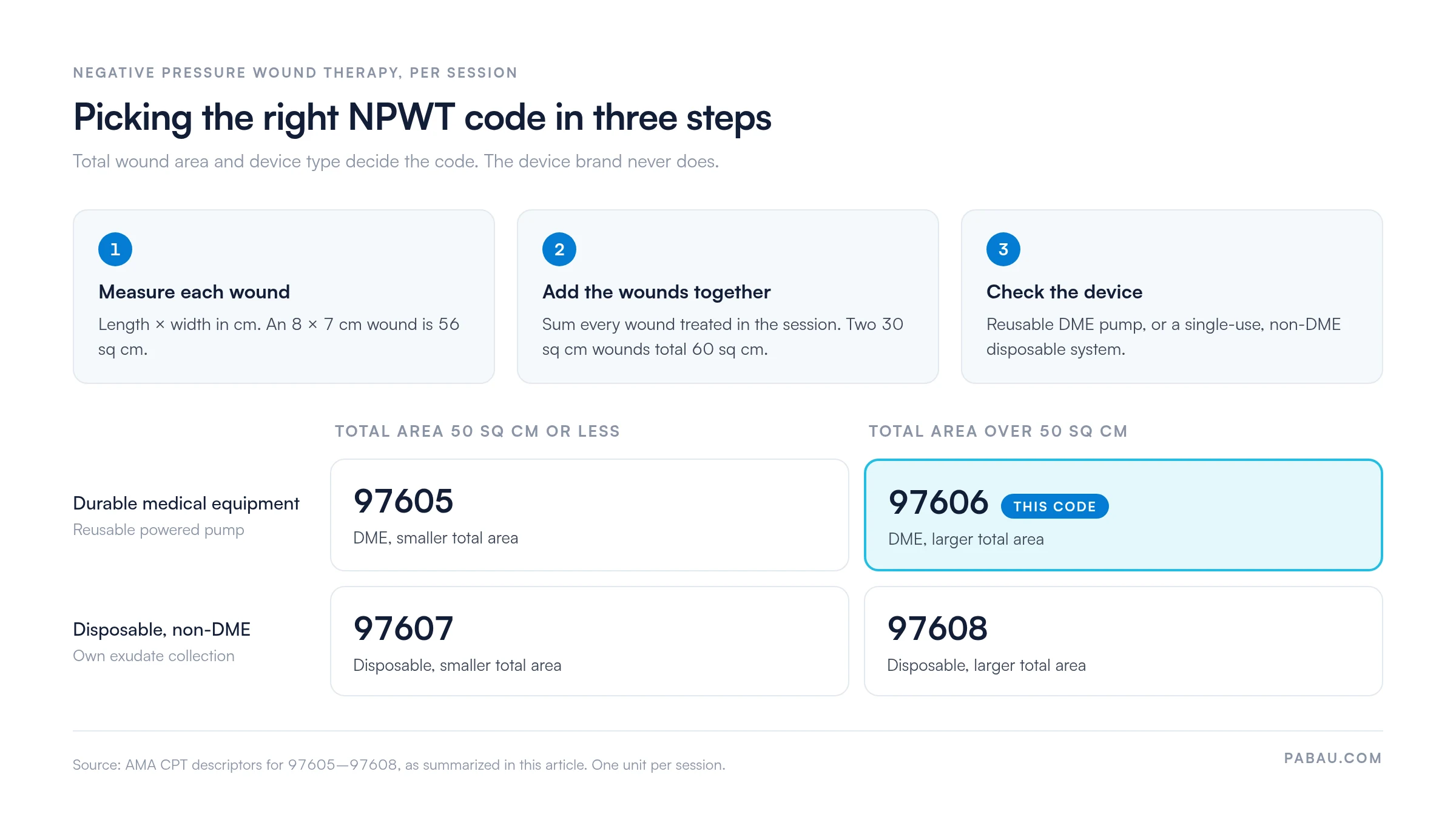
Codes 97605 through 97608 cover every NPWT billing scenario. The family splits along two axes: device type (DME or disposable non-DME) and total wound size (the 50 cm² threshold). CPT code 97606 sits in the DME, large-wound quadrant.
Disposable NPWT devices (97607/97608) are single-use, non-DME disposable systems with their own exudate collection. Their descriptors include provision of that exudate management collection system. Codes 97605 and 97606 use DME, a powered reusable pump that the practice or institution owns or rents. Billing 97606 when a disposable device was used is a coding error that creates audit exposure. Record the device type in the procedure note.
CPT code 97606 is a bundled service code. Knowing what sits inside the bundle prevents double billing. Knowing what sits outside it stops you under-reporting separately billable work.
Dressing removal, wound cleansing and exudate checks are typical session activity. The descriptor does not name them, so treat them as part of the session rather than as separate services.
Document the start and end time of each NPWT session. Timestamps show the session was a complete encounter, even though 97606 bills per session rather than by time. That supports medical necessity when payers audit for frequency.
Complete documentation is the difference between a paid claim and a denial. Every 97606 session needs a distinct set of recorded elements. Medical billing compliance for NPWT requires that these fields appear in the progress note, not just on the superbill.
For Medicare patients, Local Coverage Determination requirements add further specificity. Verify the applicable MAC LCD (such as Noridian or CGS Administrators) for your jurisdiction, as wound-type eligibility criteria and frequency limits vary by contractor.
Medicare coverage for CPT code 97606 is governed by MAC-issued Local Coverage Determinations rather than a single national policy. Practices must identify which MAC administers their jurisdiction and follow that MAC’s specific LCD for NPWT. Coverage criteria are not uniform across the country.
Run insurance eligibility verification before NPWT starts. It confirms active coverage and whether the payer needs prior authorization for this wound type and treatment setting.
CPT 97606 may be billed in office settings (POS 11) and hospital outpatient departments (POS 22). Outpatient wound care centers use POS 22 or 19, depending on designation. Facility versus non-facility reimbursement rates differ under the CMS Physician Fee Schedule, with non-facility rates typically higher when the practice owns and operates the equipment. Confirm with the current year’s MPFS for your specific locality.
Commercial payers apply their own prior authorization rules. These vary by plan and change annually. Never assume commercial payer requirements mirror Medicare LCD criteria. Check each payer’s policy directly before the first NPWT application on a new authorization cycle.
Billing 97606 correctly requires understanding its unit structure, the modifiers that apply in specific scenarios, and how place of service affects reimbursement. Clean claim submission for NPWT depends on getting all three right simultaneously.
Submitting 97606 with more than one unit for a single session is a common error that triggers automatic review. Bill one unit per session, even when several wounds are treated. Their areas are added together to choose the code, never billed wound by wound. Check the clean claim submission standards before submitting to confirm every required field is present.
Whether CPT 97606 and a debridement code such as 11042 can be billed on the same date comes up often in wound care practices. The answer needs an NCCI edit check rather than a blanket rule.
The National Correct Coding Initiative (NCCI) establishes bundling relationships between procedure codes. NCCI edits between NPWT codes and debridement codes exist and are updated quarterly. The current NCCI version should be consulted before assuming unbundling is permitted. That said, the general framework is as follows:
Verify current NCCI edit pairs between 97606 and the relevant debridement code before submitting. The NCCI Policy Manual, available through CMS, is the controlling reference. It shows whether an edit carries modifier indicator 0 (unbundling not permitted) or 1 (modifier 59 or XS may apply).
Most 97606 denials are preventable. A structured denial management workflow catches the common causes before the claim reaches the payer.
Each denial arrives with a Claim Adjustment Reason Code (CARC) on the remittance advice. Look it up in our guide to denial codes before you decide whether to correct, resubmit or appeal.
Run a monthly audit of all 97606 claims denied in the prior 30 days and group them by CARC. When the same code keeps coming back, fix the note template or workflow behind it instead of appealing each claim.
Most 97606 denials can be stopped while the note is written, before billing ever sees the claim. When wound measurements, device type and medical necessity sit in structured fields, the claim is built from them directly. Nobody has to re-check it by hand downstream.
Pabau’s claims management software links clinical documentation to claim submission, so the encounter note and the claim draw on the same structured data. Pabau also connects to Claim.MD, a US medical claims clearinghouse. Completed NPWT encounters go through it for validation, eligibility checks and payer submission, with no re-keying of encounter data.
When documentation and billing live in separate systems, someone retypes the note into the claim. That handoff is where 97605/97606 mix-ups and missing wound measurements usually creep in. With both in one system, the claim carries the clinician’s own entries. That means fewer claim corrections, fewer denials and faster payment for NPWT sessions.

Pabau prompts for wound measurements and device type at the point of care. Your NPWT claims reach the clearinghouse with the fields payers check first.

Treat the wound measurement as the coding decision for 97606. Once the note holds the session’s total surface area and the device type, the code follows and the claim holds up to review.
The trade-off is a minute of measuring and recording at every session, routine dressing changes included. Skip it, and you’ll be rebuilding the record later to answer a denial.
To see how Pabau captures wound measurements and device type before the claim is built, book a demo.

Need to understand how claim denials are tracked and resolved? Denial management in healthcare covers the full workflow for identifying, appealing, and preventing recurring claim rejections.
Want to understand the clearinghouse process behind NPWT claim submission? Medical claims clearinghouse explains how electronic claims are validated and routed to payers.
Building a superbill that captures all required NPWT fields? Superbill generation walks through what must appear on a compliant superbill for wound care services.
CPT code 97606 covers negative pressure wound therapy using durable medical equipment (DME) when the total wound surface area is greater than 50 cm². It is billed once per session. The descriptor includes topical application, wound assessment, and instructions for ongoing care.
The billing difference is total wound surface area. CPT 97605 applies when all wounds treated in the session total 50 cm² or less, and CPT 97606 applies above that. Both codes require a DME device. Multiply length by width in centimeters for each wound, then add the results to pick the code.
Yes, Medicare reimburses CPT code 97606 when the claim meets the MAC Local Coverage Determination criteria for your jurisdiction. Eligibility typically requires the wound to have failed at least 30 days of conventional wound management. It must also be a covered wound type, such as a chronic wound, surgical dehiscence, or a Stage III/IV pressure injury. Rates vary by setting (facility vs. non-facility) and locality under the annual Medicare Physician Fee Schedule.
The most common causes are a missing wound surface area measurement and a wrong code from an uncalculated wound size. Other causes include no signed physician order, a wound type outside the payer’s LCD, and an exceeded frequency limit. Review the Claim Adjustment Reason Code (CARC) on the remittance advice to find the denial category before appealing.
Sometimes. When debridement is integral to wound bed preparation right before NPWT application, it is generally bundled. When it is a clinically separate procedure with its own medical necessity, modifier 59 or XS may allow separate billing. Verify current NCCI edit pairs before submitting both codes on the same date.
CPT 97606 is billed as one unit per session. It is not billed per day, per hour, or per square centimeter of wound surface. Submit one unit per encounter regardless of session duration, and never submit multiple units on the same date for a single treatment session.
DME NPWT uses a reusable, powered pump that the practice or institution owns or rents. It is reported with CPT 97605 (smaller total area) or CPT 97606 (larger total area). Disposable NPWT uses a single-use, non-DME disposable system with its own exudate collection. It is reported with CPT 97607 or CPT 97608. Billing a DME code when a disposable device was used is a coding error and a potential audit trigger.