CPT code 95808: Attended polysomnography billing guide
CPT code 95808 covers attended PSG with 1 to 3 extra channels CPT code 95808 is ...

Last Updated: Nov 11, 2026
97607 is the CPT code for one session of negative pressure wound therapy with disposable, non-durable medical equipment. It applies when the total wound surface area is 50 sq cm or less. One session covers the exudate collection system, topical application, wound assessment and instructions for ongoing care.
The code turns on two facts in the note. The device must be a single-use system, because a durable pump moves the claim to 97605 or 97606. The measured total must also stay at or under 50 sq cm, or the code becomes 97608.
Let Pabau's smart automation suggest the right codes, reduce claim denials, and keep your practice compliant—effortlessly.
Automate repetitive tasks and focus on what matters most—your patients.
Reduce coding errors and ensure compliance with the latest regulations.
Clean claims, fewer denials, and faster reimbursements.
Powerful insights and reporting to help your practice thrive.
HIPAA compliant SOC 2 certified GDPR-compliant Trusted by 4,000+ clinics worldwide

CPT code 97607 reports negative pressure wound therapy with disposable, non-durable equipment, per session, when the total wound area is 50 sq cm or less.
Many single-use systems run on a small battery pump and still count as disposable, so the code split follows durable versus disposable equipment.
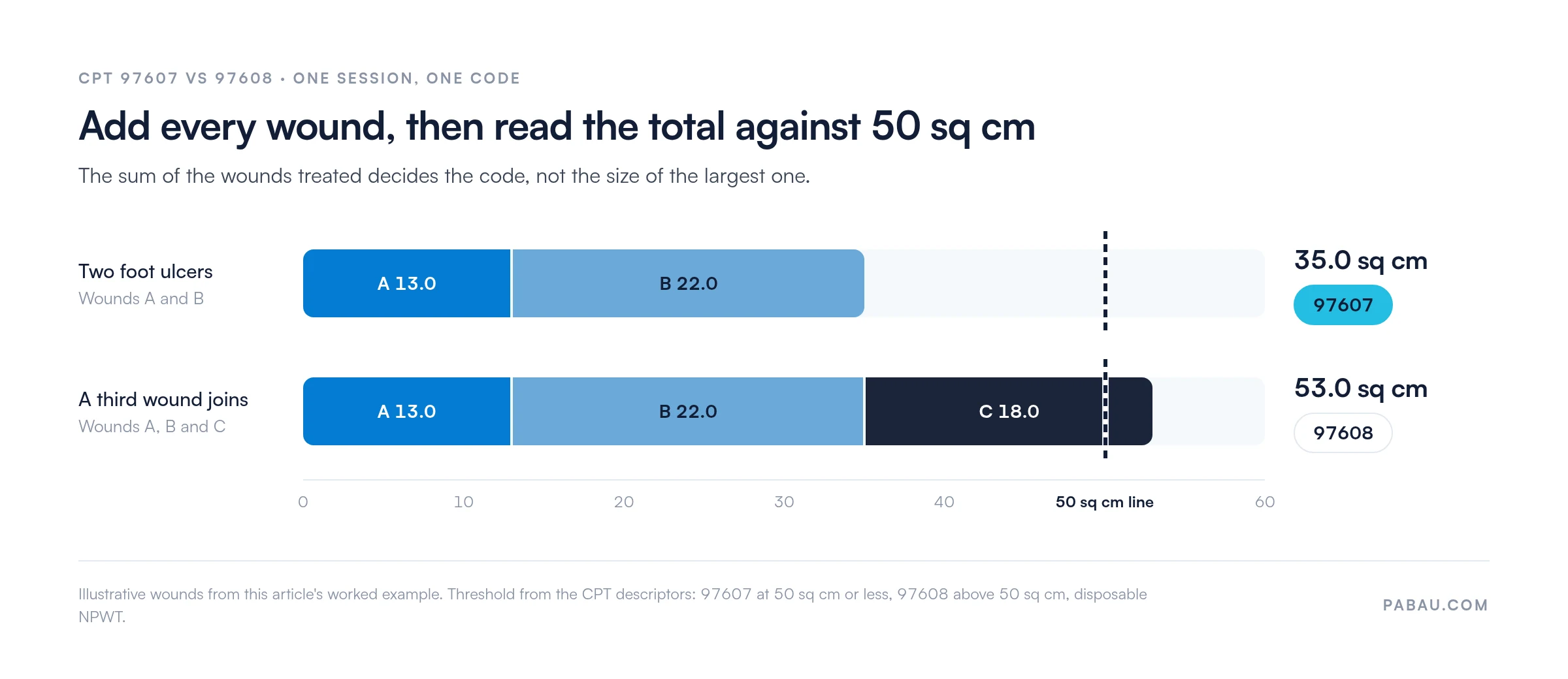
Add up the area of every wound treated in the session and report one code, 97607 up to 50 sq cm and 97608 above it.
A measured sq cm figure, the named device and the medical necessity story in the note decide whether the claim pays.
NPWT codes 97605 to 97608 carry an XXX global indicator, so each qualifying session is reported on its own.
CPT code 97607 reports one session of negative pressure wound therapy (NPWT) with a disposable device. It applies when the total wound surface area is 50 sq cm or less.
The descriptor calls the equipment “disposable, non-durable medical equipment”. It also bundles the exudate collection system, topical application, wound assessment and instructions for ongoing care into the session.
So two facts pick the code. Is the pump single-use or durable medical equipment (DME)? And what do the treated wounds measure in total? The wording above follows the CMS billing and coding article A53781, which lists 97607 and 97608 in full.
All four NPWT codes in the CPT code library sit on a simple grid. One axis is the equipment, durable or disposable. The other is total wound area, 50 sq cm or less, or more.
“Disposable” doesn’t mean unpowered. PICO from Smith+Nephew, for example, runs on a small battery-driven pump that’s thrown away after use. What moves a claim to 97605 or 97606 is a durable pump that’s reused, rented or billed as DME.
CPT Assistant guidance also says 97607 and 97608 aren’t reported in addition to 97605 and 97606. If the patient switches from a disposable system to a DME pump, the code family switches with it from that session. For the DME side, see our guides to CPT code 97605 and CPT code 97606.
Read the descriptor as a checklist. A session qualifies when the clinician performs the whole package, not just part of it.
The descriptor measures “total wound(s) surface area”, so you don’t code each wound on its own line. Add the areas together, then pick the one code that fits the total.
Say a patient with type 2 diabetes has two foot ulcers, coded E11.621 with an L97 site code. One disposable system treats both in a single session. Wound A measures 4.2 cm × 3.1 cm, about 13.0 sq cm. Wound B measures 5.0 cm × 4.4 cm, which is 22.0 sq cm.
Plotted against the 50 sq cm line, the two versions of this session land on different codes.
Record each wound’s length, width and site, plus the total, in the note. That way the code on the claim can be traced straight back to the arithmetic.
Most 97607 denials start upstream of the billing team. Here’s the path a clean claim takes.
Getting each step right the first time is what a clean claim means in practice. It costs far less than reworking a denial.
If an auditor pulls the chart, these elements should be easy to find for every date of service.
A short medical billing compliance review of a few NPWT charts each quarter will show whether these elements are landing consistently.
Pull your last 20 NPWT claims and check each note for two things. Look for an explicit sq cm total and a device named as disposable or DME. Any chart missing either one is the place to fix your template first.
These are the errors worth catching before a claim goes out. They’re listed in no particular order.
When a denial does come back, the reason code tells you which row to start with. A structured denial management process keeps the same mistake from repeating.
NCCI procedure-to-procedure edits pair some debridement codes with the NPWT codes. Some of those edits allow a modifier.
There, a separate, distinct debridement can be reported with modifier 59 or an X modifier such as XS. The note has to describe both procedures and why each was needed. A modifier with no supporting documentation is an audit risk.
A same-day E/M visit needs to be significant and separately identifiable from the NPWT session. If it is, document it on its own and append modifier 25.
NPWT codes 97605 to 97608 carry an XXX global indicator, so the global surgery concept doesn’t apply. Each qualifying session is reported on its own date. How often a payer will pay for sessions is set by its coverage policy, not by a global period.
Medicare covers NPWT when the documentation meets the medical necessity criteria its contractors apply. Criteria differ between MACs, so read your contractor’s current policy rather than relying on a generic rule. Some commercial plans cover disposable NPWT narrowly, or not at all.
Payment varies by locality and setting and resets each year. Use the CMS Physician Fee Schedule lookup for your current facility and non-facility rates.
For prior authorization, payers usually ask for the following before the first session.
Confirm insurance eligibility verification and authorization status before the device goes on. A missing authorization is hard to fix once the service has been delivered.
Wound care billing usually breaks where the clinical note and the claim live in different places. The measurement sits in one system, the authorization in an email, and the claim in a third tool.
Pabau, the practice management and billing platform we build, keeps those pieces on one patient record. Your team records wound measurements, photos and the diagnosis in the patient’s chart. Prior authorization codes, dates and sessions are tracked on the case, with a warning when one is missing.
When the claim is ready, our claims management software sends it through Claim.MD, our US clearinghouse partner, which runs its own claim edits. Eligibility checks and remittances come back the same way, so you can reconcile each NPWT session without switching systems.

Pabau keeps wound measurements, authorizations and claims on one patient record, and sends US claims through Claim.MD. Your team works the claim from the same place the note lives.

97607 rewards practices that measure and name things precisely. Get the device category right, add up every wound, and the code almost picks itself.
The trap is the old powered-versus-unpowered shorthand. A battery-driven single-use system is still disposable, so build your note template around durable versus disposable and a written sq cm total. Do that, and the denials left to work will mostly be coverage questions.
Book a demo to see how Pabau keeps wound measurements, authorizations and NPWT claims on one patient record.

Billing NPWT with a reusable pump? CPT code 97605 covers durable medical equipment NPWT on wounds up to 50 sq cm.
Treating a larger wound area with DME? CPT code 97606 explains the over-50 sq cm DME code.
Supplying the reusable pump itself? HCPCS code E2402 covers the electrical NPWT pump billed as durable medical equipment.
Reading the payer’s response? Electronic remittance advice explained covers how ERA files report adjudication back to your team.
Decoding a wound care denial? Denial codes in medical billing breaks down the CARC and RARC codes behind adjustments.
Yes, where state scope of practice allows wound care. CMS has listed 97607 as a sometimes-therapy code since 2015. Under a therapy plan of care, Medicare expects a therapy modifier such as GP.
Yes. A9272 describes disposable wound suction, including the dressing and accessories. Payers differ on whether they want it alongside 97607, so check the policy for that setting.
It can, as the code is based on the area treated, not the wound type. Many payers treat preventive use on closed incisions as not medically necessary, so check coverage first.
Common choices are L97 non-pressure chronic ulcers, L89 pressure ulcers and T81.3- surgical wound disruption. A diabetic foot ulcer usually pairs E11.621 with an L97 code.
Yes, when a clinician bills it under Part B. Medicare home health agencies work differently. Since January 1, 2024, they report the device as A9272 on the home health claim instead of 97607.