

HCPCS Code G0163: Skilled nursing observation and assessment
What is HCPCS Code G0163? HCPCS Code G0163 is a deleted Level II code for skille...

Last Updated: Oct 15, 2026
Billable Code
97167 is the CPT code for a high-complexity occupational therapy evaluation. It requires an extensive occupational profile and history, plus an assessment that identifies five or more performance deficits. The therapist's clinical decision-making must also be high complexity and produce a plan of care.
The American Medical Association introduced the code on January 1, 2017, as part of the tiered OT evaluation family with 97165 and 97166. Only a licensed occupational therapist can bill it, not an occupational therapy assistant. Denials for 97167 most often come from an occupational profile that lacks breadth or decision-making language that reads as moderate complexity.
Let Pabau's smart automation suggest the right codes, reduce claim denials, and keep your practice compliant—effortlessly.
Automate repetitive tasks and focus on what matters most—your patients.
Reduce coding errors and ensure compliance with the latest regulations.
Clean claims, fewer denials, and faster reimbursements.
Powerful insights and reporting to help your practice thrive.
HIPAA compliant SOC 2 certified GDPR-compliant Trusted by 4,000+ clinics worldwide

CPT code 97167 is the high-complexity tier of the three-level OT initial evaluation family (97165, 97166, 97167), billable by an OT only, not an OTA.
All three required components must be documented. That means an extensive occupational profile, analysis of five or more performance deficits, and a high-complexity plan of care.
Medicare requires the GO modifier on every 97167 claim. The KX modifier is added once the annual therapy threshold is exceeded and services remain medically necessary.
Pabau, the practice management platform we build, includes claims management software that supports OT billing workflows, with electronic claim submission.
CPT code 97167 is the AMA code for an occupational therapy evaluation of high complexity, with a typical time of 60 minutes. The official descriptor requires three components.
Two things distinguish 97167 from its siblings. First, it requires identifying five or more performance deficits across physical, cognitive, or psychosocial domains. Second, the clinical decision-making must be documented as high complexity. The therapist’s reasoning, synthesis of assessment findings, and plan of care rationale all need to be explicitly connected in the record.
A note that lists deficits without explaining the reasoning behind the tier selection is a frequent audit target.
The code is billable only by a licensed occupational therapist (OT). An occupational therapy assistant (OTA) may contribute to the evaluation process, but the supervising OT must perform and document the evaluation. Only the OT’s NPI appears on the claim.
A billing workflow that locks the rendering provider to the OT on evaluation claims stops a common credentialing error before it reaches the payer.
The three required components of a 97167 evaluation are the occupational profile, the performance analysis, and the plan of care. Each has a specific documentation threshold at the high-complexity tier.
A 97167 evaluation does not include re-evaluation (97164), group therapy, self-care or home management training (97535), or orthotic management (97760). Those are separately billable on subsequent visits. Billing any of them on the same date as 97167 may trigger a National Correct Coding Initiative (NCCI) edit, depending on the code pair. Check current NCCI edits before billing same-day.
Tier selection is the most contested decision in OT evaluation billing, and the three codes are not interchangeable. Upcoding a 97165 or 97166 presentation to 97167 without meeting every high-complexity criterion is an audit risk. Use this table at the point of care.
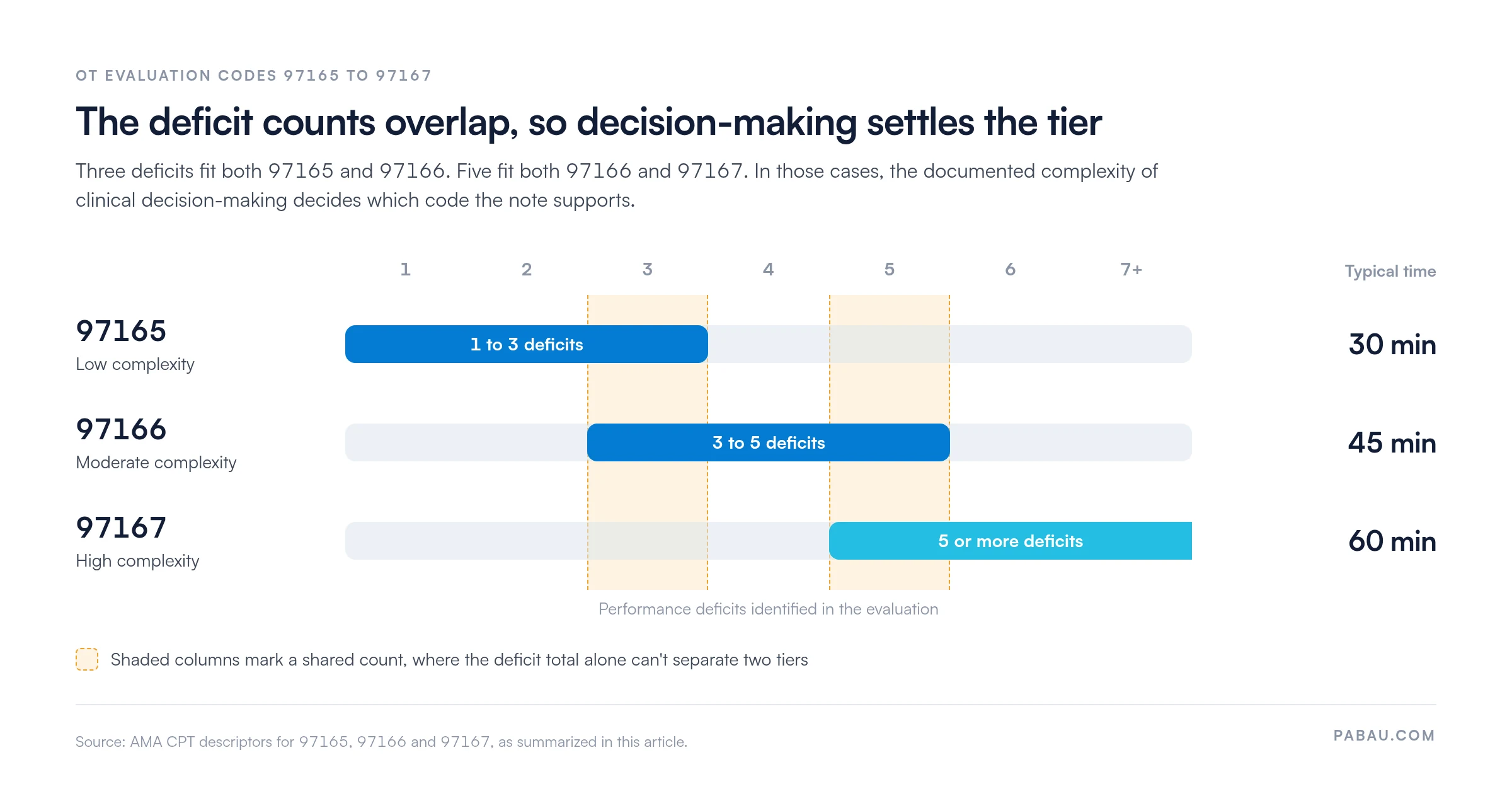
The deficit count is necessary but not sufficient for 97167. The OT Potential CPT guide notes that the clinical decision-making must also independently meet high-complexity criteria. A patient with five deficits in a straightforward context who requires routine intervention may only support 97166.
The documented reasoning for complexity is what sustains the claim under audit. The chart below shows where the deficit counts overlap, which is exactly where that reasoning decides the code.
A 97167 note that passes payer scrutiny includes all of the following elements. Missing any one of them is grounds for downcoding on post-payment review.
Document the clinical decision-making narrative as a separate paragraph titled ‘Clinical reasoning’ or ‘Clinical decision-making’ in your evaluation note. Payers reviewing for complexity tier will scan the note for this section. A well-labeled, standalone narrative signals high complexity without requiring the auditor to infer it from scattered details throughout the record.
Medicare Part B covers occupational therapy evaluations under the outpatient therapy benefit. Before submitting a 97167 claim, confirm insurance eligibility verification is complete and the patient’s therapy benefit has been checked against their plan year.
Three modifier rules govern nearly every 97167 Medicare claim.
Medicare Advantage plans may impose prior authorization requirements for OT evaluations. Requirements vary by plan and geography, so check the specific plan’s prior authorization list before scheduling the evaluation. Electronic claim submission through a clearinghouse returns payer-specific error flags before a claim reaches the payer. That catches many of the modifier errors behind 97167 denials.
The Medicare Physician Fee Schedule assigns relative value units (RVUs) to 97167 across three components. The national average allowed amount is derived from these RVUs multiplied by the annual conversion factor and a geographic practice cost index (GPCI) adjustment.
Both the conversion factor and GPCI values change annually, so check the current rate before you quote one. Use the CMS Physician Fee Schedule lookup tool to verify the current year’s allowed amount for your MAC jurisdiction.
Use the FastRVU lookup tool to retrieve current work, practice expense, and malpractice RVU values for 97167. It also shows the calculated Medicare allowable for your geographic area. Commercial payer rates are negotiated separately and may be higher or lower than the Medicare allowable depending on your contract.
CPT code 97164, the occupational therapy re-evaluation code, cannot be billed on the same date of service as CPT code 97167. The clinical logic is straightforward. 97167 is an initial evaluation. 97164 applies when a patient already in OT treatment needs a new evaluation after a significant change in condition.
NCCI edits bundle 97164 and 97167 together. A claim billing both on the same date will be denied without a modifier that overcomes the edit. No modifier is appropriate here because the services are clinically incompatible on a single date.
Bill 97167 on the evaluation date. Bill 97164 only when a documented change in the patient’s condition warrants a new evaluation later in the episode of care.
High-complexity occupational therapy evaluations are appropriate when the patient’s clinical picture meets the five-deficit threshold and requires high-complexity decision-making. The following presentations commonly support 97167.
Listing these diagnoses alone does not guarantee 97167. The evaluation note must still demonstrate five documented performance deficits and the high-complexity clinical reasoning that connects those deficits to the treatment plan. The diagnosis supports medical necessity, while the documented evaluation supports the complexity tier.
Confirm each diagnosis against the current ICD-10-CM code set before you submit. Codes change between fiscal years, as the October 1, 2025 split of G35 into subtype codes showed.
Most 97167 denials fall into one of six patterns. Understanding denial management strategies specific to therapy codes helps OT practices catch these before claims leave the practice.
Building clean claim requirements into your OT billing workflow catches most of these before they turn into denials. Check the modifier set and any same-day code pairs before each 97167 claim goes out.

Run a monthly audit of your 97167 claims by pulling all evaluations at the high-complexity tier and cross-referencing them against documentation. If the deficit count in the note is consistently four rather than five, your therapists may be selecting 97167 habitually rather than by criteria. A short documentation training session can prevent a retrospective audit demand.
The 97167 evaluation establishes the plan of care. Subsequent visits use treatment codes billed in 15-minute timed units or as untimed services. The following table shows the codes most frequently appearing on treatment visits after a high-complexity OT evaluation, with bundling notes.
Refer to the AAPC Codify CPT lookup for current NCCI bundling edit status on any code pair before billing. If you’re new to the claim cycle, start with the basics of medical billing. For timed codes, document the total timed minutes for each code in the session. Confirm you meet the 8-minute threshold before billing any 15-minute unit.
When the evaluation note and the claim live in separate systems, the biller rebuilds the claim by hand. That is where a dropped GO modifier, an OTA listed as rendering provider, or a same-day 97164 slips through.
Pabau keeps the OT’s evaluation note, the patient record, and billing in one place. Its claims management software supports OT billing workflows, with electronic claim submission to Medicare and commercial payers.
The claim starts from the note your therapist already signed. Your biller reviews modifiers and the rendering provider before submission, so fewer 97167 claims come back as rejections weeks later.

Pabau’s claims management software supports occupational therapy billing workflows, with electronic claim submission from the system that holds your evaluation notes.

Bill 97167 when the evaluation note proves the tier on its own. The diagnosis can suggest high complexity, but only the documented deficits and the reasoning that links them sustain the claim.
Before your next high-complexity evaluation, add a labeled clinical reasoning paragraph to your template and confirm GO sits on every Medicare OT claim. The trade-off is a few extra minutes of writing per evaluation, weighed against a downcode on post-payment review.
To see how Pabau keeps your evaluation notes and OT claims in one workflow, book a demo.

Billing OT in the home health setting? HCPCS code G0152 covers home health occupational therapy services and how to bill them.
Want to understand how claims clear the payer system? How a medical claims clearinghouse works explains the electronic submission pathway from practice to payer.
Managing claim denials across your OT caseload? Denial codes in medical billing provides a reference for reading and acting on CARC denial reasons on remittance advice.
Planning the first treatment visit? CPT code 97530 explains how to bill therapeutic activities in timed units.
Fitting an orthotic after the evaluation? CPT code 97760 covers orthotic management and training at the initial encounter.
CPT code 97167 bills a high-complexity occupational therapy evaluation. The evaluation includes an extensive occupational profile, five or more performance deficits, and a high-complexity plan of care. It applies only to initial OT evaluations, not re-evaluations or ongoing treatment visits.
The three codes differ by complexity tier. CPT 97165 (low complexity) requires 1-3 performance deficits. CPT 97166 (moderate complexity) requires 3-5 deficits. CPT 97167 (high complexity) requires 5 or more deficits along with high-complexity clinical decision-making. Tier selection must be supported by the evaluation note, not assumed based on diagnosis.
Medicare requires the GO modifier on every 97167 claim to indicate services were furnished under an occupational therapy plan of care. The KX modifier is added once the patient’s therapy charges for the calendar year pass the annual threshold. It certifies that continued services are medically necessary. Missing GO causes an automatic claim rejection.
No. CPT code 97167 is billable only by a licensed occupational therapist. An OTA cannot perform or bill an initial OT evaluation under any of the three evaluation codes (97165, 97166, 97167). The supervising OT must conduct the evaluation, and the OT’s NPI must appear as the rendering provider on the claim.
RVU values for CPT code 97167 are updated annually by CMS in the Medicare Physician Fee Schedule final rule. The total RVU combines work, practice expense, and malpractice components. Figures change each calendar year. Use the CMS Physician Fee Schedule lookup tool or the FastRVU calculator for current values and your area’s Medicare allowable.
The most common reasons are fewer than five documented performance deficits, a missing GO modifier on Medicare claims, or an insufficient occupational profile. Same-day billing of 97167 and 97164 also triggers an NCCI edit. So does the OTA’s NPI appearing as the rendering provider. Each of these can be caught with a pre-submission claim review before the claim reaches the payer.




