HCPCS code P9058: Red blood cells, leukocytes reduced, CMV-negative, irradiated
HCPCS code P9058: Official descriptor and key attributes HCPCS code P9058 report...

Last Updated: Oct 26, 2026
96405 is the CPT code for chemotherapy administration, intralesional; up to and including 7 lesions. It covers injecting an antineoplastic drug directly into one to seven lesions in a single session, plus the observation and supplies that go with it.
The drug is billed separately under its HCPCS J code. Each lesion beyond the seventh adds one unit of add-on code 96406.
Let Pabau's smart automation suggest the right codes, reduce claim denials, and keep your practice compliant—effortlessly.
Automate repetitive tasks and focus on what matters most—your patients.
Reduce coding errors and ensure compliance with the latest regulations.
Clean claims, fewer denials, and faster reimbursements.
Powerful insights and reporting to help your practice thrive.
HIPAA compliant SOC 2 certified GDPR-compliant Trusted by 4,000+ clinics worldwide

CPT Code 96405 covers intralesional chemotherapy injection for up to 7 lesions per session. Each lesion beyond the seventh adds one unit of add-on code 96406.
96405 bills the administration service only. The chemotherapy drug is reported separately under its HCPCS J code on the same claim.
Medicare requires direct supervision for chemotherapy administration in the office (POS 11), where the higher non-facility rate applies.
The 2026 national Medicare payment for 96405 is about $84.50 in the office and $23.71 in a facility setting.
Pabau’s claim validation checks each 96405 claim for missing or invalid details before it leaves the practice. Errors get fixed before a payer sees them.
CPT Code 96405 is defined by the American Medical Association as: Chemotherapy administration, intralesional; up to and including 7 lesions.
The code covers the complete administration service when a physician or qualified healthcare professional injects a chemotherapy agent directly into a lesion or tumor mass. That includes pre- and post-injection observation and standard supplies.
Intralesional injection differs from subcutaneous or intramuscular routes. The needle enters the lesion itself, not the surrounding tissue, so the drug acts locally on the tumor cells.
Common indications include cutaneous malignancies, Kaposi’s sarcoma lesions, and certain wart-type neoplasms where systemic chemotherapy is not indicated or has failed.
In Pabau’s claims management software, each claim is pre-filled from the patient’s invoice. The treatment note with the lesion count and anatomic sites sits in the same patient record, so the biller codes from what the clinician documented.
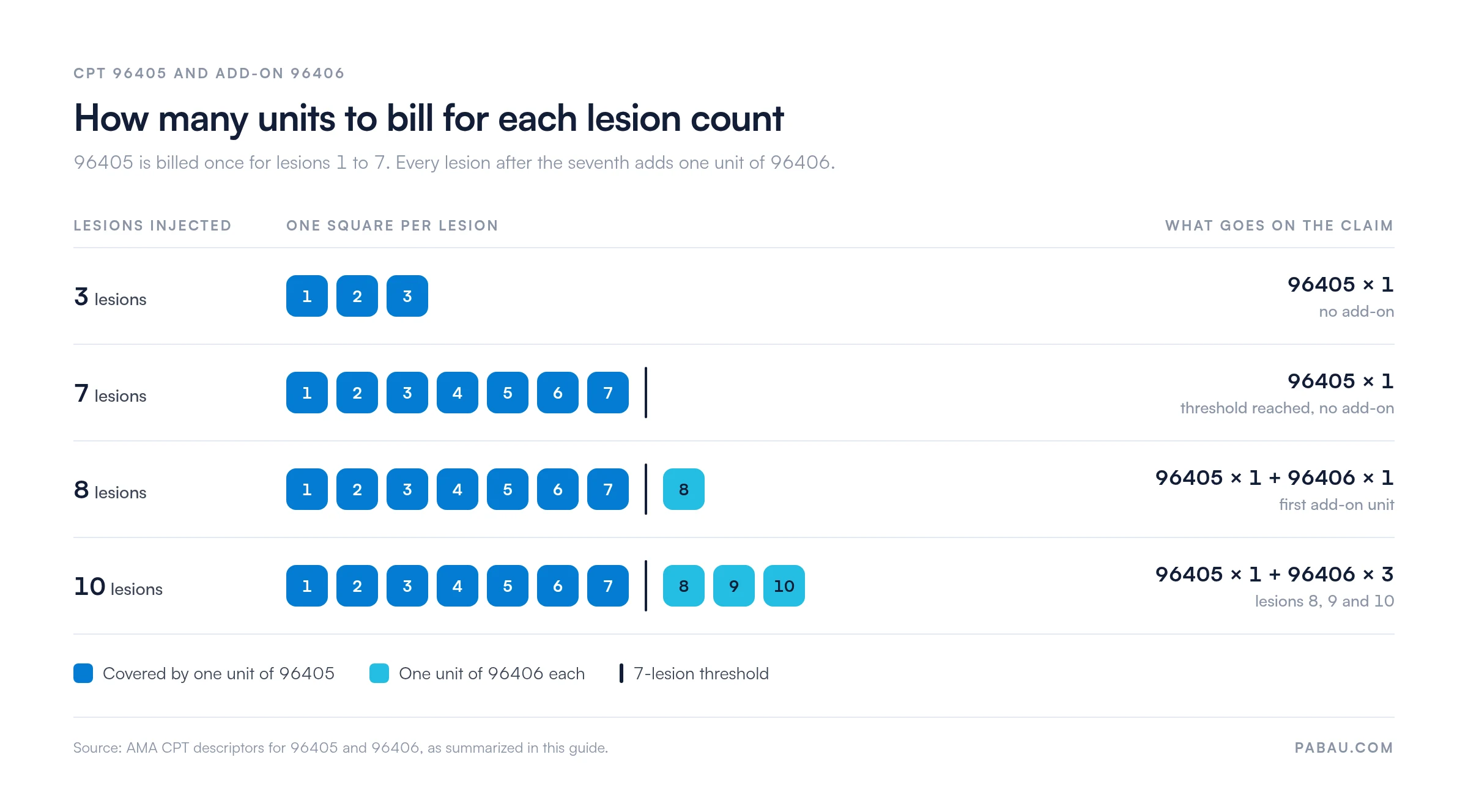
The “up to and including 7 lesions” language is the threshold that separates 96405 from its add-on code. A session treating 3 lesions bills 96405 once. A session treating 10 lesions bills 96405 once plus 96406 three times (one unit per lesion beyond 7).
The code bundles the professional service of administering the injection. That covers site preparation, the injection itself, and routine monitoring during and immediately after administration. The drug is not bundled.
96401 covers non-hormonal antineoplastic chemotherapy given by subcutaneous or intramuscular injection, and 96402 covers the hormonal version. 96405 has no hormonal or non-hormonal split. It applies to any antineoplastic agent injected into the lesion, so the route decides the code, not the drug.
A common error is selecting 96401 when the note documents a tumor injection, because both codes sit in the same chemotherapy administration family. If the physician’s note says the needle entered the lesion, 96405 is correct, however the drug is usually given elsewhere.
CPT 96406 is the add-on code for each additional lesion injected beyond the 7-lesion threshold covered by 96405. It cannot be reported without 96405 as the parent code, and its units grow with the lesion count, as the chart below shows.
Complete documentation for an intralesional chemotherapy claim must include the following elements. Missing any one of them is the most reliable path to a denial.
Practices with a structured clean claim submission workflow complete these elements at the point of care, before the claim is generated.
Before submitting any 96405 claim, run a four-point check. (1) The lesion count is a number. (2) Each lesion’s site is named. (3) The intralesional route is stated. (4) The J code carries the correct units. Each one maps to a denial reason covered later in this guide, and the whole check takes under a minute.
CPT Code 96405 covers the administration service only. The chemotherapy drug itself is billed separately under the applicable HCPCS J code. This is the buy-and-bill model.
The practice purchases the drug, administers it, and bills both the administration code and the drug code on the same claim. In the medical billing process, that means every intralesional chemotherapy visit produces at least two claim lines.
NDC (National Drug Code) reporting is required by Medicare and many commercial payers when billing J codes. The NDC goes on the claim as a qualifier on the drug line, not as a separate line item. Missing NDC information is a common secondary denial reason for J code lines that otherwise look complete.
Medicare covers intralesional chemotherapy administration when the procedure meets medical necessity criteria under the applicable Local Coverage Determination (LCD). Coverage is not automatic. The diagnosis code on the claim must map to an indication covered under the relevant LCD for the administering contractor.
The place of service code directly affects how much Medicare pays. In the office (POS 11), Medicare applies the non-facility rate, which is higher because practice expense is not shared with a facility. In an outpatient hospital (POS 22) or ASC, the facility rate applies and the facility bills a separate technical component.
In the office, chemotherapy administration is billed incident to the physician’s service, so it needs direct supervision. The physician does not need to be in the same room but must be immediately available to respond. Since January 1, 2026, that can mean presence in the office suite or real-time audio-video, though never audio-only.
The CY 2026 Physician Fee Schedule final rule made that virtual option permanent for incident-to services. It excludes services with a 010 or 090 global surgery period.
Pabau submits claims through its Claim.MD clearinghouse integration, which validates each claim and checks eligibility before the visit. Claim.MD connects to thousands of US payers, and its real-time eligibility checks cover over 400 of them.
The 2026 Medicare Physician Fee Schedule values for 96405 reflect the administration service only, not the drug. Rates vary by geographic practice cost index (GPCI), so use the CMS Physician Fee Schedule lookup for payment amounts by locality. The table below shows national unadjusted values as a baseline.
At the 2026 conversion factor, those totals work out to about $84.50 in the office and $23.71 in a facility. For locality-adjusted rates, use the FastRVU 2026 lookup tool. Commercial payers usually reimburse a contracted percentage of the Medicare rate, so check contract terms before estimating payment.
Intralesional chemotherapy claims carry two lines, an administration code and a separately billed drug, and each must clear payer edits on its own. When a claim comes back, the full list of denial codes explains each remittance remark code.
A structured denial management workflow catches these errors before submission rather than after remittance. That saves the cost of reworking claims and resubmitting them within payer timely-filing windows.
Set up a payer-specific prior authorization rule for the drug component (J code) of intralesional chemotherapy claims. The administration service (96405) rarely requires prior auth, but the drug often does, and a drug denial can pull the entire claim. Check the drug’s auth requirements separately from the procedure code before the appointment.
The documentation-to-claim chain for intralesional chemotherapy has more failure points than a standard procedure code. Lesion count, anatomic sites, drug and dose, J code, NDC and POS must all match between the clinical note and the claim.
Pabau keeps the treatment note, the invoice and the claim in one patient record. Say a clinician records “3 lesions, dorsal left forearm, bleomycin 15 units.” The biller then opens a claim pre-filled from that visit’s invoice instead of re-keying it. For out-of-network patients, the superbill comes from the same record.
Before submission, Pabau’s claim validation scrubs each claim for missing or invalid details. A claim the payer rejects is flagged Needs action with the reason, so your team fixes it inside the filing window instead of weeks later.

Pabau connects clinical notes, drug administration records, and claim generation in one workflow. See how integrated billing reduces intralesional chemotherapy denials.

CPT Code 96405 rewards the practice that counts. A lesion count written as a number, a stated intralesional route, and a J code on the same claim settle most of what payers check.
Build those three fields into your procedure note template before the next intralesional session. The trade-off is a minute of charting per visit against a denied claim that can take weeks to rework. A revenue cycle review of how your drug lines are coded and posted is the natural next step.
Book a demo to see how Pabau carries the lesion count from the treatment note to a validated 96405 claim.

Need to understand how clearinghouse submissions work for chemotherapy claims? Medical claims clearinghouse guide explains how claims route from practice to payer and where edits catch errors.
Looking for the 837P file format used to submit CPT 96405 electronically? 837 EDI file guide covers the transaction set structure and required fields for professional claims.
Want to understand how electronic remittance advice works after a 96405 claim pays or denies? Electronic remittance advice (ERA) guide explains CARC and RARC codes returned on 835 transactions.
Billing fluorouracil with an intralesional injection? HCPCS code J9190 covers the 500 mg unit math and documentation for the drug line.
Is the injected agent hormonal and given subcutaneously? CPT code 96402 explains when the hormonal route code applies instead.
CPT Code 96405 is the administration code for intralesional chemotherapy injection covering up to and including 7 lesions per session. It includes the injection service, pre- and post-injection observation, and standard supplies. The chemotherapy drug itself is not included and must be billed separately using the appropriate HCPCS J code.
96405 covers intralesional injection (needle enters the lesion directly); 96401 covers subcutaneous or intramuscular injection of a non-hormonal antineoplastic agent. The route of administration, not the drug, is the deciding factor. If the note documents injection into a lesion or tumor mass, 96405 applies.
CPT 96406 is the add-on code for each additional lesion injected beyond the 7-lesion threshold covered by 96405. Report one unit of 96406 for each lesion above 7. A session treating 10 lesions bills 96405 x1 plus 96406 x3. CPT 96406 cannot be billed without 96405 as the parent code.
Yes, Medicare covers CPT 96405 when the procedure meets medical necessity criteria under the applicable Local Coverage Determination. The diagnosis code on the claim must map to a covered indication, and the physician must provide direct supervision in the office setting. Coverage for the drug component (J code) may require separate prior authorization depending on the specific chemotherapy agent.
The top denial reasons are a missing or vague lesion count, an absent J code or NDC, and a wrong place of service code. A missing medical necessity narrative and a same-day E/M code without modifier 25 also trigger denials. Resolving all five at the point of documentation prevents the majority of intralesional chemotherapy denials.
The most common J codes paired with 96405 are J9040 (bleomycin sulfate, per 15 units) and J9190 (fluorouracil, per 500 mg). If the specific drug lacks its own J code, use J9999 (not otherwise classified chemotherapy drug) with an attached written description and invoice. NDC reporting is required by Medicare and most commercial payers on all J code drug lines.