HCPCS code A4714: Treated water for peritoneal dialysis billing guide
HCPCS code A4714: Official descriptor, code type, and payment status HCPCS code ...

Last Updated: Oct 15, 2026

CPT code 96402 covers hormonal anti-neoplastic SQ and IM injections, while non-hormonal agents belong to CPT 96401.
LHRH agonists such as leuprolide and goserelin must be paired with 96402 on the same claim under buy-and-bill.
J9217 covers leuprolide depot suspension at 7.5 mg per unit, and J9218 covers non-depot leuprolide at 1 mg.
Medicare reimbursement differs by setting, so verify the current non-facility and facility rates in the CMS MPFS Look-Up Tool.
Pabau’s claims management software pairs J-codes with administration codes and routes claims through a clearinghouse to cut 96402 denials.
CPT code 96402 is the chemotherapy administration code for a hormonal anti-neoplastic agent given by subcutaneous or intramuscular injection.
It covers leuprolide (Lupron), goserelin (Zoladex), triptorelin, and histrelin injections in an office or outpatient setting. A physician or qualified healthcare professional supervises the service, and clinical staff may give the injection.
The drug class decides the code. Hormonal agents are 96402, and non-hormonal agents given by the same routes are 96401. Under buy-and-bill, the administration code is submitted with the drug’s HCPCS J-code on the same claim. When a specialty pharmacy supplies the drug, the practice bills 96402 alone.
The American Medical Association descriptor reads: Chemotherapy administration; subcutaneous or intramuscular; hormonal anti-neoplastic. The code sits in the Chemotherapy Administration subsection of the Medicine chapter. The word hormonal is the qualifier that separates 96402 from 96401, which covers the same routes for non-hormonal agents.
The service is physician-supervised, but clinical staff may give the injection under the appropriate level of supervision. Medicare generally allows general supervision for established patients treated in an office setting. Direct supervision requirements can vary by payer and by care setting.
LHRH agonists, also called GnRH agonists, are the main drug class administered under CPT code 96402. Each drug has its own HCPCS Level II J-code, billed alongside the administration code under buy-and-bill. Picking the wrong J-code, or billing the wrong unit count, is a fast route to a denial.
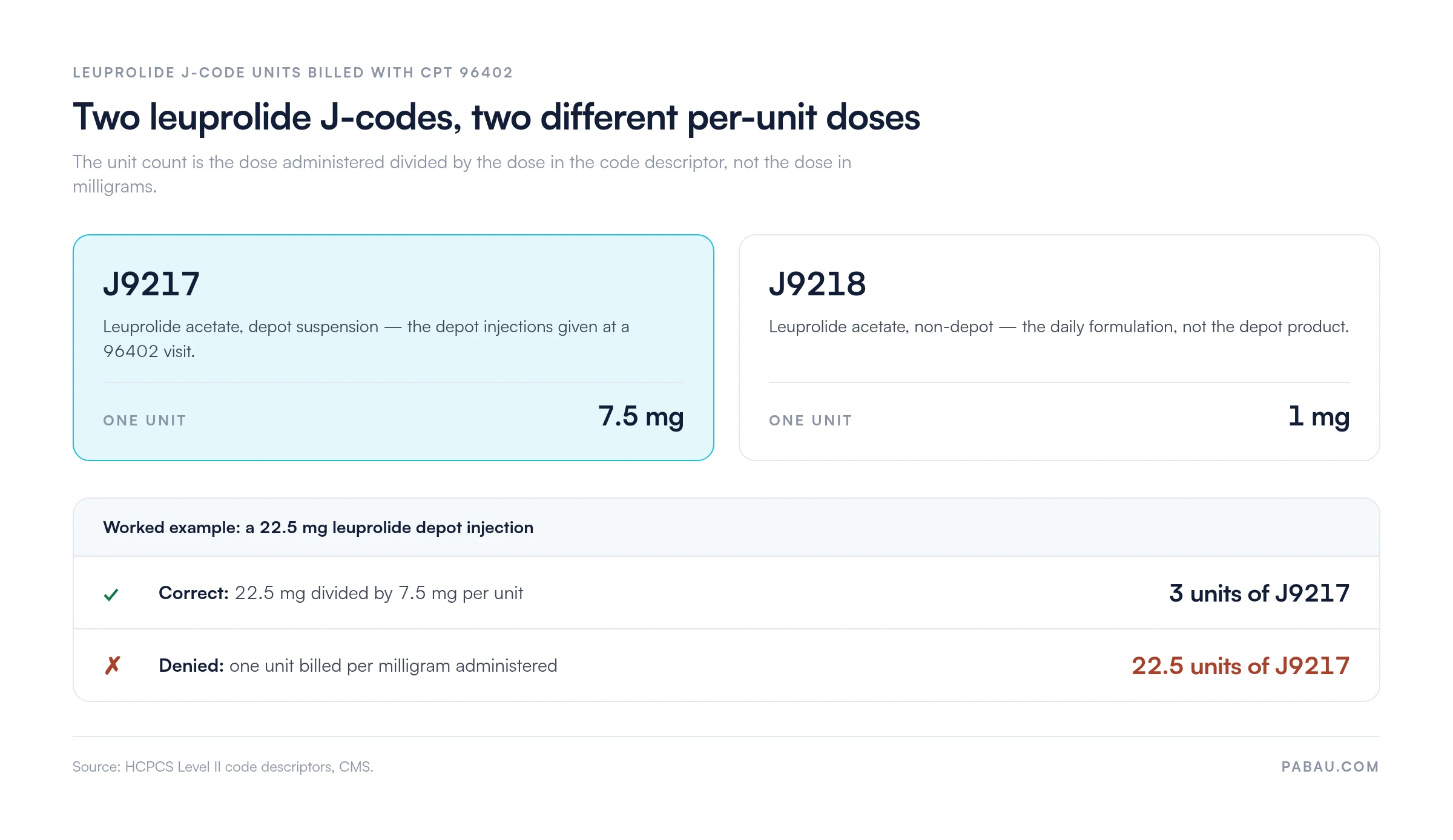
Leuprolide is where the unit math goes wrong most often. J9217 is billed per 7.5 mg, so a 22.5 mg depot injection comes to 3 units. J9218 is the per 1 mg code, and it applies to the non-depot formulation. The comparison below sets both codes against the arithmetic behind a single depot claim line.
Verify J-codes against the current CMS HCPCS Level II code set each plan year, because descriptors can be revised annually.
CPT code 96402 applies when a physician or qualified healthcare professional administers a hormonal anti-neoplastic agent by SQ or IM injection. The most common scenario is androgen deprivation therapy (ADT) for hormone-sensitive prostate cancer, where LHRH agonists suppress testosterone production. Per the CMS Medicare Coverage Database, Medicare covers LHRH agonist therapy for prostate cancer under specific documented conditions.
The ICD-10-CM diagnosis code on the claim must document the specific covered condition. Vague or missing diagnosis codes are a leading cause of LHRH agonist claim denials.
CPT 96401 covers subcutaneous or intramuscular administration of non-hormonal anti-neoplastic agents. CPT code 96402 covers the same routes for hormonal agents. Billing 96401 for a hormonal drug such as leuprolide triggers a denial, and repeated instances can prompt a payer audit.
Both codes are limited to subcutaneous and intramuscular routes. A drug delivered into the central nervous system is billed with CPT code 96450 instead, whatever its drug class.
Complete documentation is the foundation of a defensible CPT code 96402 claim. Medicare and commercial payers request medical records on LHRH agonist claims, particularly for high-cost drugs like leuprolide. A single missing element from the list below is enough to trigger a denial or a recoupment request.
Catch a missing documentation element at the point of care, not at claim submission. Build a pre-submission check into the clinical workflow. If the drug lot number, anatomical site, or supervising provider NPI is absent, the biller has to chase clinical staff before the claim goes out. Every day of delay raises denial risk and days in accounts receivable.
Submitting a CPT code 96402 claim correctly involves more than entering the administration code. J-code pairing, place of service, and same-day bundling rules all interact on the claim. Here is the claim structure, step by step.
Modifiers provide context that affects how a payer processes a CPT code 96402 claim. Using the wrong modifier, or omitting a required one, is a frequent cause of rejection or incorrect payment. The table below covers the modifiers most relevant to 96402 billing.
Medicare reimburses CPT code 96402 under the Medicare Physician Fee Schedule (MPFS). The allowable amount differs between non-facility (office) and facility (hospital outpatient) settings, and it varies by locality. Rates are updated annually and adjusted by geographic practice cost index (GPCI) multipliers. The only reliable source for a current rate is the CMS Physician Fee Schedule Look-Up Tool.
Beyond the administration fee, practices using buy-and-bill receive separate drug reimbursement under Part B of Medicare. The standard formula is ASP (average sales price) plus 6%, subject to sequestration adjustments. The drug and the administration code sit on the same claim but pay at different rates. Check the remittance line items after each adjudication cycle to confirm both lines paid at the expected allowable.
The buy-and-bill model and the specialty pharmacy model are the two dispensing approaches for hormonal anti-neoplastic agents. They produce completely different claim structures under CPT code 96402. Choosing the wrong billing structure for the dispensing method used is an audit trigger.
Coverage for CPT code 96402 and its paired J-codes varies across commercial payers and state Medicaid programs. Check each payer’s policy before the drug is administered, not after. Insurance eligibility verification upfront reduces the risk of administering a drug that will not be reimbursed.
Most CPT code 96402 denials trace back to a small set of recurring errors. The denial codes in medical billing on these claims usually point to one of the root causes below.
Constructing a 96402 claim by hand means entering the correct J-code, unit count, modifier, and place of service every time. Across dozens of injection visits a week, that is where errors enter the claim. Practice management software like Pabau links documentation, coding, and claim submission in one workflow.
Pabau’s denial-reducing claims management supports structured claim creation for administration codes paired with drug J-codes. Claims route through Claim.MD, Pabau’s integrated US clearinghouse, which supports real-time eligibility checks, 837P claims, and 835 remittance reconciliation. The clearinghouse validates the 837P data before the claim reaches the payer, so unit count and modifier errors surface early.
Superbill generation in Pabau can be configured to prompt for the J-code alongside the administration code. That reduces the chance of a missing drug line on the claim. On a leuprolide depot claim, one missed J-code can represent several hundred dollars of unreimbursed drug cost.

Pabau’s claims management workflows pair administration codes with J-codes, apply modifiers, and route claims through Claim.MD for real-time eligibility and clearinghouse validation. See how it works for oncology and urology billing.

The hormonal versus non-hormonal distinction, the J-code unit math, and the dispensing model decide whether a 96402 claim pays. Each one is settled at the point of care, long before the biller opens the claim. Standardize the injection note first, then let the claim rules run against a complete record.
Practices that work this way recover drug reimbursement accurately and stop re-working the same denial every injection cycle. Book a demo to see how Pabau handles chemotherapy administration billing from the note to the remittance.

Dealing with repeated 96402 denials? Denial management in healthcare outlines root-cause analysis and the appeal process for systematic claim rejections.
Want to understand the full claims lifecycle? What is revenue cycle management covers how every step from charge capture to payment posting affects practice cash flow.
Chasing rejections you could have prevented? Clean claim submission explains the data checks that get a claim paid on the first pass.
Reconciling what the payer actually paid? Electronic remittance advice breaks down how to read an 835 file and post payments accurately.
Building the charge before it becomes a claim? Superbill generation shows which fields a superbill needs to support a drug line and an administration line.
CPT code 96402 is the chemotherapy administration code for a hormonal anti-neoplastic agent given by subcutaneous or intramuscular injection. Drugs billed under it include leuprolide (Lupron) and goserelin (Zoladex). It covers the administration service in a physician office or outpatient setting under professional supervision. Under buy-and-bill it requires a paired HCPCS J-code on the same claim.
CPT 96401 covers subcutaneous or intramuscular administration of non-hormonal anti-neoplastic agents. CPT 96402 covers the same injection routes for hormonal anti-neoplastic agents only. The drug class determines which code applies, not the injection technique. Hormonal drugs such as LHRH agonists always use 96402, and non-hormonal chemotherapy agents given SQ or IM use 96401.
The primary drugs billed under CPT code 96402 are LHRH and GnRH agonists. They are leuprolide acetate (Lupron, J9217 or J9218), goserelin acetate (Zoladex, J9202), triptorelin pamoate (Trelstar, J3315), and histrelin acetate (Supprelin, J9225). Each drug requires its specific HCPCS J-code on the same claim under the buy-and-bill model.
J9217 is leuprolide acetate depot suspension, billed per 7.5 mg, so the unit count is the dose administered divided by 7.5. A 22.5 mg depot injection is therefore 3 units of J9217, not 22.5 units. J9218 is the separate code for non-depot leuprolide acetate and is billed per 1 mg.
Yes. Medicare covers CPT code 96402 for LHRH agonist administration in prostate cancer treatment when a documented prostate cancer diagnosis supports the claim. That diagnosis is usually ICD-10 C61, and the claim must meet the coverage conditions in the CMS Medicare Coverage Database article on LHRH agonists. Documentation of medical necessity and the specific drug administered is required each time.
Yes. Under the buy-and-bill model, CPT 96402 and the corresponding drug J-code must be billed on the same claim. The J-code covers Medicare Part B drug reimbursement at ASP plus 6%, while 96402 covers the administration service. When the drug comes from a specialty pharmacy instead, the practice bills 96402 alone and does not bill the J-code.
The modifiers most often applied with CPT code 96402 are 59, JW, GA, and GY. Modifier 59 marks a distinct procedural service when 96402 is bundled with a same-day evaluation and management visit. Modifier JW reports drug wastage from a single-use vial and goes on the J-code line. Modifier GA signals an ABN on file, and GY marks a service statutorily excluded from Medicare.