HCPCS code G0257: Unscheduled or emergency dialysis billing guide
HCPCS code G0257: Official descriptor and code overview HCPCS code G0257 is defi...

Last Updated: Oct 27, 2026
96101 was the CPT code for psychological testing, billed per hour of the psychologist's or physician's time. Each hour covered face-to-face test administration plus interpreting the results and preparing the report.
The AMA deleted 96101 on January 1, 2019, so payers now reject it as an invalid code. Its work moved to newer codes: 96130 and 96131 for the evaluation, and 96136 to 96139 for test administration and scoring.
Let Pabau's smart automation suggest the right codes, reduce claim denials, and keep your practice compliant—effortlessly.
Automate repetitive tasks and focus on what matters most—your patients.
Reduce coding errors and ensure compliance with the latest regulations.
Clean claims, fewer denials, and faster reimbursements.
Powerful insights and reporting to help your practice thrive.
HIPAA compliant SOC 2 certified GDPR-compliant Trusted by 4,000+ clinics worldwide

CPT code 96101 was deleted on January 1, 2019, so a claim that carries it today is rejected as an invalid code.
Psychological testing evaluation now bills as 96130 for the first hour and 96131 for each additional hour.
Test administration and scoring has its own codes in 30-minute units: 96136/96137 for a physician or QHP, and 96138/96139 for a technician.
The neuropsychological codes 96118, 96119 and 96120 were deleted at the same time, and 96132/96133 now cover neuropsychological evaluation.
A complete testing claim usually pairs an evaluation code with administration units, backed by time logs and a signed report.
CPT code 96101 was the psychological testing code billed per hour of the psychologist’s or physician’s time. That hour covered face-to-face test administration plus the time spent interpreting results and preparing the report.
Its official descriptor listed the areas assessed: emotionality, intellectual abilities, personality and psychopathology. It named the MMPI, Rorschach and WAIS as example tests.
The code was valid through December 31, 2018, and Medicare, most commercial payers and Medicaid programs recognized it. For any service on or after January 1, 2019, the work splits in two. Evaluation goes to 96130 and 96131, while test administration and scoring goes to 96136 through 96139.
The AMA CPT Editorial Panel deleted 96101 along with 96102 and 96103. The same 2019 revision also deleted the neuropsychological testing codes 96118, 96119 and 96120.
The reasoning was simple. An hour of face-to-face test administration was coded exactly like an hour of interpretation and report writing. Yet the two services use very different resources.
The restructure fixed three problems with the old framework:
According to the AMA’s CPT code set framework, the new structure reports evaluation, administration and scoring separately. Payers get cleaner data, and clinicians get more precise billing options. That separation is easiest to see code by code.
The replacement family spreads the work of the old testing codes across nine codes. Each one is defined by who does the work and what the work is: evaluation, administration and scoring, or a single automated instrument.
If your practice billed 96101 before 2019, this crosswalk is the map for your current claims.
Read from the old side, the same crosswalk shows where each deleted code went. Neuropsychological evaluation, which used to sit under 96118, now has its own pair starting with 96132.
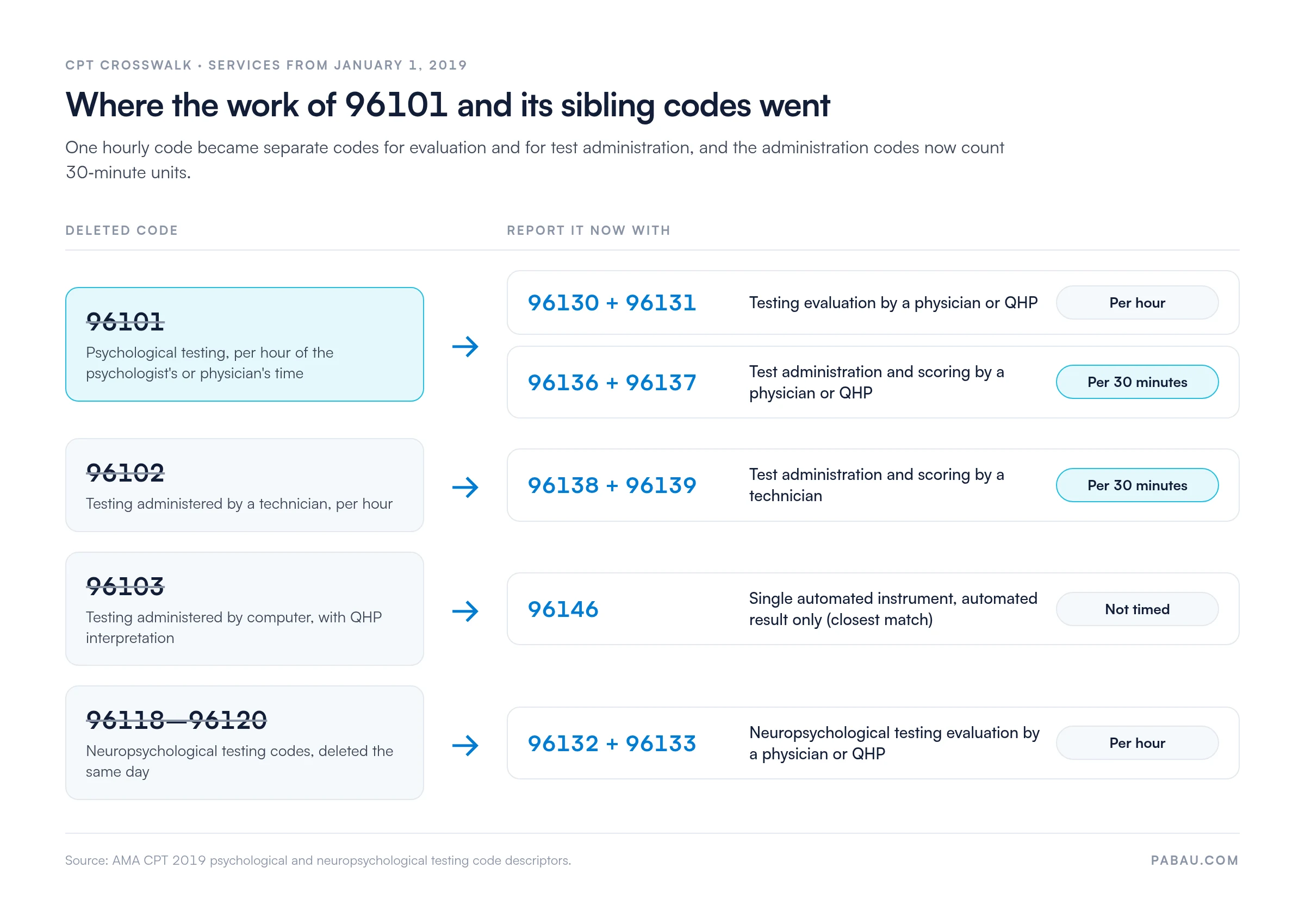
The main successor to 96101 for psychologist-performed evaluations is 96130, but it is not a one-for-one swap.
It covers the thinking work: integrating patient data, interpreting results, clinical decision making, treatment planning, the report and feedback to the patient or family.
Picture a psychologist who spends two hours administering and scoring a battery. They then spend two more hours interpreting results and writing the report. Before 2019, that encounter was four units of 96101.
Today it is one unit of 96130, one unit of 96131, one unit of 96136 and three units of 96137. The single 96101 code could never show that split, which is why payers now expect time logged by task.
All three legacy psychological testing codes were deleted on January 1, 2019. Each played a distinct role in the old framework.
Payers reject any claim carrying these codes as an invalid procedure code. There is no grace period and no legacy billing option. If a superbill, fee schedule or charge template still lists 96101, 96102 or 96103, retire those entries before the next billing cycle.
The 96130 family is billed by a physician or other qualified health care professional (QHP). State licensure decides which providers qualify, so confirm scope of practice against your state’s statutes.
Providers that payers typically recognize as QHPs for testing include:
For technician-administered testing (96138/96139), the technician works under the supervision of a QHP. That QHP interprets the results and signs the integrated report. Record the supervising QHP in the note and on the claim for every technician session.
Payers, Medicare included, look for a specific set of chart elements before they pay a testing claim. Together, these establish medical necessity and support the time you billed:
Good medical billing compliance means the report, time logs and test list sit in the patient record before the claim goes out. Filing them after a denial arrives is too late.
Medicare covers psychological and neuropsychological testing under the Physician Fee Schedule when the service meets medical necessity criteria. The coverage details come from your Medicare Administrative Contractor (MAC).
For example, Article A57481 is the WPS billing and coding article tied to LCD L34646, Psychological and Neuropsychological Testing. That is one MAC’s guidance. Each MAC publishes its own LCD and article, so check the one for your jurisdiction before you assume coverage.
Key Medicare rules for the 96130 family include:
Commercial plans are a different story. Prior authorization is common and varies by plan, so check each payer’s policy before you schedule a full battery. A real-time eligibility check on US claims confirms active coverage, but the authorization rule still has to come from the plan itself.
The current testing codes do not share one time unit. Evaluation codes 96130/96131 and 96132/96133 bill per hour. Administration and scoring codes 96136/96137 and 96138/96139 bill per 30 minutes.
Each pair has a base code for the first unit and an add-on code for each additional unit. That structure replaced the old habit of adding units of 96101.
Use the CMS Physician Fee Schedule lookup to confirm current rates for each code by locality. Rates change every year with the fee schedule update, so never bill from last year’s figures.
Report administration and scoring time (96136 or 96138) on the same claim as 96130 for a full testing encounter. A claim with only the evaluation code leaves the hours spent testing unpaid.
The 2019 restructure ended some old denial patterns but created new ones as practices moved to the new codes. When a remittance comes back denied, the CARC and RARC codes name the cause. Our walkthrough shows how to decode payer denial codes.
These are the triggers that hit testing claims:
When you resubmit, follow clean claim submission habits. Attach the report, correct the ICD-10 codes and confirm the rendering provider’s specialty matches the service.
96116 reports a neurobehavioral status exam, not psychological testing. It is a clinical assessment of thinking, reasoning and judgment by a physician or QHP. It bills for the first hour, with +96121 for each additional hour.
Use 96116 when the clinician assesses cognitive status through a clinical exam rather than a standardized battery. Use the 96130/96132 family when a test battery is needed to answer a diagnostic question.
If both happen on the same date, check the NCCI procedure-to-procedure edits first, because some pairs need a modifier or aren’t payable together.
Review the AAPC CPT code lookup for current descriptors and bundling guidance for each code in this range.
Run this check on every testing claim before it leaves the practice. Each item maps to one of the denial triggers above.
Many practices still build testing claims by hand. Someone copies codes from the report, totals the units and re-keys patient details into a claim form. Each step is a chance for a deleted code or a missing field to slip through.
Pabau, the practice management platform we build, moves that work into the patient record. With faster claims management, the claim pre-fills from the record, so the codes attached to the service land on the claim lines.
Pabau also includes a searchable CPT and HCPCS code library and validates required claim fields before submission. In the US, claims go out through Claim.MD, with real-time eligibility checks, ERA posting and claim tracking. Your team sees each claim’s status, so a rejection gets fixed and resubmitted quickly.
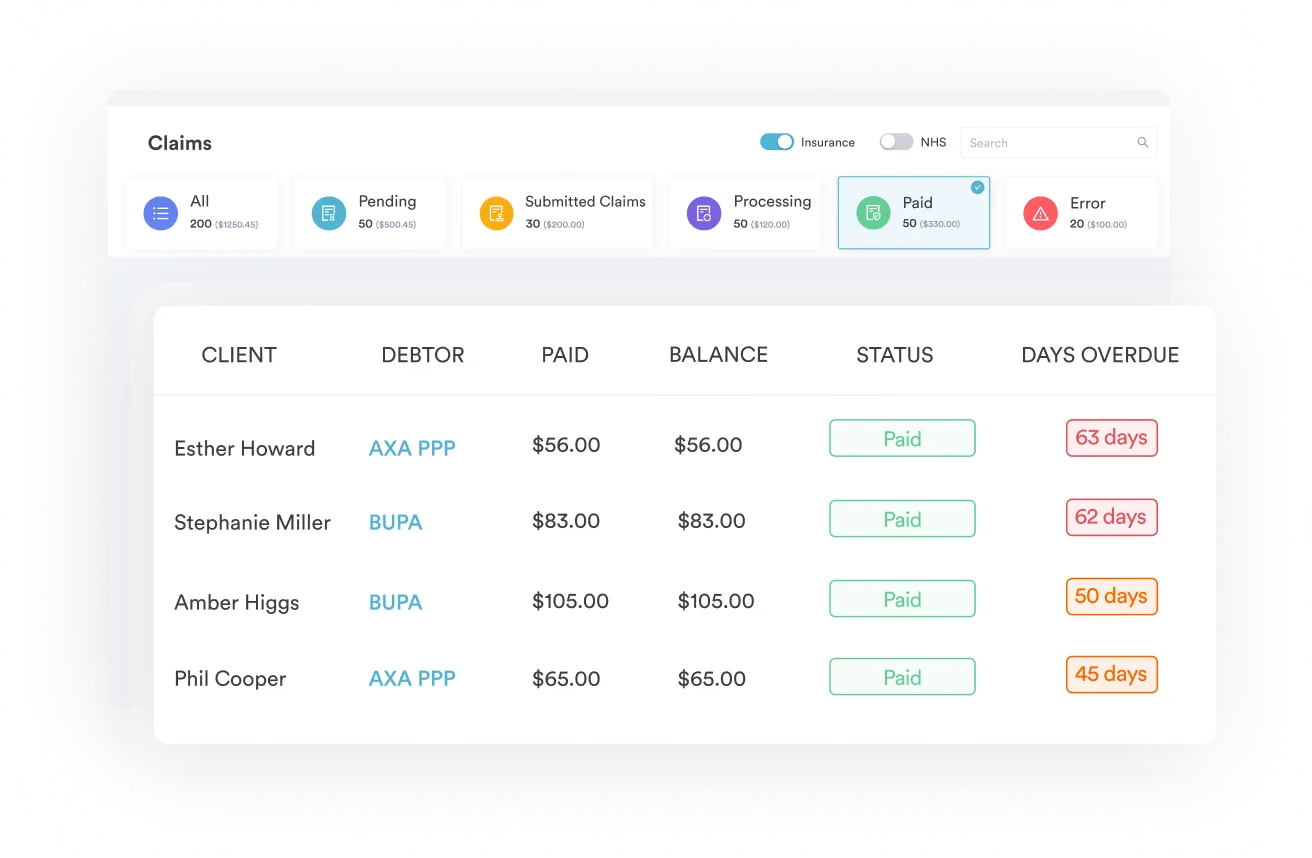

Pabau pre-fills claims from the patient record, validates required claim fields and submits US claims through Claim.MD. You also get real-time eligibility checks and tracking for every testing claim.

Treat 96101 as a historical code. It belongs in old records and crosswalk notes, not on a claim. The work that pays now is getting the replacements right. That means an evaluation pair counted in hours, an administration pair counted in 30-minute units, and documentation that shows both.
Practices that log time by task and sign the report before billing get paid for the testing hours the old code used to hide. The trade-off is more documentation per encounter, and that same record is what carries you through an audit.
Pabau pre-fills claims from the patient record, checks required fields and tracks each claim through to payment. Book a demo to see how it handles psychological testing claims from session to remittance.

Billing additional evaluation hours? CPT 96131 covers each additional hour of psychological testing evaluation after the first.
Using a technician for test administration? CPT 96138 explains how technician administration and scoring bills in 30-minute units.
Submitting testing claims electronically? Understanding the 837 file format explains the data elements payers require on professional claims.
Dealing with denied testing claims? Denial management in healthcare shows how to track, fix and prevent recurring denials.
Need the bigger billing picture? What is revenue cycle management covers how a clinical encounter turns into collected revenue.
No. CPT code 96101 has been invalid since January 1, 2019. Claims submitted using this code are automatically denied by all payers as an invalid procedure code. There is no legacy billing option or grandfather provision.
CPT counts a timed unit once you pass its midpoint. So 96130 needs at least 31 minutes of evaluation time, and 96136 needs at least 16 minutes of administration and scoring. Some payers set stricter rules, so check yours.
No. Interactive feedback to the patient, family or caregiver is part of 96130 and 96132 when it is performed. Count that time toward the evaluation codes rather than reporting a separate service.
The 96136 to 96139 descriptors cover two or more tests, any method. A single automated, standardized instrument with an automated result goes to 96146 instead. For one test given by a clinician, check payer guidance before you bill.
No. Administration and scoring time belongs to 96136 to 96139. Time spent integrating data, interpreting results and writing the report counts toward 96130 or 96132.