



CCSD code G5100: Bypass of duodenum billing guide
CCSD code G5100 bills a bypass that leaves the duodenum in place CCSD code G5100...

Last Updated: Oct 16, 2026

CPT Code 96132 covers the first hour of neuropsychological testing evaluation by a physician or qualified health care professional.
The code pays for data integration, interpretation, clinical decision making, treatment planning, and report generation, not for test administration time.
Add-on code 96133 covers each additional hour. Always report 96132 first, then one unit of 96133 per extra hour.
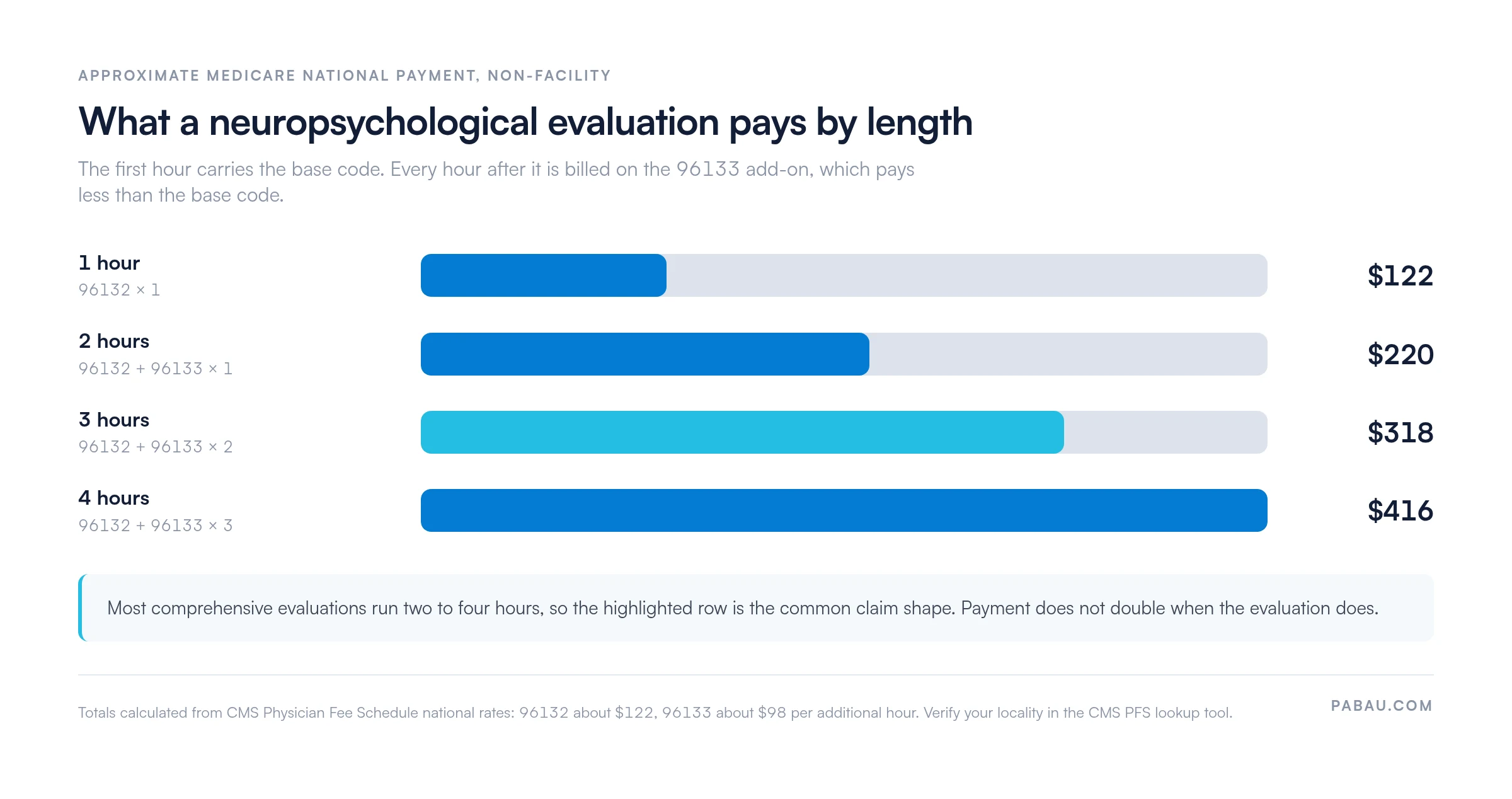
Medicare pays roughly $122 for 96132 and about $98 for each 96133 hour, before geographic adjustment.
Documentation must show total time, tests administered, raw scores, an interpretation narrative, and a signed written report.
CPT Code 96132 describes neuropsychological testing evaluation services performed by a physician or other qualified health care professional (QHP).
The descriptor covers data integration, interpretation of standardized test results, clinical decision making, treatment planning, and report generation.
All of that work applies to the first hour of evaluation. The code sits in the Psychology and Neuropsychology Testing subsection of the AMA CPT code set. It arrived with the 2019 testing code restructure that retired 96118.
Unlike shorter screening tools, 96132 captures a full hour of physician-level cognitive evaluation work. Practices billing this code need to document every component the descriptor names. Payers review neuropsychological testing claims more closely than most outpatient service categories. The table below gives the facts coders need before building a claim.
CPT Code 96132 is limited to physicians and other qualified health care professionals. In practice that includes neuropsychologists, licensed psychologists, and physicians (MD/DO) who perform the evaluation work personally. Payers recognize these providers as QHPs for 96132, but every contract still sets its own terms. Verify yours before you bill.
Nurse practitioners and physician assistants occupy a more complicated position. Some commercial payers allow NPs and PAs to bill 96132 independently under certain state laws and contract terms.
Medicare applies its own QHP definition, and scope-of-practice rules vary by state. Confirm eligibility with each payer before submitting a claim under an NP or PA NPI.
Coders frequently confuse the neuropsychological and psychological testing families. Psychological testing runs on 96130 and its add-on 96131. The table below captures the distinctions that matter most for accurate claim submission. Code 96116 causes the most trouble, because both codes involve cognitive evaluation. They differ in scope, in time, and in how much documentation a payer expects.
Key distinction: CPT Code 96116 covers a neurobehavioral status exam. It is shorter, often completed in a single visit, and it assesses orientation, memory, and basic cognition. CPT Code 96132 covers a comprehensive evaluation built on a full test battery, multi-source data integration, and a formal written report. Billing 96116 when the work performed meets 96132 criteria is a common audit flag.
When a neuropsychological testing evaluation extends beyond the first hour, use add-on code 96133 for each additional hour. It cannot be billed alone, so 96132 must always appear on the claim first. Most comprehensive evaluations run two to four hours, which puts 96133 on the majority of these claims.
Payment does not follow evaluation time in a straight line, which catches out practices quoting patients an hourly figure. Each hour after the first is billed on 96133, and 96133 carries a lower rate than the base code.
Standardized note templates that record start and end times for each phase of testing prevent the most common 96133 denial. That denial reason is insufficient time documentation.
Every CPT Code 96132 claim needs a paired ICD-10 diagnosis code that establishes medical necessity. Payer local coverage determinations (LCDs) specify which diagnoses qualify, and accepted codes vary across Medicare Administrative Contractors.
The diagnoses below are broadly accepted, but always verify against the applicable payer’s LCD before submitting. Our ICD-10-CM code library carries the full descriptor for each one.
Payer LCDs for neuropsychological testing often carry an exclusion list too. Routine school evaluations and non-medical learning assessments typically do not establish medical necessity for 96132.
An ADHD evaluation is a frequent 96132 indication, and the brief screening codes billed alongside it follow separate rules. Our guide to ADHD screening CPT codes covers 96127 and the unit limits payers apply.
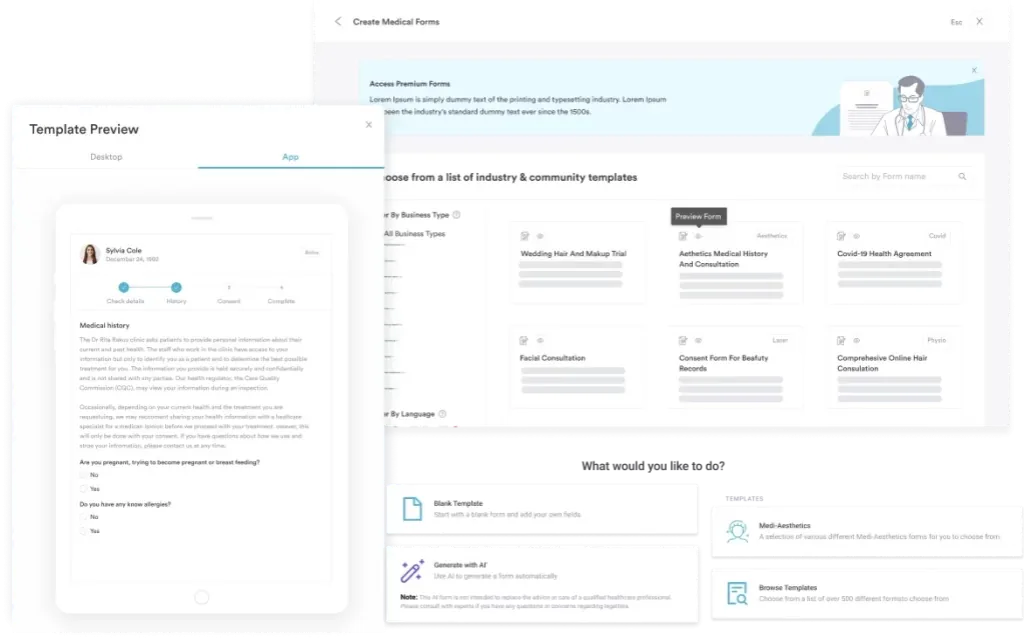
Insufficient documentation is the top reason CPT Code 96132 claims are denied or clawed back on audit. The clinical record has to contain every element that substantiates the service the code describes, not just a test score printout. Structured forms make that easier, because each required element becomes a field the clinician completes during the session.
Medicare and many commercial payers require that the report be completed and signed before the claim is submitted. Submitting a claim while the report is still in draft status creates audit exposure.
Build a documentation checklist into your note template for every 96132 session. Confirm all nine elements above are present before closing the note. Practices that use structured templates catch missing time documentation before claims go out, not after a denial arrives.
Medicare reimburses CPT Code 96132 at approximately $122 nationally, based on the non-facility rate in the CMS Physician Fee Schedule. The payment on any given claim depends on the Geographic Practice Cost Index (GPCI) for the practice location. Rates in high-cost metropolitan areas run above rural localities. Verify the current figure with the CMS PFS lookup tool, because rates update every January 1.
Commercial payer rates for CPT Code 96132 typically exceed Medicare rates, though contracted amounts vary widely by payer and network. Reconciling each remittance against the expected rate by code is how a practice spots a systematic underpayment.
Confirm each figure against the current CMS Physician Fee Schedule for your MAC locality. The numbers above are for planning, not for quoting a patient.
Modifiers signal to payers that a service was performed under specific circumstances. For CPT Code 96132, the modifiers below appear most often in neuropsychological billing. Using the wrong modifier, or omitting one a payer requires, frequently triggers a denial. The AAPC CPT code lookup adds modifier guidance by payer.
Neuropsychological testing claims attract payer scrutiny. Knowing where these claims break down before you submit costs far less than appealing a denial afterward. The errors below account for most 96132 rejections and post-payment audits.
Practices that route claims through a clearinghouse catch many of these errors before the payer does. Scrubbing flags NCCI edit violations and missing required elements, which gives the billing team a chance to correct the claim first.
Neuropsychological billing is slow work because every element of the 96132 descriptor has to reach the record before a clean claim goes out. Most denials trace back to a missing document, an omitted modifier, or a delay between the session and submission. Purpose-built software for billing teams addresses all three.
Practice management software like Pabau connects the clinical note to claim submission. When a provider finishes a session note carrying the required time, test battery, and interpretation narrative, those elements feed the claim directly. Nobody re-enters them from a PDF printout.
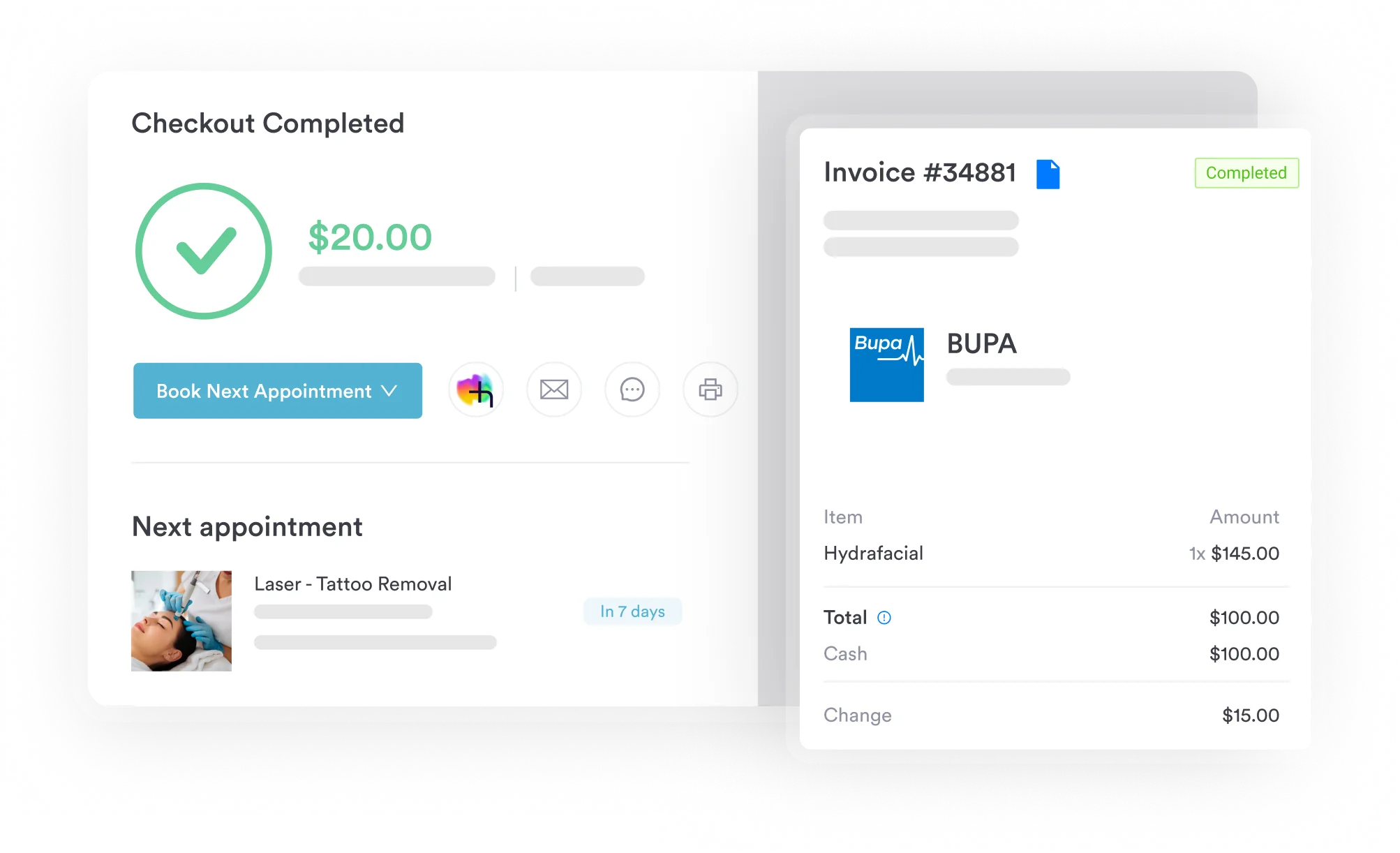
Pabau also closes the money side of the loop. It submits electronic claims through the Claim.MD clearinghouse, verifies eligibility ahead of the session, and posts the remittance when payment arrives. So a practice billing 96132 and 96133 every week spends less time reworking claims and gets paid sooner.

Pabau links CPT code entry, clinical note templates, and electronic claim submission in one platform. See how practices get paid without re-entering the note into a claim form.

The rules on 96132 are not complicated. What makes the code hard is that one missing element in the record undoes an hour of billable work.
So the decision worth making here is about workflow rather than coding. If your note template captures time, battery, interpretation, and the signed report as the session runs, the claim is complete when you submit it. If it does not, you find out on audit.
The trade-off is a small one. A few minutes of structure per session costs less than appealing denials months later. Book a demo to see how Pabau keeps 96132 documentation and claim submission in one workflow.

Want to understand how clearinghouse submission works end to end? Medical claims clearinghouse explains how electronic transmission, scrubbing, and remittance posting reduce claim errors.
Losing revenue to denied testing claims? Denial management in healthcare covers how to triage denials, appeal them, and stop the same reason code recurring.
Need to reconcile a payer’s payment against what you billed? Electronic remittance advice explains how to read an ERA and match each line back to the code you billed.
New to the billing cycle behind these codes? What is medical billing walks through each stage from eligibility check to payment posting.
CPT Code 96132 covers neuropsychological testing evaluation services by a physician or qualified health care professional, first hour. It includes integration of patient data, interpretation of standardized test results, clinical decision making, treatment planning, and report generation. It covers the QHP’s professional evaluation work, not test administration time, which uses codes 96136 to 96139.
Both physicians and licensed psychologists can bill CPT 96132. They must qualify as a physician or other qualified health care professional under the applicable payer’s policy. Neuropsychologists and psychologists holding a doctoral license are the most common billers. NP and PA eligibility depends on payer contract terms and state scope-of-practice law.
CPT 96132 covers a comprehensive neuropsychological testing evaluation requiring a full test battery, multi-source data integration, and a formal written report. CPT 96116 (neurobehavioral status exam) is a shorter, clinician-administered screening of orientation, memory, and basic cognitive function. The scope, documentation requirements, and reimbursement rate all differ. Billing 96116 for work that meets 96132 criteria is an audit risk.
The add-on code for CPT 96132 is 96133, billed for each additional hour of neuropsychological testing evaluation beyond the first. Report 96132 first, then one unit of 96133 per additional hour. Some payers cap 96133 at two or three units per session, so check the applicable LCD before billing multiple units.
Medicare pays approximately $122 nationally for CPT 96132, based on the non-facility rate in the Physician Fee Schedule. That figure is then adjusted by the Geographic Practice Cost Index for the practice location. Rates update each January 1. Verify the current amount with the CMS PFS lookup tool for your MAC locality.
Yes. CPT 96132 and 96133 are designed to be billed together on the same date of service when the evaluation runs past the first hour. Report one unit of 96132 as the primary code, then one unit of 96133 for each additional hour completed. Document total evaluation time in the clinical record to support every unit billed.
Four modifiers come up most often with CPT 96132. Modifier 59 marks a distinct procedural service billed the same day as another code. Modifier 76 marks a repeat procedure by the same physician. GY forces a denial on a service Medicare does not cover. KX confirms that LCD coverage criteria are documented. Check the payer’s policy before appending any of them.



