

CCSD code G5100: Bypass of duodenum billing guide
CCSD code G5100 bills a bypass that leaves the duodenum in place CCSD code G5100...

Last Updated: Oct 16, 2026
96131 is the CPT code for each additional hour of psychological testing evaluation by a physician or other qualified health care professional. It is an add-on code, so it only pays when 96130 bills the first hour on the same claim.
The units are where these claims go wrong. Each extra hour counts once more than 30 minutes of it is spent, and the time covers interpretation, treatment planning, the report and feedback. Test administration and scoring time never counts toward it. Get that split right, and the hours you worked become units that get paid.
Let Pabau's smart automation suggest the right codes, reduce claim denials, and keep your practice compliant—effortlessly.
Automate repetitive tasks and focus on what matters most—your patients.
Reduce coding errors and ensure compliance with the latest regulations.
Clean claims, fewer denials, and faster reimbursements.
Powerful insights and reporting to help your practice thrive.
HIPAA compliant SOC 2 certified GDPR-compliant Trusted by 4,000+ clinics worldwide

CPT code 96131 bills each additional hour of psychological testing evaluation by a physician or other qualified health care professional.
It is an add-on code, reported only with 96130 for the first hour on the same claim.
A unit of 96131 is reportable once more than 30 minutes of an additional hour is spent.
Neuropsychological testing evaluation uses 96132 and 96133, and test administration and scoring uses 96136 to 96139.
The 2026 national Medicare rate is about $86.51 per unit in the office setting.
CPT code 96131 is the add-on code for each additional hour of psychological testing evaluation by a physician or other qualified health care professional (QHP). It follows 96130, which covers the first hour of the same service.
The official descriptor names six parts of the service, all billed by the physician or QHP:
The descriptor ends “each additional hour”, and the code is listed separately in addition to the primary procedure. It belongs to the American Medical Association’s CPT code set, in the Medicine section under Central Nervous System Assessments/Tests (96105-96146).
Three rules apply to every 96131 claim:
The evaluation codes pay for interpreting results, not for producing them. Time spent giving or scoring tests never counts toward 96130 or 96131, even when the same psychologist does both.
Since 2019, CPT has split testing into two kinds of work. Evaluation codes pay for interpretation and reporting, while administration codes pay for giving and scoring tests. Psychological and neuropsychological evaluation then have separate code pairs.
The most common mix-up is billing 96133 for extra psychological evaluation time. 96133 is the add-on for neuropsychological evaluation and pairs only with 96132. If the work was a psychological evaluation, the extra hours go to 96131.
The clinical question decides which pair you use. A psychological evaluation looks at personality, emotional functioning, mood or psychopathology. A neuropsychological evaluation looks at how brain function shapes cognition and behavior, and is covered in our guide to CPT code 96132.
Physicians and other qualified health care professionals can bill 96131 when psychological testing falls within their state license. In practice, licensed psychologists bill most of these claims, with psychiatrists and some neurologists also reporting them.
Payers add their own conditions. Some limit testing codes to doctoral-level providers, and some credential providers for testing separately from therapy. Confirm that each provider is credentialed for testing with the plan before the first session.
Billing 96131 correctly comes down to counting evaluation time accurately. Walk each claim through these six steps.
Because the thresholds sit at fixed points on the clock, total minutes map straight to units.
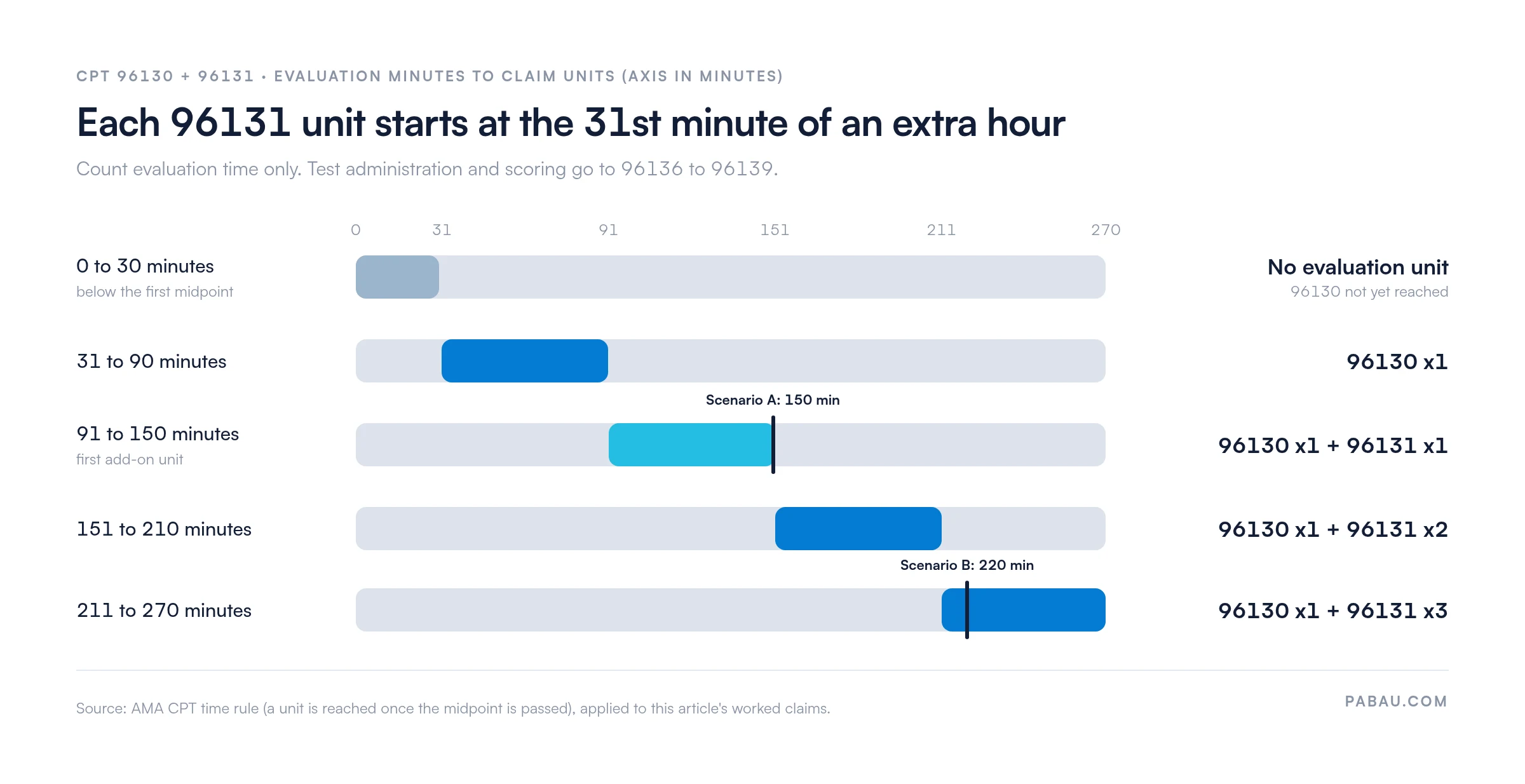
A few payers pay only completed hours, so check the policy before you count a partial one. Evaluation work also often spans several days, from scoring review to the feedback session. Many payers expect the codes on the date the evaluation is completed. Confirming that rule up front keeps clean claims going out the first time.
The diagnosis on a 96131 claim must support the need for psychological testing. Psychological evaluation is often used to clarify a diagnosis, so mood, anxiety and developmental codes are as common as cognitive ones.
Choose the code that matches the documented presentation most closely. Our library of ICD-10-CM codes lists the full descriptor for each one. When cognition is the main question, the evaluation may belong under 96132 and 96133 instead.
Medicare pays 96131 through the Medicare Physician Fee Schedule (MPFS). The 2026 national rate is about $86.51 per unit in the office, up from about $82.81 in 2025.
These figures come from the CMS 2026 national RVU file, at a conversion factor of $33.4009. The work RVU is the same in both settings. The difference comes from practice expense, which is lower when the facility carries the overhead.
Your payment will differ by locality. Use the CMS Physician Fee Schedule lookup tool to find your area’s rate. Commercial rates are negotiated separately, so check each contract.
Original Medicare does not usually require prior authorization for psychological testing, but Medicare Advantage and commercial plans often do. Requirements differ by plan, so start the prior authorization process before the first session.
A request for an evaluation that will include 96131 usually asks for:
The approved hours cap the payable units of 96131. If an evaluation runs longer than approved, request an amendment before you bill the extra time.
Record the authorization number and approved hours on the patient’s billing record before testing begins. If evaluations regularly run past the estimate, ask the payer for an amendment within a day or two of the session.
Time is the first element auditors check on a 96131 claim. If the record cannot show the evaluation time, each unit of 96131 is open to recoupment.
Following medical billing compliance practice, the record for a 96131 claim should contain:
Run through these checks on every testing claim before it leaves the practice.
Most 96131 denials trace back to a short list of preventable errors. Catching them before submission costs far less than working denials afterward.
Two scenarios show how evaluation time turns into claim lines. In both, the tests were administered separately and billed under the administration codes.
Scenario A: 2.5 hours of psychological testing evaluation
A psychologist evaluates an adult referred for possible ADHD with co-occurring anxiety. Integrating the results, writing the report and giving feedback take 2 hours and 30 minutes in total.
Scenario B: 3 hours 40 minutes of psychological testing evaluation
A psychologist evaluates a teenager for autism spectrum disorder and depression. The evaluation work totals 3 hours and 40 minutes.
Here the 40 minutes of the fourth hour pass the midpoint, so they earn the third unit of 96131.
Most 96131 errors creep in when someone retypes a testing record into a claim form. Pabau, the practice management platform we build, includes claims management software that prepares the claim from the patient record instead.
Your team still decides the units and the code pair. Pabau removes the retyping and status chasing around that decision, so staff can spend their time on the calls that need judgment.

Pabau pre-fills claims from the patient record, checks required fields before submission and tracks each claim through Claim.MD. Your team spends less time fixing rejected testing claims.

Getting 96131 paid starts with naming the evaluation correctly. A psychological evaluation pairs 96130 with 96131, while a neuropsychological one pairs 96132 with 96133. Payer edits catch a mixed pair faster than any other error.
After that, the claim rests on the clock. Log evaluation minutes apart from testing minutes, and count a 96131 unit only past the 30-minute mark. Then confirm the authorized hours before the session, not after the report is written.
If your practice runs psychological testing every week, book a demo to see how Pabau pre-fills and tracks each testing claim from the patient record.

Billing the testing time too? CPT code 96136 covers test administration and scoring by a physician or QHP, the work 96131 leaves out.
Starting with a diagnostic interview? CPT code 90791 explains how the psychiatric diagnostic evaluation is billed before testing begins.
Want to understand how clearinghouse claims processing works? How the Claim.MD clearinghouse works explains payer routing, real-time eligibility, and ERA handling for US practices.
Dealing with recurring claim rejections? Denial codes in medical billing covers the most common CARC denial reason codes and how to respond to each one.
Evaluation running across several weeks? Timely filing limits sets out how long payers give you to submit the claim after the date of service.
CPT deleted 96101 on January 1, 2019. Its work was split between the evaluation codes, 96130 and 96131, and the administration and scoring codes, 96136 to 96139.
The diagnostic interview is usually billed as 90791, the psychiatric diagnostic evaluation. It is a separate service, so its time never counts toward 96130 or 96131.
Yes, under the CPT time rule, once more than 30 minutes of the extra hour is spent. A few payers pay only completed hours, so confirm the policy before you count 31 minutes.
Most state Medicaid programs cover psychological testing, but each sets its own rules. Many require prior authorization and cap units per day or per year, so check your state’s provider manual.
96131 is the add-on for psychological testing evaluation and pairs with 96130. 96133 is the add-on for neuropsychological testing evaluation and pairs with 96132.
The 2026 national rate is about $86.51 per unit in the office and about $70.14 in a facility. Your local rate depends on your Medicare locality.



