CCSD code A2720: Proximal gastric vagotomy billing guide
What is CCSD code A2720? CCSD code A2720 is the procedure billing code assigned ...

Last Updated: Oct 8, 2026
T2035 is the HCPCS Level II code for utility services to support medical equipment and assistive technology/devices, waiver.
It is billed under a state's Medicaid home and community-based services (HCBS) waiver. It pays for the added electricity, gas, or water cost of running qualifying equipment at home. Coders most often confuse it with T2036, which covers overnight therapeutic camping. H2035 is a behavioral health (substance use treatment) code in a different series altogether.
Let Pabau's smart automation suggest the right codes, reduce claim denials, and keep your practice compliant—effortlessly.
Automate repetitive tasks and focus on what matters most—your patients.
Reduce coding errors and ensure compliance with the latest regulations.
Clean claims, fewer denials, and faster reimbursements.
Powerful insights and reporting to help your practice thrive.
HIPAA compliant SOC 2 certified GDPR-compliant Trusted by 4,000+ clinics worldwide

T2035 covers the added utility cost of running qualifying medical equipment or assistive technology at home, not general household bills.
Coverage, rates and the billing unit are set by each state’s Medicaid HCBS waiver, and no national Medicare fee schedule applies.
Missing prior authorization and thin medical necessity documentation are the two leading causes of T2035 denials.
T2034, T2036 and H2035 are the codes most often confused with T2035, and none of them covers utility support.
Pabau, the practice management platform we build, helps billing teams submit and track claims from one system.
HCPCS code T2035 is the code for utility services that keep medical equipment and assistive technology running in a Medicaid waiver beneficiary’s home. It belongs to the T-series of HCPCS Level II codes, which the Centers for Medicare and Medicaid Services (CMS) maintains for state Medicaid agencies. The official descriptor reads “Utility services to support medical equipment and assistive technology/devices, waiver.” The code is active for the 2026 billing year.
T-series codes give states a way to bill Medicaid home and community-based services (HCBS) waiver services that fall outside Medicare’s benefit categories. T2035 sits among neighboring codes for very different waiver services. Knowing those neighbors is the fastest way to catch a wrong-code claim before it goes out.
T2035 covers only the portion of a utility bill that comes from powering qualifying durable medical equipment (DME) or assistive technology (AT). The key word is “incremental,” meaning only the cost above what the household would pay without the equipment running.
The exclusion of Medicare-covered equipment is a frequent audit trigger. If a beneficiary’s ventilator is billed under a Medicare DME claim, the associated utility costs cannot also be billed under T2035 through Medicaid. State Medicaid integrity contractors look for that kind of double billing.
Put together, coverage comes down to four checks, and a claim that fails one of them stops there.
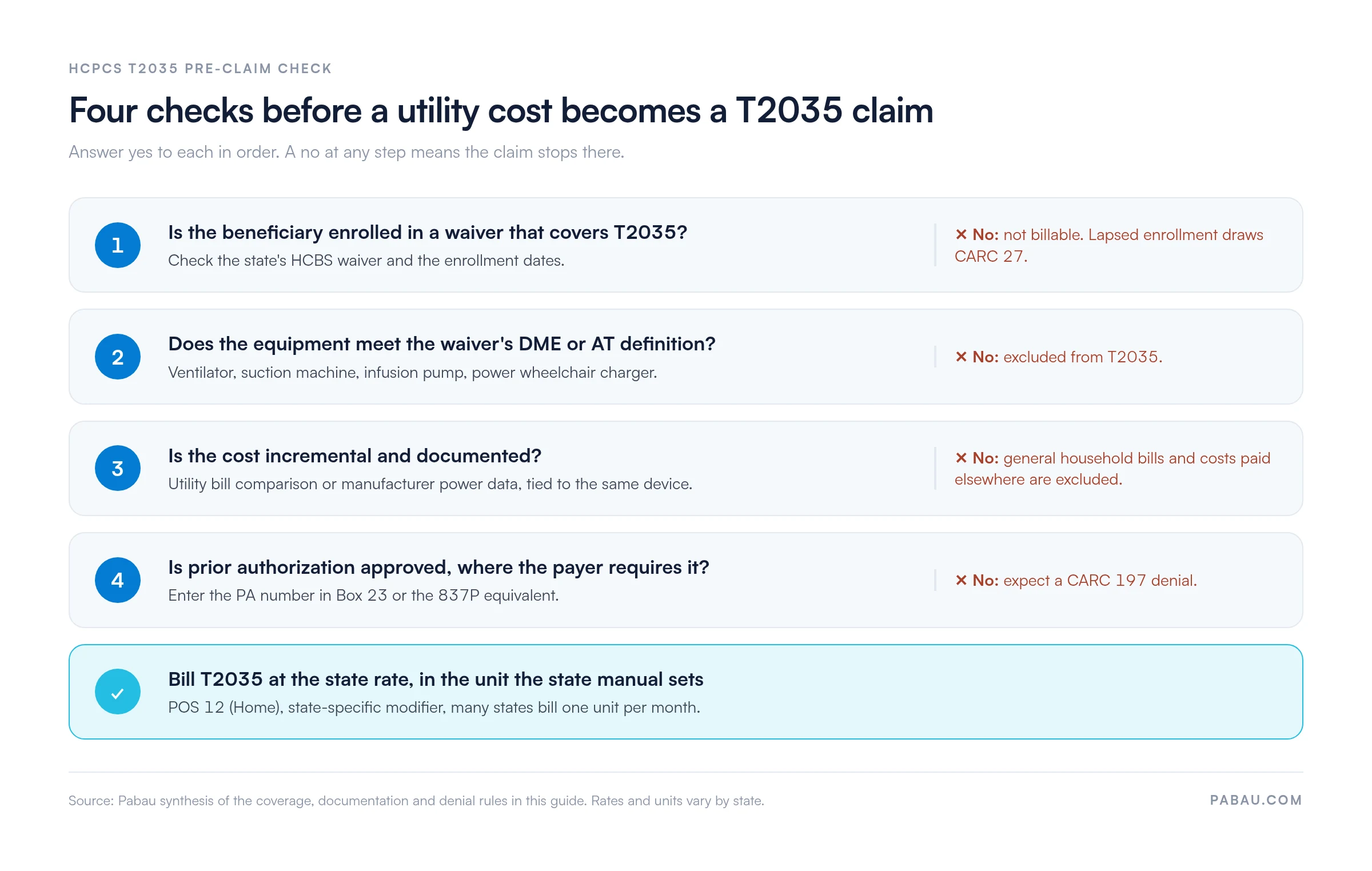
T2035 is not a Medicare benefit. It is a Medicaid HCBS waiver code, so payment depends on two conditions. The beneficiary’s state must include this service in its approved waiver, and the beneficiary must be enrolled in that waiver. Medical billing workflows for Medicaid differ from Medicare billing. States have their own fee schedules, eligibility rules, and coverage scopes.
According to the CMS HCPCS Level II code set, T-series codes are national codes that states adopt at their discretion. Whether a given state covers T2035 depends on that state’s waiver authority under 42 CFR Part 441 Subpart G.
There is no national Medicare fee schedule for HCPCS code T2035. Each state Medicaid agency sets the rate and publishes it in that state’s Medicaid fee schedule. Rates vary widely. Some states set a flat monthly allowance, and others reimburse documented incremental costs up to a defined cap.
The CMS Physician Fee Schedule lookup does not include T2035 because this code is not a Medicare benefit. To find the applicable rate and billing unit, billing staff need to check their state Medicaid agency’s published fee schedule directly.
Before billing T2035, download your state Medicaid agency’s current fee schedule and check both the rate and the billing unit for utility services. Some states cap reimbursement at a percentage of documented incremental costs rather than paying a flat rate. Billing without checking the state rate first is the fastest way to a zero-pay adjustment on an otherwise clean claim.
Incomplete documentation is the second leading cause of T2035 denials, after missing prior authorization. The file has to show that the qualifying equipment exists and that the beneficiary is enrolled in the applicable waiver. It also has to show the utility cost is incremental to running that equipment.
Auditors look for internal consistency. If the plan of care names a ventilator and the utility calculation references a suction machine, that mismatch is enough to trigger a payback demand. Every document in the file should reference the same piece of equipment.
Medical billing compliance for Medicaid waiver services means keeping this documentation in the patient record for the state’s audit period, typically five to seven years.
Billing HCPCS code T2035 on an 837P or CMS-1500 form means filling several fields that differ from standard Medicare claims. Good claims management software cuts the manual entry and helps catch field-level errors before submission.
A well-structured superbill captures the waiver program identifier, the PA number, and the equipment reference. That makes the 837P or CMS-1500 faster to fill and less error-prone.
The T2030-T2040 block covers a range of HCBS waiver services that are easy to conflate. Picking the wrong code gets the claim denied or overpaid even when the underlying service is legitimate.
Coders sometimes expect T2034 to be a transport code, but non-emergency transport sits earlier in the series, at codes such as T2003.
H2035 deserves special attention because it differs from T2035 by a single character. H-series codes cover behavioral health and substance use services and have no link to T-series waiver codes. Submitting H2035 on a utility services claim will draw an immediate categorical mismatch denial.
Most T2035 denials trace back to one of six root causes. Treat Medicaid waiver denials as their own track in your denial management workflow, because their causes differ from standard fee-for-service denials. The two biggest, missing prior authorization and lapsed waiver enrollment, can both be caught before the claim goes out.
The AAPC’s HCPCS Level II code reference and the PGM Billing HCPCS lookup tool help you cross-check the current descriptor and payer edits. Use them before you resubmit a denied T2035 claim.
Run a quarterly audit of all T2035 claims by filtering for CARC 197 (missing prior authorization) and CARC 27 (eligibility). Match each denial to enrollment dates and PA approval logs in your billing system. That shows whether the problem is operational, such as staff not checking PA status, or systemic, such as slow waiver enrollment confirmations from the state.
Without a shared system, a T2035 claim is pieced together by hand. The plan of care lives in one place, the utility calculation in a spreadsheet, and the claim in a payer portal. Each handoff is a chance for details to be retyped wrong.
Pabau, the practice management platform we build, keeps patient records, forms and billing in one system. Its claims management tools pull the data already on the patient record into the claim, then submit it and track its status. Your team stops copying the same details between systems.
Your billers still confirm waiver enrollment, prior authorization and the state’s billing unit. With the claim built from the record, their time goes into those checks instead of data entry.

Pabau’s claims management tools help billing teams submit and track claims using the data already on the patient record. See how it fits your workflow.

HCPCS code T2035 is a narrow Medicaid waiver benefit that pays for the added cost of keeping essential medical equipment running at home. Many billing teams overlook it. The code is simple to report, but it punishes incomplete documentation and skipped prior authorization with consistent denials.
Before the first claim, read your state’s waiver manual and fee schedule once. Confirm that the waiver covers T2035, which billing unit it uses, and whether prior authorization applies. Get those three answers on file and each later claim becomes routine.
Book a demo to see how Pabau helps your team submit and track waiver claims built from the patient record.

Need a cleaner claim submission process? What is medical billing explains the end-to-end workflow from service documentation through payment posting.
Want to cut your denial rate on Medicaid claims? Denial management in healthcare covers the root-cause analysis and appeal workflows that recover denied revenue.
Building a tighter billing documentation process? Superbill documentation walks through what belongs in a compliant superbill for Medicaid and commercial payers alike.
Losing T2035 claims to missing approvals? The prior authorization process sets out a step-by-step workflow for getting approvals in place before the claim goes out.
Want more claims paid on first submission? What is a clean claim breaks down the fields and checks that keep a claim from bouncing back.
HCPCS code T2035 covers the added utility costs of running qualifying medical equipment or assistive technology in a beneficiary’s home under a Medicaid HCBS waiver. That is mainly electricity, but also gas or water. General household utility bills are excluded, and only the portion caused by the qualifying equipment is reimbursable.
Yes, T2035 is a Medicaid-only code. It belongs to the HCPCS Level II T-series, the national codes established for state Medicaid agencies, which standard Medicare fee-for-service does not cover. Medicare Advantage plans do not typically include T2035, and commercial payers have no use for T-series codes.
Prior authorization requirements for T2035 vary by state. Many state Medicaid HCBS waiver programs require PA before billing utility services, and some managed care organizations add their own PA rules on top. Check the state billing manual and the MCO’s provider manual before submitting a T2035 claim without a PA number.
T2035 can generally appear on the same claim as other HCBS waiver service codes. Each code has to reflect a distinct service delivered in the same period. Some state Medicaid programs restrict same-claim billing for certain code combinations. Billing the same utility cost under two different codes on one claim is always a denial risk.