HCPCS code C1731: Catheter billing, OPPS reimbursement, and denial guide
HCPCS code C1731: Official descriptor and code series context HCPCS code C1731 i...

Last Updated: Oct 8, 2026
A2720 is the CCSD code for proximal gastric vagotomy, a stomach operation that divides the vagal nerve branches to the acid-secreting body and fundus. The branches to the antrum and pylorus stay intact, so gastric emptying remains normal and no drainage procedure is needed.
Surgeons bill A2720 to UK private medical insurers such as Bupa, AXA Health and Aviva. The CCSD schedule lists it under 11.2.0 Stomach, and also under 8.11.0 Other.
Let Pabau's smart automation suggest the right codes, reduce claim denials, and keep your practice compliant—effortlessly.
Automate repetitive tasks and focus on what matters most—your patients.
Reduce coding errors and ensure compliance with the latest regulations.
Clean claims, fewer denials, and faster reimbursements.
Powerful insights and reporting to help your practice thrive.
HIPAA compliant SOC 2 certified GDPR-compliant Trusted by 4,000+ clinics worldwide

CCSD code A2720 covers proximal gastric vagotomy, and other vagotomy types are coded separately.
Proximal gastric vagotomy preserves antral innervation, so no drainage procedure (pyloroplasty or gastrojejunostomy) is required or billable alongside A2720.
CCSD is a UK-specific private insurance coding system and is not equivalent to CPT, HCPCS, or ICD-10.
Pabau, the practice management platform we build, supports CCSD claim submission and operative documentation tracking for private practices.
CCSD code A2720 is the procedure billing code for proximal gastric vagotomy in the schedule of CCSD codes used for UK private practice billing. The official descriptor is “Proximal gastric vagotomy.” The schedule lists it under 11.2.0 Stomach in the abdomen chapter, and also under 8.11.0 Other in the thorax chapter.
CCSD codes are not CPT codes. They are not HCPCS codes. They apply exclusively to invoices submitted to UK private medical insurers (PMI) such as Bupa, AXA Health, Aviva, and Vitality Health.
A coder trained on US systems should treat the CCSD schedule as a separate reference. It has its own bundling rules, fee structures, and insurer-specific requirements. Bupa’s own recognized list is covered in our guide to Bupa CCSD codes.
Proximal gastric vagotomy is also known by two clinical synonyms: highly selective vagotomy (HSV) and parietal cell vagotomy. All three terms describe the same anatomical procedure. Coders and surgeons use these names interchangeably in documentation. When you see any of them on an operative note, A2720 is the applicable CCSD code.
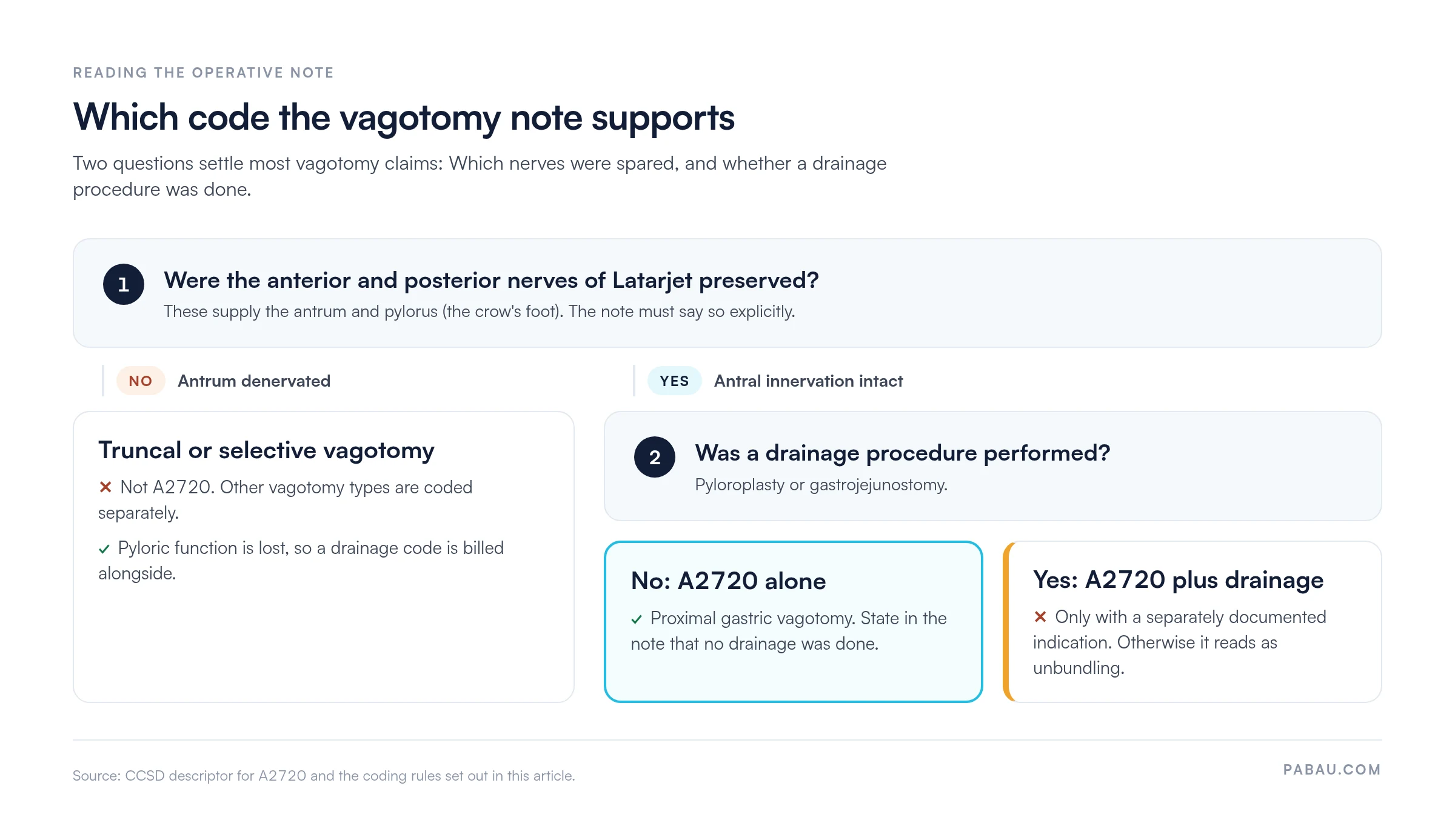
Proximal gastric vagotomy denervates the acid-secreting parietal cells of the gastric body and fundus. It preserves the vagal branches that supply the antrum and pylorus. This is its defining clinical feature and the one detail that most directly shapes correct billing.
The primary indication is refractory peptic ulcer disease, most commonly a chronic duodenal ulcer. Typically, the ulcer has failed adequate treatment with proton pump inhibitors (PPIs) such as omeprazole or lansoprazole.
Some surgeons also apply the technique to selected cases of intractable gastresophageal reflux disease (GERD). The procedure is elective, performed under general anesthesia, and typically takes 90 to 150 minutes depending on approach.
Surgical steps in the standard open technique:
Because antral and pyloric innervation is preserved throughout, gastric emptying remains normal after proximal gastric vagotomy. This is why no drainage procedure is needed. Billing one alongside A2720 counts as unbundling, unless the operative note documents a drainage procedure done for a distinct clinical reason.
The vagotomy family includes three main procedure types, each with different anatomical scope, clinical consequences, and billing implications. Selecting the wrong code within this group is the most common coding error for A2720 claims.
The critical billing distinction is what happens to the pylorus. Truncal vagotomy divides the main vagal trunks, and selective vagotomy divides the gastric branches to the whole stomach. Both abolish pyloric function and mandate a drainage procedure.
Those drainage codes are legitimately billed alongside truncal or selective vagotomy. They are not billable alongside A2720 because proximal gastric vagotomy preserves pyloric function by design.
Say a surgeon performs truncal vagotomy with pyloroplasty, and the coder submits A2720 with a pyloroplasty companion code. The insurer will query the combination, because A2720 and a drainage code are clinically incompatible. The reverse error, coding truncal vagotomy as proximal gastric, also misdescribes the procedure and may result in underpayment or fraud risk.
Two questions settle most vagotomy claims, so check both against the operative note before you choose a code.
No. The base code A2720 covers proximal gastric vagotomy whether it is performed open or laparoscopically. The approach does change the operative note requirements, and potentially the applicable CCSD modifier. Always verify the current CCSD technical guide before assuming a laparoscopic modifier applies, as the schedule is updated periodically and modifier rules change.
When laparoscopic approach is confirmed in the current schedule as modifier-eligible, the operative note must explicitly state the approach to support the modifier. Required documentation elements for a laparoscopic A2720 claim:
If the surgeon begins laparoscopically and converts to open, the code and modifier should reflect the completed approach. Document conversion clearly: State the reason (adhesions, anatomical difficulty, bleeding) and at what stage the conversion occurred. Insurers reviewing laparoscopic modifier claims scrutinize conversion cases closely.
If the current CCSD schedule specifies no laparoscopic modifier, submit A2720 without one. Include a cover note explaining the minimally invasive technique. Contact the insurer’s provider line before submission if the approach significantly affects the surgeon’s fee expectation.
A2720 is typically a standalone code. The procedure’s design means most companion codes appropriate for truncal vagotomy are not applicable here. However, surgeons occasionally perform additional upper GI procedures in the same operative episode, and coders need to know which combinations are permissible.
When in doubt about whether a companion code is permissible, the CCSD schedule and the relevant insurer’s unbundling guidelines are the authoritative references. Healix, for example, publishes specific fee schedule unbundling rules that practitioners billing to Healix Health must follow.
Before adding any companion code to an A2720 claim, check whether the procedure would have been separately indicated even if no vagotomy had been performed. If the answer is no, the companion code is likely unbundling. Document the separate clinical indication explicitly in the operative note if you believe the combination is justified.
The operative note is the primary document supporting an A2720 claim. Insurers reviewing a surgical claim for a procedure now rarely performed will scrutinize the note more carefully than for a common elective code. Digital operative documentation tools that capture structured surgical note fields reduce the risk of omission. They also make retrieval straightforward if a claim is challenged.
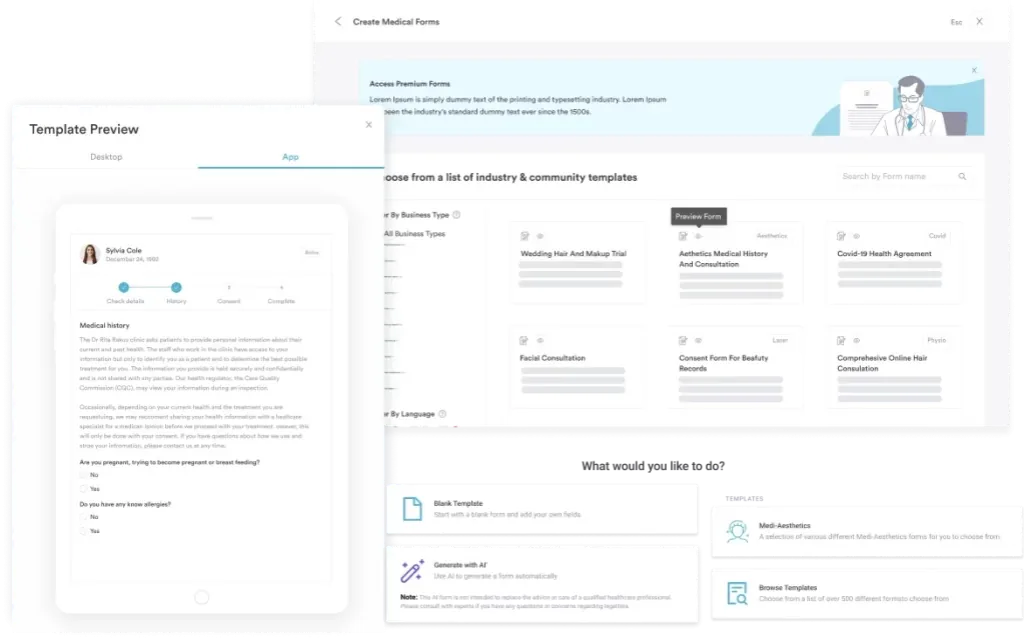
The operative note must include:
The pre-authorization request should include the same clinical indication summary and reference the endoscopic confirmation. Insurers will cross-check the pre-auth clinical details against the operative note at the claims stage. Discrepancies between the two documents are a significant denial trigger. UK GDPR should also govern how the billing team stores and accesses patient records, consent forms, and operative data.
Pre-authorization is mandatory for proximal gastric vagotomy under most UK PMI policies. Because surgical vagotomy is now uncommon, some insurers classify it under specialist surgical review pathways that require additional clinical justification beyond a standard pre-auth form.
Typical evidence required across major UK insurers:
Insurer-specific notes:
Standard PMI policies routinely exclude treatment for conditions that pre-date policy inception. If the patient’s peptic ulcer disease pre-dates their current policy, review exclusion clauses carefully before booking surgery and before submitting a pre-auth request. Getting a written exclusion decision before proceeding protects the practice from an unrecoverable debt situation.
Denials for CCSD code A2720 have two root causes. The procedure is rare, so coders and reviewers know it less well, and the vagotomy family carries its own coding traps. Understanding each denial reason makes it easier to build a clean claim at submission rather than managing an appeal.
Billing teams handling upper GI surgical claims benefit from tracking denial patterns by code. Claims management software that logs denial reasons per claim shows whether denials are systemic or case-specific. A systemic pattern usually points to a documentation issue affecting several A2720 claims.
CCSD surgical claims for procedures like proximal gastric vagotomy follow the same general pathway across major UK insurers. Variations appear at the pre-auth and portal stages. The steps below apply to most PMI submission workflows.
When submitting to multiple insurers, keep a CCSD code reference log. Record the current schedule year’s fee for frequently used codes, including A2720. Update it when CCSD publishes its annual schedule. This prevents fee errors and speeds up the pre-auth process by giving the billing team immediate access to accurate figures.
A2720 denials usually trace back to paperwork. The operative note leaves out nerve preservation, the pre-auth details don’t match the claim, or a drainage code slips on. Fixing each one by email and spreadsheet can hold up payment for weeks.
In Pabau, the surgeon completes the operative note as a structured digital form, so the nerve-preservation and drainage statements are there before coding starts. The billing team then submits the claim through Healthcode and logs every denial reason against the code.
The result is a claim the insurer can match to its pre-auth without a query. When denials do arrive, the log shows whether a documentation habit needs fixing across your surgeons.

Pabau links structured operative notes, Healthcode claim submission, and denial tracking, so A2720 claims reach insurers complete. See how it fits your surgical practice.

CCSD code A2720 is a low-volume surgical code that carries a high risk of miscoding precisely because of its rarity. The defining rule is simple: Proximal gastric vagotomy preserves pyloric innervation and therefore never requires a drainage companion code.
So code from the operative note, never from memory. If the note names the procedure, confirms the nerves of Latarjet were preserved, and documents failed medical management, insurers can process the claim without query. If it falls short, ask the surgeon for an addendum before you submit.
Book a demo to see how Pabau keeps operative notes and CCSD claims in step for your surgical practice.

Need a broader CCSD billing reference? Bupa procedure fee schedule guide covers how CCSD fees are structured and published for UK private practice billing.
Billing another abdominal procedure? CCSD code J0310 covers liver tumor resection, another code in the CCSD abdomen chapter.
Coding other nerve procedures? CCSD code A7300 explains billing for permanent peripheral nerve lesions by radiofrequency, cryoprobe or phenol.
CCSD code A2720 is used to bill for proximal gastric vagotomy (also called highly selective vagotomy or parietal cell vagotomy) in UK private healthcare settings. It applies when a surgeon selectively denervates the parietal cell mass of the stomach to reduce acid secretion, typically for refractory peptic ulcer disease. The code is submitted to UK private medical insurers such as Bupa, AXA Health, Aviva, and Vitality as part of the CCSD schedule.
Yes. Proximal gastric vagotomy, highly selective vagotomy (HSV), and parietal cell vagotomy are three names for the same anatomical procedure. All three describe dividing the vagal branches to the acid-secreting body and fundus of the stomach. The antral and pyloric innervation is preserved. Any of these terms on an operative note points to A2720 as the applicable CCSD code.
Proximal gastric vagotomy divides only the vagal branches to the parietal cell mass, preserving antral and pyloric nerve supply, so no drainage procedure is needed. Truncal vagotomy divides the main vagal trunks, abolishing pyloric function and requiring a drainage procedure (pyloroplasty or gastrojejunostomy) to prevent gastric stasis. Other vagotomy types are coded separately, and confusing them is the most common coding error in this procedure family.
No. Because proximal gastric vagotomy preserves pyloric innervation, gastric emptying remains normal and no drainage procedure is clinically necessary. Billing a pyloroplasty or gastrojejunostomy code alongside A2720 constitutes unbundling unless the operative note documents a separately indicated drainage procedure with its own clinical justification.
Only in rare cases where the operative note documents antrectomy as a separately indicated procedure. Antrectomy is not part of the standard proximal gastric vagotomy technique, so the combination is unusual. When billed together, both the clinical indication for each procedure and the technical steps of each must be clearly documented in the operative note. Confirm with the relevant insurer’s unbundling guidelines before submitting the combination.
The most common denial reasons are selecting the wrong vagotomy code (truncal coded as proximal or vice versa) and missing pre-authorization. An operative note that does not confirm the vagotomy type or nerve preservation is another, as is unbundling a drainage code that was not performed. Pre-existing condition exclusions and unrecognized surgeons also generate denials. Each has a specific corrective action covered in the denial table above.