

HCPCS code E0198: Water pressure pad billing guide
HCPCS code E0198 is a water pad for a standard mattress HCPCS code E0198 is the ...

Last Updated: Oct 13, 2026
93571 is the CPT add-on code for Doppler velocity or pressure-derived coronary flow reserve measurement in the first coronary vessel or graft studied. It is reported during coronary angiography and covers fractional flow reserve (FFR) and related wire-based physiology, with pharmacologic stress when performed.
Each additional vessel in the same session goes on add-on code 93572, one unit per vessel. Both codes are billed only with a qualifying primary angiography or PCI code on the same claim.
Let Pabau's smart automation suggest the right codes, reduce claim denials, and keep your practice compliant—effortlessly.
Automate repetitive tasks and focus on what matters most—your patients.
Reduce coding errors and ensure compliance with the latest regulations.
Clean claims, fewer denials, and faster reimbursements.
Powerful insights and reporting to help your practice thrive.
HIPAA compliant SOC 2 certified GDPR-compliant Trusted by 4,000+ clinics worldwide

CPT 93571 is an add-on code for coronary flow reserve measurement, such as FFR, in the first coronary vessel or graft studied.
Each additional vessel studied in the same session is reported with add-on code 93572, one unit per vessel, never with a second unit of 93571.
Both codes need a qualifying primary coronary angiography or PCI code on the same claim, or the add-on line is denied.
The physician in a hospital cath lab bills 93571-26, which carries 2.78 RVUs and pays about $92.85 nationally at the 2026 non-QP conversion factor.
Claims software such as Pabau keeps the cath report, claim and remittance in one record. Your coders still choose and pair the codes.
CPT code 93571 reports intravascular Doppler velocity and/or pressure-derived coronary flow reserve measurement in the first coronary vessel or graft studied during coronary angiography. The American Medical Association lists it as an add-on code, marked with a “+” in the CPT code book. It never stands alone on a claim.
The 2026 AMA descriptor has three parts:
The words “when performed” are new for 2026, according to the ACC coding overview for 2026. Earlier editions described pharmacologic stress as part of the service without that qualifier.
In practice, the code covers wire-based coronary physiology. The two common methods are a pressure wire, which measures fractional flow reserve (FFR) across a stenosis, and a Doppler-tipped wire, which measures flow velocity.
CPT 93571 and 93572 split one service by vessel count. The first vessel or graft studied goes on 93571, and every further vessel studied in the same session goes on 93572.
There is no CPT 93570 in this family. Some billing references still teach a 93570 initial-vessel code, and a claim built on that pairing fails at the first edit.
CPT 93571 is paid only when a qualifying primary coronary angiography or PCI code appears on the same claim. The CPT parenthetical before 2026 listed 92920, 92924, 92928, 92933, 92937, 92941, 92943, 92975, 93454-93461, 93563 and 93564.
Two of those parents are add-on codes themselves. When 93563 or 93564 anchors the claim, its own primary congenital catheterization code must be present too.
CPT 2026 reshaped the PCI family. It deleted the branch add-on codes 92921, 92925, 92929, 92934, 92938 and 92944, plus thrombolysis code 92975, and folded branch work into the base codes.
It also added 92930 for multiple lesions or a bifurcation in one major artery, and 92945 for a combined antegrade and retrograde CTO approach. Check the 2026 CPT parenthetical before pairing 93571 with either new code, and never with a deleted one.
CPT 93571 includes the wire placement, the physiologic recording and interpretation in the first vessel, and any pharmacologic stress used to reach hyperemia. Common methods reported under the code include:
In 2019, the ACC and SCAI advised appending modifier 52 to 93571 or 93572 when no stress agent was given. The descriptor then included stress without a qualifier. The 2026 “when performed” wording changes that premise, so confirm with your MAC and main payers whether they still expect modifier 52 for resting indices.
These services are not part of 93571 and are reported on their own lines when performed:
A procedure note supporting CPT 93571 has to show which vessel was measured, how, and why. Missing vessel detail is one of the most common reasons these lines fail clean claim submission review.
CPT 93571 has a professional component/technical component (PCTC) indicator of 1 in the 2026 CMS RVU file, so modifiers 26 and TC apply. Its global period is ZZZ, which ties it to the global period of the primary procedure.
Hospital outpatient departments have historically seen 93571 packaged into the primary procedure payment under OPPS (status indicator N). Check the current OPPS Addendum B before coding the facility claim.
The 2026 physician fee schedule prices 93571-26 at 2.78 total RVUs in both facility and non-facility settings. CMS publishes two conversion factors for 2026: $33.5675 for qualifying APM participants (QPs) and $33.4009 for all other clinicians.
These are national unadjusted amounts from the CMS RVU26D file (October 2026 release). Your MAC adjusts them by the geographic practice cost index (GPCI) for your locality, which you can check in the CMS Physician Fee Schedule lookup.
The global and TC rows carry no national rate, because both are carrier-priced. Commercial contracts usually pay a negotiated percentage of Medicare, so check each payer schedule.
Vessel count sets the units, and the order of study sets which code each vessel gets. Consider a diagnostic left heart catheterization with FFR in the LAD, then the circumflex, then a vein graft.
Line 1 changes if the grafts are imaged as well. Bypass graft angiography during the same left heart catheterization makes 93459 the parent code instead of 93458.
At the 2026 non-QP rate, the physiology lines total $92.85 plus $146.96, or $239.81 before GPCI. The breakdown below lines up each vessel with its code and payment.
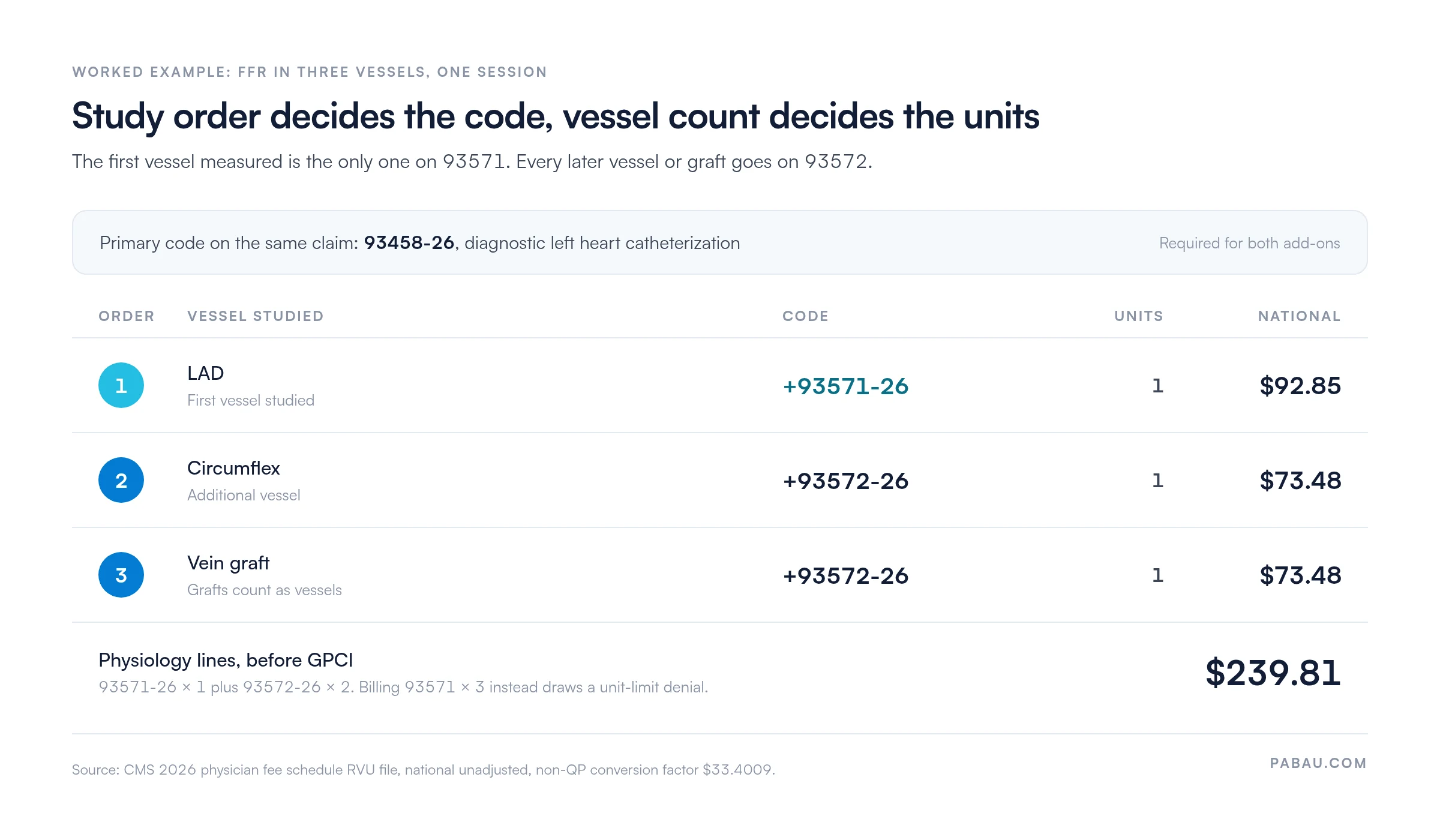
Coding that session as 93571 × 3 inflates the claim and draws a unit-limit denial on all three lines.
The same logic applies when FFR guides a same-session PCI. The physiology add-ons can attach to the diagnostic angiography or the PCI code, but each vessel still appears once.
Same-day diagnostic angiography is separately reportable with PCI only under set conditions. Examples are no prior study, or a change in the patient’s condition. Medicare claims for that case usually carry modifier 59 or XU on the diagnostic code.
In an interventional program, the pre-procedure checklist should already record which parent code the physiology lines will attach to.
Medicare covers CPT 93571 when the measurement is reasonable and necessary to decide on treatment for a specific stenosis. The note has to connect the measurement to that decision, and the claim’s ICD-10-CM diagnosis codes have to show the coronary disease behind it.
The typical indication is an angiographically intermediate stenosis where visual grading alone cannot settle whether to revascularize. FFR of 0.80 or lower and iFR of 0.89 or lower are the ischemic thresholds most labs use.
Chronic coronary atherosclerosis is reported from the I25.1 subcategory, and I25.10 covers native-artery disease without angina.
MAC policies differ in how much documentation they expect. Search the Medicare Coverage Database for your MAC’s local coverage determinations and billing articles before relying on a single template.
Most 93571 and 93572 denials trace back to the code pairing or to vessel documentation. Strong denial management workflows catch both before the claim leaves the practice.
Many cath lab teams retype the procedure report into a billing system. When a physiology line comes back short, they chase the payer by phone. Each handoff risks losing the vessel order or the numeric result.
Pabau keeps the procedure note, the charges and the claim on one patient record. Its payment-tracking claims software pulls the data already on that record into a pre-filled claim and sends it through Claim.MD. Status updates and remittances then come back to the same record.

Pabau does not choose codes or check add-on pairings for you. Your coders still decide between 93571 and 93572 and attach them to the right parent. A consistent superbill then carries those choices from the cath lab to the claim unchanged.

Pabau keeps procedure notes, claims and remittances on one record, submits through Claim.MD, and tracks every claim to payment. See how it fits a cardiology billing team.

Get the vessel count right and CPT 93571 is one of the simpler add-ons in cardiology. The first vessel goes on 93571, each further vessel on 93572, and both ride on a 2026-valid parent code.
The riskier work in 2026 sits around the code. PCI branch codes are gone, and the descriptor now says “when performed.” Old habits, such as modifier 52 or a phantom 93570, need checking against current payer rules.
Audit your charge sheet and note template against those changes before your next multi-vessel case. Book a demo to see how Pabau keeps cath lab notes, claims and payments on one record.

Need to understand how claims move from cath lab to payer? Medical claims clearinghouse overview explains how electronic claim submission and ERA processing work from charge capture to payment posting.
Want to reduce denial rework time across your cardiology team? Denial codes in medical billing breaks down the most common CARC denial codes and the corrective workflows that resolve them fastest.
Looking for guidance on insurance credentialing before billing intervention codes? Getting credentialed with insurance companies walks through the enrollment steps that determine whether a claim pays or denies at the payer level.
Coding the noninvasive study that came before the cath lab? CPT code 75574 walks through cardiac CT angiography billing for the same patient group.
Billing the surgical route when physiology points to bypass? CPT code 33533 explains how a single arterial coronary bypass graft is coded and paid.
CPT 93571 covers Doppler velocity or pressure-derived coronary flow reserve measurement, such as FFR, in the first coronary vessel or graft studied during coronary angiography. It is an add-on code, so it is billed with a qualifying primary angiography or PCI code.
CPT 93571 reports the first vessel studied, and 93572 reports each additional vessel in the same session. A study of three vessels is billed as 93571 once and 93572 twice, with the primary procedure code on the same claim.
No. The initial-vessel code in this family is 93571, and 93572 covers each additional vessel. A claim that lists 93570 fails at the first edit and should be recoded.
Yes. CPT 93571 carries the add-on symbol and a ZZZ global period, so it is never billed on its own. It must share a claim with a qualifying coronary angiography or PCI code, and modifier 51 never applies.
A cardiologist in a hospital cath lab usually bills 93571-26 for the professional component. TC and the global service are carrier-priced. Modifier 52 was advised for resting indices before 2026, so confirm current payer policy before using it.
In 2026, 93571-26 carries 2.78 total RVUs. That pays about $92.85 nationally at the non-QP conversion factor of $33.4009, or $93.32 at the QP factor of $33.5675, before GPCI adjustment.



