

CCSD code G5100: Bypass of duodenum billing guide
CCSD code G5100 bills a bypass that leaves the duodenum in place CCSD code G5100...

Last Updated: Oct 16, 2026
93321 is the CPT add-on code (+93321) for Doppler echocardiography, pulsed wave and/or continuous wave with spectral display, follow-up or limited study. It is never billed alone.
It is reported with a primary echo imaging code on the same claim, such as 93307, 93308, 93312 or 93350. It is not reported with 93306, which already includes spectral and color Doppler.
Let Pabau's smart automation suggest the right codes, reduce claim denials, and keep your practice compliant—effortlessly.
Automate repetitive tasks and focus on what matters most—your patients.
Reduce coding errors and ensure compliance with the latest regulations.
Clean claims, fewer denials, and faster reimbursements.
Powerful insights and reporting to help your practice thrive.
HIPAA compliant SOC 2 certified GDPR-compliant Trusted by 4,000+ clinics worldwide

CPT code 93321 is an add-on code (+93321) for a limited or follow-up spectral Doppler study, so it is never billed alone.
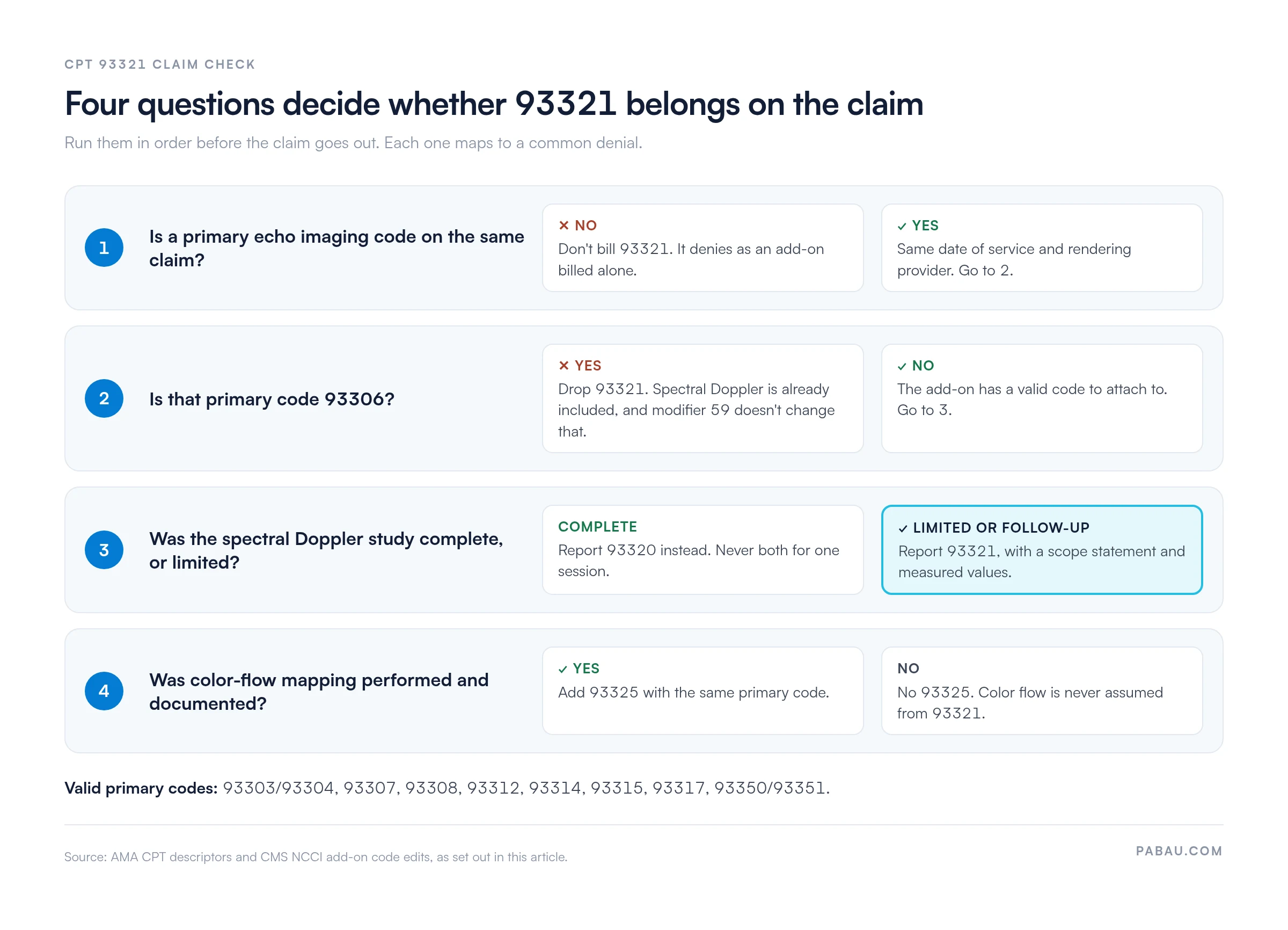
Report it with a primary echo imaging code on the same claim, such as 93303/93304, 93307, 93308, 93312, 93314, 93315, 93317 or 93350/93351.
Never add 93321 to 93306, which already includes spectral and color Doppler, and modifier 59 does not change that.
Color-flow mapping is a separate add-on, 93325, reported with the same primary code only when it was performed and documented.
Pabau, the practice management platform we build, checks echo claims for modifiers and payer-specific rules before they go out.
CPT code 93321 is an add-on code, written +93321, for a limited or follow-up Doppler echocardiography study with spectral display. It is reported only with a primary echo imaging code on the same claim and is never billed alone.
The American Medical Association descriptor has two parts, joined by a semicolon:
The phrase “List separately in addition to codes for echocardiographic imaging” is what makes it an add-on. CMS treats it the same way. It is a Type I add-on in the National Correct Coding Initiative (NCCI) add-on code edit files. It also carries global indicator ZZZ on the Medicare Physician Fee Schedule.
“Follow-up or limited” describes the scope of the Doppler work, not the patient’s history. CPT sets no rule that a prior complete study must exist before 93321 can be reported.
During a 93321 service, the physician evaluates one or more of the following hemodynamic parameters, depending on the clinical question:
The service is pulsed wave, continuous wave, or both, always with spectral display. The 2D and M-mode imaging belongs to the primary code it is added to.
93321 covers the spectral Doppler portion of an echo, and the imaging sits on a separate primary code. Knowing these boundaries prevents three common errors. The first is billing 93321 with no primary code. The second is adding it to 93306. The third is omitting 93325 when color flow was also performed. The four checks below catch all three before the claim goes out.
93320 and 93321 are the two spectral Doppler add-on codes, and both need a primary echo imaging code on the claim. The choice between them turns on the scope of the Doppler work. Choosing the wrong one is a common audit trigger, because 93320 carries more relative value units (RVUs).
The physician determines the Doppler scope based on the clinical question. Report one of the two for a session, never both. The report must state which Doppler parameters were assessed and why that scope answered the question.
Because 93321 is an add-on, every claim pairs it with a primary echo imaging code. NCCI edits govern which pairings are payable and which are bundled. On a follow-up transthoracic study, the usual primary code is 93308.
Check the current NCCI edit tables before you submit any 93321 pairing. The NCCI Policy Manual for Medicare Services is the authoritative source, and the edit tables are updated quarterly.
Medicare coverage for 93321 is set by your MAC’s transthoracic or transesophageal echocardiography LCD and its billing and coding article. The MAC is your Medicare Administrative Contractor, and the LCD is its local coverage determination, so the rules vary by region. Medical necessity requires a supported ICD-10 diagnosis and a documented reason for the Doppler assessment on top of the primary echo. Confirm coverage up front with insurance eligibility verification.
ICD-10-CM codes that commonly support 93321 claims include:
Coverage criteria vary by MAC jurisdiction. A diagnosis code alone does not guarantee coverage. The documentation must establish why Doppler assessment was medically necessary at this encounter, and why a limited scope answered the clinical question.
Before submitting a 93321 line, confirm its primary echo code sits on the same claim. Both lines need the same date of service and rendering provider. A 93321 line without its primary code denies as an add-on billed alone. A 93321 line on a 93306 claim denies as bundled.
As an add-on, 93321 follows its primary code. Modifiers 26 and TC are the ones that matter, and most others rarely apply to the add-on line on its own.
Place of service (POS) affects the payment rate. A physician office (POS 11) is paid at the higher non-facility rate, because the practice bears the equipment cost. Hospital outpatient departments (POS 22) and ambulatory surgical centers (POS 24) are paid at the lower facility rate.
Check that the POS code matches where the echo was performed before you submit. A mismatch leads to a payment reduction or a denial.
93321 carries global indicator ZZZ, so it has no global period of its own. It falls within the global period of the primary code it is reported with. Review billing compliance requirements before appending any modifier to an add-on line.
The CMS Physician Fee Schedule sets Medicare rates for 93321 from RVUs and the annual conversion factor. A geographic practice cost index (GPCI) then adjusts them. As an add-on, 93321 pays on top of the primary echo code, never on its own. Rates vary by location and are updated each January 1.
The table shows how the payment splits by component and setting. Verify current-year rates in the CMS fee schedule lookup before billing.
Commercial payer rates for 93321 vary significantly by geographic region and payer contract. A cardiology group in St. Louis may receive a materially different contracted rate than one in Raleigh for the same code. Use the FastRVU lookup tool as a baseline reference, then negotiate commercial rates using your payer contracts as the benchmark.
Payers review a 93321 line against the physician’s interpretation report. To hold up in that review and support clean claim submission, the report needs these elements:
Reports that state only “Doppler assessment performed, values within normal limits” without specific measurements will fail medical review. Every parameter listed in the findings section should correspond to a numeric value, not a qualitative summary.
Most 93321 denials come from its add-on status or from the limited Doppler scope. These are the seven patterns that generate the most denials, along with the fix for each.
Effective denial management workflows for echo codes start with a pre-submission checklist. Checking that every 93321 line has a valid primary code catches most of these errors before they reach the payer. A reference of common denial codes helps billing teams read the claim adjustment reason codes (CARCs) on returned 93321 claims.
Run a monthly audit of 93321 claims using your denial codes as the filter. Group denials by CARC, then identify whether the failure pattern is documentation, code selection, or modifier. Fixing the upstream process for the most frequent CARC cuts resubmission volume faster than working individual claims.
Most 93321 denials start before the claim is built, when the add-on line is keyed in without its primary echo code or next to 93306. Catching that by hand means a coder rereads every echo claim.
Pabau’s claims management software tracks modifiers and applies payer-specific rule sets to echo code families. Claims then go out electronically through Claim.MD, Pabau’s US clearinghouse partner. Claim.MD handles real-time eligibility checks, 837P claim submission, and electronic remittance advice (ERA) across more than 4,000 US payers.
The result is fewer add-on lines denied for a missing primary code, and fewer resubmissions for your billing team to work.

Pabau’s claims management tools support echo code families, modifier tracking, and electronic claim submission through Claim.MD for 4,000+ US payers. See how it fits your cardiology billing workflow.

Treat 93321 as an extension of the primary echo it sits beside. If the claim carries a valid imaging code, and that code is not 93306, the add-on has somewhere to land. If it does not, no amount of documentation will save the line.
The other half of the work is the report. Specific Doppler values and a clear limited-scope statement are what keep 93321 from being recoded to 93320 or denied on review.
Book a demo to see how Pabau helps your billing team pair echo add-on codes correctly before claims reach the payer.

Need to understand how clearinghouses process echo claims? Medical claims clearinghouse guide covers how 837P transmission, ERA matching, and payer enrollment work end to end.
Want a reference for 837 electronic claim file requirements? 837 EDI file guide explains the claim segments and loops relevant to cardiology and echo code submissions.
Looking for reimbursement data beyond the Medicare fee schedule? Revenue cycle management overview explains how payer contract rates, RVUs, and ERA reconciliation connect in a cardiology practice workflow.
Coding the primary study as a complete TTE? CPT code 93307 covers the complete transthoracic echo that most often carries a Doppler add-on.
Adding Doppler to a stress echo? CPT code 93350 explains the stress echocardiography primary code and its documentation rules.
CPT code 93321 covers the spectral Doppler portion of a limited or follow-up echo study. It includes pulsed wave and/or continuous wave Doppler, used to assess parameters such as transvalvular gradients, cardiac output, or diastolic function. It is an add-on, so the 2D imaging is reported on a separate primary code. Color-flow mapping is a separate add-on, 93325.
Both are spectral Doppler add-on codes reported with a primary echo imaging code. 93320 is the complete Doppler study, with every required element assessed. 93321 is the limited or follow-up version, covering a subset of Doppler parameters. Report one or the other for a session, and bill 93320 only when the complete scope was documented.
Modifiers 26 (professional component) and TC (technical component) are the ones that commonly apply, and they should match the modifier on the primary code. Modifiers 59, 76 and 77 rarely apply to 93321 on its own. Modifier 59 does not unbundle 93321 from 93306.
Commonly covered ICD-10 diagnoses include valvular disorders (I34.x, I35.x, I36.x, I37.x), heart failure (I50.x) and cardiomyopathy (I42.x). Pulmonary hypertension (I27.0, I27.2), atrial fibrillation (I48.x) and congenital heart defects (Q20-Q28) also qualify. Coverage criteria vary by MAC jurisdiction, so always verify against the applicable LCD version before submission.
Yes. CPT 93325 (color-flow Doppler velocity mapping) is a separate add-on code that can be reported with 93321 when color mapping was performed. Both add-ons need the same primary echo imaging code on the claim. The color-flow work must be documented, not assumed from the presence of 93321.
The most common denial reasons are an add-on billed without its primary echo code, 93321 reported with 93306, and a missing or unsupported ICD-10 diagnosis. Others include a missing modifier 26 or TC in split-billing settings, and reports with qualitative findings instead of specific Doppler measurements.
93321 is an add-on code (+93321), not a stand-alone code. It is reported only with a qualifying primary echo imaging code on the same claim. Examples include 93307, 93308, a TEE code or a stress echo code. It is never billed alone, and it is not reported with 93306.



