



CCSD code G5100: Bypass of duodenum billing guide
CCSD code G5100 bills a bypass that leaves the duodenum in place CCSD code G5100...

Last Updated: Oct 16, 2026

CPT code 93307 describes transthoracic echocardiography with real-time 2D imaging and M-mode recording when performed, without spectral or color flow Doppler.
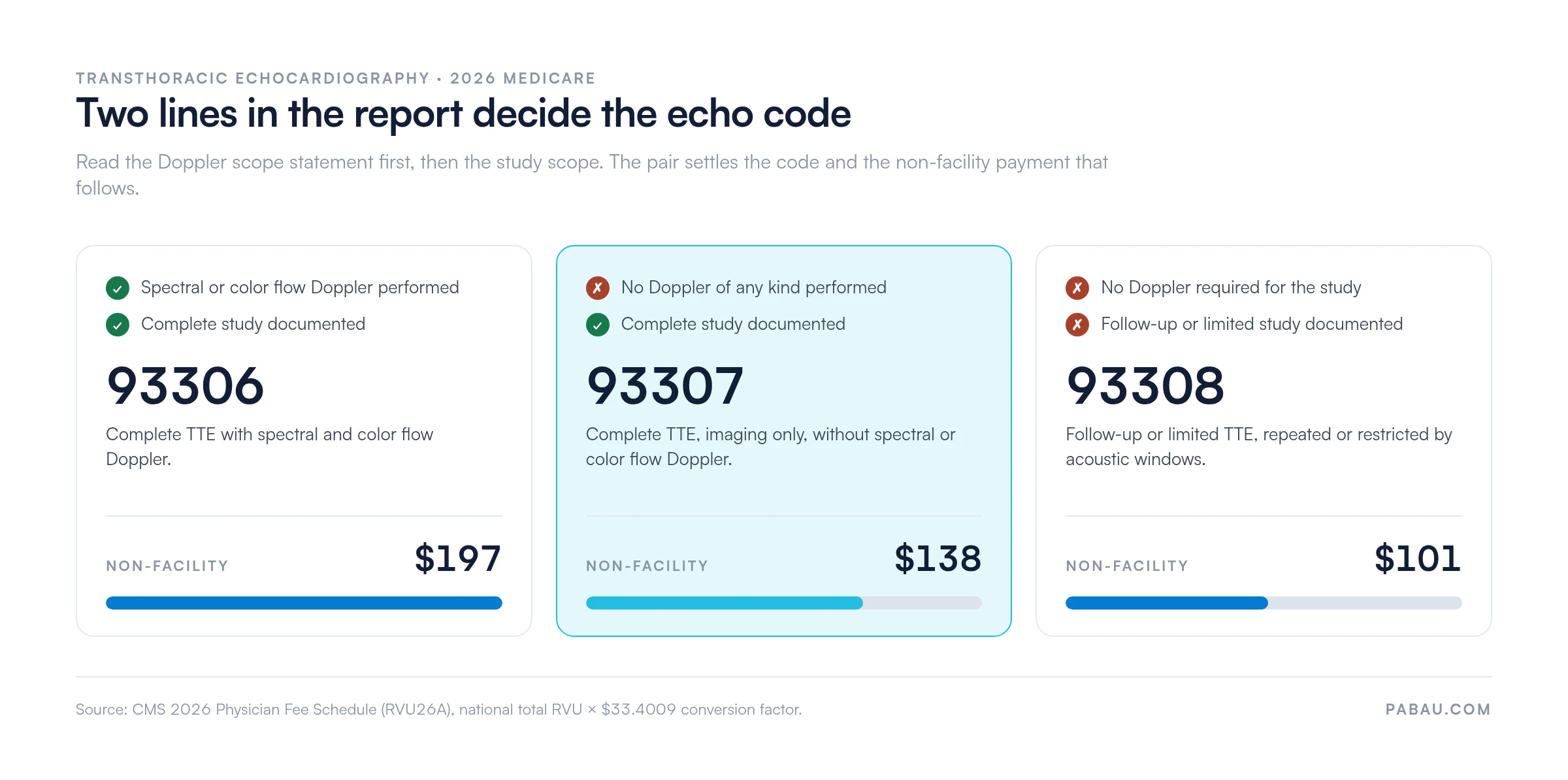
Use 93307 when imaging only is performed. Select 93306 when complete Doppler, spectral and color flow, is included in the same session.
The 2026 Medicare national average for 93307 is about $138 non-facility and about $43 for the professional component. Verify exact figures with the CMS Physician Fee Schedule lookup tool.
Practice management software like Pabau flags bundling conflicts, enforces documentation checklists, and routes 93307 claims through the Claim.MD clearinghouse.
CPT code 93307 is transthoracic echocardiography with real-time 2D imaging and M-mode recording, performed without Doppler. The verbatim AMA descriptor reads: Echocardiography, transthoracic, real-time with image documentation (2D), includes M-mode recording, when performed, complete, without spectral or color flow Doppler echocardiography.
Three elements define this code and separate it from the adjacent codes in the 93303-93352 echocardiography section.
The “without Doppler” restriction is what defines CPT code 93307 in practice. If the interpreting cardiologist adds even a brief color flow or pulsed-wave Doppler pass, the study qualifies as 93306. Document the absence of Doppler explicitly in the report to support the lower code choice.
Selecting the wrong transthoracic echocardiogram CPT code is the single biggest source of denial risk for cardiology billing teams. The three codes share a common imaging base but differ on Doppler scope and study completeness.
The AAPC’s CPT code lookup confirms these distinctions. One practical rule covers the hardest call of the three. If the cardiologist intended a complete study but the patient’s body habitus blocked adequate Doppler windows, the correct code is often 93308. The choice rests on clinical intent and what was technically achievable, rather than on what data ended up captured.
Two documented facts decide the whole selection, and the payment attached to each outcome is very different.
CPT code 93307 applies when the clinician performs transthoracic echocardiography as an imaging-only study, with no Doppler evaluation planned or performed. Common scenarios include structural screening in patients with low pre-test hemodynamic suspicion. It also covers follow-up sizing of a known pericardial effusion, and protocols where Doppler is captured at a separate visit.
Documenting the clinical rationale for omitting Doppler is not optional. Medicare’s Local Coverage Determination LCD L33577 requires that the record support medical necessity for the specific study performed. A report that simply lists “TTE performed” without explaining the scope of the study creates audit exposure. For a practice running several cardiologists, standardizing the documentation language in the report template is what keeps that risk down.
Reimbursement for CPT code 93307 varies by place of service and geographic locality. The rates below reflect 2026 Medicare national averages; exact amounts depend on the MAC jurisdiction and geographic practice cost index. Always verify current figures using the CMS Physician Fee Schedule lookup tool before submitting claims.
When billing from a hospital outpatient department, the cardiologist bills only the professional component. The facility bills the technical component separately. An office-based practice billing the global service receives the full non-facility rate. Both figures above come from the CMS 2026 RVU file at a $33.4009 conversion factor. Use FastRVU’s 2026 RVU lookup to cross-reference the work, practice expense, and malpractice components before commercial contract talks.
Missing documentation is the most preventable cause of 93307 claim denials. The interpreting physician’s report must establish five elements before the claim leaves the practice. Each one can sit in the echocardiography report template as a required field.
A structured report checklist is what stops one of those five items going missing. Running it at charge entry catches the omission while the report is still open for correction. Once the claim has reached the clearinghouse, fixing it costs a resubmission and weeks of delay.
Flag every echocardiography report for a Doppler scope statement before billing. A report that documents “2D echocardiography performed” is not enough on its own. Without an explicit statement that no Doppler was used, it cannot support 93307 over 93306 in a payer audit. Add a one-sentence required field to your echo report template: “No spectral or color flow Doppler was performed during this study.”
Medicare coverage for 93307 is governed by Local Coverage Determination LCD L33577. The LCD defines covered indications for transthoracic echocardiography broadly, and applies to both 93306 and 93307. The specific code billed must still match the scope of the study performed. Claiming 93307 for a study that included Doppler is an inaccurate claim. So is claiming 93306 for a study that omitted it, even where the diagnosis clearly supports coverage.
Commercial payers generally follow similar medical necessity criteria. They vary on covered indications and documentation thresholds. Verify coverage with the individual payer before assuming LCD L33577 applies to a private insurance claim. Scheduling is the right moment to confirm echocardiography benefits for the specific plan.
The ICD-10-CM diagnosis code paired with CPT code 93307 must establish medical necessity for the imaging study. The table below lists commonly accepted ICD-10-CM codes. Payer coverage policies vary, so confirm the pairing with the specific plan.
Always select the most specific ICD-10-CM code available, and check that the one you pick is billable. I31.3 is a parent code and will reject on its own, so the billable subcode I31.39 or I31.31 is what belongs on the claim. I51.9 works as a primary code only until a more granular diagnosis is established.
Modifier selection for 93307 depends on place of service and billing arrangement. Applying the wrong modifier is one of the most common technical reasons for claim rejection.
Modifier 26 and TC are payer-specific in their application rules. Some commercial payers do not recognize the TC modifier, and others require it. Confirm the payer’s split-billing policy before submitting. Modifier 59 needs robust documentation of a separate clinical indication. Applied routinely without supporting records, it carries audit risk.
The Correct Coding Initiative (CCI) is maintained by CMS. It defines which code pairs cannot be billed together for the same patient on the same date of service. CCI edits for echocardiography codes are updated quarterly; always verify the current version using the CMS CCI tool before billing.
A clearinghouse that runs pre-submission CCI edit checks catches these bundling conflicts before the claim reaches the payer. Pabau supports that check through its Claim.MD connection. A denial on CCI edit grounds requires a corrected claim and delays payment by weeks.
Most 93307 denials trace back to one of five recurring errors. Catching the pattern before submission costs far less than working a denial queue afterwards.
Audit 93307 and 93306 claims together rather than one at a time. The ratio between them should track the practice’s clinical mix. A practice billing nearly every echocardiogram as 93307 looks as odd to a payer as one billing them all as 93306. Electronic remittance advice from your clearinghouse is the most granular source of denial reason codes for that review.
Manual echocardiography billing relies on individual coders remembering modifier rules, CCI edits, and documentation checklist items for every claim. That approach works until claim volume scales, staff turns over, or a payer changes its policy mid-year.
An integrated billing platform can embed the 93307 documentation requirements directly into the workflow. Pabau’s medical claims management connects to the Claim.MD clearinghouse. That connection reaches thousands of US payers and validates 837P claims against payer-specific edit libraries before transmission.
Bundling conflicts between 93307 and 93306 surface before the claim leaves the practice, rather than after a denial arrives. So do missing modifier flags for split billing and ICD-10 mismatches. Superbill and ERA data run through the same system, which gives billing managers one view of coding accuracy over time.
Accurate 93307 billing also depends on consistent documentation upstream. When the cardiologist writes the report in the same system that builds the claim, the two stay in step. Build the Doppler scope statement into a required field in the echo report template. Link that field to claim generation, and the manual check between the two disappears.

Pabau’s integrated claims management and Claim.MD clearinghouse connection helps cardiology practices flag bundling conflicts, validate modifiers, and submit clean echocardiography claims. See how it works for your practice.

CPT code 93307 turns on one documented fact: whether any Doppler was performed. Put that line in the echo report template and the code stops being a judgment call for the coder.
The expensive 93307 errors are rarely complicated. They are missing scope statements and modifiers that do not match the place of service, and a checklist catches both in seconds. The practices that review 93306 and 93307 side by side are the ones that notice a drifting code mix before a payer does.
To see how Pabau’s claims management and Claim.MD connection keeps cardiology claims clean, book a demo.

Need a clearinghouse that validates claims before submission? Medical claims clearinghouse explains how claims route to thousands of US payers and where pre-submission edits catch errors.
Want to understand how denial codes work in cardiology billing? Denial codes in medical billing explains CARC reason codes, how to read ERAs, and steps to appeal denied echocardiography claims.
Tracking 93307 claim accuracy across your billing cycle? Revenue cycle management fundamentals covers how to build denial pattern reports and measure coding accuracy over time.
CPT code 93307 is transthoracic echocardiography (TTE) performed as real-time two-dimensional imaging with M-mode recording, without spectral or color flow Doppler. It applies when a cardiologist performs structural cardiac imaging only, with no Doppler evaluation of any kind.
CPT 93306 includes complete Doppler evaluation, so both spectral and color flow Doppler are required. CPT 93307 describes the same imaging base, real-time 2D with M-mode, performed without any Doppler. If any Doppler was performed during the session, bill 93306.
The 2026 Medicare national average is about $138 for the global service in a non-facility (office) setting. The professional component with modifier 26 is about $43. Exact rates vary by geographic area and MAC jurisdiction. Verify current figures with the CMS Physician Fee Schedule lookup tool before submitting claims.
No. CCI edits prohibit billing CPT 93307 and 93306 together for the same patient on the same date. The two codes describe mutually exclusive study types. Submitting both triggers an automatic denial. Done systematically, it creates compliance exposure for upcoding.
CPT 93307 is a complete transthoracic echo without Doppler. CPT 93308 is a follow-up or limited TTE. It applies when the study is repeated to assess a specific finding, or when body habitus and poor acoustic windows prevent a complete exam. If the report documents the study as limited, bill 93308.
The report must carry the clinical indication, an explicit statement that no Doppler was performed, and confirmation that images were acquired and stored. It also needs a description of findings, a clinical impression, and the physician’s dated signature. Missing the Doppler scope statement is the most common deficiency for this code.



