



CCSD code G5100: Bypass of duodenum billing guide
CCSD code G5100 bills a bypass that leaves the duodenum in place CCSD code G5100...

Last Updated: Oct 16, 2026

CPT code 93320 is the add-on code for a complete Doppler echocardiography study, pulsed wave and/or continuous wave with spectral display.
Its companion code, 93321, covers the follow-up or limited Doppler study, and it pays less.
The AMA marks 93320 with a plus symbol, so it is never billed alone. Valid parents include 93307, 93308, 93312, and 93314.
93306 already includes spectral Doppler, so NCCI bundles 93320 into it. No modifier overrides that edit, which makes 93306 the costliest pairing mistake.
Practice management software like Pabau pre-fills the claim from the record. It also holds the claim until every required field is complete.
CPT code 93320 is the add-on code for a complete Doppler echocardiography study, pulsed wave and/or continuous wave, with spectral display. It never stands alone. The AMA gives it a plus symbol, so it pays only when a valid primary echocardiography code sits on the same claim.
That one rule causes most of the denials cardiology billers see on this line. The report matters just as much, because the Doppler findings have to read as a separate service.
What follows walks through the descriptor, the parent codes, the 93306 conflict, documentation, modifiers, and 2026 Medicare rates.
CPT code 93320 covers Doppler echocardiography, pulsed wave and/or continuous wave with spectral display, performed as a complete study.
The American Medical Association (AMA) marks it with a plus symbol. That symbol means the code must be listed in addition to a code for echocardiographic imaging, never on its own.
The last word of the descriptor, complete, decides which code applies. A follow-up or limited Doppler interrogation belongs to 93321 instead.
Report 93320 for a limited study and you have overstated the service, which usually ends in a post-payment refund request.
The two techniques inside the descriptor do different jobs. Pulsed wave Doppler measures blood flow velocity at one specific location. Continuous wave Doppler measures peak velocities along the whole beam, without depth resolution.
Both produce spectral waveform displays. Those waveforms carry diagnostic weight the 2D and M-mode images from the primary code do not. That is why 93320 exists as a separately billable line.
The official descriptor is one sentence with an instruction folded into it. It reads: “Doppler echocardiography, pulsed wave and/or continuous wave with spectral display (List separately in addition to codes for echocardiographic imaging); complete.”
Code 93321 borrows the same parent language. It simply ends with “follow-up or limited study” in place of “complete.”
The two codes describe the same technique and differ only in scope. 93320 applies when the Doppler exam covers the valves and flows a complete study expects. 93321 applies when the Doppler portion is a focused re-check, such as one valve gradient after a therapy change.
A worked example makes the split concrete. A patient with known aortic stenosis comes back at six months for a repeat study.
The sonographer records the peak gradient across the aortic valve and nothing else. That is 93321, even where the primary code is a complete transthoracic echo.
Both codes are add-ons, both need a parent echocardiography code, and both need their own documented findings. Payment follows the scope, so 93320 pays more than 93321 under the Medicare Physician Fee Schedule.
Coding the complete study on a record that supports only a limited one is an overpayment the payer can recover.
CPT code 93320 pays only when an appropriate primary echocardiography code sits on the same claim, for the same date of service. Submitted on its own, it denies automatically.
The AAPC’s CPT code lookup confirms the add-on designation. At adjudication, CMS’s NCCI edits enforce the parent-child relationship, so the pairing gets checked by machine before a human reviewer ever sees it.
Valid parents span three families: transthoracic (TTE), transesophageal (TEE), and stress echocardiography.
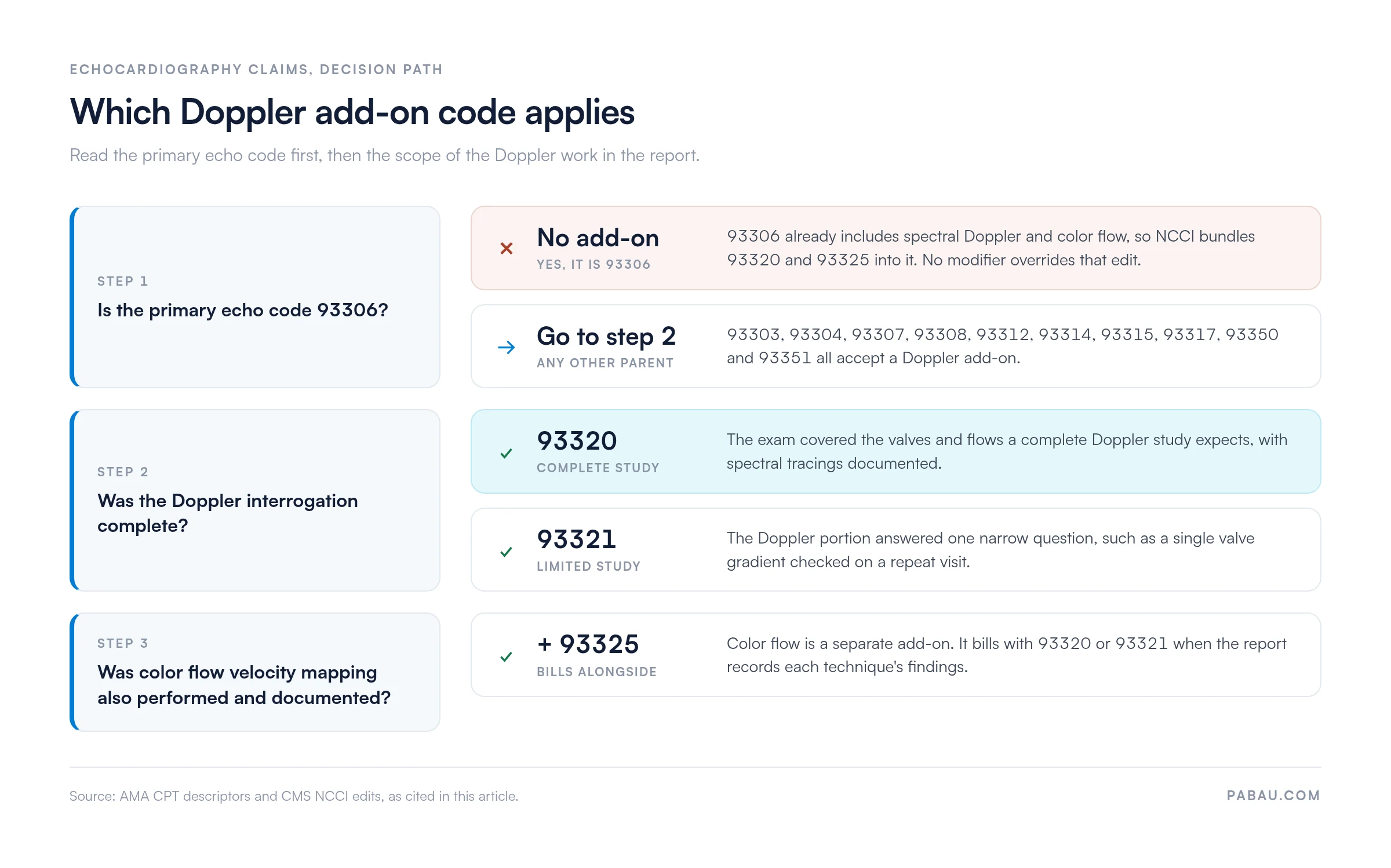
93306 is the exception that costs practices the most money. Its descriptor already includes spectral Doppler and color flow Doppler, so 93320 and 93325 are bundled into it by definition.
NCCI applies that edit with no modifier override, so the add-on line denies on every 93306 claim. When a complete TTE captures spectral Doppler but no color flow, report 93307 with 93320 instead.
93325 covers color flow velocity mapping, which is a different technique from the spectral Doppler in 93320. Coders swap the two often, and payers notice.
Both can sit on the same claim when both were performed and documented separately.
Picture one study. A cardiologist quantifies aortic valve gradients with pulsed wave Doppler, which is 93320. The same session maps a mitral regurgitant jet with color flow, which is 93325. Both lines bill, provided the report records each technique’s findings distinctly.
Put the four codes side by side and the choice becomes mechanical. The primary echo code decides whether an add-on is available at all, and the scope of the Doppler work decides which one you report.
The record has to show that pulsed wave and/or continuous wave Doppler with spectral display was performed. It also has to read as a service separate from the primary imaging narrative.
Noting “Doppler performed” inside the 2D echo findings is not enough, and documentation failures cause more 93320 denials than any other single factor.
MAC coverage articles set the baseline rather than the detail. Article A56505, which governs transesophageal echocardiography claims, asks for legible records, a signed interpretation, and a diagnosis that supports the service. It does not prescribe a separate Doppler heading.
So the structure below is a practical safeguard, not a payer rule. It is still the fastest way to show an auditor that the add-on was earned.
Run a quarterly documentation audit on a sample of 93320 claims. Pull 10 to 15 records and check whether the Doppler findings appear in their own section with quantitative measurements. If cardiologists are burying Doppler results inside the 2D echo narrative, the practice is both losing revenue and inviting audit risk.
For 93320, the modifier depends on three things. Who performed the study, where it was performed, and whether the service split into a technical and a professional component.
Applying the wrong one, or leaving out one the payer requires, triggers an edit and delays payment.
Modifier rules are payer-specific. Medicare Part B and commercial payers differ on whether -59 or the XU, XE, XP and XS modifiers are required.
Verify current payer policy before you append a modifier to a 93320 line. The Medicare fee schedule shows whether a code carries a technical and professional split, which settles whether -26 and TC apply at all.
Medicare sets the 93320 rate each year through the Medicare Physician Fee Schedule (MPFS), and the amount varies by locality. Geographic Practice Cost Index (GPCI) factors adjust the national figure up or down.
That makes a national average a starting point rather than a number you can quote to a patient. Check your own locality with the CMS MPFS lookup tool before you build a figure into a billing workflow.
Practices running Pabau submit 93320 claims electronically through Claim.MD, which reaches thousands of US payers. Real-time eligibility runs before the encounter. A plan that excludes the Doppler add-on then surfaces before the study happens, rather than after the denial lands.
Commercial rates for 93320 typically run from the Medicare benchmark up to around 150% of it, depending on the contract. Some payers take a different route and bundle Doppler into the primary echocardiography payment, which rules out separate billing without a carve-out.
Read your payer contracts for Doppler add-on provisions before you build 93320 into a standing workflow. One bundling clause you missed can quietly wipe out a year of add-on revenue.
Medical necessity for 93320 rests on an ICD-10 code that describes a cardiac condition needing Doppler interrogation.
Payers expect the diagnosis to explain why pulsed or continuous wave Doppler formed part of the evaluation. Linking 93320 to an unrelated diagnosis is one of the more common audit findings.
When you need to confirm a diagnosis code, our ICD-10-CM code index is quicker than a payer portal. For echocardiography, these are the codes 93320 pairs with most often.
Coverage for 93320 also depends on MAC-specific Local Coverage Determinations. Article A56505 covers transesophageal echocardiography and takes in the Doppler add-on codes. Confirm which ICD-10 codes your own MAC accepts before you hard-code a pairing into a billing template.
Three root causes account for most 93320 denials. The claim carries no parent code, the Doppler documentation is thin, or the modifier is wrong.
Systematic fixes beat chasing individual claims after adjudication, which is the whole point of denial management on high-volume diagnostic codes.
It helps to know where the line can drop off. A 93320 claim passes four checkpoints, and each one can strip it.
The fourth checkpoint is the visible one, because it produces a remittance code someone has to work. The first two are where the money is actually saved.
Run these six questions over any claim carrying 93320. It takes under a minute, and it closes the denial patterns above.
CPT code 93320 belongs to a small family, and picking the right combination is easier when you can see the whole set. A primary code covers the complete service, and the add-ons capture specific components of it.
Manual review catches some errors, but cardiology volumes make a full pre-submission audit impractical. A coder working through 150 echocardiography claims a day cannot hand-check every 93320 line. Parent code, modifier, and diagnosis link all need looking at.
Pabau’s claims software for cardiology works on the input side of that problem. The CPT code attached to the service lands on the charge line automatically. ICD-10 slots are seeded from the client’s recorded problem list, so the diagnosis link starts from the record rather than from memory.
Built-in CPT and ICD-10 lookup libraries sit behind a search icon on the claim. That is where a coder settles 93320 against 93321, without opening a second tab. The claim itself will not send until every required field is complete, so half-built lines never reach the clearinghouse.
None of that picks a modifier for you, and no software should pretend to. It does mean claims leave your practice complete. It also means a denied 93320 line comes back through the same system that produced it, with its remittance reason attached.

Break your 93320 denials out by parent code in your billing reports. Any 93320 line attached to 93306 is a coding error rather than a payer quirk, and it will deny every time. If the denials cluster around 93307 or 93308 instead, the problem is the Doppler documentation, or the complete versus limited call between 93320 and 93321.

Pabau pre-fills the claim from the client record and keeps CPT and ICD-10 lookups a click away. It holds the claim until every required field is complete. See how cardiology practices keep their Doppler add-on lines clean.

93320 is a small line on a large claim, and it behaves like one. The dollars are rarely worth an appeal on their own. Across a year of echocardiography volume, though, they add up to a number worth protecting.
So the work belongs before submission, not after it. Pair the code, check the parent is not 93306, and make the Doppler findings easy to find in the report. Those three habits close most of the denial patterns in this guide.
If 93320 denials keep turning up in your remittances, it is usually a workflow problem rather than a coding one. Book a demo to see how Pabau pre-fills and validates cardiology claims before they leave the practice.

Want to understand how clearinghouses process cardiology claims? Medical claims clearinghouse guide covers how electronic claim routing works and why clearinghouse selection affects echocardiography billing outcomes.
Getting repeated 835 remittance codes on 93320 denials? Electronic remittance advice explains how to read ERA files and map CARC denial codes back to specific claim errors.
Need to verify eligibility before the echo appointment? Insurance eligibility verification outlines how real-time checks catch plans that exclude the Doppler add-on.
Want fewer add-on lines coming back at all? What makes a clean claim sets out the fields and checks that get a claim paid on first submission.
No. 93320 belongs to the cardiac echocardiography family only. Vascular duplex studies fall in the 93880 to 93998 range, and fetal Doppler echocardiography uses 76827 and 76828. Reporting 93320 for a non-cardiac study is a coding error, not a shortcut.
On most plans the authorization attaches to the primary echocardiography code, not to the add-on. If the payer approved 93307 or 93312, the Doppler line usually rides on that approval. A few payers list the Doppler codes separately, so check the plan policy before the study.
A sonographer can acquire the images and the spectral tracings under the required level of physician supervision. The billing physician still has to interpret the study and sign the report. Where the practice does not own the equipment, the physician bills the interpretation with modifier -26.
The add-on denies with it. An add-on line pays only when its parent pays, so any appeal has to fix the primary code first. Resubmitting 93320 on its own will not work, whatever the original denial reason was.



