



CCSD code G5100: Bypass of duodenum billing guide
CCSD code G5100 bills a bypass that leaves the duodenum in place CCSD code G5100...

Last Updated: Oct 16, 2026

CPT code 93308 covers a limited or follow-up transthoracic echocardiogram that targets specific cardiac structures rather than the whole heart.
Scope decides the code, so bill 93306 for a complete study with spectral and color flow Doppler, and 93307 for a complete study without Doppler.
The echo report has to state that the study was limited and name the structures evaluated, or the claim cannot be defended.
In 2026 the non-facility total for 93308 is about 3.03 RVUs, and practice expense accounts for roughly 82% of that.
Practice management software like Pabau pre-fills the claim from the patient record, offers code lookup, and validates required fields before you submit.
CPT code 93308 bills a limited transthoracic echocardiogram, a real-time 2D study of specific cardiac structures rather than the whole heart. The AMA descriptor calls it a “follow-up or limited study”, and that one word decides the code.
If the report documents every chamber, valve and Doppler measurement, the claim belongs on 93306 or 93307 instead. Payers audit that boundary closely, because a complete study pays far more than a limited one.
What follows is the scope test, the diagnosis pairings that prove medical necessity, 2026 payment, and the Doppler add-ons.
The code covers a real-time 2D transthoracic echocardiogram with image documentation, including M-mode recording when performed, reported as a follow-up or limited study.
That is the AMA descriptor almost word for word. In practice it means the physician looked at one or more specific structures and stopped there.
Three studies that sit squarely inside 93308:
What the code leaves out is the comprehensive survey. A complete study walks all four chambers, every valve, the pericardium and the Doppler hemodynamics, and the report reads that way.
Billing 93308 when the report supports a complete study is downcoding. Billing 93306 for a targeted look is upcoding. Both draw audits, and the echo report is the only evidence either way.
Two variables separate the three transthoracic codes. First, was the study complete or limited. Second, was Doppler performed and reported.
Per the American Medical Association’s CPT code set, those two questions settle it.
Work it in this order, before the code is entered rather than after:
That order matters because it treats code selection as a documentation check. The report either supports the scope or it does not, and no amount of clinical context added later changes what the payer reads.
Medicare pays for a limited study when the clinical question is narrow enough that a targeted look answers it. Accepted indications include, but are not limited to:
The scope of the study has to match the clinical question. If the presentation called for a full survey, a limited study will struggle on review whichever code you pick. That clinical decision lands on the biller weeks later, so it pays to flag it early.
Every 93308 claim needs a linked ICD-10-CM diagnosis that explains why a limited echocardiographic study was appropriate. These pairings are the ones Medicare and commercial payers accept most consistently:
Check each pairing against the current fiscal year CDC/NCHS ICD-10-CM tables before you submit. Your Medicare Administrative Contractor may publish a Local Coverage Determination with a narrower list.
Some will not process the claim unless the diagnosis appears on that list. For the diagnosis side of the pairing, our ICD-10-CM code guides set out what each family covers.
The sentence is the scope statement. Reports often list findings for several structures without ever saying the study was limited. Payers then read that as a complete study billed under the wrong code.
Adding one line closes the argument: “This was a limited echocardiographic study targeting left ventricular function and the pericardial space.”
Beyond that, the report needs six elements to stand up:
Treat the echo report as a billing document as well as a clinical one. It is the only thing an auditor reads, and it is written long before anyone thinks about the claim.
Payment varies by locality, by facility versus non-facility setting, and by the annual conversion factor.
For your own number, run code 93308 through the CMS Physician Fee Schedule lookup tool with your MAC locality. The national values below are the 2026 relative value units behind that calculation.
Read the split rather than the total. Practice expense dwarfs the work component on this code. That is what makes the technical and professional decision in the next section worth so much money.
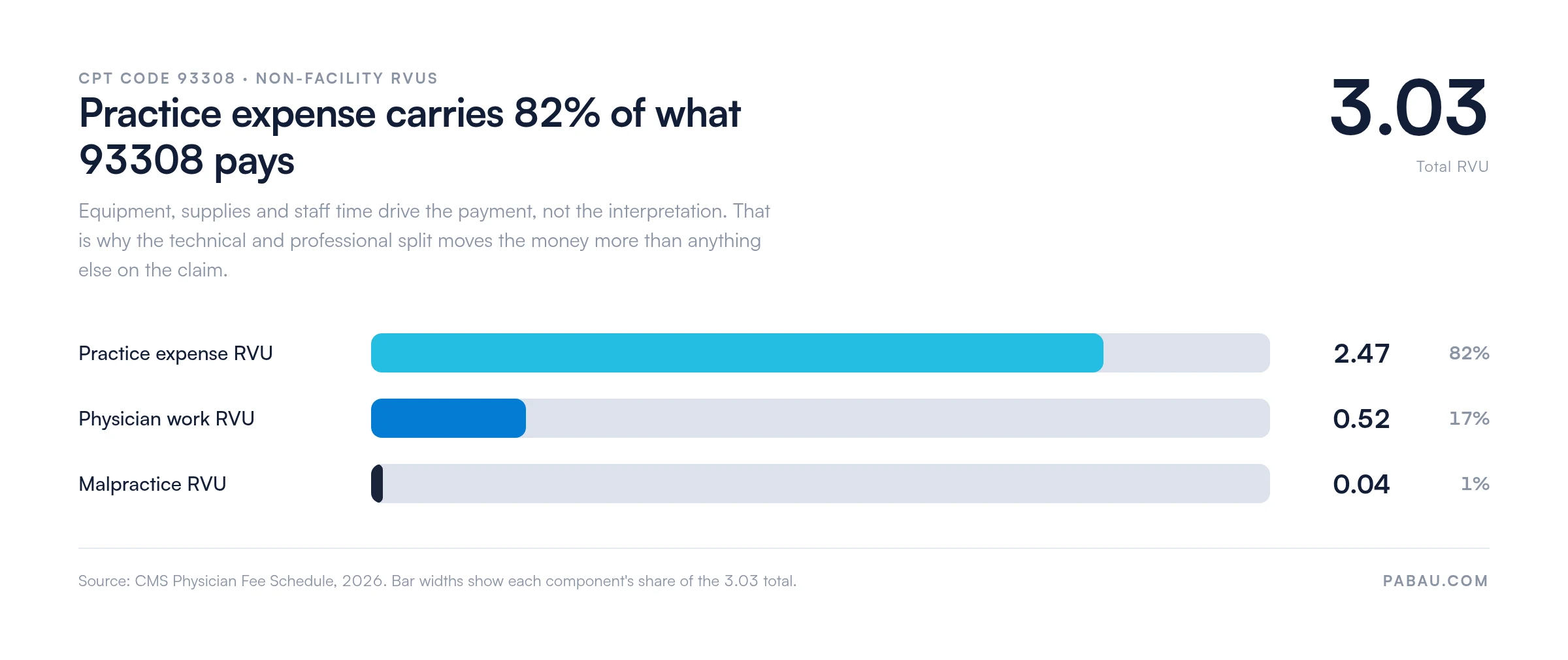
The conversion factor turns total RVUs into dollars, and CMS resets it every year. Commercial rates for 93308 usually sit above Medicare, though that depends entirely on the contract and the region.
Run eligibility verification before every echo appointment, not just for new patients. Coverage for outpatient cardiology can change mid-year when a plan renews. Catching a failed check beforehand stops a 93308 claim bouncing for a procedure that was not covered that day.
Equipment ownership drives the modifier on 93308. Two modifiers do almost all the work here, and the third option is to use none at all.
Global billing fits an office-based cardiology group that owns and runs its own echo equipment. Hospital-based cardiologists almost always bill with modifier 26.
Billing globally when a facility owns the technical component creates a duplicate, and payers catch that during adjudication.
Two add-on codes attach Doppler work to a limited study. CPT 93321 reports limited or follow-up spectral Doppler. CPT 93325 reports Doppler color flow velocity mapping.
The AAPC code reference lists both as add-ons, so neither is billable on its own.
Watch the spectral pair. CPT 93320 is the complete spectral Doppler study, so it is not the code to append to a limited echo. Use 93321 for the limited or follow-up version.
Submitting either add-on without matching documentation is a familiar audit trigger. The report should say that color flow mapping was performed, or that spectral Doppler was recorded, and name the structures. A color image sitting in the study file is not documentation.
Denials on this code repeat, which is good news. Six patterns cover almost all of them, and each one has a fix that lives upstream of the claim.
Tracking denials by code across billing cycles surfaces the repeat offenders faster. It also helps to count technical denials separately from medical necessity denials.
The first kind clears on resubmission, while the second needs a physician addendum and takes far longer to turn around.
Build a monthly 93308 denial review into your billing cycle. Pull every denial citing ‘service not medically necessary’ or ‘documentation insufficient’, then trace each one back to the echo report. The pattern shows up fast, and two or three missing report elements usually explain most of them. Fix the report template rather than each claim.
The path is short, and it breaks in three predictable places. Knowing where helps you decide who has to fix what.
First the physician performs the limited study and dictates the report. That wording is what the code rests on, so the scope and the structures have to be named there. Coding then selects 93308, attaches any Doppler add-on, and links the diagnosis that justifies the study.
Next the claim leaves as an 837 professional file. The clearinghouse runs its own edits before the payer sees the claim. Those edits catch a missing NPI, a bad place-of-service code, or a diagnosis in the wrong format. They are cheap to fix and easy to miss, because they never appear in payer remittances.
Finally the payer adjudicates and returns an electronic remittance advice. That file tells you whether 93308 paid in full, paid short, or bounced on medical necessity.
Posting it promptly is how a downcoded line gets caught inside the appeal window instead of a quarter later.
Five checks catch most of what would otherwise come back:
Clear all five and you are sending a clean claim, which is by far the cheapest kind to work. Miss one and the correction usually lands back on the physician days later, once the study is no longer fresh in anyone’s memory.
Most 93308 denials are not a code lookup problem. The physician finishes the study and writes it up in a generic template that never asks for the scope statement. The biller then sees the report days later, without the wording needed to defend the code.
Two different tools handle the two halves of the problem. Clinical documentation templates in the patient record can require the indication, the scope statement and the structure list before a report is signed off. That is an EMR job, done at the point of care.
The billing half belongs to integrated claims management software. Pabau pre-fills the claim form from the patient record. The CPT code attached to the service lands on the charge line, and the ICD-10 slots seed from the recorded problem list.
Built-in ICD-10-CM and CPT lookup libraries save the trip to a separate reference. Required-field validation then holds the claim until membership numbers and authorization codes are complete.
Submission runs through the clearinghouse for your region, with real-time eligibility checks, remittance posting and claim-status tracking on the US pipeline. So the billing step becomes verification rather than reconstruction, and a short-paid echo line shows up while you can still appeal it.
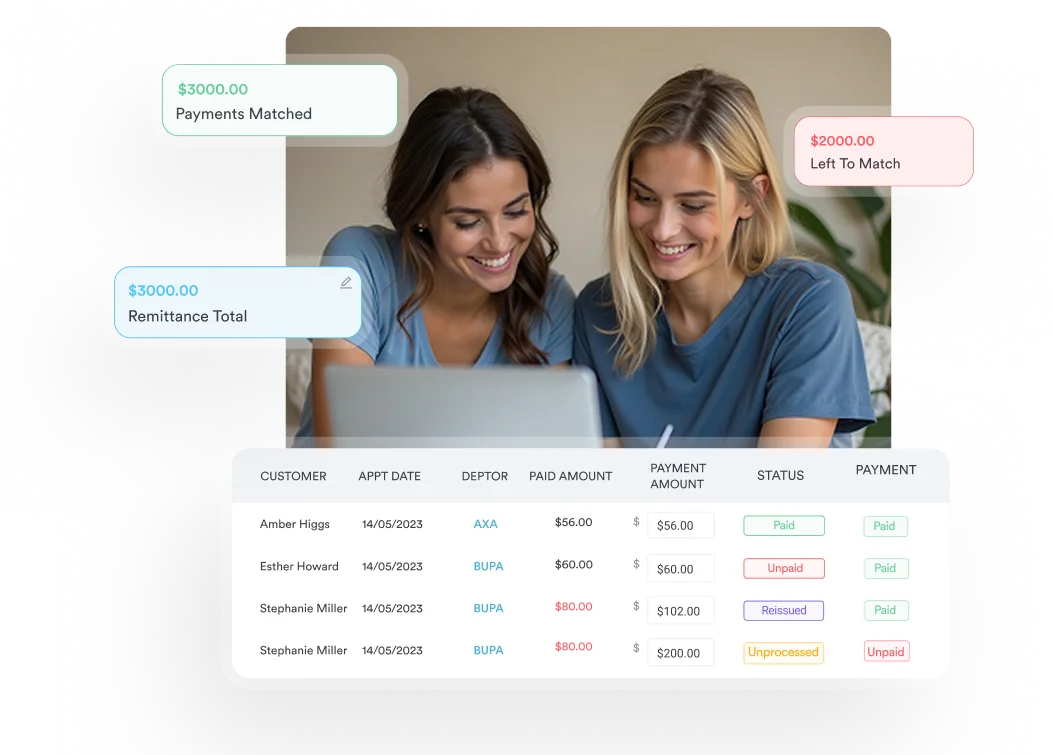

Pabau pre-fills the claim from the patient record, looks up ICD-10 and CPT codes in place, and holds submission until required fields are complete. So fewer claims come back for something the record already knew.

The code is the easy part. The sentence that defends it is the work. Does your echo template force a scope statement and a structure list? If not, that is the single change worth making this quarter, ahead of any work on appeals.
Expect the trade-off to feel backwards at first. Asking the interpreting physician for one more line adds seconds to the report and saves the biller an afternoon of reconstruction. Practices that make the swap stop arguing about 93308 versus 93306 altogether, because the report answers the question before anyone asks it.
Book a demo to see how Pabau pre-fills echo claims from the patient record and validates them before they leave your practice.

Want to see how clearinghouse submission works end to end? How Claim.MD clearinghouse works with Pabau walks through eligibility checks, remittance posting and payer enrollment.
Denials piling up across more codes than 93308? Denial management in healthcare sets out a workflow for triaging, appealing and preventing them.
Not sure what a clearinghouse checks before your payer does? Medical claims clearinghouse guide explains the edits a claim passes on its way to adjudication.
Need a pre-claim audit layer for cardiology visits? Superbills in medical billing shows how to confirm code, modifier and diagnosis before the claim is submitted.
Worried an audit would find your echo reports thin? Medical billing compliance covers the documentation standards payers apply when they review a paid claim.
No. Medicare assigns 93308 a global period of XXX, so the global surgery concept does not apply. You can report it inside another procedure’s global period when it is medically necessary and documented.
Yes. A limited echo is a diagnostic test, so it is separately reportable from an evaluation and management service. Document the visit as distinct work, and expect some payers to want modifier 25 on the E/M line.
Use 93304, not 93308. Congenital echocardiography has its own pair of codes. CPT 93303 covers a complete study and 93304 covers a follow-up or limited one.
Traditional Medicare does not require prior authorization for an outpatient echo. Many Medicare Advantage and commercial plans do, usually through a third-party imaging review program. Check the plan’s rules before the appointment.
A qualified sonographer or cardiac technologist can acquire the images under physician supervision. The interpreting physician has to perform the interpretation, document it, and sign the report. The professional component follows the interpretation, not the scan.



