

CCSD code G5100: Bypass of duodenum billing guide
CCSD code G5100 bills a bypass that leaves the duodenum in place CCSD code G5100...

Last Updated: Oct 16, 2026
93271 is the CPT code for the transmission and analysis component of an external cardiac event monitor with a symptom-related memory loop. It covers 24-hour attended monitoring, remote download, and analysis of the recorded events for up to 30 days.
The monitoring center usually bills it. Recording bills under 93270, and physician review and interpretation under 93272. When one provider performs all three parts, 93268 is the global code instead. Because 93271 is technical-only, it never takes modifier 26 or TC.
Let Pabau's smart automation suggest the right codes, reduce claim denials, and keep your practice compliant—effortlessly.
Automate repetitive tasks and focus on what matters most—your patients.
Reduce coding errors and ensure compliance with the latest regulations.
Clean claims, fewer denials, and faster reimbursements.
Powerful insights and reporting to help your practice thrive.
HIPAA compliant SOC 2 certified GDPR-compliant Trusted by 4,000+ clinics worldwide

CPT code 93271 reports the transmission and analysis component of external cardiac event monitoring, with 24-hour attended monitoring for up to 30 days.
It is a technical-only code, so modifiers 26 and TC never apply. The physician’s review and interpretation bills separately under 93272.
When one provider performs the recording, transmission, analysis, and interpretation, bill the global code 93268 instead of any component code.
Reporting 93271 with 93268 for the same monitoring period bills the same work twice, and the duplicate line is denied.
Medicare values 93271 at 4.12 RVUs in 2026, about $137.61 nationally at the non-qualifying APM conversion factor.
CPT code 93271 reports the transmission and analysis component of an external cardiac event monitor. The attended monitoring center receives the recorded events, analyzes them, and passes the findings to the ordering physician. The American Medical Association lists it under Cardiovascular Monitoring Services in the Medicine section of CPT.
The device itself is the same one billed under 93270 and 93268. It stores a symptom-related memory loop around each event the patient triggers. Where the device supports it, it also captures auto-activated events. The descriptor covers both cases with the phrase “when performed.”
The official descriptor is long, so here it is in three parts. Quote this wording when you check a payer contract or appeal a denial.
An auto-activation feature does not change the code. CPT folds patient-activated and auto-activated recording into the same four codes, so device features never move a claim from 93268 to 93271.
CPT splits external event monitoring into one global code and three component codes. 93271 is one of the two technical components, and it never carries the physician work.
Bill 93268 only when one provider performs the whole service. Once the work is split, each party bills its own component code. Never report 93268 alongside 93270, 93271, or 93272 for the same monitoring period.
Billing the global code is not undercoding. 93268 already includes the transmission and analysis that 93271 describes. Adding 93271 to it charges the payer twice for the same work.
Say a cardiology practice fits a 30-day event monitor for recurring palpitations. An IDTF runs the attended monitoring, and the practice’s cardiologist reads the final report. The episode bills like this:
Nobody bills 93268, because no single provider did all three parts. All three claims carry the same diagnosis and the same monitoring dates. Agree who owns which component before the device goes on, and the clean claim work gets much simpler.
CPT code 93271 takes no component modifier. The Medicare fee schedule gives it PC/TC indicator 3, which marks a technical-component-only code. The physician side of the service already has its own code, 93272.
Don’t use 59 or XU to push 93271 through next to 93268 or a Holter code for the same dates. Both lines in each pair bill the same monitoring period, and a modifier can’t turn overlapping work into a separate service.
Payers need an ICD-10-CM diagnosis that establishes medical necessity for event monitoring. The monitoring center’s claim should carry the diagnosis from the physician’s order, matching the 93270 and 93272 claims.
Coverage varies by jurisdiction, so check each diagnosis against your Medicare Administrative Contractor’s local coverage policy. Mismatched diagnoses across the three component claims invite a medical necessity review. When syncope prompted the order, code R55 unless the physician has already confirmed an arrhythmic cause.
The device decides the code family before duration does. Event recorders capture around events, Holter devices record every beat, and mobile cardiovascular telemetry (MCT) transmits continuously.
MCT has a single technical code. 93229 covers the hook-up and the attended surveillance together, so there is no MCT equivalent of 93270 or 93271. Report one ambulatory ECG monitoring service per period, and never pair 93271 with an MCT or Holter code for overlapping dates.
For the neighboring codes, see CPT code 93270 for the recording component and CPT code 93229 for MCT technical support.
Medicare pays CPT code 93271 through the Medicare Physician Fee Schedule (MPFS). The figures below come from the CMS July 2026 relative value file, before geographic adjustment.
Rates use the 2026 non-qualifying APM participant conversion factor of $33.4009. Qualifying APM participants are paid at $33.5675, which puts 93271 at about $138.30. Your MAC adjusts both by locality.
As the chart below shows, the three component RVUs add up to 5.08, exactly the global value. Medicare pays the same for one episode whether one provider bills 93268 or three parties split it. Splitting the work never earns more, so the split should simply follow who performed each part.
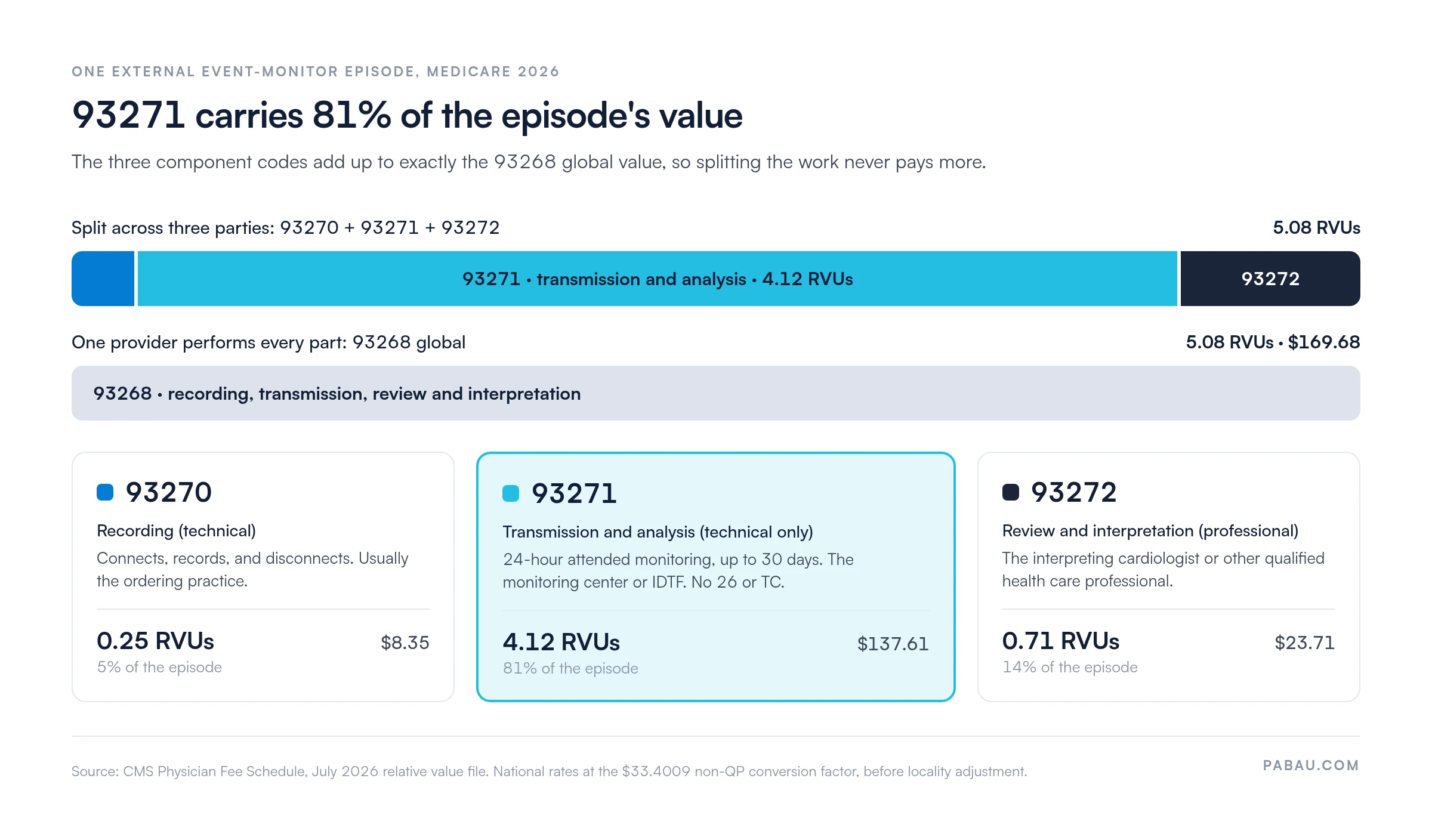
93271 carries almost all of the episode’s value. Losing it to a denial costs far more than losing the 93270 or 93272 line. Commercial payer rates are negotiated separately and often differ from Medicare.
Medicare covers ambulatory cardiac monitoring under National Coverage Determination 20.15, Electrocardiographic Services. Your MAC may add local coverage rules, so check its policies before you rely on a diagnosis.
Use insurance eligibility verification at scheduling to confirm the authorization covers the whole episode, not only the interpretation.
Documentation for CPT code 93271 has to prove the monitoring center received, watched, and analyzed the transmissions. The connection note supports 93270, and the signed interpretation supports 93272.
Share the monitoring dates between the practice and the monitoring center before either side bills. When the 93270, 93271, and 93272 claims show different dates, payers tend to query the whole episode.
CPT code 93271 denials follow a few predictable patterns. The table maps each one to its cause and the fix.
When a denial arrives, the denial codes on the remittance tell you which row applies. A steady denial management routine then fixes the pattern, not only the claim.
A split event-monitor episode creates up to three claims from different parties. When the dates or the diagnosis differ between them, payers query the whole episode.
Pabau, the practice management and billing platform we build, keeps the order, the monitoring dates, and the diagnosis on one patient record. Its claims management software pre-fills each claim from what is already on that record.
Before a claim goes out, Pabau checks that required fields such as authorization numbers are complete. US claims go through Claim.MD, with eligibility checks, claim-status tracking, and remittance posting. Your team chooses the codes, and Pabau keeps each claim consistent with the record.

Pabau pre-fills claims from the patient record and checks required fields before submission. US claims go through Claim.MD, so split cardiac monitoring claims go out complete and consistent.

CPT code 93271 is the monitoring center’s code, and its value sits almost entirely in the technical work. It pays for transmission and analysis, nothing more. Add 26 or TC, or stack it on 93268, and the claim comes back.
So decide the billing split before the device goes on. If one provider does every part, bill 93268 and stop there. If the work is shared, each party bills its own component with matching dates and diagnosis.
Want to see how Pabau keeps split cardiac monitoring claims on one patient record? Book a demo and we’ll walk through an event-monitor episode with you.

Need a structured approach to reducing claim denials? Denial codes in medical billing breaks down CARC and RARC reason codes and maps them to prevention actions.
Submitting cardiac monitoring claims electronically? 837 electronic claim files explains the 837P format that each component claim in the episode travels in.
Preparing monitoring claims for a payer audit? Medical billing compliance covers payer policy documentation and audit readiness for monitoring services.
Weighing an event monitor against a Holter study? CPT code 93227 covers the physician review and interpretation of a Holter recording of up to 48 hours.
Billing an event monitor ordered for syncope? ICD-10 code R55 sets out how syncope and collapse are coded and sequenced.
CPT code 93271 covers the transmission and analysis component of external cardiac event monitoring, with 24-hour attended monitoring for up to 30 days. It does not include recording (93270) or physician review and interpretation (93272).
93268 is the global code for the whole event-monitoring service, including recording, transmission, review and interpretation. 93271 is only the transmission and analysis component. Bill one or the other for a monitoring period, never both.
No. The descriptors for 93268, 93270, 93271, and 93272 all cover patient-activated and, when performed, auto-activated recording. The choice between them depends on who performs which part of the service.
No. 93271 is a technical-only code, so neither modifier applies. The physician’s review and interpretation bills separately under 93272.
Not for overlapping dates. Holter codes (93224-93227, 93241-93248) and MCT codes (93228, 93229) describe a different monitoring service. Report one ambulatory ECG monitoring service per period.
CPT 93271 carries 4.12 total RVUs in 2026. That is about $137.61 nationally at the non-qualifying APM conversion factor, before your locality adjustment.



