HCPCS code J3471: Hyaluronidase ovine injection billing guide
HCPCS code J3471: Descriptor, code type, and quick-reference data HCPCS code J34...

Last Updated: Oct 14, 2026
93270 is the CPT code for the recording component of an external cardiac event monitor with a symptom-related memory loop. It covers connecting the device, up to 30 days of recording with 24-hour attended monitoring, and disconnection.
The split is the fact to remember. Transmission and analysis bill under 93271, and physician review and interpretation under 93272. When one provider performs all three, 93268 is the global code. Because 93270 is technical-only, it never takes modifier 26 or TC. Pair it with 93268 or add a modifier, and the line is denied. Below, you'll see who bills each part, which diagnoses carry it, and what to check before you submit.
Let Pabau's smart automation suggest the right codes, reduce claim denials, and keep your practice compliant—effortlessly.
Automate repetitive tasks and focus on what matters most—your patients.
Reduce coding errors and ensure compliance with the latest regulations.
Clean claims, fewer denials, and faster reimbursements.
Powerful insights and reporting to help your practice thrive.
HIPAA compliant SOC 2 certified GDPR-compliant Trusted by 4,000+ clinics worldwide

CPT code 93270 covers only the recording component of external event monitoring: connecting the device, the recording period, and disconnection.
Transmission and analysis bill under 93271, and review and interpretation under 93272. One provider doing all three bills 93268 instead.
93270 is a technical-only code, so modifiers 26 and TC never attach to it.
Report event monitoring once per 30-day period, and never alongside Holter or MCT codes for the same monitoring window.
Put the same diagnosis on every component claim in the episode, or payers may query all of them.
CPT code 93270 reports the recording component of an external cardiac event monitor. The American Medical Association places it under Cardiovascular Monitoring Services in the Medicine section of the CPT code set. It pays for putting the recorder on, the recording period, and taking it off. The analysis and the physician’s read bill elsewhere.
The official descriptor is long, so here it is in its three parts. Quote this wording when you check a payer contract or appeal a denial.
With the wording settled, the next question is what your team does to earn the code.
Think of 93270 as one timeline with three points on it. Your team connects the recorder, the patient wears it, and your team removes it.
Physicians usually order an event monitor for palpitations, syncope, dizziness, or a suspected intermittent arrhythmia such as atrial fibrillation. It suits symptoms that come and go too rarely for a short Holter study to catch.
The transmissions and the interpretation report aren’t part of 93270. They bill under 93271 and 93272.
Device type matters more than study length here. Implantable loop recorders and continuous-recording devices fall outside the 93268-93272 family entirely, as the diagram below shows.
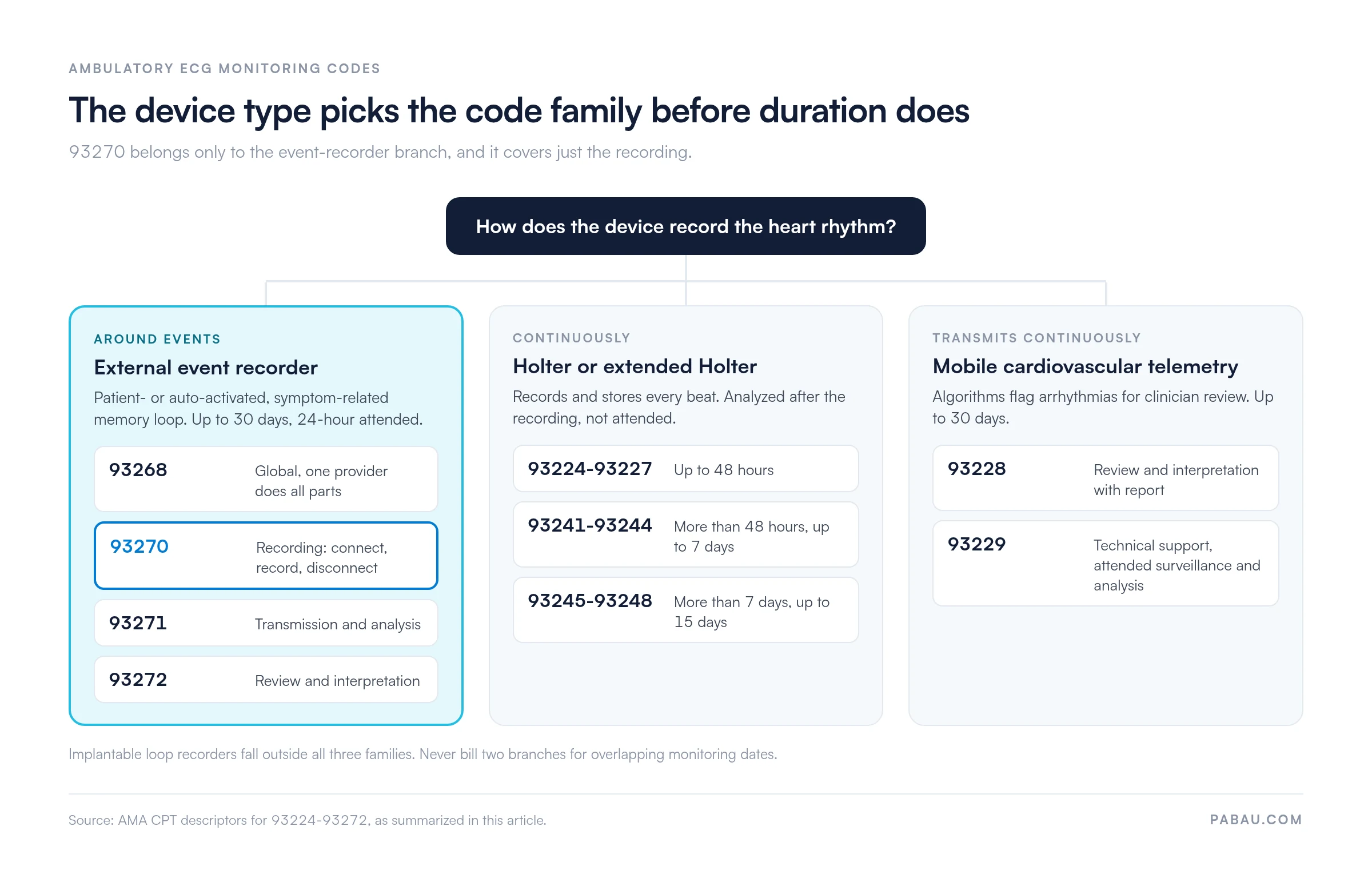
CPT splits external event monitoring into one global code and three component codes. 93270 is one of the two technical pieces, so it never carries the physician work.
Bill 93268 only when one provider performs the whole service. Once the work is split, each party bills its own component code. Never report 93268 alongside 93270, 93271, or 93272 for the same monitoring period.
Because the CPT descriptors already define each component, 93270 never takes modifier 26 or TC. A claim written as 93270-26 is a coding error. The physician’s side belongs on 93272.
Say a cardiology practice fits a 30-day event monitor for recurring palpitations. An IDTF runs the attended monitoring, and the practice’s cardiologist reads the final report. Here’s how the episode bills.
Nobody bills 93268, because no single provider did all three parts. All three claims carry R00.2 and the same monitoring dates. A clean claim submission process confirms who owns which component before any claim goes out.
Payers need an ICD-10-CM diagnosis that establishes medical necessity for CPT code 93270. An unlinked or unsupported diagnosis is the top denial driver for event monitoring claims. Coverage varies by jurisdiction, so check each code against your MAC’s local coverage determination (LCD).
Use the same diagnosis on the 93270, 93271, and 93272 claims for one episode. Mismatched diagnoses across the three claims invite a medical necessity review.
Match the claim to the ordering note, too. If the note documents palpitations but the claim carries R00.0, payers may reject on specificity grounds. Likewise, R55 needs a note that rules out an arrhythmic cause, and R42 needs a stated cardiac workup goal.
Once the diagnosis holds up, the next trap is picking the wrong monitoring family altogether.
Holter codes record continuously, while 93270 records only around events. Holter monitoring up to 48 hours bills under 93224-93227, with 93225 as its recording component. Since 2021, extended Holter monitoring has its own family, 93241-93248, which replaced Category III codes 0295T-0298T.
If the device records only around events, use the 93268-93272 family. If it records continuously, pick from 93224-93227 or 93241-93248 by duration. Never bill an event-monitor component and a Holter code for overlapping service dates.
CPT 93228 and 93229 cover external mobile cardiovascular telemetry (MCT), a different technology from the event recorder behind CPT code 93270. The two families aren’t interchangeable.
MCT devices transmit continuously, and algorithms flag arrhythmias for clinician review. Event recorders depend on the patient noticing symptoms or on an auto-trigger. Billing MCT and event-monitor codes for the same dates of service triggers a duplicate-service edit.
Medicare pays CPT code 93270 through the annual Medicare Physician Fee Schedule (MPFS), published by the Centers for Medicare and Medicaid Services. Rates are adjusted by Geographic Practice Cost Indices (GPCI), so payment varies by locality.
Each component code carries its own rate, so 93270 is never priced as a share of 93268. Commercial payer rates are negotiated separately and often differ from Medicare.
Pull the four 93268-93272 rates from the current MPFS for your MAC locality each January. Rates shift with each annual CMS final rule, and a stale rate skews fee comparisons and write-off estimates.
Prior authorization rules for CPT code 93270 vary by payer. Traditional Medicare generally does not require it for event monitoring, while many Medicare Advantage and commercial plans do. A missed authorization usually denies every component claim in the episode.
Then use insurance eligibility verification to confirm the authorization covers the whole episode, not only the interpretation.
Documentation for CPT code 93270 has to prove the device was connected, worn, and removed. Transmission logs and the interpretation report support the 93271 and 93272 claims instead.
Even with complete notes, the same few errors keep sending 93270 claims back.
CPT code 93270 denials follow predictable patterns. The table maps each one to its root cause and the fix.
When a denial does arrive, the claim adjustment reason code on the remittance tells you which row applies. Learn to decode denial codes and you’ll fix the right problem first.
Check your MAC’s LCD and quarterly newsletter for updates to ambulatory cardiac monitoring coverage. MACs revise covered ICD-10 indications periodically, and an old list produces avoidable denials.
Run these checks before any 93270 claim goes out. They catch the component-split errors from the denial table above.
A split event-monitor episode creates up to three claims from different parties, and many practices track them in spreadsheets. When the connection date or diagnosis differs between claims, payers query the whole episode.
Pabau, the practice management and billing platform we build, works from the patient record instead. Its time-saving claims management builds each claim from the patient record. The CPT code on the service fills the charge line.
Before a claim can be sent, Pabau checks that required fields such as membership numbers and authorization codes are complete. US claims go through Claim.MD, with eligibility checks, claim-status tracking, and remittance posting. Your team then spends its time on coding decisions instead of rekeying.

Pabau pre-fills claims from the patient record and validates required fields. It submits through Claim.MD with real-time eligibility checks, so split cardiac monitoring claims go out complete.

CPT code 93270 is a narrow code, and that’s why it’s easy to get wrong. It pays for the recorder going on, the recording period, and the recorder coming off. Treat it as a global service, or add 26 or TC, and the claim comes back.
So settle ownership before the device goes on. Agree who bills 93270, 93271, and 93272, then lock the dates and the diagnosis. Every claim in the episode will tell the same story.
Want to see how Pabau keeps split cardiac monitoring claims on one patient record? Book a demo and we’ll walk through an event-monitor episode with you.

Need a structured claims submission workflow? Clean claim submission best practices covers the pre-submission checklist steps that prevent CPT denials across all cardiac monitoring codes.
Billing the MCT side instead? CPT code 93229: MCT technical component billing guide covers the attended surveillance code for devices that transmit continuously.
Starting from a resting ECG? CPT code 93000: ECG billing, modifiers, and reimbursement explains the 12-lead study payers expect to see in the prior workup.
Want to understand how clearinghouses process cardiac claims? How medical claims clearinghouses work explains the transmission path from practice management system to payer adjudication.
Looking to reduce denial write-offs across your cardiology department? Denial codes in medical billing maps common CARC denial reason codes to their resolution steps.
Use 93268 when one provider does the whole service. When the work is split, bill 93270 for recording, 93271 for transmission and analysis, and 93272 for review and interpretation.
Yes. A practice that applies the device and interprets the results bills both, while the monitoring center bills 93271. If the practice also does the analysis, it bills 93268 instead.
No. Implantable loop recorders fall outside the 93268-93272 family. Inserting the subcutaneous monitor is reported with CPT 33285, and its follow-up uses separate device evaluation codes.
By how it records. A patch that records continuously for more than 48 hours bills under the extended Holter codes 93241-93248, not 93270. Event-only devices stay in the 93268-93272 family.
No. 93270 is technical-only, so neither modifier applies. The physician’s review and interpretation bills under 93272.
Yes, when the service meets your MAC’s LCD and the claim carries a supporting ICD-10-CM diagnosis. Medicare Advantage plans set their own prior authorization rules.