

HCPCS Code Q4185: Cellesta flowable amnion billing guide
HCPCS Code Q4185: definition and official descriptor HCPCS Code Q4185 is the Lev...

Last Updated: Nov 20, 2026
93042 is the CPT code for a rhythm ECG, 1-3 leads, interpretation and report only. It pays the physician or other qualified health care professional who reads a rhythm strip and writes a signed report. It has no tracing component.
The tracing is billed separately as 93041, and a practice that both records and reads the strip bills the global code 93040 instead. Because 93042 is already the professional component, modifiers 26 and TC never apply. Review of telemetry strips is not reported with 93040-93042.
Let Pabau's smart automation suggest the right codes, reduce claim denials, and keep your practice compliant—effortlessly.
Automate repetitive tasks and focus on what matters most—your patients.
Reduce coding errors and ensure compliance with the latest regulations.
Clean claims, fewer denials, and faster reimbursements.
Powerful insights and reporting to help your practice thrive.
HIPAA compliant SOC 2 certified GDPR-compliant Trusted by 4,000+ clinics worldwide

CPT code 93042 reports only the interpretation and written report of a rhythm ECG of one to three leads, with no tracing component.
Bill the tracing alone as 93041 and the complete service as 93040, so modifiers 26 and TC never attach to 93042.
CPT instructions call for a specific order plus a separate, signed, written, and retrievable report. A signed machine printout does not qualify.
In 2026, Medicare values 93042 at 0.21 total RVUs, about $7.01 nationally before geographic adjustment, with a global period of XXX.
Pabau, the practice platform we build, keeps the order, the signed report, and the claim in one record, so the dates on each one match.
CPT code 93042 covers the interpretation and written report of a rhythm ECG of one to three leads, with no tracing component. AAPC’s ECG myth-busting guide lists it beside its two siblings. It marks 93040 as the global service, 93041 as technical only, and 93042 as professional only.
The official descriptor in the American Medical Association’s CPT code set reads “Rhythm ECG, 1-3 leads; interpretation and report only.” That wording covers the professional’s read and signed report, not the recording.
The code pays whoever reads the strip. A cardiologist who interprets strips sent in from another facility, a monitoring device, or a hospital unit bills 93042. Whoever owns the equipment and records the strip bills 93041 for that work.
93042 sits in the Cardiography subsection of the CPT Medicine section, next to the 12-lead ECG codes 93000-93010. Clinicians order a rhythm strip to answer a rhythm question, such as palpitations, syncope, or rate control in known atrial fibrillation.
The rhythm ECG codes mirror the 12-lead codes one for one, which is why they get confused. Each family has a global code, a tracing-only code, and an interpretation-only code.
Read the table as two parallel sets. 93042 is the rhythm counterpart of 93010, and 93041 is the rhythm counterpart of 93005.
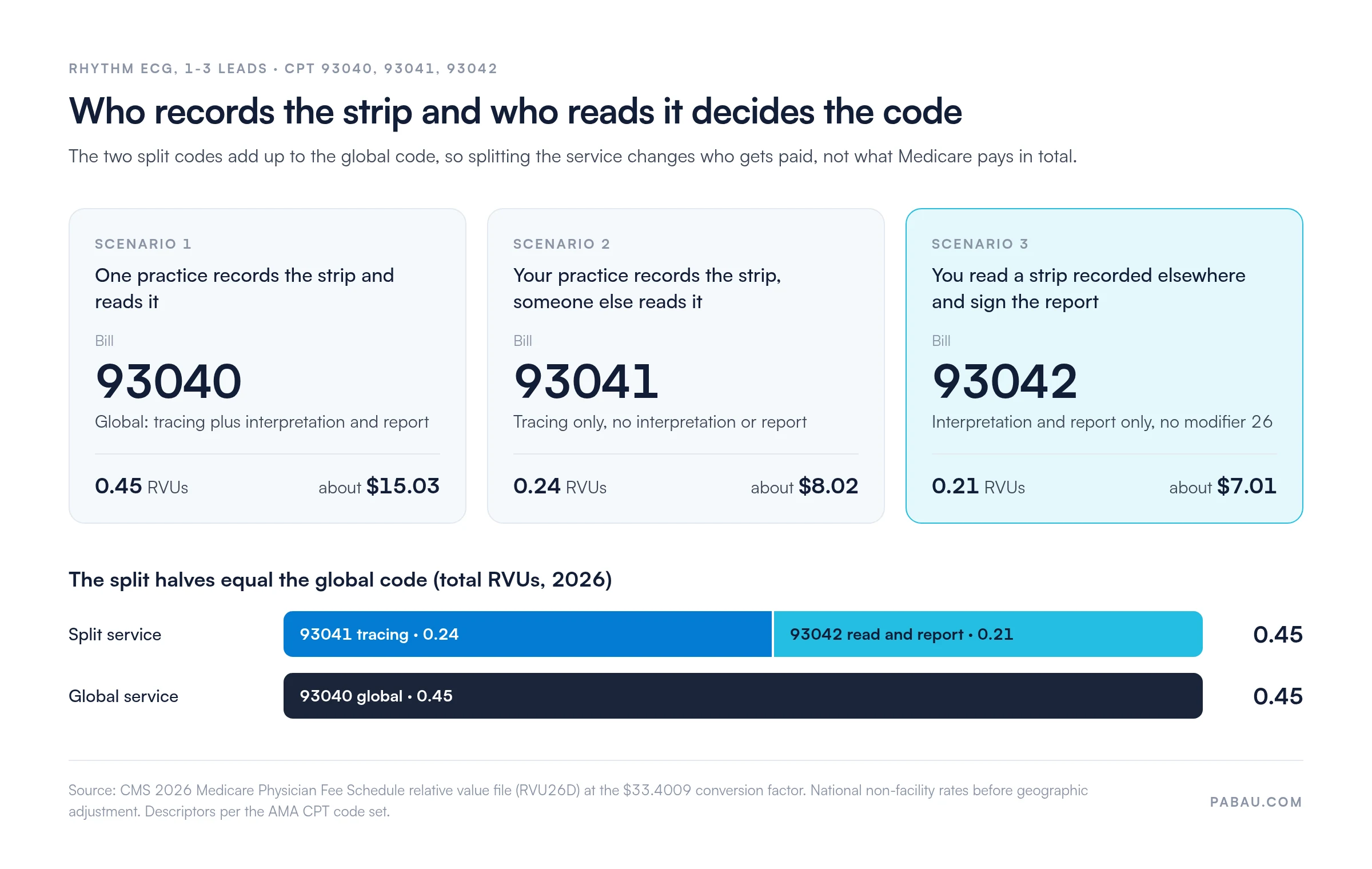
A split rhythm service is billed as 93041 by the entity that records the strip and 93042 by the professional who reads it. When one practice records and reads the strip, it bills 93040 alone. The panel below maps each scenario to its code and its 2026 Medicare value.
93005 never stands in for a rhythm strip tracing. It describes a 12-lead recording, so pairing it with a rhythm strip read reports a different test from the one performed.
A rhythm ECG records the heart’s rhythm on one to three leads, usually as a short strip. CPT 93042 covers only the work that happens once that strip exists.
Recording the strip is not part of 93042. If a strip is recorded but never formally interpreted, there is no 93042 to bill. The recording itself belongs to 93041, billed by the entity that performed it.
93042 is a professional-component code, so its scope stops at the read. The table shows what falls inside it and what belongs to another code.
AAPC’s Ray Cathey summarizes the CPT instructions in two parts. There must be “a specific order for an electrocardiogram or rhythm strip,” followed by “a separate, signed, written, and retrievable report.” Payers audit 93042 claims against each part of that requirement.
Medicare contractors enforce each element. In a prepayment review reported by AAPC, NGS reduced or denied every 93042 claim from New York and Connecticut cardiologists in early 2016. The review covered January to March, and its findings named missing orders, telemetry billed as rhythm strips, signed machine printouts, and mismatched dates.
Every claim for CPT code 93042 needs an ICD-10-CM diagnosis that explains why the rhythm strip was ordered, such as R00.0 for tachycardia. These diagnoses come up most often for rhythm questions.
When Z13.6 is the only diagnosis, many Medicare Administrative Contractors (MACs) deny the claim as a screening test. Medicare generally does not pay for tests ordered without a sign, symptom, or condition. Record the reason that triggered the order and code it.
Before you submit a claim with Z13.6 as the only diagnosis, check your MAC’s coverage articles for ECG services. If the chart documents the symptom or risk factor that prompted the strip, code that diagnosis first. A screening-only claim is the easiest 93042 denial to prevent.
Medicare covers CPT code 93042 when a specific order and a documented clinical reason support the test. Coverage details vary by MAC jurisdiction and by commercial payer.
Medicare pays 93042 through the Medicare Physician Fee Schedule (MPFS). The figures below come from the CMS 2026 relative value file (RVU26D, October release) at the $33.4009 conversion factor. Check your locality’s rate in the CMS Physician Fee Schedule lookup tool.
The two halves of a split service add up to the global code. 93041 at 0.24 RVUs plus 93042 at 0.21 RVUs equals the 0.45 RVUs of 93040. Splitting the service changes who gets paid, not the total Medicare pays.
Geographic variation applies through the Geographic Practice Cost Index (GPCI). Use the FastRVU lookup tool to calculate the locality-adjusted rate for your MAC jurisdiction and fee schedule year.
Modifiers 26 and TC do not apply to 93042. CMS assigns the code PC/TC indicator 2, which marks a professional-component-only code. Appending modifier 26 to a code that already describes the professional component is a coding error.
Each repeat strip on one date needs its own order and its own signed report. The MUE stops payment above 3 units per patient per day.
National Correct Coding Initiative (NCCI) procedure-to-procedure (PTP) edits decide which codes pay together on one date. In the 2026 practitioner PTP edits, 93042 is the column 2 code against every other ECG service. When an edit fires, 93042 is the line that gets denied.
Modifier 59 misuse is a recognized audit target. Apply 59 or XU only when the chart shows two separate orders, two separate reports, and a clinical reason for each.
CPT code 93042 has a predictable denial profile. Most rejections trace back to the documentation rules or the code-family split covered above. Refer to medical billing denial codes for the CARC and RARC codes behind these patterns.
A systematic denial management workflow that tracks ECG-code denials by reason helps billing staff spot patterns before they spread across encounters.
A clean claim for CPT code 93042 comes from a consistent billing workflow. Using claims management software that links clinical documentation to claim fields at the point of service reduces rework.
Reviewing claim edit flags before submission with a clean claim submission checklist costs less than working denials afterward. A denied 93042 claim needs a correction, a resubmission, and sometimes a physician addendum. That staff time quickly exceeds the code’s $7 national rate.
Run a quarterly audit of every 93042 claim denied in the previous period, sorted by denial reason code. When one CARC accounts for more than 15% of them, fix it at the template or charge-capture level. Common culprits are CO-4 for a modifier problem and CO-50 for medical necessity.
In many practices the rhythm strip, the signed report, and the claim live in three different places. The strip prints at the bedside, the cardiologist reads it later, and billing staff assemble the claim from whatever reaches them. Unsigned reports, mismatched dates, and 93040-versus-93042 mix-ups start there.
Pabau keeps the order, the uploaded strip, and the signed interpretation in the patient’s record. Its claims management software builds the claim from that record, with the diagnosis and the interpretation date already linked.
The result is a 93042 claim that matches the report it came from. Billing staff spend less time chasing signatures and reworking denied claims.

Pabau links the order, the signed rhythm strip report, and the claim in one record. Your 93042 claims reach payers with the documentation they need.

CPT code 93042 pays only for the professional read of a rhythm strip, written up and signed. Treat it as a complete rhythm ECG and the errors follow, from modifier 26 to tracing codes that describe a different test.
The fix is one question at charge entry. Ask who recorded the strip and who read it, then bill 93040, 93041, or 93042 to match. Keep the order and a separate signed report on file, and never bill telemetry review as a rhythm strip.
Pabau’s claims tools tie the signed report to the claim, so the code and the chart agree before submission. Book a demo to see how Pabau handles cardiac interpretation claims from order to payment.

Billing the 12-lead tracing instead? CPT code 93005 covers the 12-lead tracing-only code, the counterpart of 93041 for a full ECG.
Recording and reading a full 12-lead ECG? CPT code 93000 explains the global 12-lead ECG, with the tracing and the interpretation billed together.
Coding a rhythm strip ordered for fainting? ICD-10 code R55 covers syncope and collapse, one of the common diagnoses behind a rhythm strip order.
Want to reduce ECG claim denials at the source? Medical billing compliance covers the documentation and audit controls that keep cardiac code claims out of the appeals queue.
Checking coverage before the rhythm strip? Insurance eligibility verification outlines how checking eligibility before the encounter prevents coverage-related denials.
CPT code 93042 covers only the interpretation and written report of a rhythm ECG of one to three leads. Recording the strip is billed separately as 93041, and the complete service is 93040. The code also excludes 12-lead ECGs, Holter monitoring, and telemetry review.
CPT 93000 is a complete 12-lead ECG, covering the tracing plus the interpretation and report. CPT 93042 is the interpretation and report of a 1-3 lead rhythm strip, with no tracing. The 12-lead counterpart of 93042 is 93010. NCCI bundles 93042 into 93000 on the same date unless a separately ordered strip supports a modifier.
Yes, Medicare covers CPT code 93042 when a specific order and a documented sign, symptom, or condition support the test. The 2026 national rate is about $7.01 before geographic adjustment. Claims with a screening-only diagnosis such as Z13.6 are often denied without a supporting diagnosis.
You need a specific order with a clinical reason, the tracing in the record, and a separate, signed, dated written report. The report must sit apart from routine progress notes or under its own heading. Signing the printout from the ECG machine does not satisfy the requirement.
Yes, when two different entities do the work. The entity that records the strip bills 93041, and the professional who reads it bills 93042. When one practice does both, it bills 93040 instead. CPT 93005 is the 12-lead tracing code and never pairs with a rhythm strip read.
No. CPT 93042 is already the professional component, and CMS assigns it PC/TC indicator 2. Modifiers 26 and TC do not apply to it. Bill 93041 for the tracing and 93040 for a global service.
Yes. The interpretation and report are the whole of CPT 93042, so the code cannot be billed without them. A physician or other qualified health care professional, acting within scope, must read the strip and sign the report. A strip recorded but never interpreted supports only the tracing code, 93041.
No. Review of telemetry strips is part of monitoring and is not reported with 93040-93042. Medicare reviewers have denied 93042 claims where the chart showed telemetry review instead of an ordered rhythm strip.
The most common are a missing order or report, a screening-only diagnosis, and NCCI edits with 93000, 93010 or 93040. Others include modifier 26 on a professional-only code and telemetry billed as a rhythm strip. A billed date that differs from the interpretation date also triggers denials.





