HCPCS Code C1891: Non-programmable implantable infusion pump billing guide
HCPCS Code C1891: Definition and official descriptor HCPCS Code C1891 is defined...

Last Updated: Oct 15, 2026

CPT code 93010 covers the ECG interpretation and report only, so use 93000 when one provider records the tracing and reads it.
Medicare’s 2026 national average for 93010 is about $8.35, and locality adjustments under the GPCI move that figure up or down.
Modifier 26 is usually wrong on 93010, because the code already describes the professional component on its own.
A signed, dated interpretation in the record is what carries a 93010 claim through a post-payment audit.
The diagnosis on the claim line has to match the indication the ordering note documents for the ECG.
CPT code 93010 covers the interpretation and report for a routine 12-lead ECG, and nothing beyond that. It is the professional component of the ECG service. The physician who reads a tracing recorded by someone else bills it, while the entity that ran the tracing bills 93005 for its own half.
That single distinction is where ECG claims go wrong. Use 93010 for a tracing your own provider recorded, and the payer bundles the line against 93000.
This guide covers when 93010 applies, what Medicare pays in 2026, and how modifier 26 works. It also runs through the ICD-10 codes that support the claim, and the errors behind most denials.
The descriptor for 93010 reads electrocardiogram, routine ECG with at least 12 leads; interpretation and report only.
The physician reads the tracing and documents a signed interpretation. The code includes no tracing, no equipment time, and no technician work.
So 93010 fits a tracing acquired somewhere else, whether that is a facility, another provider, or a remote monitoring service.
That outside source still has to be a routine 12-lead ECG. A Holter recording of up to 48 hours is read under CPT code 93227 instead.
A portable EKG round at a nursing home is one such outside source. The trip carries its own HCPCS code, R0076, which Medicare bundles into the EKG payment instead of paying it separately.
Per the AMA’s CPT code set, each code in the 93000 series has its own defined scope. Overlap two of them on one claim and NCCI edits stop the payment.
The three ECG codes below divide one service between two billing parties. The table shows which half each code buys, and who sends the claim.
Start with the scenario 93010 was written for. A hospital outpatient department runs the tracing and bills 93005. The attending cardiologist reads it the same day and bills 93010. Two codes, one date of service, one patient, and two separate billing entities.
Now flip it around. A primary care physician runs the ECG in the office and reads it before the patient leaves. That encounter is 93000, the global code, and 93010 would understate the work. NCCI edits block 93000 and 93010 from one provider on one date, so a line denies.
Can 93005 and 93010 go out for the same visit? Yes, by different entities. The facility bills the tracing and the reading physician bills the interpretation. Added together, the two cover the same ground as 93000.
Picking the code is one step in a longer sequence, and a claim can pass that step and still fail later. The flow below follows a split-billed ECG from the moment the tracing prints to the day the remittance posts.
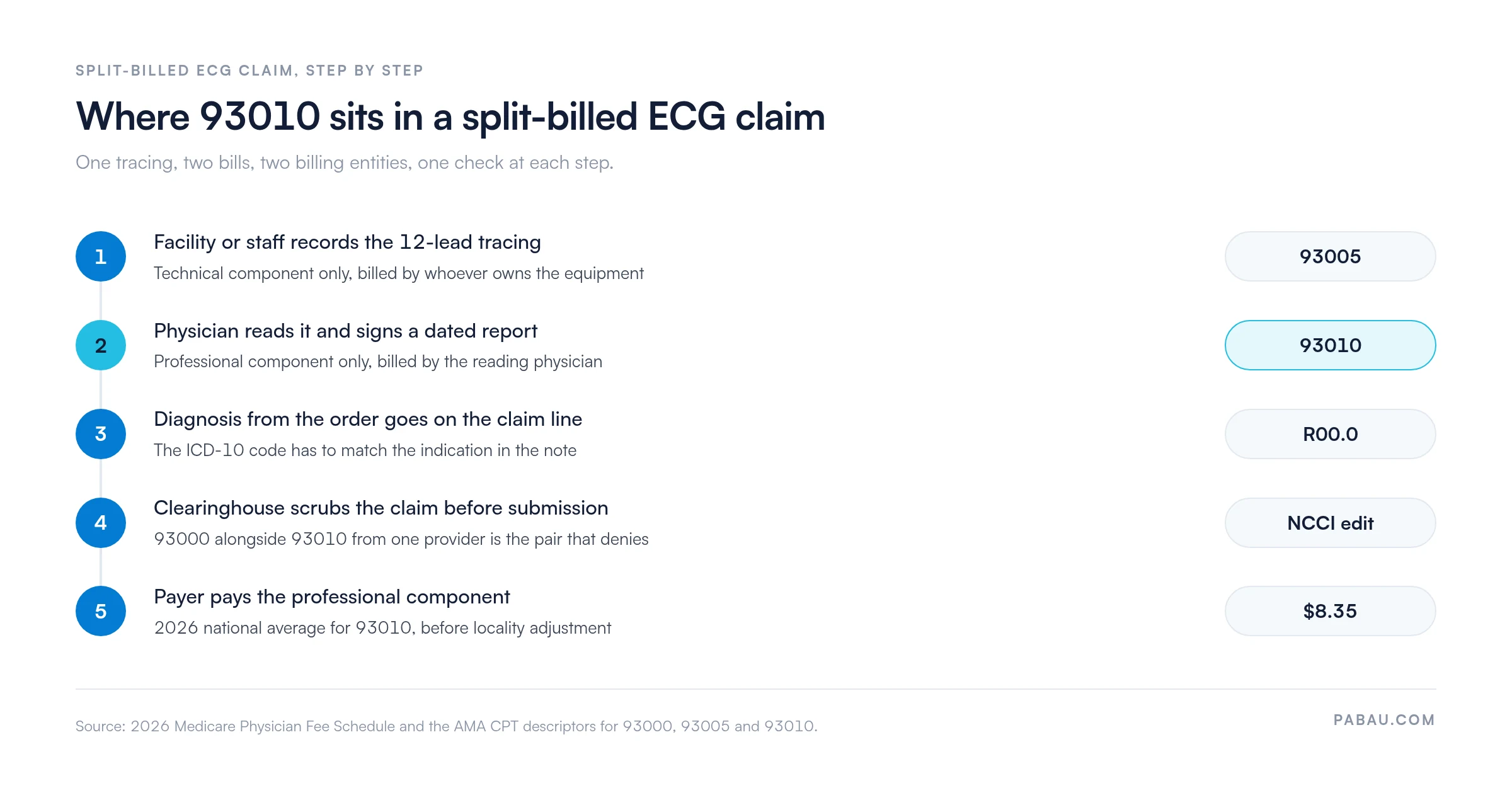
Two details in that sequence cause most of the trouble. The interpretation has to be signed and dated before the claim goes out, rather than after a payer asks for it. And the diagnosis on the claim line has to be the reason the ordering note gives for the ECG.
Medicare pays 93010 on the strength of the written interpretation, so that document is the claim. A missing or unsigned report is the top reason a paid 93010 claim gets recouped later. CMS article A57326 sets the minimum documentation standard for electrocardiogram billing.
Confirm each of these elements sits in the medical record before the claim leaves the practice.
An oral read passed to the ordering provider does not satisfy the requirement. The record needs the written version, signed and dated by the physician who read the tracing.
The 2026 Medicare Physician Fee Schedule sets the national average for 93010 at roughly $8.35. Locality adjustments under the Geographic Practice Cost Index move that number up or down, so your allowable will differ. Confirm the rate for your MAC jurisdiction with the CMS Physician Fee Schedule lookup tool.
Commercial rates usually sit above the Medicare allowable. Many payer contracts are written as a percentage of MPFS, which makes the national figure a useful floor when you review those contracts.
The total is low because the code buys reading time and clinical judgment, and nothing else. Work carries most of it. Practice expense and malpractice add the remainder, and the total times the 2026 conversion factor of $33.4009 produces the payment.
RVUs shift with annual rulemaking, and the conversion factor moves with them. Pull the current MPFS data file before you build a fee schedule or a payer negotiation around these numbers.
Short answer first: 93010 does not need modifier 26. The descriptor already limits the code to the professional component, so the modifier repeats what the code says. Many payers reject the line for exactly that reason.
Payer policy still varies. A handful of commercial contracts and facility-billing setups ask for modifier 26 anyway, so check rather than assume. The AAPC Codify CPT lookup carries modifier guidance and NCCI edit data for the 93000 series.
When billing 93010 in an outpatient hospital or facility setting, check with your MAC before you omit modifier 26. Some facility contracts require it even though 93010 is inherently a professional code. Document the payer’s written policy and keep it in your billing reference file.
Every 93010 claim needs an ICD-10-CM diagnosis that explains the order. The claim carries the clinical reason the ECG was requested, and the note has to document that reason. A vague or unsupported diagnosis is a standing audit trigger.
The codes below turn up most often on ECG interpretation claims, drawn from CMS article A57326 and routine cardiology coding practice.
Z13.6 needs care. Medicare covers preventive cardiovascular screening only in defined circumstances, so verify the policy before you use it. If the indication is not in this table, search the full ICD-10-CM code index for one that matches the note.
ECG denials repeat themselves, which is good news for anyone auditing them. These five account for the bulk of rejected and recouped 93010 claims across Medicare and commercial payers.
The National Correct Coding Initiative publishes quarterly tables of code pairs that one provider cannot bill together. Three rules govern 93010.
Check the current NCCI Policy Manual before you change a billing rule. An edit that is active this quarter can be revised or dropped in the next one.
Five questions, asked in this order, catch nearly all of the denials above. A biller can work through them in about a minute per claim.
Those five checks are what turn an ECG charge into a clean claim. Fixing a denial afterwards costs far more staff time than the minute spent here.
Run a quarterly audit of your 93010 claims. Pull every claim where 93000 and 93010 appear for the same provider on the same date. That count should be zero. If it is not, your charge entry process is generating NCCI denials and compliance exposure.
Plenty of practices split this work across two systems. The interpretation lives in the clinical record, while the charge gets keyed into a separate billing tool or a payer portal. Someone then reconciles the two by hand at week’s end.
Practice management software like Pabau keeps both in one record, so a signed interpretation and its claim line never drift apart.
Claims go out electronically through Claim.MD, our US clearinghouse partner, which reaches thousands of US payers. Required claim fields are validated before submission, and remittances post back against the original claim.
The payoff is visibility. A biller can see which ECG claims were paid, which were denied, and what each denial code says, without opening a payer portal. That is what cleaner claims management looks like for a two-person billing team.
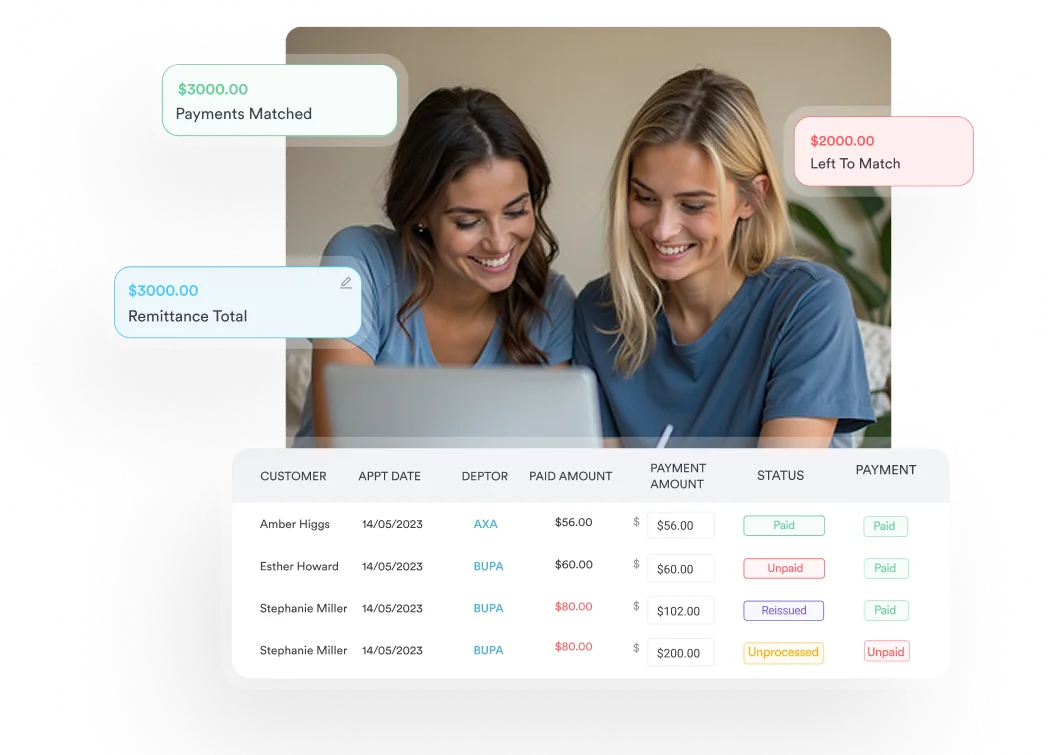

Pabau’s claims management submits your 93010 charges electronically through Claim.MD, validates the fields payers require, and posts remittances against the original claim. Your billing team tracks ECG claims in the same place that holds the note.

93010 is a narrow code with one job, and the discipline it asks for is procedural rather than clinical. Ask who recorded the tracing, confirm the report is signed and dated, then attach the diagnosis the order documents. Three checks, in that order, and ECG denials stop repeating.
The practices that stay clean here are the ones where those checks live in the workflow, not in someone’s memory. Book a demo to see how Pabau keeps ECG documentation and claim submission in one system.

Need to understand how claims move through a clearinghouse? Medical claims clearinghouse guide explains how 837 files are validated, how ERAs come back, and what happens when a claim is rejected.
Getting too many ECG claim denials? Denial codes in medical billing breaks down the most common CARC denial reasons and how to respond to each.
Want to check credentialing as part of your billing setup? How to get credentialed with insurance companies walks through the enrollment steps that affect your ability to bill codes like 93010.
Yes. The interpretation is a diagnostic service, separate from the evaluation and management visit, so both lines can go out for the same date. Where a payer asks for a modifier on that pair, it belongs on the E/M code rather than on 93010.
No. The descriptor requires at least 12 leads. A rhythm ECG of one to three leads has its own codes. Use 93040 for the tracing with interpretation and report. 93041 covers the tracing alone, and 93042 the interpretation only.
Usually yes, when the read sits inside their state scope of practice and they bill under their own NPI. The signed interpretation has to be their own work. Payer rules on non-physician practitioners differ, so confirm the policy before you submit.
One per tracing. A second interpretation on the same date needs a second tracing in the record, with its own clinical reason. CMS publishes a medically unlikely edit for 93010, so check the current MUE table before you send more than one unit.