HCPCS code J3471: Hyaluronidase ovine injection billing guide
HCPCS code J3471: Descriptor, code type, and quick-reference data HCPCS code J34...

Last Updated: Oct 14, 2026

CPT Code 93005 covers the technical component of a routine 12-lead ECG. It pays for the tracing only, with no physician interpretation or report.
Facilities bill 93005. A physician who only reads and reports the tracing bills 93010. Billing the global code 93000 on a facility encounter is a common and costly error.
Appending modifier TC to 93005 is a coding error rather than a requirement, because 93005 is already the technical-component code. Place-of-service and modifier mismatches are the top denial trigger.
Pabau’s claims management software runs validation checks in the background before a claim is sent, so details insurers need are in place first.
CPT Code 93005 is the billable code for the technical component of a routine electrocardiogram with at least 12 leads. The American Medical Association’s CPT code set defines it as “Electrocardiogram, routine ECG with at least 12 leads; tracing only, without interpretation and report.” That last clause is where the billing rules come from.
The code pays for the physical act of recording the ECG. Attaching the electrodes, running the tracing, and generating the waveform output all sit inside it. The physician’s reading of that output does not.
CMS Local Coverage Article A57326 governs Medicare billing and coding for electrocardiograms. It confirms 93005 is covered when the tracing is medically necessary, not as a blanket entitlement. Medical necessity has to be documented at the encounter level and tied to a covered clinical indication.
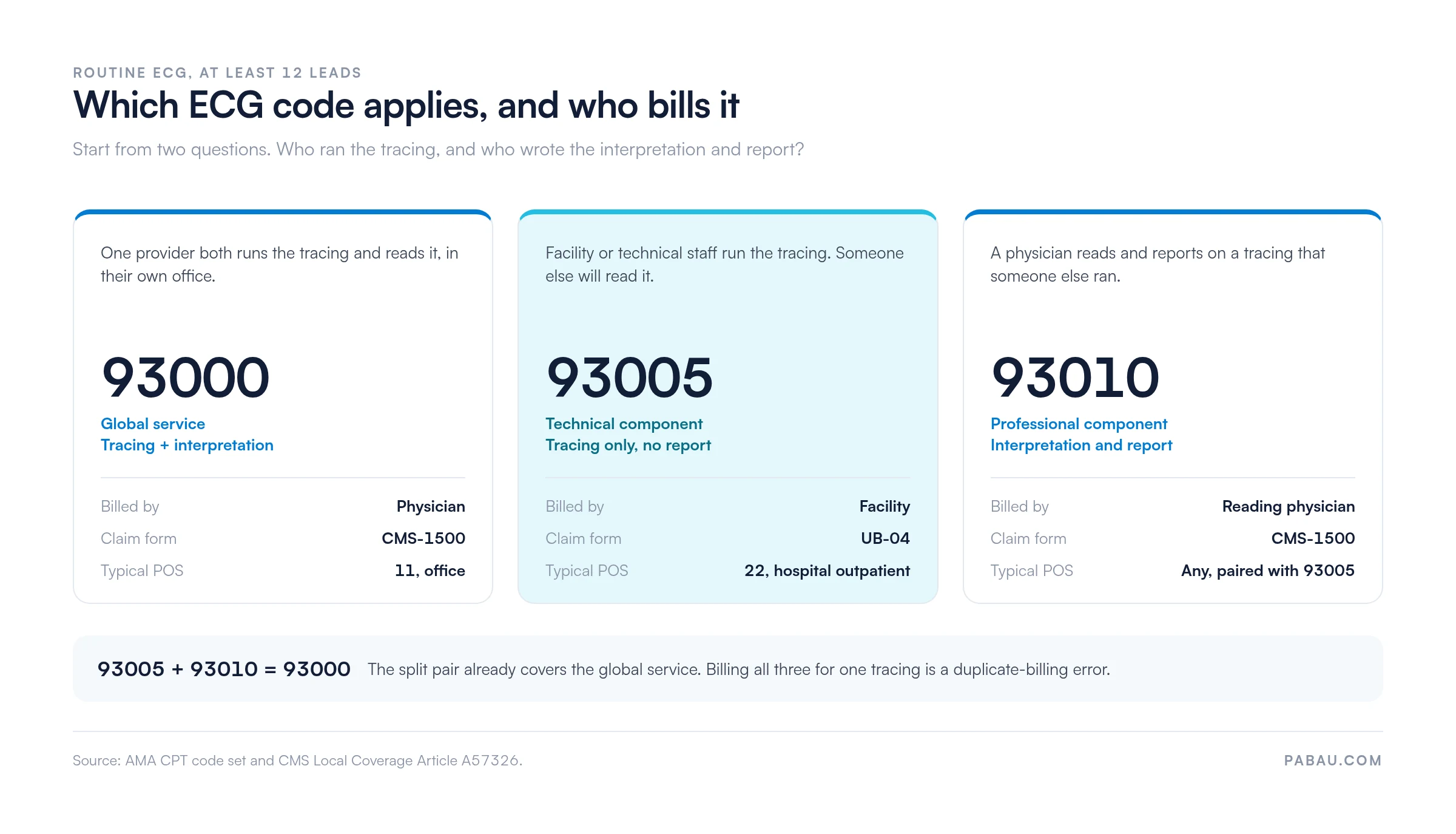
The three ECG codes form a split-component pair with a global rollup. Choosing the wrong one for the setting is the single most common ECG coding error. Here is what each covers and who bills it.
The AMA’s rule here is arithmetic. 93005 plus 93010 equals 93000, so the three are never billed together for one tracing. When a hospital outpatient facility runs the tracing and a cardiologist reads it, the facility bills 93005 on the institutional claim (UB-04).
The cardiologist bills 93010 on the professional claim (CMS-1500). Billing 93000 in that scenario claims payment for equipment and staff time the physician never provided.
Which code applies comes down to two questions about who did what, and the chart below settles both.
Bill 93005 when the facility or its technical staff performs the ECG recording and a separate provider will interpret it. The place-of-service (POS) code matters here more than almost any other variable on the claim.
Common clinical situations that support medical necessity for the 12-lead tracing, per CMS LCD A57326:
POS 22, on-campus hospital outpatient, is the most common setting for 93005. At POS 22 the facility is reimbursed through the Outpatient Prospective Payment System (OPPS) rather than the Physician Fee Schedule. A physician interpreting at that same encounter still bills 93010 on a separate professional claim.
Portable EKG suppliers still report 93005 for each tracing when the machine travels to a skilled nursing facility. The trip itself is R0076, which Medicare bundles into the EKG payment instead of paying it separately.
Modifier usage is the most nuanced part of 93005 billing. CMS and commercial payers apply different rules, so check every statement below against your payer contract. Three modifiers come up repeatedly.
The most common modifier mistake with CPT Code 93005 is appending modifier TC. Because 93005 is already defined as the technical-component-only code, adding TC creates a redundant claim that many payers reject outright. Modifier 26 does not belong on 93005 either.
That combination bills the professional component of a technical-only code, which is incoherent. When physician interpretation is separate, bill 93010 on its own.
Flag 93005 with modifier TC as a pre-submission edit rule in your claims scrubber. Because 93005 is already the TC-only code, the combination is almost always a coder error rather than an intentional split-billing scenario. Catching it before submission saves the rework cycle.
The ICD-10-CM diagnosis code has to support medical necessity for the ECG tracing. A code that does not align with a covered indication in CMS LCD A57326 is a denial waiting to happen. These are the diagnosis codes most frequently reported alongside 93005.
No ICD-10 code guarantees coverage. Medical necessity is a payer-by-payer determination. Code to the highest level of specificity your documentation supports. An unspecified code paired with thin chart notes is a reliable denial trigger.
Medicare reimbursement for CPT Code 93005 runs through the Medicare Physician Fee Schedule (MPFS) for professional claims and through OPPS for facility claims. Rates change annually with each MPFS update.
Verify the current figure against the CMS Physician Fee Schedule lookup tool before you use it. The approximate ranges below reflect 2026 estimates and should be confirmed before any financial projection.
The technical component pays modestly by design, because the cognitive work of interpretation sits in 93010 instead. Treat 93005 as a volume-dependent revenue line rather than a high-margin service. At that unit price, a rework cycle on a denied claim can cost more staff time than the claim is worth.
Missing a single documentation element is enough for a MAC to deny the claim on medical necessity grounds. This is the minimum the record has to contain, per CMS LCD A57326.
The separation between the tracing record and the interpretation report is what distinguishes a defensible split claim from a bundling error. Auditors look for a single document serving double duty. Two distinct entries hold up better, one from the technician and one from the interpreting physician.
Audit a sample of 93005 claims quarterly and check whether the interpretation report for the paired 93010 is filed as a separate document. If technicians and physicians are signing the same note, your documentation structure may not survive a payer audit. Separate records are non-negotiable.
Denials on CPT Code 93005 follow predictable patterns. Practices that track denial reason codes find the same four errors recurring. Here they are, with the fix for each.
The split-code trap deserves particular attention. Practices billing from an outpatient hospital or a multi-specialty group often have staff who learned to bill 93000 for office ECGs.
Coding a facility encounter, those same staff default to 93000 out of habit. The resulting claim says the physician both performed and interpreted the ECG, which may not have happened at all.
Read the remittance advice against a medical billing denial codes reference. That tells you whether 93000 and 93005 confusion is driving a pattern or is a one-off.
AAPC Codify also lists the NCCI bundling edit pairs, which flag codes that cannot be billed together without a modifier exception.
Reference tools give you the data. Getting from that data to a clean claim still needs someone to apply it correctly, on every encounter and at every location. A check that runs at submission, rather than a memo asking coders to be careful, is what actually holds at volume.
Practice management software like Pabau moves that check into the workflow. Pabau’s software for billing teams runs validation checks in the background every time a claim is sent. Those checks confirm the details insurers need are in place. Membership numbers and authorization codes are the two it catches most often, and both are cheap to fix before submission.
The submission itself is pre-filled from the patient record, so patient, treatment and insurer details are never retyped onto the claim. In the US, claims go to Claim.MD without leaving Pabau. Every claim then sits on one dashboard as Pending, Submitted, Processing, Paid or Error, filterable by date, insurer or invoice ID.
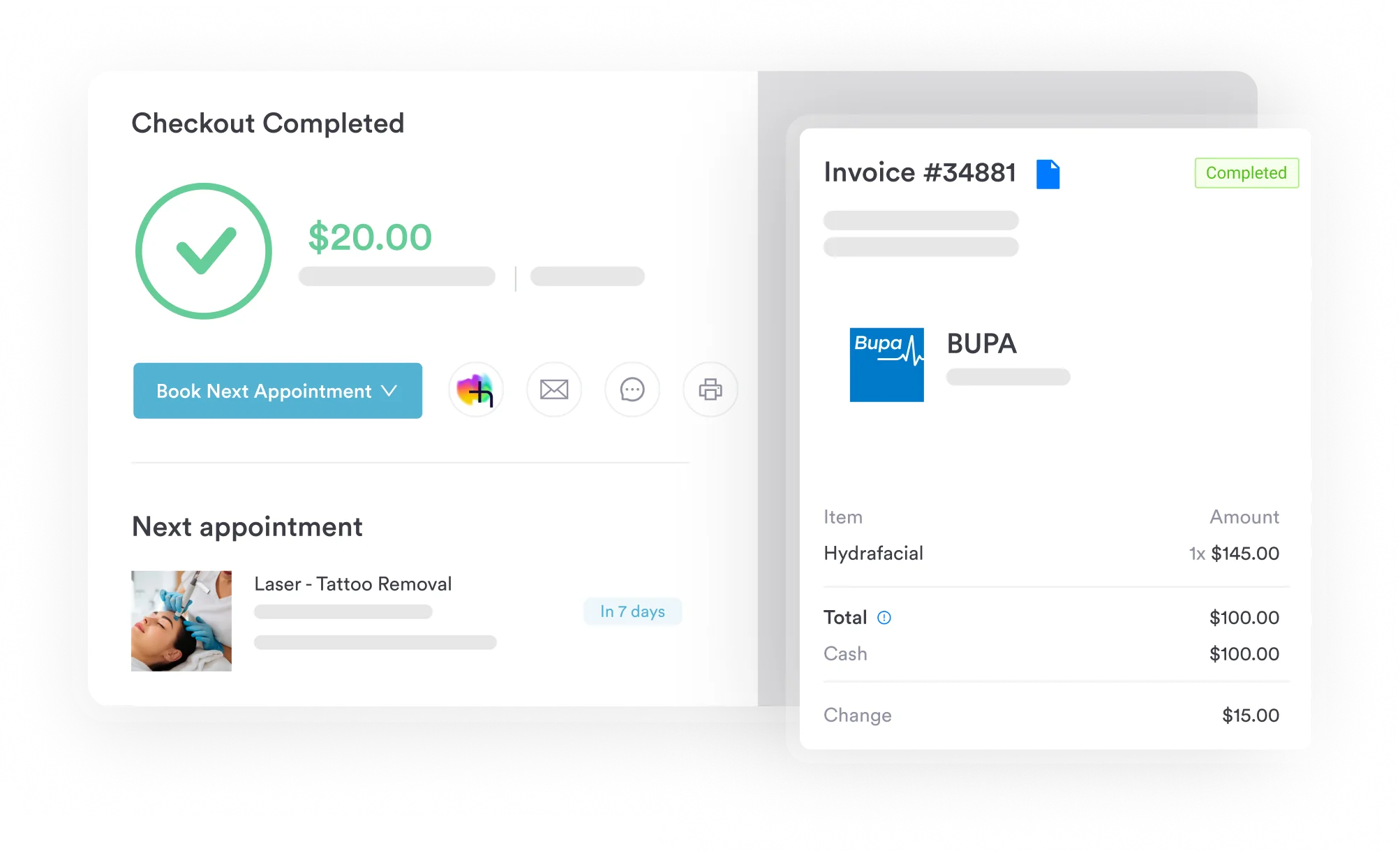
Practices running high ECG volume get the most out of that dashboard view. Cardiology groups and multi-location primary care networks can filter by insurer or date and see whether 93005 rejections cluster at one site. A claim-by-claim review would never surface that pattern.

Pabau runs validation checks in the background every time you send a claim, confirming the details insurers need are in place first. See how the claims dashboard works for cardiology and primary care billing teams.

CPT Code 93005 is narrow by design. The tracing-only scope, the split-claim structure with 93010, the POS rules and the modifier restrictions leave almost nothing to interpretation. That same precision is why the code is denial-prone. Nearly every failure traces back to a coder applying office-visit habits to a facility encounter.
The durable fix is procedural. Settle who ran the tracing and who wrote the report before anyone picks a code, and the modifier questions answer themselves.
At roughly $7 to $10 a tracing, the rework on a denied claim costs more than the claim. So the check has to happen before submission. Book a demo to see how Pabau validates claim details before they reach the payer.

Coding an arrhythmia as the indication? ICD-10 Code I49.9 explains when unspecified cardiac arrhythmia holds up and when a more specific code is expected.
Want to see how ECG denials fit the wider revenue picture? What is revenue cycle management covers the financial workflow from eligibility through payment posting.
Looking for a framework to cut claim rejections? Clean claim requirements breaks down every element a claim must satisfy before a payer will process it without manual review.
Handling denials after submission? Denial management in healthcare walks through how to categorize, appeal, and prevent recurring denial patterns across a practice.
CPT Code 93005 bills the technical component of a routine 12-lead electrocardiogram, meaning the tracing only, without interpretation or report. Facilities or technical staff bill it when a separate provider will interpret the ECG. It does not include the physician’s reading of the tracing, which is billed under CPT Code 93010.
CPT 93000 is the global ECG code, covering both the tracing and the interpretation. A physician who performs and reads the ECG in a non-facility setting bills it. CPT 93005 covers only the technical component, the tracing, and is typically billed by the facility. CPT 93010 covers only the professional component, the interpretation and report, billed by the physician who reads the tracing. Together 93005 and 93010 equal 93000, so all three are never billed together.
The facility bills CPT 93005 on the institutional claim (UB-04) when technical staff perform the tracing. The physician who separately reads and interprets the ECG bills CPT 93010 on the professional claim (CMS-1500). A physician who both performs and interprets an ECG in their own office uses CPT 93000 instead.
Modifier TC should not be appended to 93005, because 93005 is already the technical-component-only code and the combination is redundant. Modifier 26 is also incorrect on 93005, so use CPT 93010 when billing interpretation only. Modifier 59 may apply where 93005 is clinically distinct from another procedure billed on the same date. That use requires clear documentation of the separate rationale.
Medicare reimburses CPT Code 93005 at roughly $7 to $10 nationally for the technical component under the Physician Fee Schedule, before geographic adjustment. Facility claims are reimbursed under OPPS at the applicable APC rate. Rates change annually, so verify the current figure with the CMS Physician Fee Schedule lookup tool before any financial modeling.
Yes, 93005 and 93010 can be billed together when different providers perform and interpret the ECG. The facility bills 93005 on the institutional claim and the interpreting physician bills 93010 on the professional claim. Do not also bill CPT 93000, because 93005 plus 93010 already equals the global service. Billing all three is a duplicate billing error.
Technical component ECG billing applies when the facility or its technical staff perform the 12-lead tracing without the interpreting physician present. The facility submits 93005 on the UB-04 and the physician submits 93010 on the CMS-1500. This split-claim structure is standard in hospital outpatient departments and in multi-specialty groups where cardiologists read ECGs performed by practice technicians.