



CCSD code G5100: Bypass of duodenum billing guide
CCSD code G5100 bills a bypass that leaves the duodenum in place CCSD code G5100...

Last Updated: Oct 16, 2026

CPT code 92134 reports computerized ophthalmic diagnostic imaging of the posterior segment, retina, with interpretation and report. In everyday billing it is the OCT code for the retina.
Bill 92134 once per encounter, not once per eye. The descriptor reads unilateral or bilateral, and the fee schedule assigns bilateral surgery indicator 2. Appending -50, or splitting the visit into -RT and -LT lines, is duplicate billing.
CPT 92132 is the anterior segment code, and CPT 92133 covers the posterior segment optic nerve. NCCI pairs 92133 with 92134 at modifier indicator 0, so they are never separately payable at one encounter.
Medicare pays about $31.38 nationally for 92134 in 2025, on 0.98 total RVUs. The facility rate lands close to the office rate, and the technical and professional halves run near $19 and $13.
Coverage comes from your MAC’s Local Coverage Determination rather than a national policy. The leading denial is a missing physician interpretation and report, so that document has to be signed before you bill.
Practice management software like Pabau pre-fills CPT and ICD-10 codes from the patient record. Eligibility checks before the visit confirm active coverage, so fewer scans happen against a lapsed policy.
CPT code 92134 reports computerized ophthalmic diagnostic imaging of the posterior segment, retina, with interpretation and report. In everyday billing, it is the OCT code for the retina. One rule decides most 92134 claims. You bill the code once per encounter, whether you image one eye or both.
Practices that split the visit into -RT and -LT lines lose that payment on audit, often months after it arrived. Coverage adds a second trap, because the rules come from your Medicare Administrative Contractor rather than a national policy.
The sections below work through coverage, 2025 payment, modifiers, documentation, and the five denials that hit hardest.
According to the American Medical Association’s CPT code set, 92134 sits in the computerized ophthalmic diagnostic imaging family.
Its descriptor reads: Computerized ophthalmic diagnostic imaging (e.g., optical coherence tomography [OCT]), posterior segment, with interpretation and report, unilateral or bilateral; retina.
CPT 2025 dropped the word “scanning” from this family, so older references to SCODI describe the same service.
The scan captures cross-sectional images of the posterior segment using low-coherence light. Ophthalmologists and optometrists read those images to track age-related macular degeneration (AMD), diabetic macular edema, macular holes, and retinal vein occlusions.
One code covers the scan and the physician’s reading together. Modifiers -TC and -26 split the two halves when separate entities bill them.
Key distinctions:
The most common error in this family is treating 92133 as the anterior segment code. It is not.
CPT 92132 covers the anterior segment, while 92133 and 92134 both sit in the posterior segment and differ only in what they target. That distinction drives every bundling decision below.
Because 92133 and 92134 image the same segment, NCCI treats them as a mutually exclusive pair with modifier indicator 0. No modifier releases that edit.
Pick the single code that matches the scan performed and its documented purpose. CPT 2025 goes further and bars reporting 92133, 92134, and 92137 together at one encounter.
Medicare has no national coverage determination for 92134. Each Medicare Administrative Contractor (MAC) publishes its own Local Coverage Determination for its jurisdiction.
That LCD sets the covered indications, the non-covered ones, frequency limits, and documentation standards. Two practices in different states can follow different rules for the same scan.
To find yours, open the CMS Medicare Coverage Database and filter by Local Coverage Determinations. Then pick your jurisdiction, which will be Noridian, Novitas, CGS, WPS, Palmetto, First Coast, or NGS. SCODI policies sit anywhere in the L33xxx to L35xxx range depending on the contractor, so search by code rather than by policy number.
Coverage starts at the order. Confirm that each OCT order rests on a retinal diagnosis the applicable LCD actually covers. Ordering the scan for a non-covered indication, then billing 92134, is the shortest route to a medical necessity denial.
Commonly covered indications, which vary by MAC:
Optic nerve head and retinal nerve fiber layer scans belong to 92133, not 92134. Where a glaucoma workup images the optic nerve and the macula, report only the code matching the scan you are billing.
Commonly non-covered indications:
Every 92134 claim needs at least one covered ICD-10-CM diagnosis behind it. Parent codes will not do the job. H35.31 and H35.32 are category headers, so a claim carrying either one rejects before a human reads it. Bill the full code, with laterality and, where the category demands it, a stage.
The table below lists codes that appear on most MAC LCDs. Coverage lists still vary by payer and change periodically, so verify against your own LCD before billing.
The AAPC’s CPT code reference is a useful cross-check when you pair a procedure code with a diagnosis.
The list is illustrative, not exhaustive. Your MAC’s LCD is the authority for covered diagnoses in your jurisdiction.
Check the diagnosis on the order against that list before the patient is scanned, because you cannot repair the code after the claim denies.
Medicare pays about $31.38 for 92134 in 2025, built on 0.98 total RVUs. That is the global amount, covering the scan and the interpretation together. Geographic Practice Cost Index adjustment then moves it a few dollars either way depending on your locality.
Unlike most imaging codes, 92134 pays roughly the same in a facility as in an office, because its practice expense component is small.
Split the code and the two halves add back up to about the global amount. Confirm the current figure with the CMS Physician Fee Schedule lookup tool, since amounts reset every January 1.
At roughly $31 a scan, the economics of 92134 sit in volume and in clean submission. A single denial and rework cycle can cost more staff time than the claim returns.
Payment for CPT code 92134 shifts every year with the CMS Physician Fee Schedule conversion factor. Run a fee schedule audit each December using the CMS lookup tool. Update your practice management system before January 1, so you never bill at last year’s rates.
Modifier choice on this code is short work. -TC and -26 split the service when two entities bill it. -RT and -LT record which eye was imaged, where your MAC asks for that detail. Modifier -50 does not belong on 92134 at all.
Important note on bilateral billing: 92134 is billed once per encounter, whether you image one eye or both. The descriptor already reads unilateral or bilateral, and the fee schedule assigns bilateral surgery indicator 2. Payment is identical for one eye and for two.
Appending -50, or splitting the encounter into separate -RT and -LT lines, bills the same service twice. Those claims deny. The ones that slip through get recouped on audit, usually long after the money was posted.
No universal frequency rule applies to 92134. Each MAC LCD sets its own limits by clinical indication and disease activity.
As a rough reference point, many LCDs allow OCT imaging up to four times a year for an established condition under treatment. Your jurisdiction’s number may differ, so read the policy before you bill a repeat scan.
A few practical rules hold across most payers:
The National Correct Coding Initiative decides which codes can be billed together on one date of service. For 92134, the relationships that matter sit inside the ophthalmic imaging family and around the same-day eye exam.
NCCI edits update quarterly, so check a pair’s current status before you submit. Each pair carries a modifier indicator.
An indicator of 1 allows an override with supporting documentation, and an indicator of 0 allows none. Where a comprehensive exam happens at the same visit, 92014 needs its own medical decision making documented.
Weak documentation is the most common audit trigger on 92134, and the most preventable one. The record has to support medical necessity at the time of service.
Nothing gets reconstructed after a denial arrives, so the work happens at the encounter or it does not happen.
Required documentation elements:
Capture and link these at the point of care. Chasing a missing signature four weeks after submission costs more staff time than the claim is worth.
Those OCT findings carry into the operative note when macular edema is later treated with focal laser under 67210. One documented scan then supports medical necessity for the imaging claim and the treatment claim.
A 92134 claim passes five checkpoints, and each one can stop it. The order carries the diagnosis. The scan happens. The physician writes and signs the interpretation. A coder picks the single posterior segment code. Billing sends one line to the payer.
Downstream steps cannot repair an upstream failure. A coder cannot invent a covered diagnosis, and an appeal cannot produce a signature nobody wrote. The chart below maps each checkpoint to the denial that lands when it fails.
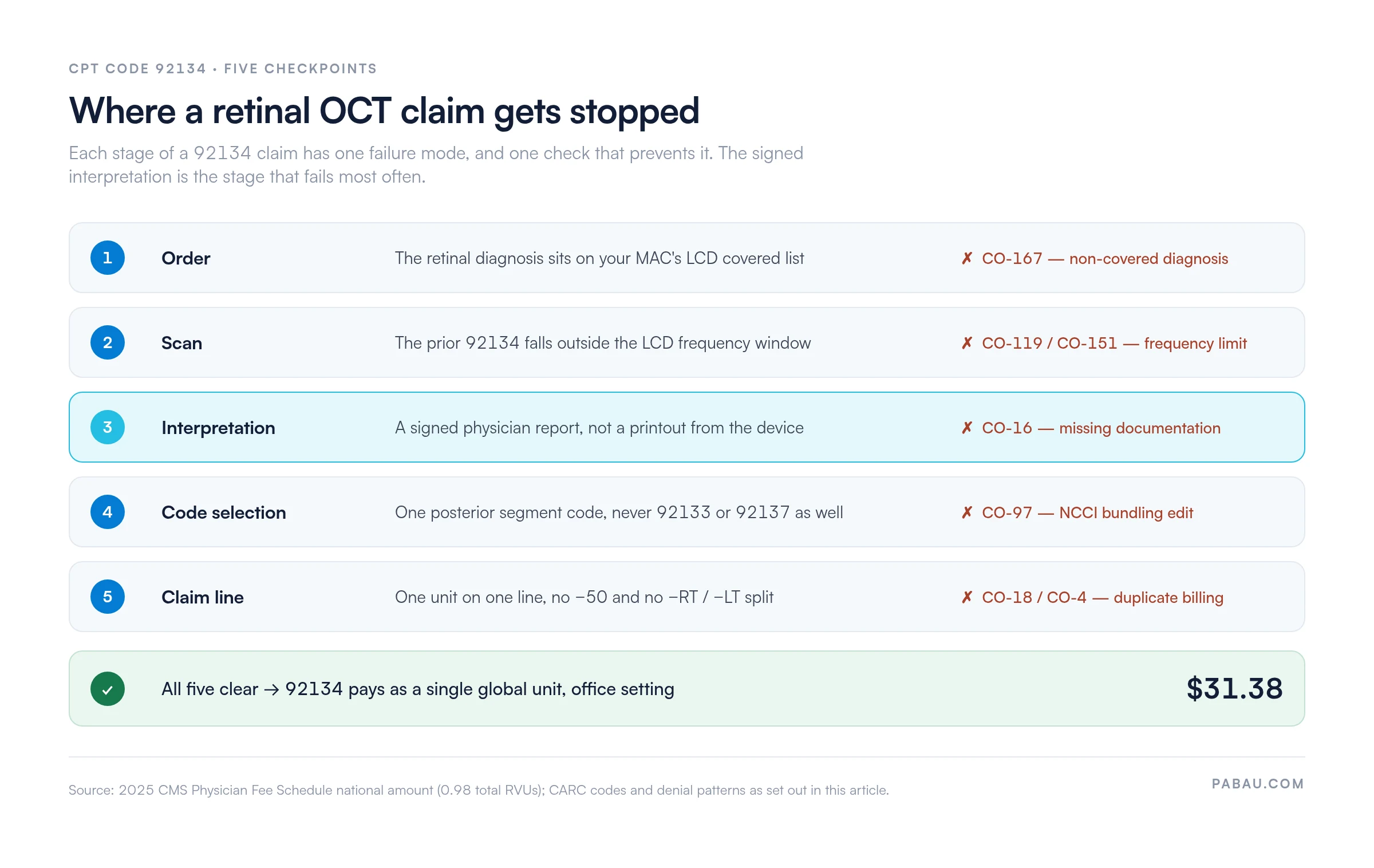
Read it top down before your next OCT-heavy clinic. The stage that fails most often is the third one, and it is also the cheapest to fix.
Denials on this code cluster tightly. The common denial codes that come back on ophthalmology claims fall into five patterns, and each one has a clear prevention step.
Track your denial rate by category, then run a root-cause review every month. A practice denying more than 5% of its 92134 claims should pull the last 30 rejections and sort them into these five buckets. The pattern usually points at one broken step, not five.
Sixty seconds at the claim line beats a four to six week denial cycle. Before a 92134 claim goes out, confirm all six:
Five of the six take a glance at the chart. The last one is where people slip under pressure, because a bilateral scan feels like it should pay twice.
High OCT volume turns 92134 billing into repetition. Coders re-key the same handful of diagnosis codes, and somebody checks by hand that the interpretation was signed. Practice management software like Pabau removes the re-keying and catches the blanks before a claim leaves the practice.
Practices running high OCT volume lean on software that pre-fills claims from the encounter itself. The CPT and ICD-10 codes come off the patient record, so the diagnosis on the claim matches the one on the order. Built-in code libraries let a coder search by description instead of memory.
Required-field validation is the part that pays for itself here. A claim missing the signed interpretation, the covered diagnosis, or the laterality note gets held back rather than sent. Eligibility checks before the appointment confirm the patient’s coverage is active, so fewer scans happen against a lapsed policy.
The result is a shorter feedback loop. Errors surface at the desk while the patient record is still open, not four weeks later in a remittance file.

Pabau helps ophthalmology and optometry practices pair CPT codes with covered ICD-10 diagnoses and track claim outcomes in one platform.

Most of the money lost on 92134 goes to three mistakes. The diagnosis is not on the LCD, the interpretation is unsigned, or a bilateral scan gets billed as two lines. All three are caught at the desk, before the claim exists.
Fix them upstream and retinal OCT stops being interesting on the billing side, which is the point. Fix them downstream and you appeal $31 claims one at a time, which costs more in staff hours than the claims return.
If your denial rate on 92134 sits above 5%, add a pre-submission check that runs on every claim. Reviewing only the ones somebody remembers to check is how the pattern survives.
Book a demo to see how Pabau pre-fills the codes and holds back an OCT claim that is missing its interpretation.

Wondering what happens to the claim after you hit submit? What is a medical claims clearinghouse? traces an electronic claim from the practice to the payer and back.
Need to confirm Medicare coverage before the scan? Insurance eligibility verification walks through checking active coverage before the patient arrives.
Not sure what a payer counts as a clean claim? What is a clean claim in medical billing? lists the fields that have to be right first time.
Want to track denial patterns across your OCT volume? What is revenue cycle management? shows how to build denial tracking into the practice’s financial workflow.
Preparing for a Medicare audit on imaging claims? Medical billing compliance sets out the documentation standards reviewers look for.
Yes, where state scope of practice allows it and the optometrist is enrolled with the payer. The billing rules do not change by provider type. The same LCD covered-diagnosis list, the same interpretation and report requirement, and the same once-per-encounter rule all apply.
A trained ophthalmic technician can capture the images. The interpretation and report must come from the billing physician or optometrist, and it has to be signed. A printout from the OCT device is not an interpretation, and billing on one invites a refund request.
92250 is fundus photography, a color image of the retinal surface. 92134 is a cross-sectional scan that shows retinal layers and thickness. They answer different clinical questions, so both can be billed on one date when each carries its own documented indication.
Medicare Advantage plans cover what Original Medicare covers, so 92134 is a covered benefit. Plans can still add prior authorization, their own frequency caps, and network rules. Read the plan’s medical policy before scanning, because a covered diagnosis is not automatic approval.



