

CCSD code G5100: Bypass of duodenum billing guide
CCSD code G5100 bills a bypass that leaves the duodenum in place CCSD code G5100...

Last Updated: Oct 16, 2026
92132 is the CPT code for computerized ophthalmic diagnostic imaging (eg, optical coherence tomography [OCT]), anterior segment, with interpretation and report, unilateral or bilateral. It covers imaging of the cornea, anterior chamber, iris, ciliary body, and angle.
Payment is bilateral, so the code is reported once per date of service, with no -50, RT, or LT modifier. Most denials trace back to an unsupported ICD-10 pairing, a missing physician interpretation, or same-day billing with 92133 or 92134.
Let Pabau's smart automation suggest the right codes, reduce claim denials, and keep your practice compliant—effortlessly.
Automate repetitive tasks and focus on what matters most—your patients.
Reduce coding errors and ensure compliance with the latest regulations.
Clean claims, fewer denials, and faster reimbursements.
Powerful insights and reporting to help your practice thrive.
HIPAA compliant SOC 2 certified GDPR-compliant Trusted by 4,000+ clinics worldwide

CPT 92132 covers imaging of the cornea, anterior chamber, angle, and iris, while 92133 and 92134 cover the optic nerve and retina.
Payment is bilateral, so report one unit per date of service with no -50, RT, or LT modifier, whether you image one eye or both.
Only one of 92132, 92133, and 92134 is payable on the same date, so bill the scan that answers the clinical question.
Medicare coverage depends on your MAC’s own LCD, such as First Coast’s L33751, plus a covered diagnosis and a written interpretation.
Pabau’s claims management software checks each claim before it’s sent and tracks it to payment through the Claim.MD clearinghouse.
CPT code 92132 describes computerized ophthalmic diagnostic imaging (eg, optical coherence tomography [OCT]) of the anterior segment, with interpretation and report, unilateral or bilateral.
The American Medical Association maintains it in the Ophthalmology subsection of the CPT code set. The AMA dropped the word “scanning” from the descriptor in January 2025, so older references still show the previous wording.
The code applies when a clinician captures cross-sectional images of the cornea, anterior chamber, iris, ciliary body, or angle structures. The scan is non-invasive and needs no pupil dilation.
Supervision rules don’t apply to 92132, so the physician doesn’t need to be present while a technician captures the images. What the physician must do is write a separate interpretation and report.
Imaging the retina, macula, or vitreous falls under 92134 instead. Optic nerve head and retinal nerve fiber layer imaging is reported with 92133.
One date of service equals one unit of 92132, however many images you take. Payment is bilateral, so a scan of both eyes is still one unit with no -50, RT, or LT modifier.
Payers deny CPT 92132 claims more often for documentation problems than for coverage reasons. The five checks below follow a claim from the order to the remittance, and each one blocks a specific denial.
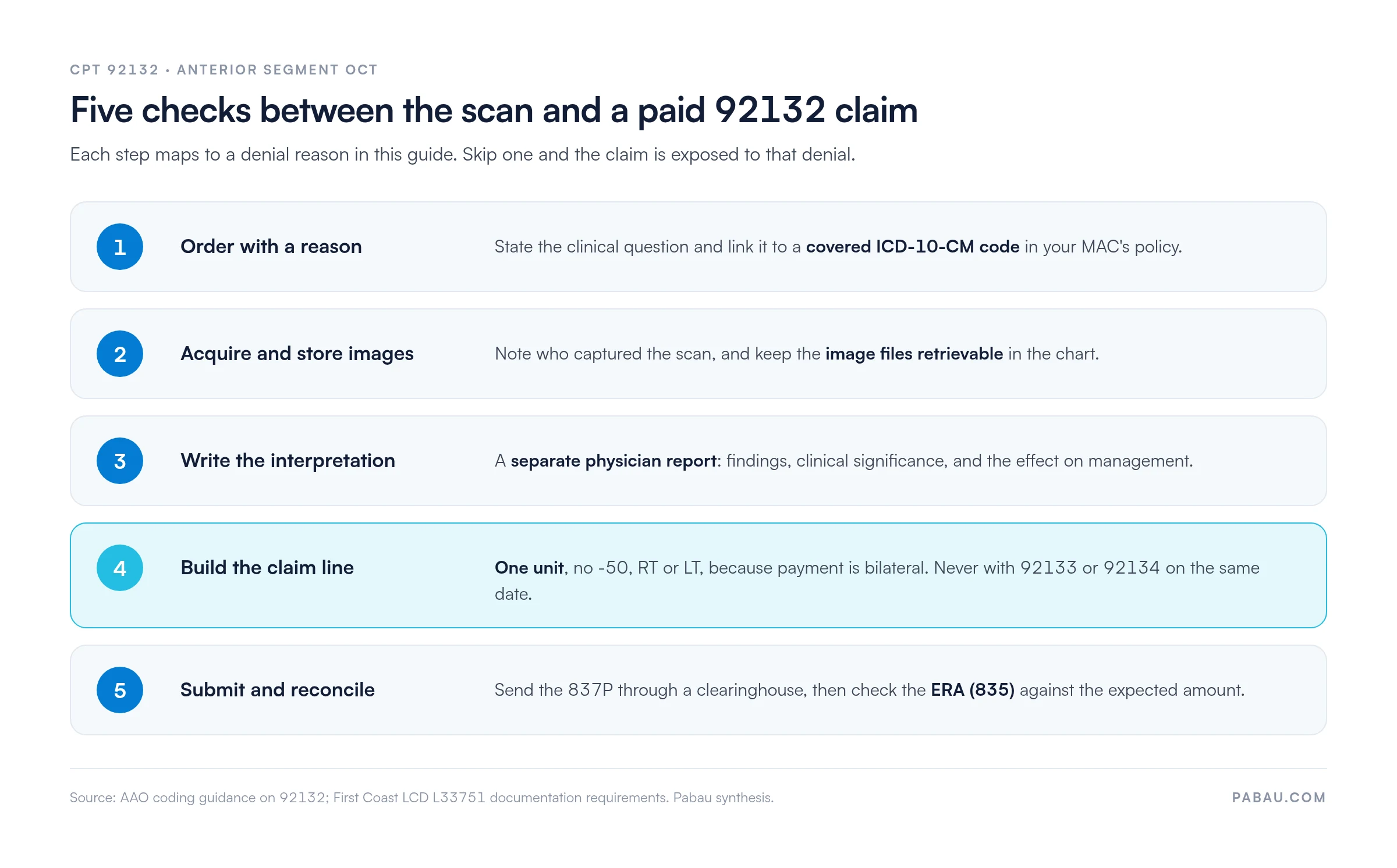
First Coast’s LCD L33751 expects the medical record to show all of the following before submitting a clean claim:
Write down the clinical question the OCT was ordered to answer. Payer reviewers look for a diagnostic purpose tied to the imaging date. ‘Anterior segment OCT performed; corneal thickness normal’ fails review. ‘Anterior segment OCT ordered to evaluate angle status in ocular hypertension, H40.053; open angle confirmed, no plateau iris; observation plan unchanged’ passes.
The three SCODI codes map to three anatomical zones. Picking the wrong one is a common ophthalmology imaging error, and billing two of them on one date triggers an NCCI denial.
NCCI edits stop any two of these codes from being paid on the same date of service. AAO coding guidance says 92132 can’t be billed the same day as 92133 or 92134, so don’t plan on a modifier to unbundle the pair. When a patient needs both anterior and posterior imaging, bill the scan that answers the visit’s clinical question.
Medicare covers CPT 92132 through local coverage determinations (LCDs), and each Medicare Administrative Contractor (MAC) publishes its own.
LCD L33751 is First Coast Service Options’ policy for Jurisdiction N, which covers Florida, Puerto Rico, and the US Virgin Islands. Other MACs run their own SCODI LCDs under different numbers, so check the version for your jurisdiction.
Commercial payers, including Blue Cross Blue Shield plans, often adopt similar criteria, though the wording varies by state and plan. Prior authorization isn’t universal, but high-frequency billing patterns increasingly trigger it. Check each payer’s medical policy before assuming it matches your MAC’s LCD.
Pairing CPT 92132 with an unsupported ICD-10 diagnosis is the most common cause of medical necessity denials. The codes below are glaucoma and anterior segment diagnoses that SCODI LCDs commonly list. Covered lists are revised periodically, so check your MAC’s current LCD for the complete set.
Avoid “unspecified” codes whenever the record supports a more specific diagnosis. Unspecified glaucoma codes such as H40.9 draw more medical necessity review than staged, laterality-specific codes. The AAPC Codify CPT lookup offers CPT-to-ICD-10 crosswalk guidance for matching diagnoses to each SCODI code.
Medicare reimburses CPT 92132 under the Medicare Physician Fee Schedule (MPFS). Rates vary by geographic practice cost index (GPCI) and by whether the service happens in a facility or non-facility setting.
Non-facility rates are higher because the practice carries the overhead. Facility rates apply in a hospital outpatient department or ambulatory surgery center.
Use the CMS Physician Fee Schedule lookup tool to find the current payment rate for your locality. Enter code 92132 and your ZIP code to see the non-facility and facility amounts. Rates change with each January MPFS update, so a dollar figure in a third-party article may be out of date.
For 2026 RVU values and the work, practice expense, and malpractice breakdown, the FastRVU 2026 lookup tool carries current MPFS data.
Private payer rates are contractual and are often negotiated at or above Medicare rates for high-volume ophthalmology practices. Compare each remittance with your contracted rate, because a 92132 line paid short is easy to miss.
Most CPT 92132 denials fall into five categories, each with a specific fix. Denial management workflows that track reason codes by CPT code show a pattern before it repeats across months of remittances.
The denial codes reference explains the CARC codes these rejections carry, such as CO-97 for a bundled service.
Set a charge-entry rule that posts 92132 as one unit with no eye modifier, whichever eyes were scanned. Catching a stray -50 or a second unit before submission costs nothing. Recovering the claim through an appeal takes weeks and can still end in partial payment.
Same-day billing with exam codes and other diagnostic tests is common in ophthalmology, but each pair has its own NCCI status. Check the current quarterly NCCI tables before billing any combination.
CPT 92014 covers a comprehensive ophthalmological service for an established patient. NCCI doesn’t automatically bundle 92132 into 92014, so both can usually be billed on the same date when each is documented on its own. The scan needs its own order and medical necessity note. An exam note that just says “OCT performed,” with no separate interpretation, won’t support the claim.
Visual field testing (92083) and anterior segment OCT are often ordered together in glaucoma workups. NCCI doesn’t bundle them, and both are payable on the same date when each meets its own medical necessity criteria.
Fundus photography images the posterior pole, while 92132 images the anterior segment. The two are anatomically distinct and aren’t bundled by NCCI.
Each needs its own clinical indication documented in the encounter. After submission, review the electronic remittance advice line by line to confirm both codes paid at the expected rate.
In many eye practices, the 92132 claim is still built by hand from the exam note. A biller re-keys the code and picks the modifiers. A missing interpretation only surfaces when the denial arrives weeks later.
Pabau, the practice management platform we build, keeps the order, the interpretation, and the charge in one patient record. Its claims software for ophthalmologists runs validation checks every time you send a claim. The claim stays unsent until required details, such as membership numbers and authorization codes, are in place.
US claims go out through the Claim.MD clearinghouse to thousands of payers. You can check a patient’s coverage in real time before the scan, then follow each claim from submission to payment or denial. Remittance comes back into Pabau tied to the claim it settles, so a short-paid 92132 line stands out without manual reconciliation.
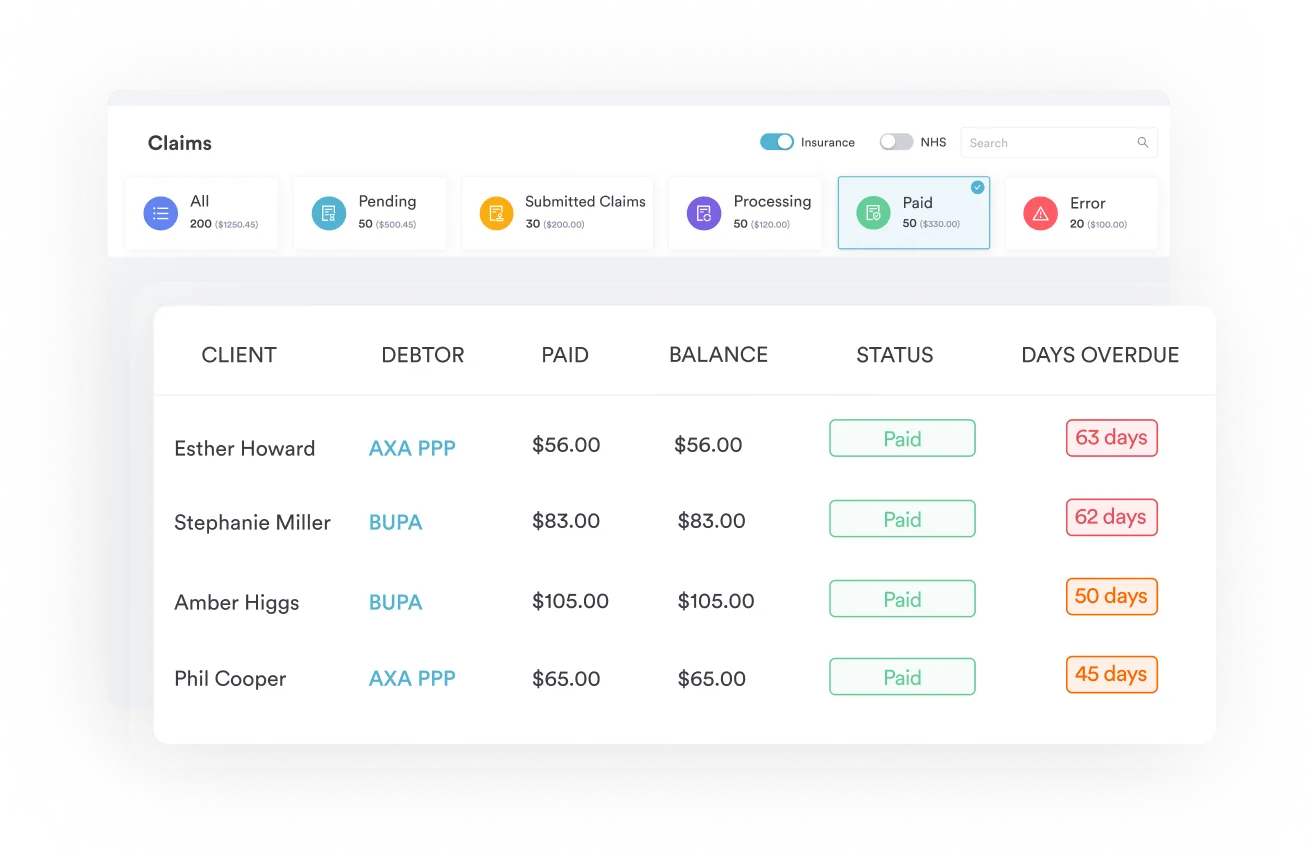

Pabau checks each claim before it’s sent, submits it through the Claim.MD clearinghouse, and matches remittance back to the claim. See how it fits your eye practice’s billing.

Anterior segment OCT pays a modest fee, so a denied 92132 claim can cost more to appeal than it’s worth. Prevention is the only approach that adds up.
Three habits prevent most denials. Pair the scan with a diagnosis your MAC’s LCD covers, and write the interpretation before anyone builds the claim. Then bill one unit with no eye modifier. If your team still adds -50 to bilateral scans, fix the charge template first, because that error repeats on every claim.
Those checks work best when they don’t depend on someone’s memory at the end of a long clinic day. Book a demo to see how Pabau keeps the order, interpretation, and claim for each scan in one record.

Need to understand how claims flow from encounter to payment? Revenue cycle management fundamentals covers the end-to-end process from charge capture through ERA posting.
Submitting 837P claims electronically for the first time? 837 file format guide explains the transaction set structure and how clearinghouses validate CPT and ICD-10 codes before payer submission.
Want to verify payer eligibility before the patient arrives? Insurance eligibility verification explains real-time eligibility checks and how they prevent coverage-based denials.
Is the visit a glaucoma screening rather than a diagnostic scan? HCPCS code G0118 explains how Medicare bills glaucoma screening for high-risk patients.
CPT code 92132 is the billing code for computerized ophthalmic diagnostic imaging of the anterior segment, with interpretation and report, unilateral or bilateral. It covers OCT imaging of the cornea, anterior chamber, iris, ciliary body, and angle. Practices use it in glaucoma workups, corneal disease, and narrow-angle assessment. Retinal and optic nerve imaging use 92134 and 92133 instead.
Medicare rates for CPT 92132 vary by locality and are updated each year under the Medicare Physician Fee Schedule. Use the CMS fee schedule search tool at cms.gov to look up the current non-facility and facility rates for your area. A dollar figure in a third-party resource may reflect an earlier payment year.
CPT 92132 images the anterior segment, meaning the cornea, chamber, and angle. 92133 images the optic nerve head and retinal nerve fiber layer, and 92134 images the retina and macula. NCCI edits block payment for any two of the three on the same date of service.
No. Payment for 92132 is bilateral, so one unit covers one eye or both. AAO coding guidance says modifier -50 and the RT and LT eye modifiers are inappropriate on this code. Report one unit per date of service, and check your MAC for any local billing instructions.
The most common reason is a diagnosis that your MAC’s LCD doesn’t cover. Next come a missing physician interpretation and same-day billing with 92133 or 92134. Bilateral scans billed as two units or with -50 also get denied, as do claims over a payer’s frequency limit. Each has a corrective action before or after submission.
Yes, as long as the claim carries a diagnosis your MAC’s LCD covers and a documented physician interpretation. Examples include H40.059 for ocular hypertension, or H40.051 to H40.053 when the eye is known, and H40.009 for preglaucoma. First Coast’s LCD L33751 is one of these policies, and other MACs publish their own. Laterality-specific codes carry less medical necessity review risk than unspecified ones.



