

CCSD code G5100: Bypass of duodenum billing guide
CCSD code G5100 bills a bypass that leaves the duodenum in place CCSD code G5100...

Last Updated: Oct 16, 2026
67210 is the CPT code for destruction of localized lesion of retina (eg, macular edema, tumors), 1 or more sessions; photocoagulation. It covers focal or grid laser applied to a discrete lesion, billed once per treatment episode however many sessions it takes.
Coders most often confuse it with CPT 67228, which describes panretinal (scatter) photocoagulation across the retinal periphery. Mixing up the two is a common coding error on retinal laser claims. Medicare pays 67210 under the Physician Fee Schedule with a 90-day global period.
Let Pabau's smart automation suggest the right codes, reduce claim denials, and keep your practice compliant—effortlessly.
Automate repetitive tasks and focus on what matters most—your patients.
Reduce coding errors and ensure compliance with the latest regulations.
Clean claims, fewer denials, and faster reimbursements.
Powerful insights and reporting to help your practice thrive.
HIPAA compliant SOC 2 certified GDPR-compliant Trusted by 4,000+ clinics worldwide

CPT 67210 covers focal or grid laser destruction of a localized retinal lesion, not panretinal scatter laser (67228).
Medicare contractors generally expect an RT or LT modifier on 67210, and a missing modifier commonly causes a denial. Confirm your MAC’s policy.
The code carries a 90-day global surgical period, so related services in that window need a modifier or they are denied.
The ICD-10-CM code must carry the correct laterality character and match the RT or LT modifier on the claim.
Practice software such as Pabau lets you submit and track 67210 claims electronically through Claim.MD.
CPT Code 67210 is a surgical procedure code in the Retina or Choroid subsection (67101-67229) of the AMA CPT code set. The official descriptor reads: Destruction of localized lesion of retina (e.g., macular edema, tumors), one or more sessions; photocoagulation.
“One or more sessions” means multiple laser treatment sessions on the same eye for the same lesion are bundled under a single code. In short, bill 67210 once per treatment episode, not once per session.
Focal laser photocoagulation for CPT Code 67210 directs a laser beam at a discrete, localized retinal lesion to seal abnormal vessels or reduce edema. First, the surgeon finds the target lesion using indirect ophthalmoscopy or slit-lamp biomicroscopy. Laser burns then go in a focal or grid pattern directly to or around the lesion.
Common clinical indications for this code include:
The operative report must document the procedure as focal or grid laser to a localized area. Indeed, a note that says only “laser treatment,” with no pattern or anatomical target, is a frequent documentation deficiency on audit.
Knowing what 67210 includes, and what it excludes, prevents the most avoidable retinal laser denials. In addition, retinal laser billing carries specific bundling rules that differ from general surgical coding.
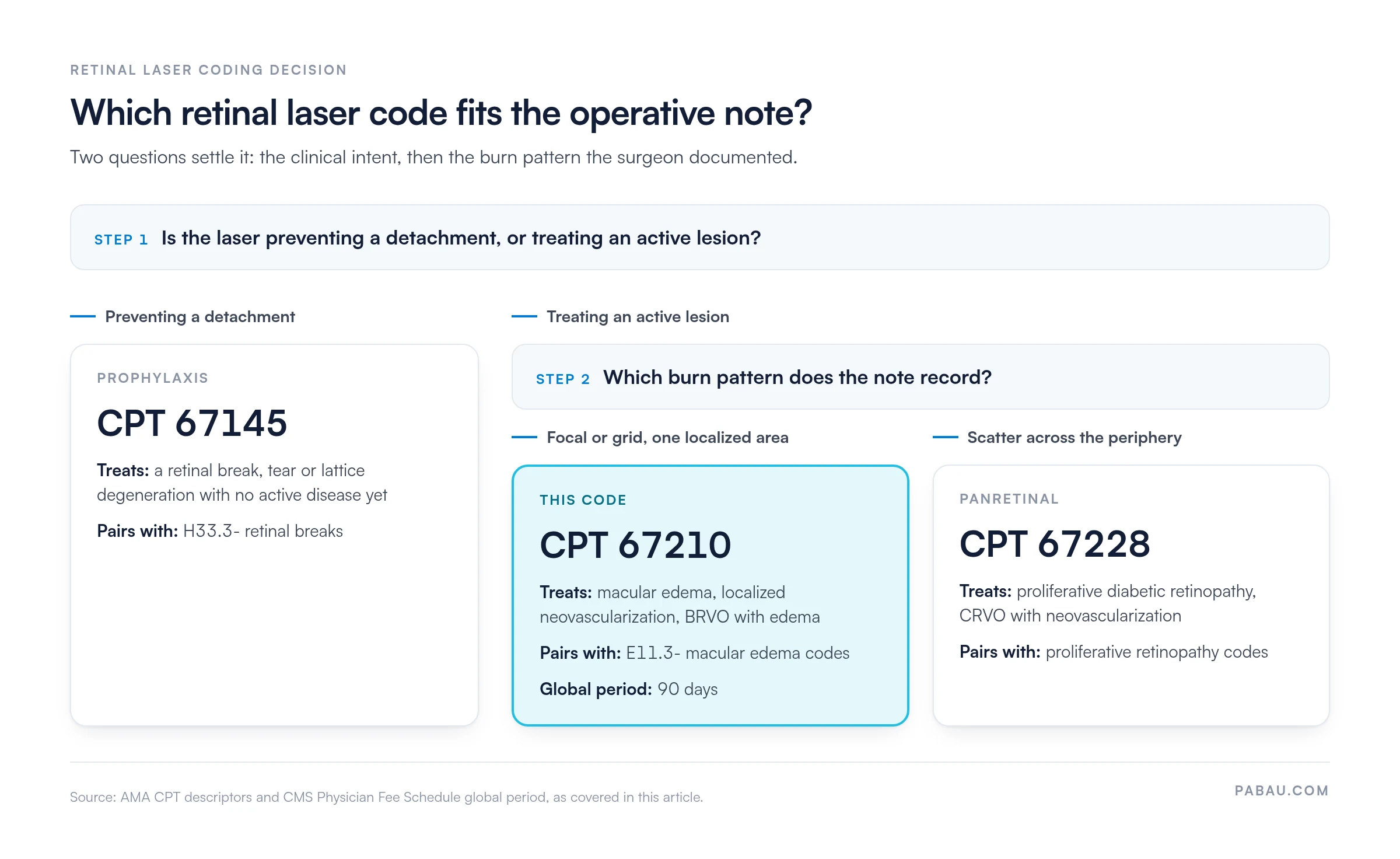
Confusing CPT 67210 with CPT 67228 is a common coding error in retinal laser billing. In short, what separates them is the laser pattern and how much of the retina is treated. However, both can run on the same laser.
For example, if the operative report documents scatter laser burns across the peripheral retina, the correct code is 67228, not CPT Code 67210. Each code carries its own RVU values, so billing one for the other misstates the service and may trigger audit flags for inconsistency.
CPT 67145 describes prophylaxis of retinal detachment, meaning preventive treatment to a high-risk area before detachment occurs. In contrast, CPT Code 67210 treats an active, existing retinal lesion causing current pathology. Clinical intent decides between them, since the laser technique can look much the same.
In short, put the two comparisons together and the choice between all three codes comes down to two questions, shown below.
Modifier errors are another frequent source of retinal laser claim denials. So, match the clinical scenario to the correct modifier in the table below before submitting.
Modifier 50 (bilateral procedure) is handled differently across payers. Some require two separate line items with RT and LT, while others accept a single line with Mod 50 at 150% of the fee. Therefore, check your MAC’s specific policy and the payer’s billing manual before submitting bilaterals.
CPT Code 67210 carries a 90-day global surgical period under the CMS Physician Fee Schedule. As a result, all routine post-operative evaluation and management visits within those 90 days are bundled into the procedure payment and cannot be billed separately.
Therefore, practices that schedule follow-up retinal laser sessions within the 90-day window for the same lesion on the same eye should not file a separate claim. The original 67210 claim covers those subsequent sessions.
Medicare reimburses CPT Code 67210 under the CMS Physician Fee Schedule. Payment rates vary by geographic locality and by setting: facility (hospital, ASC) or non-facility (office). Therefore, always use the CMS PFS Look-Up Tool to verify the current rate for your MAC jurisdiction.
The table below shows the national average RVU components. Multiply each by the annual conversion factor (CF) published by CMS to calculate the approximate payment. Then apply the geographic practice cost index (GPCI) for your locality.
The non-facility rate (office setting) is higher than the facility rate because the practice bears the cost of equipment and clinical staff. As a result, retina practices performing 67210 in the office should confirm the non-facility rate applies to their setting.
Claim.MD, Pabau’s integrated US clearinghouse partner, lets you submit claims online to payers without manual re-keying. Also, use the FastRVU 2026 RVU lookup tool to verify current work, practice expense, and malpractice RVU values for your locality before finalizing fee schedules.
Medical necessity for CPT Code 67210 rests on selecting an ICD-10-CM diagnosis code that supports focal or grid laser treatment of a localized retinal lesion. The CDC/NCHS ICD-10-CM tool provides the official code lookup for the current fiscal year.
So, always code to the highest level of specificity available. Use the laterality character where the ICD-10-CM code requires it (right eye = 1, left eye = 2, bilateral = 3, unspecified = 9). Indeed, a mismatch between the diagnosis code’s laterality and the claim’s RT or LT modifier commonly triggers a denial.
Medicare does not currently include CPT Code 67210 in its prior authorization program for physician-administered outpatient services. However, commercial payers, Medicaid managed care plans, and Medicare Advantage plans often require precertification for retinal laser procedures.
Therefore, perform insurance eligibility verification and prior authorization checks before scheduling the procedure. In fact, a retinal laser claim denied for missing auth is typically non-payable on appeal without the authorization reference number.
Run eligibility and prior auth checks at least 72 hours before the procedure date. For Medicare Advantage patients, pull the plan’s clinical policy for retinal laser, as the coverage criteria often differ significantly from Medicare fee-for-service LCD policies.
Retinal laser claims using CPT Code 67210 are denied for predictable reasons. Denial management workflows that flag these issues before submission cut re-work. Below are the most frequent denial triggers and a one-line prevention for each.
Review common billing denial codes to see which CARC reason codes payers attach to retinal laser denials. Then map each one to its root cause in your workflow.
Every operative report supporting CPT Code 67210 must contain specific elements for the claim to survive audit. Clean claim submission for retinal laser procedures depends on the note as much as the code. Reviewers look for these elements first.
Indeed, missing any of these elements is a frequent finding in ophthalmology billing audits. However, structured operative note templates help by making each element a field the surgeon completes before signing. In addition, pairing them with claims management software keeps the signed note and the claim in the same record.
Build a pre-billing documentation checklist specific to 67210: procedure name (focal or grid), eye treated, lesion site, diagnosis code, laser session count, and physician signature. Run every retinal laser chart through this list before coding.
In many retina practices, the operative note sits in one system and the claim gets built in another. As a result, a coder re-reads the note to find the laser pattern and the eye treated, then re-keys both into the claim.
In Pabau, the operative note, the appointment and the invoice live in the same patient record. For example, treatment note templates can be built to ask for the pattern, the eye and the lesion site before the note is signed. Claims are then submitted and tracked electronically through Claim.MD.
Your coder reads one record instead of three. As a result, the claim goes out carrying the details a payer checks first on a 67210 submission.
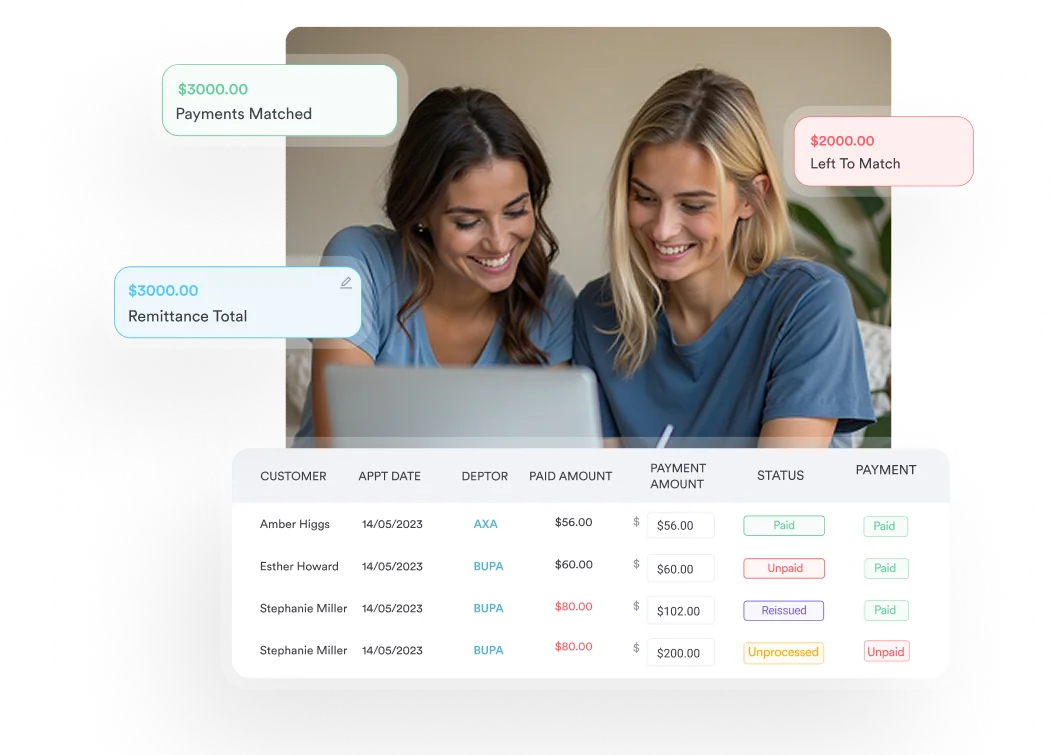

Pabau keeps operative notes, invoices and patient records together, and lets you submit and track claims online through Claim.MD.

Treat the operative note as the source of the code. When it names the pattern, the eye and the lesion, the choice between 67210, 67228 and 67145 follows, and the modifier matches the diagnosis.
The quickest win is a pre-billing check on your last few 67210 claims. Compare each note against the documentation list and your MAC’s laterality policy, then fix the template rather than the individual claim. Finally, a standing medical billing compliance review keeps that fix from drifting.
Book a demo to see how Pabau keeps retinal laser notes, invoices and claim tracking in one patient record.

Need guidance on clearinghouse claim submission for ophthalmic codes? Medical claims clearinghouse guide explains how electronic claim routing works for specialty practices.
Want to see what payers check in an electronic claim? 837 file format guide covers how electronic claims are structured and what fields payers validate first.
Looking for a broader view of ophthalmic revenue cycle? Revenue cycle management overview walks through the claim lifecycle from eligibility to payment posting.
CPT Code 67210 covers destruction of a localized lesion of the retina using focal or grid laser photocoagulation. It is billed once for one or more treatment sessions on the same lesion in the same eye. It does not cover panretinal scatter laser (CPT 67228) or cryotherapy-based retinal treatment.
CPT 67210 carries a 90-day global surgical period under the CMS Physician Fee Schedule. Routine post-operative visits for the treated retinal lesion during this period are bundled into the procedure payment. They cannot be billed separately without an appropriate modifier.
The most common denial reasons are a wrong code (67210 vs. 67228), a missing RT or LT laterality modifier, and a diagnosis-procedure mismatch. That mismatch happens when the ICD-10 laterality character does not match the claim modifier. Missing prior authorization on commercial plans and thin medical necessity documentation in the operative note round out the list.
Medicare fee-for-service generally does not require prior authorization for CPT 67210, but Medicare Advantage plans and most commercial payers do. Always verify authorization requirements with the specific plan before scheduling the procedure. Missing auth is non-payable on appeal without an authorization number.



