CCSD code L6530: Revision femoral bypass graft
CCSD code L6530: Definition and clinical scope CCSD code L6530 carries the offic...

Last Updated: Nov 13, 2026
90966 is the CPT code for ESRD-related services for home dialysis per full month, for patients 20 years of age and older. One monthly payment covers the visits, lab review and care planning an adult home dialysis patient needs.
Three facts decide whether it applies. The patient dialyzed at home, was 20 or older at month end and received care for the whole month. A shorter month is billed per day with 90970, and the record needs at least one face-to-face visit.
Let Pabau's smart automation suggest the right codes, reduce claim denials, and keep your practice compliant—effortlessly.
Automate repetitive tasks and focus on what matters most—your patients.
Reduce coding errors and ensure compliance with the latest regulations.
Clean claims, fewer denials, and faster reimbursements.
Powerful insights and reporting to help your practice thrive.
HIPAA compliant SOC 2 certified GDPR-compliant Trusted by 4,000+ clinics worldwide

CPT 90966 covers a full month of ESRD-related services for a patient aged 20 or older who dialyzes at home.
Age is set at the end of the month, and 90963, 90964 and 90965 cover the younger home dialysis bands.
Visit-count tiers apply only to the in-facility codes 90951 to 90962, never to 90966.
The record must still show at least one face-to-face visit during the month.
For a partial month, bill 90970 once per day instead of 90966, and never both in the same month.
CPT code 90966 reports a full calendar month of ESRD-related services for an adult who dialyzes at home. The official descriptor reads: End-stage renal disease (ESRD) related services for home dialysis per full month, for patients 20 years of age and older.
It sits in the home dialysis series, 90963 to 90966, which splits by age alone. Medicare pays it as a monthly capitation payment (MCP) to the physician or practitioner managing the patient’s care. The quick reference below holds the details you’ll check most often.
One payment covers the routine ESRD management an adult home dialysis patient needs that month. Under the CGS Medicare ESRD fact sheet, the practitioner who completes the assessment and sets the plan of care bills it.
Another physician or practitioner can furnish some visits. They must be a partner, a group employee or an employee of the MCP practitioner. The MCP practitioner still submits the claim.
Knowing where the bundle stops matters just as much. Bill a bundled service separately and you get an unbundling denial, while folding a separate service into the month leaves money on the table.
Once you know the bundle, the next question is which home code applies. The four home dialysis monthly codes differ only by age, and none of them carries a visit-count tier.
Medicare sets the age at the end of the month. So a patient who turns 20 during a month is billed with 90966 for that whole month.
Check each home dialysis patient’s date of birth before the monthly billing close. A 19-year-old who turns 20 mid-month moves from 90965 to 90966 for that month, because age is set at month end.
The in-facility monthly codes, 90951 to 90962, work differently. They split by age and then by the number of face-to-face visits in the month. Those visit tiers don’t apply to the home dialysis codes.
Choose 90966 when the adult dialyzes at home, whatever the visit count. If the patient dialyzes in a center, use the visit-based code instead. Our guide to CPT code 90960 covers the in-facility tiers in detail.
Setting is only the first of three questions. The decision path below runs all three in order, and any exit to the side means a code other than 90966.
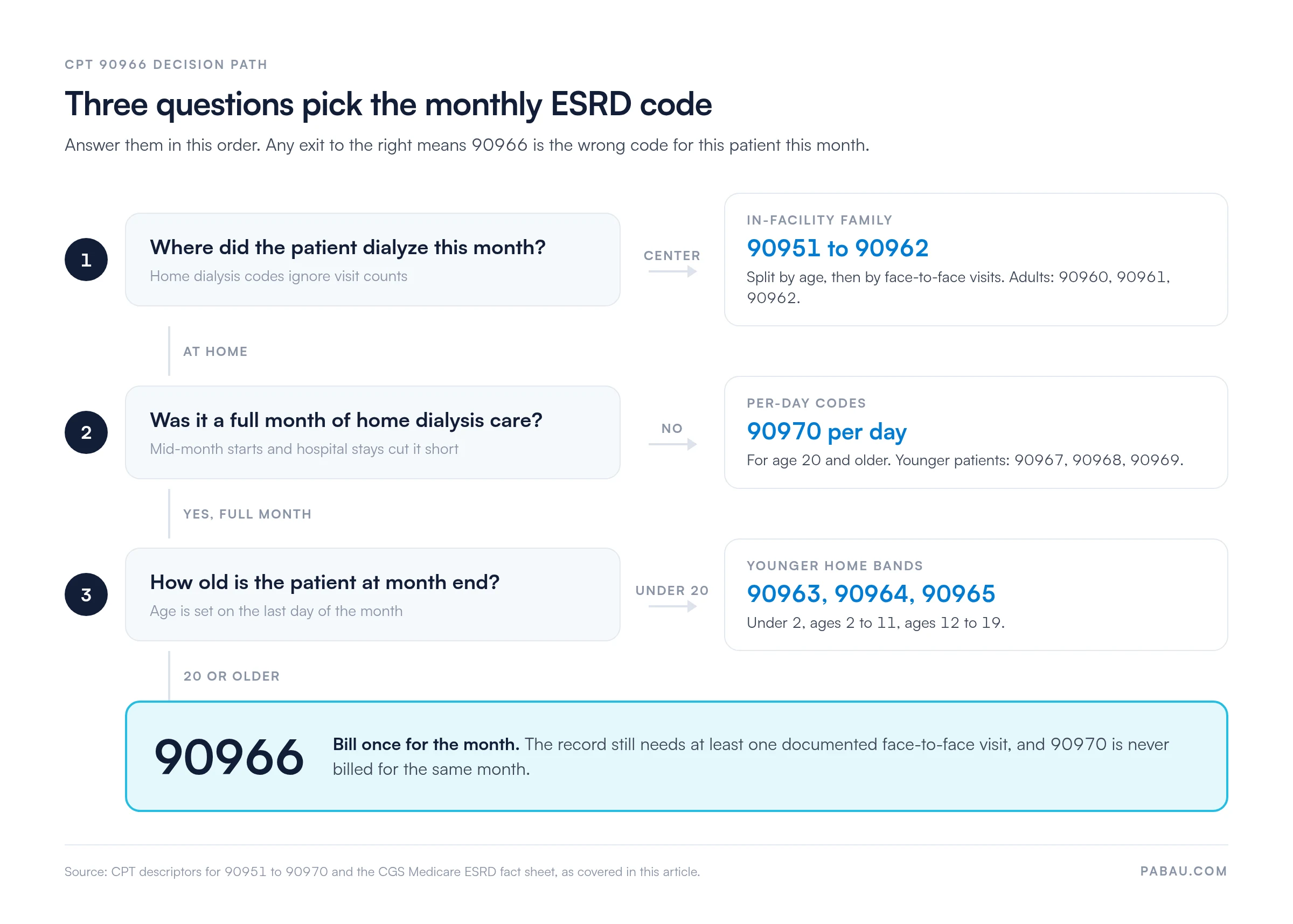
CPT 90966 needs a full month of home dialysis care. When the month is incomplete, the per-day code for the patient’s age replaces it.
For an adult, the per-day code is 90970. The CGS fact sheet gives a worked case. A patient dialyzes at home for 14 days and spends the rest of the month in the hospital, so you submit 90970 with 14 units.
With the code settled, the diagnosis comes next. Pair 90966 with N18.6 for end-stage renal disease and Z99.2 for dependence on renal dialysis.
Where hypertension or diabetes caused the kidney failure, ICD-10-CM guidelines sequence that combination code first. N18.6 then follows as an additional code.
List an underlying cause only when the record documents it. Check your Medicare Administrative Contractor (MAC) policy for any extra diagnosis rules.
A plan of care on file isn’t enough. The record has to show the care was delivered, and the CGS fact sheet lists what reviewers look for on a home dialysis MCP claim. Getting these right before submission is the basis of a clean claim.
Telehealth rules for home dialysis assessments differ by payer and change often. Confirm with your MAC before a telehealth visit stands in for the face-to-face visit.
Medicare pays 90966 through the Physician Fee Schedule as one monthly capitation payment. That physician payment is separate from the dialysis facility’s ESRD PPS payment. Look up the current rate for your locality with the CMS Physician Fee Schedule search tool.
Rates change every year and vary by locality, so check the current fee schedule before each billing cycle. Tracking how consistently you capture each monthly payment is part of wider revenue cycle management.
The rules are easier to apply when you watch them change from one month to the next. Take an illustrative patient, aged 58, who dialyzes at home for all of March.
Her nephrologist sees her face to face on March 12, reviews her monthly labs and updates the plan of care. At month end, all three questions point to 90966. The practice bills one unit with N18.6 and Z99.2.
April goes differently. She dialyzes at home until April 14, then spends the rest of the month in the hospital. The month is no longer full, so the practice bills 90970 with 14 units, one for each home day.
One rule holds across both months. Nobody bills 90966 for April on top of those per-day units, even though April started as a normal home month.
Work through these checks in order at month end. Each one rules out a common reason the claim comes back.
Commercial and Medicaid plans may not follow Medicare’s rules for these codes. Check each payer contract for coverage and any authorization requirements.
Denials on 90966 usually trace back to the wrong code family or a record that can’t prove the month. Denial management works best when these checks run before submission. When a denial does arrive, a list of denial codes helps decode the reason.
Home dialysis billing breaks down when the month’s details sit in different places. The visit note is in one system, the labs in another and the claim in a third. Before each claim goes out, someone has to piece the month back together.
Pabau, the practice management platform we build, keeps that month on one patient record. Visit notes, uploaded documents and lab results sit beside the patient’s date of birth. US practices send CMS-1500/837P claims and run eligibility checks through the Claim.MD clearinghouse integration.
Recall workflows can remind patients to book their monthly visit, so the face-to-face note is in place before billing closes. Remittances then post back through Pabau’s claims management software, so you can see which months were paid.

Pabau keeps visit notes, lab results and patient details on one record, then sends claims and eligibility checks through Claim.MD. See the workflow in a live demo.

Treat 90966 as a month-end decision rather than a code you set once. The setting, the length of the month and the patient’s age can each change from one month to the next. Any one of them moves the claim to another code.
The trade-off favors checking early. A few minutes before billing closes costs far less than reworking a denied monthly claim. And a visit that never happened can’t be documented after the fact, so book it before the month runs out.
Book a demo to see how Pabau puts each home dialysis patient’s visits, labs and claims on one record before the month closes.

Billing an in-center dialysis patient? CPT code 90960 covers the adult in-facility monthly code and its visit tiers.
Need to decode a Medicare ESRD denial? Denial management in healthcare covers CARC/RARC reason codes and appeals workflows.
Want to understand the clearinghouse layer? Medical claims clearinghouse explains how claim files move from practice to payer.
Billing for the first time? What is medical billing walks through the revenue cycle from service to payment.
Yes. The code covers home dialysis by either method, home hemodialysis or peritoneal dialysis. The same monthly rules apply to both, so the setting, a full month and age at month end still decide it.
No. It is a standalone code billed once per patient for the month. It is never reported alongside an in-facility monthly code or 90970 for the same patient and month.
One. CPT 90966 is billed as a single unit for the whole month. Units only come into play with 90970, where each day of home dialysis care counts as one unit.
Yes. Under Medicare, a nurse practitioner, physician assistant or clinical nurse specialist who manages the patient’s ESRD care can bill the monthly code. They work within their state scope of practice, and only one practitioner bills each month.
Both are for patients aged 20 and older. CPT 90960 is the in-facility code for 4 or more face-to-face visits in a month. CPT 90966 is for patients who dialyze at home, whatever the visit count.
Use 90963 for patients younger than 2, 90964 for ages 2 to 11 and 90965 for ages 12 to 19. Age is set at the end of the month.