HCPCS code G0257: Unscheduled or emergency dialysis billing guide
HCPCS code G0257: Official descriptor and code overview HCPCS code G0257 is defi...

Last Updated: Oct 27, 2026
90960 is the CPT code for monthly end-stage renal disease (ESRD) related services for patients 20 years of age and older. It applies when a physician or other qualified health care professional provides 4 or more face-to-face visits in the month.
Billing errors with CPT code 90960 tend to cluster in three places. Practices pick the wrong code in the 90960-90962 series or pair the claim with the wrong ICD-10 diagnosis. Others submit incomplete claim data that draws a CARC 16 denial.
Let Pabau's smart automation suggest the right codes, reduce claim denials, and keep your practice compliant—effortlessly.
Automate repetitive tasks and focus on what matters most—your patients.
Reduce coding errors and ensure compliance with the latest regulations.
Clean claims, fewer denials, and faster reimbursements.
Powerful insights and reporting to help your practice thrive.
HIPAA compliant SOC 2 certified GDPR-compliant Trusted by 4,000+ clinics worldwide

CPT code 90960 covers ESRD monthly management with 4 or more face-to-face visits in a calendar month. Use 90961 for 2-3 visits and 90962 for 1 visit.
ICD-10 N18.6 (end-stage renal disease) is the required primary diagnosis code. A missing or incorrect primary code is a common cause of CARC 16, which flags missing or invalid claim data.
Medicare reimburses 90960 as a bundled Monthly Capitation Payment – one payment covers all ESRD physician management regardless of visit count above the threshold.
Pabau’s claims management software, with its Claim.MD integration, supports electronic claim submission, real-time eligibility checks, and ERA receipt for 90960 claims.
CPT code 90960 is published by the American Medical Association (AMA) in the Medicine section of the CPT code set.
It sits under the End-Stage Renal Disease Services subsection (90951-90970). Its official descriptor covers monthly ESRD-related services for patients 20 years of age and older. The code requires 4 or more face-to-face visits per month by a physician or other qualified health care professional.
CPT code 90960 bundles all ESRD-related physician management services delivered in a calendar month into a single Monthly Capitation Payment (MCP). The following services are included within the MCP and may not be billed separately in the same month by the same managing physician.
Services outside the monthly ESRD management scope remain separately billable. These include acute inpatient hospital services, emergency department visits, and surgical procedures, including transplant services. Evaluation and management (E&M) visits for conditions entirely unrelated to the patient’s ESRD are also billable. When billing separately billable services in the same month, use the appropriate CPT code with a modifier if required by your MAC’s local coverage determination. Always verify current National Correct Coding Initiative (NCCI) edits before billing any code alongside 90960.
The 90960 series is visit-count driven. The managing physician’s number of face-to-face visits with the patient in the calendar month determines which code to bill. Selecting the wrong code is one of the most common denial triggers for ESRD monthly claims.
Visit count is determined by the managing physician’s own direct face-to-face encounters with the patient. Visits by mid-level providers do not count toward the physician’s threshold unless they meet incident-to or split/shared billing rules applicable to your MAC jurisdiction. Count visits from the first through the last day of the calendar month, not a rolling 30-day window. The decision path below adds the partial-month case, which moves the claim out of this series entirely.
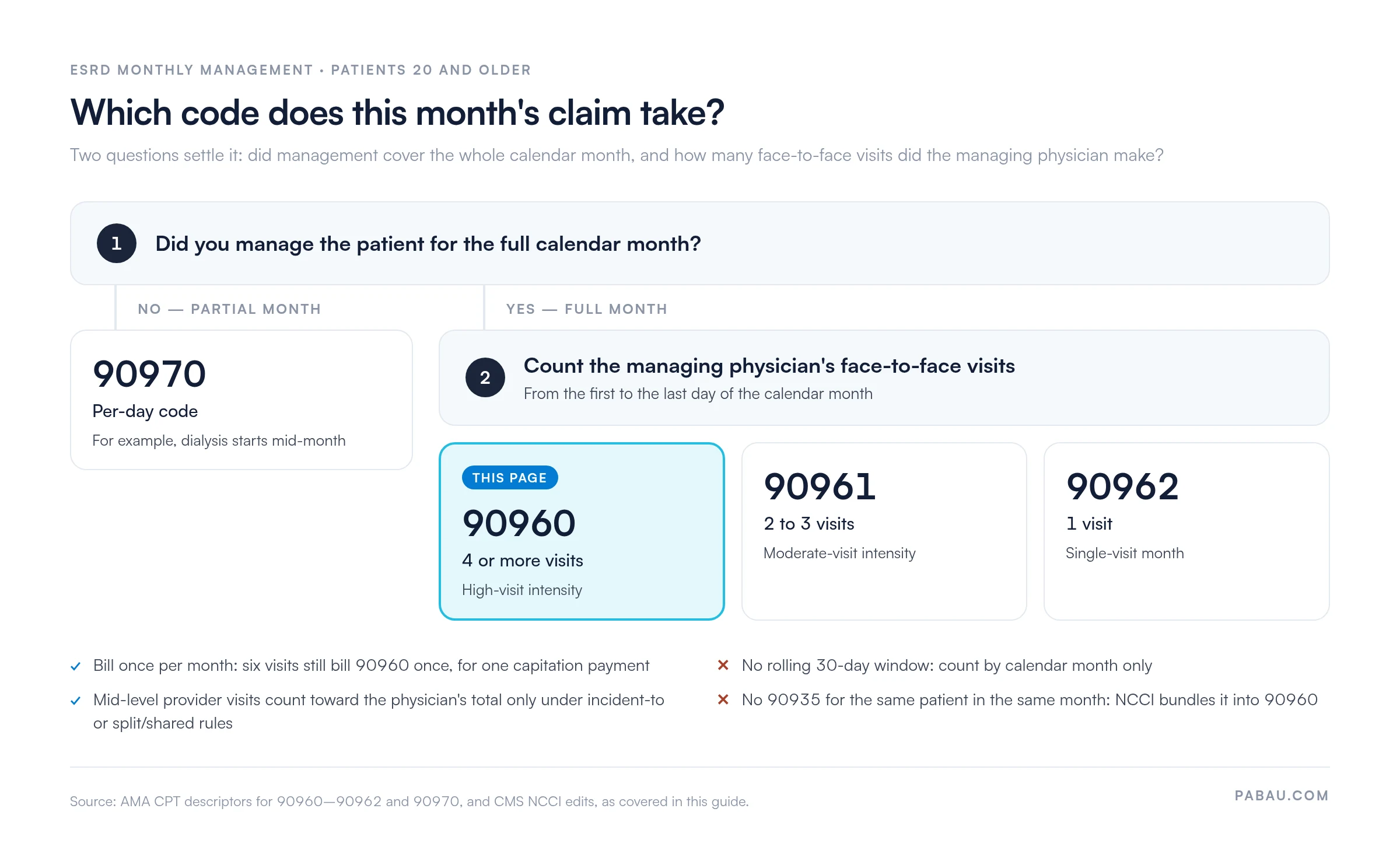
CPT 90935 (hemodialysis procedure with single evaluation by a physician) is a per-session procedure code, not a monthly management code. The two code families serve different billing purposes and are not interchangeable.
The managing physician billing 90960 for an ESRD patient cannot also bill 90935 for the same patient in the same month. NCCI edits bundle the per-session hemodialysis codes into the monthly MCP payment. Confirm current edit pairs in the CMS NCCI table before each billing cycle.
ICD-10 N18.6 is the required primary diagnosis code for CPT code 90960 claims. N18.6 maps specifically to end-stage renal disease and satisfies Medicare’s medical necessity requirement for ESRD monthly management services. Using a less-specific CKD stage code such as N18.5 (chronic kidney disease, stage 5) in place of N18.6 will generate a claim denial. N18.5 does not confirm that the patient is on dialysis.
Some ESRD patients reach dialysis after a kidney transplant fails. The graft failure itself is coded T86.12, while N18.6 remains the required primary diagnosis on the 90960 claim.
Verify ICD-10 code validity annually. The CMS ICD-10 codes page publishes the official update files each fiscal year. N18.6 has been stable, but secondary comorbidity codes shift with annual guideline updates.
Run a monthly pre-billing audit: pull all claims coded 90960 and confirm each has N18.6 in the primary diagnosis field. A missing or incorrect primary ICD-10 is the fastest path to a CARC 16 denial and the easiest to prevent with a checklist.
Medicare reimburses CPT code 90960 as a bundled Monthly Capitation Payment under the ESRD physician services fee schedule. The payment covers all included management services for the month regardless of how many visits above the 4-visit threshold the physician actually delivers. Rates are set annually through the Medicare Physician Fee Schedule (MPFS) final rule and vary by geographic locality.
Use the CMS Physician Fee Schedule lookup tool to confirm the current national and locality-adjusted rates for 90960. The 2026 rates reflect the annual conversion factor update published in the MPFS final rule. Because rates are locality-adjusted, a nephrology practice in a high-cost metropolitan area will receive more than the national average. A rural practice will receive less. Always pull the rate for your specific Medicare Administrative Contractor (MAC) jurisdiction rather than relying on national averages.
Examples of MACs include Novitas Solutions (Jurisdictions H and L) and CGS Administrators (Jurisdiction 15). Noridian Healthcare Solutions (Jurisdictions E and F) and Palmetto GBA (Jurisdictions J and M) are others. Each MAC publishes local coverage determinations (LCDs) that supplement CMS national policy and can affect documentation requirements and coverage criteria in your region.

Pabau’s claims management software, with its Claim.MD integration, supports electronic claim submission, real-time eligibility checks, and ERA receipt for your 90960 claims.

Documentation is the single most audited element of 90960 claims. Under general medical billing compliance and audit best practice, the medical record should clearly support all of the following before the claim is submitted.
As a general audit best practice, avoid templating visit notes to the point where they can’t be told apart. Each note should reflect what happened at that specific encounter, including any changes to the dialysis prescription, medication adjustments, or patient response to treatment.
Billing CPT code 90960 correctly requires confirming visit counts, verifying diagnosis codes, and submitting complete claims before the end of the billing month. Follow this workflow to minimize denials.
Submit no later than the filing deadline for your MAC jurisdiction. For Medicare, the standard timely filing limit is one year from the date of service. Submitting within 30-45 days of the billing month-end reduces denial risk from eligibility changes or patient status updates. When submitting a clean claim, ensure the diagnosis pointer on each service line maps correctly to N18.6.
Most 90960 denials fall into a predictable set of categories. Understanding the root cause of each lets billing teams resolve them quickly rather than resubmitting with the same error. Effective denial management workflows for nephrology practices should include a 90960-specific denial tracker.
CARC 16 means the claim lacks information or has a submission or billing error. Payers usually pair it with a remittance advice remark code (RARC) that names the missing item. On a 90960 claim, it typically traces to missing or invalid claim data. Common culprits are an absent or incorrect primary diagnosis, wrong service-date data, or a missing or mismatched NPI.
To resolve a CARC 16, read the RARC on the remittance advice, correct the flagged claim data, and resubmit the claim. Visit notes aren’t sent with the claim, so a CARC 16 isn’t a review of the medical record. Keep note-based appeals for record-review denials, where the appeal letter states the number of face-to-face visits, references each note date, and attaches redacted copies. Understanding the range of common denial codes in medical billing helps billing teams build standard correction checklists for recurring CARC 16 scenarios. Where an appeal is needed, file it within the timeframe stated on the remittance advice to preserve your appeal rights.
The Monthly Capitation Payment (MCP) model pays the managing physician one bundled amount per patient per month. The amount stays the same however many visits above the threshold occur. A physician who sees an ESRD patient 6 times in a month still bills 90960 once. That physician receives the same payment as one who saw the patient exactly 4 times.
CMS adopted the MCP model for ESRD because dialysis patients require ongoing, intensive physician management that does not fit a standard fee-for-service per-visit model. The capitation structure encourages comprehensive monthly management rather than fragmented visit-by-visit billing. It also simplifies the administrative burden for nephrology practices that see the same chronic ESRD patients repeatedly throughout each month.
Codes 90960-90962 cover a full calendar month of ESRD management. Some patients aged 20 and older receive less than a full month of management, such as when dialysis starts mid-month. For them, the managing physician reports the per-day code 90970 instead. Learning medical billing fundamentals for capitation-based codes differs from standard fee-for-service CPT coding, and ESRD practices benefit from training staff specifically on MCP mechanics.
The managing physician – typically a nephrologist – is the primary eligible biller for CPT code 90960. The managing physician is the one who oversees the patient’s ESRD care plan. That physician is responsible for the overall monthly management of dialysis and related services.
Nurse practitioners (NPs) and physician assistants (PAs) may bill 90960 under their own NPI when they serve as the managing provider. State scope-of-practice laws and CMS supervision requirements still apply. Incident-to billing under a physician’s NPI has three conditions. The physician must have provided the initial service and be present in the office suite during NP/PA visits. The physician must also stay actively involved in the patient’s care. Sometimes more than one physician co-manages an ESRD patient during the same month. In that shared-care arrangement, only one physician may bill the monthly management code. The physicians must determine among themselves who bills based on which provider furnished the majority of services.
In shared-care nephrology practices, designate a monthly managing physician for each ESRD patient at the start of each billing period. Document the designation in the record and ensure only that physician bills 90960. Conflicting claims from two physicians for the same patient in the same month will trigger a duplicate billing denial.
CPT code 90960 is straightforward in principle but prone to preventable denials in practice. The visit-count threshold, the N18.6 pairing requirement, and the documentation standards are all points where a claim can fail. Each one can stop the claim before it reaches an adjudicator.
Pabau’s claims management software, with its Claim.MD integration, supports electronic claim submission, real-time eligibility checks, and ERA receipt. To see how Pabau fits ESRD billing workflows for nephrology practices, book a demo with the team.

Need a framework for managing clearinghouse denials? Pabau’s Claim.MD clearinghouse guide explains how electronic claim routing and real-time eligibility checks reduce ESRD denial rates.
Want to understand how ERA responses map to denial codes? Electronic remittance advice explained covers how to read ERA files and action CARC codes systematically.
Looking for the full range of ESRD and nephrology billing resources? Best medical billing software for US practices reviews the platforms nephrology teams use to manage complex monthly capitation billing.
CPT code 90960 covers monthly ESRD-related physician management services for patients aged 20 and older. It applies when the managing physician has 4 or more face-to-face visits with the patient in a calendar month. The code bundles all ESRD management services including dialysis oversight, medication review, care coordination, and clinical assessment into a single Monthly Capitation Payment.
The three codes differ only by monthly visit count. 90960 requires 4 or more face-to-face visits, 90961 covers 2 to 3 visits, and 90962 covers 1 visit. All three codes cover the same type of ESRD monthly management services – the visit count determines which code applies.
ICD-10 N18.6 (end-stage renal disease) is the required primary diagnosis code. Common secondary codes include Z99.2 (dialysis dependence), D63.1 (anemia in chronic kidney disease), and comorbidity codes for hypertensive or diabetic nephropathy. Using N18.5 instead of N18.6 will cause a claim denial because N18.5 does not confirm dialysis status.
CARC 16 on a 90960 claim means the claim lacks information or has a submission or billing error. Common causes are a missing or incorrect primary diagnosis (N18.6), invalid visit or service-date data, or a missing NPI. Read the paired remark code, fix the flagged claim data, and resubmit. Visit notes aren’t sent with the claim, so keep note-based appeals for record-review denials.
Generally no – E&M visits for ESRD-related services are bundled into the 90960 MCP payment. The same managing physician cannot bill them separately in the same month. E&M visits for conditions entirely unrelated to ESRD may be separately billable; verify current NCCI edits and your MAC’s LCD before doing so.
The 2026 Medicare rate for CPT 90960 is locality-adjusted and updated annually through the Medicare Physician Fee Schedule final rule. Use the CMS Physician Fee Schedule lookup tool at cms.gov to confirm the current rate for your MAC jurisdiction. National averages do not reflect geographic payment adjustments.